
Market Insights
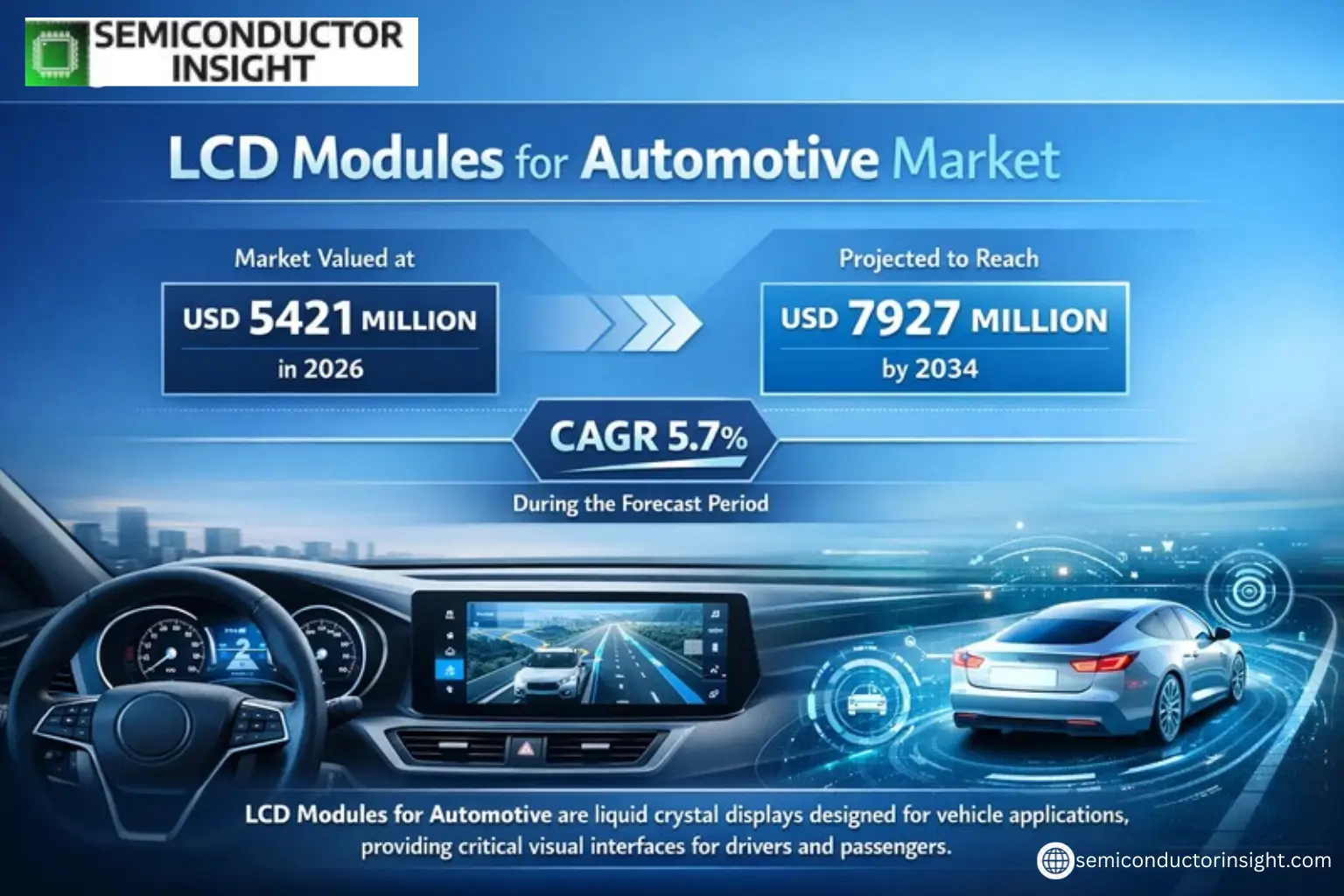
Global LCD modules for Automotive Market was valued at USD 5421 million in 2026 and is projected to reach USD 7927 million by 2034, exhibiting a CAGR of 5.7% during the forecast period.
LCD modules for Automotive are liquid crystal displays designed for vehicle applications, providing critical visual interfaces for drivers and passengers. These modules display essential information such as speed, navigation data, entertainment content, rear-view camera feeds, and system diagnostics. They are engineered to meet stringent automotive standards, featuring high brightness, wide operating temperature ranges (-40°C to +85°C), vibration resistance, and anti-glare coatings for optimal visibility under various lighting conditions.
The market growth is driven by increasing vehicle digitization, rising demand for advanced driver assistance systems (ADAS), and consumer preference for enhanced in-vehicle experiences. Technological advancements such as higher resolution panels (up to 4K), thinner bezels (below 1mm), and improved energy efficiency are further accelerating adoption. Major industry players including LG Display, BOE Technology, and Tianma Microelectronics are investing heavily in automotive-grade LTPS TFT-LCD production lines to meet growing OEM requirements for premium display solutions.
MARKET DRIVERS
Growing Demand for Advanced Driver-Assistance Systems (ADAS)
The automotive industry’s rapid adoption of ADAS technologies is driving demand for high-performance LCD modules for automotive applications. These displays provide critical real-time data visualization for features like lane departure warnings and collision avoidance systems. Global ADAS market is projected to grow at over 11% CAGR through 2030, creating parallel growth for automotive display solutions.
Electric Vehicle Boom Accelerating Display Demand
Electric vehicle manufacturers are incorporating larger, more sophisticated LCD modules for automotive dashboards and infotainment systems. EV models now average 2-3 displays per vehicle compared to 1-2 in traditional ICE vehicles. This shift is creating a 35% higher display content per vehicle in the premium EV segment.
The transition to digital instrument clusters is another key driver, with over 60% of new vehicles expected to feature all-digital dashboards by 2027.
MARKET CHALLENGES
Stringent Automotive Certification Requirements
LCD modules for automotive use must meet rigorous quality and reliability standards such as AEC-Q100 and ISO 26262, significantly increasing development time and testing costs. Only 25% of display manufacturers currently meet all automotive-grade certification requirements.
Other Challenges
Thermal Management in Extreme Conditions
Automotive LCD modules must maintain performance across -40°C to 85°C temperature ranges, requiring advanced materials and thermal management solutions that add 15-20% to component costs.
MARKET RESTRAINTS
Supply Chain Constraints for Specialized Components
LCD modules for Automotive Market faces bottlenecks in the supply of specialized components like driver ICs and touch panels, with lead times extending to 40+ weeks for some critical parts. This is constraining the ability of OEMs to scale production despite strong demand.
MARKET OPPORTUNITIES
Growing Adoption of OLED Technology in Premium Segments
While LCD modules for automotive applications currently dominate, there is significant growth potential for OLED displays in luxury vehicles. OLED adoption is projected to grow at 28% CAGR through 2030, offering suppliers opportunities to develop hybrid LCD-OLED solutions for different vehicle classes.
LCD modules for Automotive Market Trends
Growing Demand for Advanced Display Technologies
Global LCD modules for Automotive Market is projected to grow from USD 5.4 billion in 2026 to USD 7.9 billion by 2034, driven by increasing adoption of high-resolution displays in vehicles. Automotive LCD modules are critical for instrument clusters, infotainment systems, and head-up displays, with LTPS-LCD gaining market share due to superior performance despite higher costs (averaging USD 70 per unit). Manufacturers are focusing on enhanced durability, sunlight readability, and thinner form factors to meet stringent automotive requirements.
Other Trends
Transition to Larger and Curved Displays
OEMs are adopting larger LCD modules (8-16 inches) and curved designs to create immersive cockpit experiences. The shift toward pillar-to-pillar dashboards and panoramic layouts reflects consumer demand for integrated digital surfaces, with 12-16 inch displays growing at 6.2% CAGR. Curved displays now represent 18% of shipments, offering better ergonomics and design flexibility.
Supply Chain Evolution
LCD modules for Automotive Market supply chain is becoming more regionalized, with panel makers in China, Japan, and Korea expanding production capacity. Key suppliers are vertically integrating touch sensors, optical bonding, and cover glass to deliver turnkey solutions. Gross margins remain tight (15-20%) due to competition and rising material costs for polarizers and driver ICs.
Regulatory and Safety Considerations
New EU regulations mandating driver distraction monitoring by 2024 are influencing display design, pushing manufacturers to develop clearer interfaces and hybrid control systems. Euro NCAP safety protocols now reward optimized human-machine interfaces that minimize eyes-off-road time, accelerating the adoption of head-up displays (projected 22% market share by 2026) and simplified UI architectures.
Competitive Landscape
The market remains concentrated, with BOE Technology, LG Display, and Tianma controlling 58% of LCD modules for Automotive production. Recent expansions in LTPS-LCD and Mini-LED backlight capacity indicate technology differentiation strategies, particularly for premium electric vehicles where display quality impacts brand positioning.
COMPETITIVE LANDSCAPE
Key Industry Players
Leading LCD Module Suppliers Drive Automotive Display Innovation
LCD modules for Automotive Market is dominated by established display panel manufacturers from Asia, led by BOE Technology and LG Display which collectively hold over 30% market share. These players are investing heavily in automotive-grade LTPS and Mini-LED technologies to meet growing demand for high-resolution, energy-efficient displays in next-generation vehicles. The market structure shows tight integration between panel makers and Tier-1 suppliers, with joint development programs for cockpit solutions becoming prevalent.
Niche specialists like Tianma Microelectronics and JDI (Japan Display Inc.) have carved strong positions in premium automotive displays through technological differentiation in wide-temperature operation and sunlight readability. Meanwhile, Chinese manufacturers including TCL CSOT and InfoVision are gaining traction by offering cost-competitive TFT-LCD solutions for mass-market vehicles, though they face margin pressures in the sub-8 inch segment.
List of Key LCD Modules for Automotive Companies Profiled
- BOE Technology
- LG Display
- Japan Display Inc. (JDI)
- Sharp Corporation
- Tianma Microelectronics
- TCL China Star Optoelectronics
- Innolux Corporation
- Caihong Display Devices
- InfoVision Optoelectronics
- AU Optronics
- Samsung Display
- Truly Semiconductors
- Panasonic Automotive Systems
- Visteon Corporation
- Yunnan OLiGHTEK Opto-Electronic Technology
Segment Analysis:
| Segment Category | Sub-Segments | Key Insights |
| By Type |
|
LTPS-LCD is gaining traction in premium vehicles due to superior performance characteristics:
|
| By Application |
|
Center Display segment dominates as the focal point of vehicle HMI:
|
| By End User |
|
Electric Vehicles represent the fastest-growing segment:
|
| By Display Size |
|
8-12 Inches represents the sweet spot for optimal functionality:
|
| By Display Shape |
|
Curved Displays are emerging as a premium differentiator:
|
Regional Analysis: LCD Modules for Automotive Market
China’s automotive LCD module production benefits from vertically integrated supply chains and government incentives for domestic display manufacturers. The country leads in cost-competitive medium-sized LCD panels for mainstream vehicle models.
Japan maintains its edge in high-quality automotive-grade LCD modules, with manufacturers focusing on reliability and performance for luxury vehicles. Japanese suppliers dominate the premium segment with advanced bonding and touch technologies.
South Korean display giants are pioneering OLED and mini-LED technologies for automotive applications, creating premium LCD module alternatives. Their R&D investments focus on sunlight readability and ultra-wide temperature performance.
Emerging automotive production hubs in Thailand and Indonesia are driving demand for LCD modules as regional automakers upgrade vehicle infotainment systems. Local assembly of display modules is increasing to serve regional OEMs.
North America
The North American market for automotive LCD modules is characterized by strong demand from premium vehicle segments and electric vehicle manufacturers. U.S.-based automakers are accelerating the adoption of larger center stack displays and digital instrument clusters. The region benefits from close collaboration between display suppliers and automotive software developers, creating integrated solutions. Regulatory requirements for advanced safety systems are driving the adoption of LCD displays for ADAS visual interfaces. Domestic production focuses on high-value display systems despite reliance on Asian panel suppliers.
Europe
European automakers prioritize high-resolution LCD modules for luxury vehicles with specialized requirements for sunlight readability and low-power consumption. German display suppliers lead in developing automotive-grade solutions meeting stringent quality standards. The region sees strong demand for curved and flexible display solutions from premium brands. European regulations regarding driver distraction are influencing LCD module design and user interface considerations. Local manufacturers focus on system integration and optical bonding technologies.
South America
The South American automotive LCD module market is developing through technology transfer from global OEMs establishing local production. Brazilian automakers are upgrading entry-level vehicle displays to remain competitive. The region shows growing interest in cost-effective LCD solutions for fleet vehicles and public transportation. Limited local manufacturing capabilities result in dependence on imported display modules, with some assembly operations emerging in major automotive hubs.
Middle East & Africa
This region presents growth opportunities for automotive LCD modules as luxury vehicle penetration increases in Gulf countries. African markets are gradually adopting basic display systems in new vehicle models. The hot climate conditions create specific requirements for display durability and high-temperature performance. Regional distributors play a key role in supplying replacement displays for the aftermarket, though OEM adoption remains limited outside premium segments.
Report Scope
This market research report provides a comprehensive analysis of the LCD modules for Automotive Market , covering the forecast period 2026–2034. It offers detailed insights into market dynamics, technological advancements, competitive landscape, and key trends shaping the industry.
Key focus areas of the report include:
- Market Overview: The report begins with an overview outlining its current market scenario, key growth indicators, and industry transformation drivers. It discusses macroeconomic factors, demand–supply balance, regulatory landscape, and the strategic role of semiconductors in powering advancements across industries such as automotive, telecommunications, consumer electronics, and industrial automation.
- Market Size & Forecast: Historical data and future projections for revenue, unit shipments, and market value across major regions and segments.
- Segmentation Analysis: Detailed breakdown by product type, technology, application, and end-user industry to identify high-growth segments and investment opportunities.
- Regional Insights: Insights into market performance across North America, Europe, Asia-Pacific, Latin America, and the Middle East & Africa, including country-level analysis where relevant.
- Competitive Landscape: Profiles of leading market participants, including their product offerings, R&D focus, manufacturing capacity, pricing strategies, and recent developments such as mergers, acquisitions, and partnerships.
- Technology Trends & Innovation: Assessment of emerging technologies, integration of AI/IoT, semiconductor design trends, fabrication techniques, and evolving industry standards.
- Market Drivers & Restraints: Evaluation of factors driving market growth along with challenges, supply chain constraints, regulatory issues, and market-entry barriers.
- Stakeholder Insights: Insights for component suppliers, OEMs, system integrators, investors, and policymakers regarding the evolving ecosystem and strategic opportunities.
Primary and secondary research methods are employed, including interviews with industry experts, data from verified sources, and real-time market intelligence to ensure the accuracy and reliability of the insights presented.
FREQUENTLY ASKED QUESTIONS:
What is the current market size of LCD modules for Automotive Market?
-> LCD modules for Automotive Market was valued at USD 5421 million in 2026 and is projected to reach USD 7927 million by 2034, exhibiting a CAGR of 5.7% during the forecast period.
What is an automotive LCD module?
-> An automotive LCD module is a liquid crystal display used in vehicles to present visual information such as speed, navigation, entertainment, rear-view camera images, and system status. These screens feature high brightness, wide temperature tolerance, vibration resistance, and anti-glare coatings for visibility in sunlight.
What are the key applications of automotive LCD modules?
-> Key applications include digital instrument panels, center displays, rear entertainment screens, and other vehicle display systems integrated into instrument clusters, head-up displays, and infotainment systems.
Which are the major companies in automotive LCD module market?
-> Major players include Boe Technology, LG Display, Innolux, Tianma Microelectronics, JDI, Sharp, and TCL China Star Optoelectronics Technology among others.
What are the emerging technology trends in this market?
-> Emerging trends include transition from a-Si to LTPS LCD technology, adoption of Mini-LED backlighting, integration of wider dashboard displays, and development of solutions to reduce driver distraction while increasing display functionality.
Get Sample Report PDF for Exclusive Insights
Report Sample Includes
- Table of Contents
- List of Tables & Figures
- Charts, Research Methodology, and more...


