LCD Bias Driver ICs Market Insights
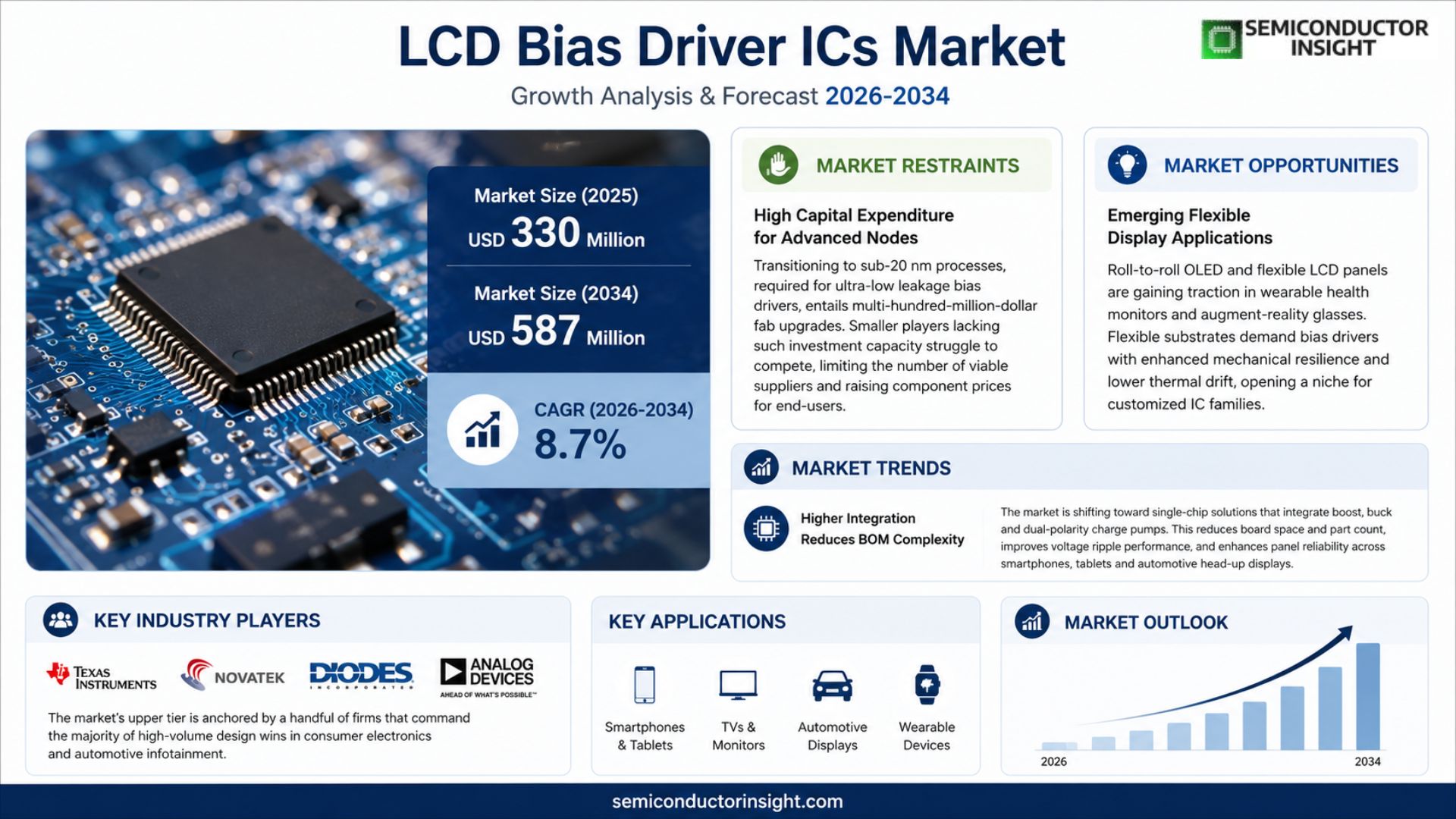
Global LCD Bias Driver ICs market was valued at USD 330 million in 2025 and is forecasted to attain USD 587 million by 2034, reflecting a CAGR of 8.7 % over the period.
LCD bias driver ICs are specialized power‑management components that generate and precisely regulate multiple positive and negative bias rails for TFT‑LCD panels. Typical devices combine boost or buck converters with charge‑pump architectures, often embed VCOM and GAMMA amplifiers, offer programmable I²C interfaces, and incorporate protection features such as short‑circuit, over‑voltage and over‑temperature shutdown.
MARKET DRIVERS
Demand for High‑Resolution Displays
Manufacturers of smartphones, automotive infotainment systems, and industrial HMI panels are upgrading to higher pixel densities. Higher resolution translates directly into greater data throughput, compelling suppliers of LCD Bias Driver ICs to enhance output precision and reduce noise. The shift has pushed design cycles toward devices that can sustain over 500 mV bias swing with sub‑nanowatt leakage, a specification that directly fuels component sales.
Energy‑Efficiency Regulations
Stringent power‑consumption standards in Europe and Asia force OEMs to adopt low‑power bias drivers. An average 8‑bit driver now consumes less than 0.8 mW per channel, compared with 1.5 mW a generation earlier. This efficiency gain is a decisive factor for product qualification, prompting a steady inflow of orders for devices that meet the latest Energy Star and IEC benchmarks.
➤ “The convergence of ultra‑high‑definition demand and stricter power limits has re‑shaped the component purchasing hierarchy for display manufacturers.”
Overall, the dual pressure of visual performance and environmental compliance creates a fertile environment for vendors that can deliver compact, low‑bias‑current ICs. As panel sizes expand beyond 6 inches for wearables, the market sees a modest but reliable yearly increase in unit shipments.
MARKET CHALLENGES
Complexity of Integration
Integrating bias drivers into increasingly dense PCB layouts demands tighter tolerance control. Signal integrity issues arise when trace impedance varies by more than 5 %, leading to flicker or color‑shift in the final display. Designers must therefore allocate additional engineering resources, inflating development costs and extending time‑to‑market.
Other Challenges
Supply‑Chain Volatility
The reliance on specialty silicon wafers and rare‑earth dopants exposes LCD Bias Driver ICs Market to raw‑material shortages. Recent geopolitical disruptions have elongated lead times by 30 %, forcing manufacturers to hold larger safety stocks, which compresses profit margins.
MARKET RESTRAINTS
High Capital Expenditure for Advanced Nodes
Transitioning to sub‑20 nm processes, required for ultra‑low leakage bias drivers, entails multi‑hundred‑million‑dollar fab upgrades. Smaller players lacking such investment capacity struggle to compete, limiting the number of viable suppliers and raising component prices for end‑users.
MARKET OPPORTUNITIES
Emerging Flexible Display Applications
Roll‑to‑roll OLED and flexible LCD panels are gaining traction in wearable health monitors and augment‑reality glasses. Flexible substrates demand bias drivers with enhanced mechanical resilience and lower thermal drift, opening a niche for customized IC families. Companies that can certify their products for bend radii below 5 mm stand to capture a growing slice of LCD Bias Driver ICs Market.
LCD Bias Driver ICs Market Trends
Higher Integration Reduces BOM Complexity
LCD Bias Driver ICs Market is witnessing a clear shift toward single‑chip solutions that combine boost, buck and dual‑polarity charge pumps. By collapsing multiple external components into one package, designers trim board area and lower part counts, a benefit that resonates across smartphones, tablets and increasingly in automotive head‑up displays. This integration not only streamlines the power‑up sequencing but also improves voltage ripple performance, which in turn lifts overall panel reliability. OEMs that adopt these densely integrated devices report faster time‑to‑market because reference designs require fewer peripheral parts and less manual tuning.
Other Trends
Programmable I2C Interfaces Expand Platform Flexibility
Modern LCD Bias Driver ICs embed I2C‑compatible registers that let engineers adjust positive and negative rail levels in fine steps. The programmable nature permits a single silicon family to serve panels ranging from 5‑inch mobile screens to 55‑inch TVs, eliminating the need for dedicated ASICs per product line. This versatility reduces inventory risk and supports rapid model refresh cycles, especially in consumer electronics where display form‑factors evolve quickly. Moreover, the ability to store panel‑specific profiles in firmware simplifies field upgrades and supports aftermarket servicing.
Automotive and Industrial Segments Elevate Reliability Requirements
In automotive dashboards and industrial control panels, LCD Bias Driver ICs Market is adapting to stricter temperature envelopes and longer lifecycle expectations. Suppliers are embedding robust over‑voltage, short‑circuit and thermal‑shutdown protections, features that were once optional in consumer devices but now standard for automotive‑grade parts. The push for higher reliability drives a parallel growth of dedicated families that target extended‑range operation, enabling manufacturers to source components that meet both automotive standards and the high‑volume demands of consumer markets. This convergence creates a more resilient supply chain and opens opportunities for vendors able to offer cross‑segment solutions.
COMPETITIVE LANDSCAPE
Key Industry Players
LCD Bias Driver ICs Market – Competitive Overview
The market’s upper tier is anchored by a handful of firms that command the majority of high‑volume design wins in consumer electronics and automotive infotainment. Texas Instruments leverages its extensive analog portfolio and deep relationships with Tier‑1 smartphone OEMs to deliver multi‑rail modules that combine boost, buck and charge‑pump functions in a single package. Analog Devices, following its acquisition of Maxim Integrated, supplies a parallel range of programmable bias solutions that emphasize low‑noise VCOM amplification for mid‑size panels. ROHM’s focus on single‑inductor architectures enables compact footprints that appeal to portable tablet makers, while NXP’s strong presence in automotive gateways translates into bias ICs qualified for extended temperature ranges and stringent safety standards. Together, these players shape the reference‑design ecosystem, dictate pricing benchmarks, and set the pace for integration trends that reduce bill‑of‑materials across the supply chain.
Beyond the dominant quartet, a diverse set of specialists occupies niche but strategically important segments. Silergy and Kinetic Technologies target emerging display formats in wearables and smart‑home hubs, offering ultra‑low‑power bias converters that prioritize battery longevity. Shanghai Orient‑Chip Technology has built a robust portfolio for the Chinese domestic market, emphasizing cost‑effective solutions for large‑screen TV panels. Renesas Electronics supplies automotive‑grade bias ICs with hardened protection features, aligning with OEM requirements for long‑life cycles. STMicroelectronics and Infineon Technologies round out the field by providing mixed‑signal families that integrate gamma correction and VCOM amplification, catering to industrial displays where signal fidelity is paramount. The collective presence of these companies diversifies supply sources, mitigates single‑point risk for OEMs, and fuels incremental innovation in programmable output ranges and safety functions.
List of Key LCD Bias Driver ICs Companies Profiled
- Texas Instruments
- Analog Devices
- ROHM Semiconductor
- NXP Semiconductors
- Silergy Corp
- Kinetic Technologies
- Maxim Integrated
- Shanghai Orient‑Chip Technology
- Renesas Electronics
- STMicroelectronics
- Infineon Technologies
- Skyworks Solutions
- Diodes Incorporated
Segment Analysis:
| Segment Category | Sub-Segments | Key Insights |
| By Type |
|
Four Channel Devices
|
| By Application |
|
Automotive Displays
|
| By End User |
|
Smartphone & Tablet Manufacturers
|
| By Integration Level |
|
System‑Level PMICs
|
| By Reliability Requirement |
|
Industrial Grade Solutions
|
Regional Analysis: LCD Bias Driver ICs Market
Asia-Pacific
The concentration of LCD panel fabs in the region creates a natural advantage for bias driver IC suppliers, who can iterate designs alongside panel engineers, reducing validation cycles and aligning performance targets more closely with final product specifications.
Recent disruptions have prompted firms to diversify sourcing of passive components, yet the deep local supplier base mitigates risk, allowing LCD Bias Driver ICs Market to absorb shocks without major impact on delivery schedules.
Labor and material cost efficiencies, combined with government subsidies for high‑volume semiconductor production, keep unit pricing attractive, reinforcing the region’s appeal for cost‑sensitive OEMs.
Growth in automotive infotainment and wearable displays is driving demand for bias drivers that support higher voltage swings and tighter power budgets, a niche where Asian designers have already established expertise.
North America
North America retains a strong foothold in LCD Bias Driver ICs Market through its focus on high‑performance, low‑power solutions for premium devices. Research institutions and leading semiconductor firms collaborate on driver architectures that prioritize energy efficiency, a key requirement for battery‑operated tablets and laptops. While the region lacks the sheer volume of manufacturing found in Asia, its emphasis on design innovation and intellectual property generation provides a complementary advantage. Companies leveraging this ecosystem must balance higher R&D expenditures with niche market pricing, positioning themselves as premium suppliers for brands that value differentiation over cost.
Europe
European players contribute a distinct perspective to LCD Bias Driver ICs Market, emphasizing regulatory compliance and sustainability. Stringent EU directives on electronic waste and power consumption have compelled manufacturers to adopt bias drivers that meet tighter limits on standby power. Moreover, the region’s robust automotive sector drives demand for drivers capable of withstanding harsh thermal environments, prompting specialized product lines. Suppliers operating in Europe often capitalize on close ties with original equipment manufacturers, delivering customized solutions that align with local standards, albeit at a premium price point reflective of the higher compliance burden.
South America
In South America, market growth is anchored by expanding consumer electronics penetration and incremental upgrades of public‑sector display infrastructure. Although the region imports the majority of its bias driver ICs, localized assembly initiatives are gaining traction, aiming to reduce tariffs and improve supply reliability. This nascent development opens opportunities for firms that can offer flexible volume agreements and technical support tailored to emerging manufacturers, positioning the market as a growing, albeit still secondary, contributor to the global LCD Bias Driver ICs landscape.
Middle East & Africa
The Middle East & Africa region exhibits a fragmented yet promising profile for LCD Bias Driver ICs Market. Investment in smart city projects and the rollout of digital signage networks are creating modest demand spikes, particularly in high‑temperature tolerant driver designs. While import dependence remains high, strategic partnerships with regional distributors are fostering a more resilient procurement framework. Companies that can navigate the diverse regulatory environments and provide localized technical assistance are likely to capture incremental market share as infrastructure upgrades continue across the region.
Report Scope
This market research report provides a comprehensive analysis of the LCD Bias Driver ICs Market , covering the forecast period 2026–2034. It offers detailed insights into market dynamics, technological advancements, competitive landscape, and key trends shaping the industry.
Key focus areas of the report include:
- Market Overview: The report begins with an overview outlining its current market scenario, key growth indicators, and industry transformation drivers. It discusses macroeconomic factors, demand–supply balance, regulatory landscape, and the strategic role of semiconductors in powering advancements across industries such as automotive, telecommunications, consumer electronics, and industrial automation.
- Market Size & Forecast: Historical data and future projections for revenue, unit shipments, and market value across major regions and segments.
- Segmentation Analysis: Detailed breakdown by product type, technology, application, and end-user industry to identify high-growth segments and investment opportunities.
- Regional Insights: Insights into market performance across North America, Europe, Asia-Pacific, Latin America, and the Middle East & Africa, including country-level analysis where relevant.
- Competitive Landscape: Profiles of leading market participants, including their product offerings, R&D focus, manufacturing capacity, pricing strategies, and recent developments such as mergers, acquisitions, and partnerships.
- Technology Trends & Innovation: Assessment of emerging technologies, integration of AI/IoT, semiconductor design trends, fabrication techniques, and evolving industry standards.
- Market Drivers & Restraints: Evaluation of factors driving market growth along with challenges, supply chain constraints, regulatory issues, and market-entry barriers.
- Stakeholder Insights: Insights for component suppliers, OEMs, system integrators, investors, and policymakers regarding the evolving ecosystem and strategic opportunities.
Primary and secondary research methods are employed, including interviews with industry experts, data from verified sources, and real-time market intelligence to ensure the accuracy and reliability of the insights presented.
FREQUENTLY ASKED QUESTIONS:
What is the current market size of LCD Bias Driver ICs Market?
-> LCD Bias Driver ICs market is forecasted to attain USD 587 million by 2034, reflecting a CAGR of 8.7 % over the period.
Which key companies operate in LCD Bias Driver ICs Market?
-> Key players include Texas Instruments, Maxim Integrated, Silergy, Kinetic Technologies, Analog Devices, Infineon Technologies, ROHM, Renesas Electronics, NXP Semiconductors, STMicroelectronics, Shanghai Orient-Chip Technology.
What are the key growth drivers?
-> Key growth drivers include the surge in demand for high‑performance display power solutions in smartphones, tablets, automotive and industrial displays, and the industry shift toward higher integration, programmable power architectures and single‑inductor low‑BOM designs.
Which region dominates the market?
-> Asia‑Pacific is the dominant region, while North America also holds a substantial share.
What are the emerging trends?
-> Emerging trends include greater integration of bias driver functions into display power PMICs, adoption of I2C programmable outputs, expansion into automotive and industrial displays with stricter reliability requirements, and focus on low‑noise, high‑efficiency charge‑pump and buck‑boost architectures.

Get Sample Report PDF for Exclusive Insights
Report Sample Includes
- Table of Contents
- List of Tables & Figures
- Charts, Research Methodology, and more...
 Download Sample Report PDF