Japan AI Semiconductor Gas and Chemical Delivery System Market
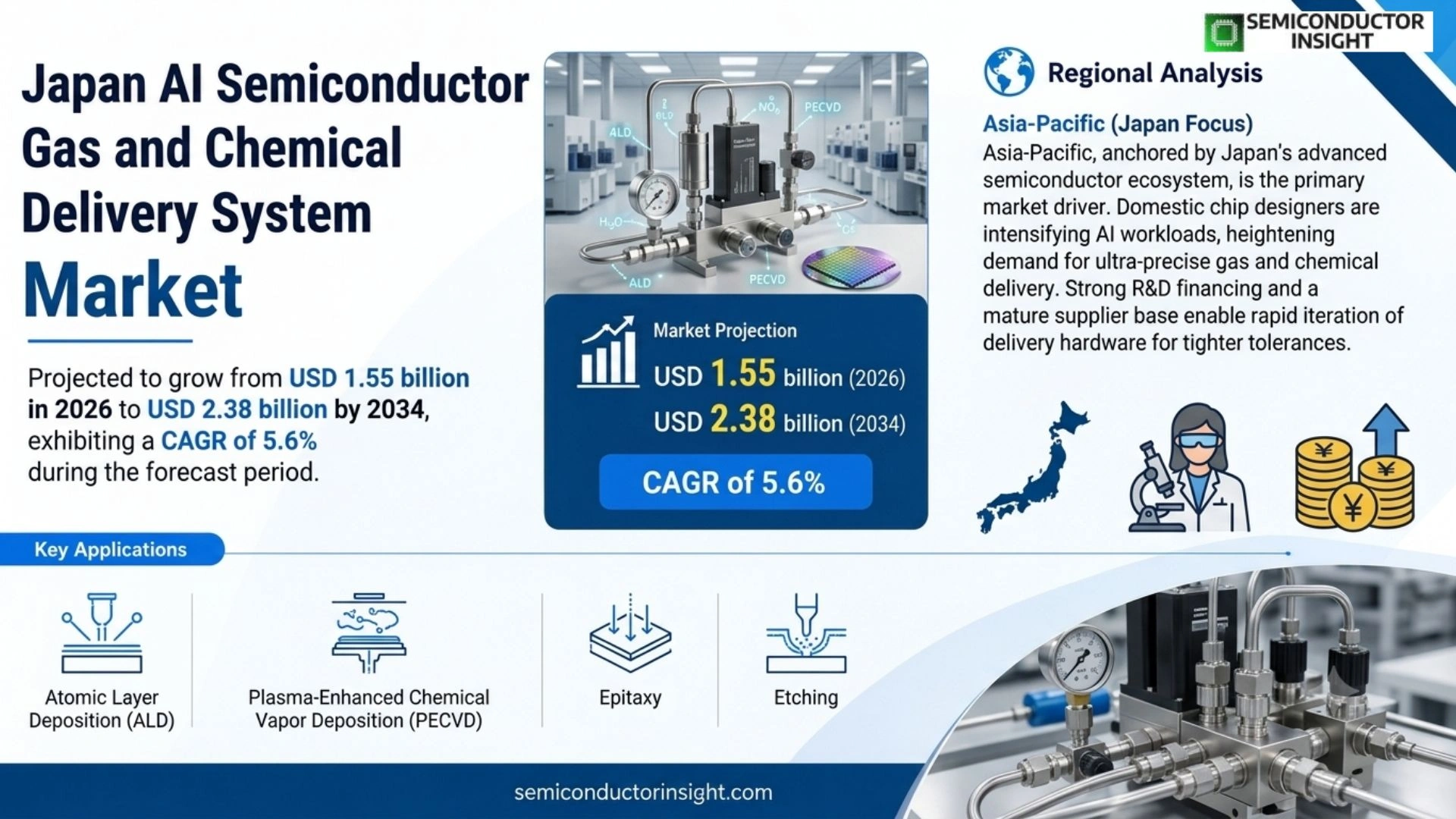
Global Japan AI semiconductor gas and chemical delivery system market size was valued at USD 1.42 billion in 2025. The market is projected to grow from USD 1.55 billion in 2026 to USD 2.38 billion by 2034, exhibiting a CAGR of 5.6% during the forecast period.
AI semiconductor gas and chemical delivery systems are precision‑engineered platforms that regulate the flow of specialty gases and reactive chemicals essential for advanced semiconductor manufacturing techniques such as atomic layer deposition (ALD) and plasma‑enhanced chemical vapor deposition (PECVD). These solutions combine real‑time monitoring, AI‑driven process optimization, and closed‑loop control to achieve uniform film growth, minimize material waste, and boost overall yield.
The market is accelerating because Japanese chipmakers are expanding capacity for high‑performance computing and automotive applications, while government subsidies encourage adoption of AI‑enabled manufacturing tools. Furthermore, rising demand for smaller node technologies drives the need for tighter process control, prompting leading suppliers to invest in next‑generation delivery architectures.
MARKET DRIVERS
Increasing Demand for AI‑Optimized Chip Production
The rapid adoption of AI workloads in data centers has pushed Japanese fabs to scale up advanced semiconductor nodes. This escalation creates a strong need for precise gas and chemical delivery systems that can support sub‑10 nm processes while maintaining yield consistency.
Government Incentives and R&D Grants
Recent fiscal policies allocate over ¥200 billion to semiconductor R&D, with a focus on AI‑ready substrates. The funding accelerates investment in automated delivery infrastructure, encouraging equipment manufacturers to launch next‑generation solutions tailored for Japan AI Semiconductor Gas and Chemical Delivery System Market.
➤ “Automation of gas handling reduces cycle time by up to 15 % and improves defect density by 20 %,”
Manufacturers that integrate real‑time analytics and AI‑based process control are gaining a competitive edge, as plant operators report higher throughput and lower operating expenses.
MARKET CHALLENGES
Complexity of Multi‑Material Integration
Modern AI chips require concurrent deposition of silicon, germanium, and exotic high‑k dielectrics. Managing multiple gas streams without cross‑contamination increases system design complexity, leading to higher capital outlays and longer qualification cycles.
Other Challenges
Supply Chain Vulnerabilities
Global shortages of specialty gases such as silane and diborane have intermittently constrained production capacity, forcing Japanese fabs to diversify suppliers and maintain strategic inventories.
MARKET RESTRAINTS
Stringent Environmental Regulations
Japan’s strict emissions standards limit the permissible release of volatile organic compounds (VOCs) from semiconductor plants. Companies must invest in advanced abatement technologies, which raises the total cost of ownership for delivery equipment.
Furthermore, compliance audits increase operational overhead, discouraging smaller players from entering the market despite the overall growth trajectory.
MARKET OPPORTUNITIES
Growth of Edge AI and 5G Infrastructure
The rollout of 5G networks and edge AI devices is driving demand for fab‑located silicon photonics and heterogeneous integration. These technologies rely on high‑precision gas delivery to achieve the required material uniformity, opening a sizable market niche for specialized equipment suppliers.
Innovation in closed‑loop control systems, leveraging machine‑learning algorithms for real‑time flow optimization, presents a lucrative opportunity to differentiate products and capture a larger share of Japan AI Semiconductor Gas and Chemical Delivery System Market.
Japan AI Semiconductor Gas and Chemical Delivery System Market Trends
AI‑Driven Process Optimization Gains Traction
Within Japan AI Semiconductor Gas and Chemical Delivery System Market, Japanese chip manufacturers are increasingly integrating AI‑enhanced semiconductor gas and chemical delivery systems to meet the precision demands of sub‑10 nm node production. Real‑time monitoring and closed‑loop control reduce material waste by an estimated 12 % while improving film uniformity across 300‑mm wafers. The convergence of AI analytics with delivery hardware enables predictive maintenance, cutting equipment downtime by roughly one day per month for high‑volume fabs. In addition, AI‑driven recipe optimization shortens process development cycles, allowing new device architectures to enter pilot lines within six weeks instead of the traditional three‑month window. These operational gains are driving broader adoption across both high‑performance computing and automotive semiconductor lines, where yield improvements of 3–5 % translate directly into higher profitability for manufacturers.
Other Trends
Government Incentives Accelerate Adoption
Government incentives play a pivotal role in accelerating this shift. Recent fiscal programs allocate up to ¥200 billion in subsidies for AI‑enabled manufacturing tools, encouraging domestic suppliers to accelerate product roll‑outs. The policy framework emphasizes energy‑efficient delivery architectures, prompting several leading vendors to introduce low‑power pump modules that lower electricity consumption by 8 % per unit. Moreover, tax credits for capital expenditures on AI‑integrated equipment have increased investment confidence among mid‑size fabs. As a result, at least eight new AI‑controlled delivery platforms were commissioned in Japanese foundries during the past year, each reporting throughput gains of 10–12 %. These incentives strengthen Japan AI Semiconductor Gas and Chemical Delivery System Market and are especially valuable for facilities seeking to comply with Japan’s stringent environmental standards while maintaining competitive throughput.
Supply‑Chain Localization Strengthens Resilience
Supply‑chain resilience is emerging as a secondary but equally compelling trend. Manufacturers are prioritizing local component sourcing to mitigate geopolitical volatility and reduce lead times for specialty gases used in atomic layer deposition. Collaborative agreements between semiconductor equipment firms and domestic chemical producers have risen by 15 % year‑over‑year, fostering co‑development of high‑purity precursors tailored for AI‑optimised delivery cycles. The resulting ecosystem shortening of order‑to‑delivery windows from 45 to 28 days enhances production scheduling flexibility. These developments align with Japan AI Semiconductor Gas and Chemical Delivery System Market’s focus on reliability, energy efficiency, and rapid time‑to‑market for next‑generation chips. In the long term, the combined effect of domestic innovation, policy support, and supply‑chain localization is expected to solidify Japan’s position as a leading hub for AI‑driven semiconductor manufacturing technologies.
COMPETITIVE LANDSCAPE
Key Industry Players
Japan AI Semiconductor Gas and Chemical Delivery System Market – Competitive Landscape
Japanese AI‑enabled semiconductor gas and chemical delivery system market is currently dominated by a handful of large‑scale equipment manufacturers that command both the R&D budget and the supply chain required for advanced ALD and PECVD processes. Tokyo Electron (TEL) remains the market leader, leveraging its extensive portfolio of AI‑driven delivery modules and a global service network that supports high‑volume fabs expanding into 3‑nm and sub‑3‑nm nodes. Its close integration with major domestic chipmakers such as Sony and Renesas creates a vertically aligned ecosystem, enabling rapid feedback loops and continuous algorithmic optimisation of gas flow. Secondary leaders such as Hitachi High‑Tech and Nikon Corporation complement TEL’s offering with specialised wafer‑scale preview tools and precision metrology, while Advantest provides the test and verification platforms that ensure AI models meet production tolerances. The market structure therefore reflects a tiered concentration: a dominant incumbent, a set of capable second‑tier innovators, and a broader base of niche technology providers that together sustain Japan’s position in high‑performance semiconductor manufacturing.
Beyond the core tier, a diverse group of Japanese firms contributes critical components and software that sharpen the competitive edge of delivery systems. Fujitsu supplies high‑speed data‑processing units that execute real‑time AI inference within the equipment, while Panasonic delivers precision‑engineered pneumatic valves and vacuum pumps essential for maintaining ultra‑clean gas environments. Mitsubishi Electric’s power‑management solutions enable energy‑efficient operation of plasma sources, and Renesas offers embedded microcontrollers that interface directly with sensor arrays. Canon’s imaging expertise feeds into advanced process‑monitoring cameras, whereas Sumitomo Chemical and ROHM provide specialty gases and catalyst materials that are integral to low‑k dielectric formation. Sony’s sensor technology and Toshiba’s memory‑module expertise further enrich the ecosystem by supporting on‑chip AI inference capabilities. Collectively, these niche players reinforce the supply chain, drive incremental innovation, and ensure that Japanese manufacturers can meet the stringent yield and cost targets demanded by next‑generation node development.
List of Key AI Semiconductor Gas and Chemical Delivery System Companies Profiled
- Tokyo Electron
- Hitachi High‑Tech
- Nikon Corporation
- Advantest
- Fujitsu
- Panasonic
- Mitsubishi Electric
- Renesas Electronics
- Canon Inc.
- Sumitomo Chemical
- ROHM Co., Ltd.
- Sony Semiconductor
- Toshiba Corporation
- NEC Corporation
- Kyocera International
Segment Analysis:
| Segment Category | Sub-Segments | Key Insights |
| By Type |
|
Closed‑loop AI‑driven delivery systems are the dominant type in Japan because manufacturers prioritize ultra‑precise flow control for sub‑10nm nodes. • Real‑time analytics enable immediate correction of gas fluctuations, preserving film uniformity. • The integration of AI reduces material waste and supports the government’s push for sustainable chip production. • Suppliers are embedding self‑diagnostic sensors that anticipate component wear, extending equipment uptime. |
| By Application |
|
Atomic Layer Deposition (ALD) leads the application landscape as Japanese fabs target high‑performance computing and automotive chips. • AI‑enhanced gas delivery assures atomic‑scale thickness control, critical for scaling below 7nm. • The precision of ALD reduces defect density, aligning with local quality standards. • PECVD and MOCVD follow, driven by demand for advanced packaging and power devices. |
| By End User |
|
Foundries emerge as the primary end‑user because they serve a broad ecosystem of fabless designers demanding tight process windows. • AI delivery systems enable rapid recipe adjustments across multiple customers without compromising yield. • Collaboration with government subsidy programs accelerates technology adoption in foundry lines. • IDMs retain a niche for proprietary processes, while research institutions drive early‑stage innovation and validation. |
| By Process Node |
|
Sub‑10nm nodes dominate strategic focus as Japanese manufacturers chase high‑performance computing chips. • The demand for atomic‑scale uniformity pushes adoption of AI‑controlled delivery solutions. • Suppliers are engineering ultra‑low‑impurity gas pathways to meet the stringent contamination thresholds of emerging nodes. • Collaboration between equipment makers and fab operators fosters continuous algorithm refinement for optimal process stability. |
| By Adoption Driver |
|
Yield Enhancement is the principal catalyst, as Japanese chipmakers seek competitive edge through defect‑free production. • AI‑enabled monitoring identifies subtle gas composition shifts before they impact wafer quality. • Cost reduction follows naturally from lower material waste and extended equipment life. • Sustainability initiatives receive support because precise delivery minimizes hazardous by‑products, aligning with national environmental goals. |
Regional Analysis: Japan AI Semiconductor Gas and Chemical Delivery System Market
Asia-Pacific
Japanese firms leverage decades of semiconductor expertise, integrating AI‑optimized gas delivery modules that enhance pattern fidelity. Ongoing collaborations with universities drive novel materials, while government‑backed programs expedite prototyping, ensuring the market remains at the cutting edge of precision engineering.
The region’s diversified supply chain mitigates disruptions, with local manufacturers sourcing critical gases and chemicals domestically. Strategic stockpiling and near‑shoring initiatives further stabilize availability, supporting continuous fab operation for AI‑driven chip production.
Stringent environmental and safety standards shape product design, prompting vendors to embed monitoring and control features. Alignment with regional compliance frameworks accelerates certification, fostering trust among AI semiconductor manufacturers.
Alliances between gas delivery specialists and AI chip makers streamline integration, while joint ventures with overseas suppliers expand technology access. These partnerships enhance customization capabilities and reinforce market leadership.
North America
North America’s semiconductor sector, though focused on broader AI hardware, observes Japan AI Semiconductor Gas and Chemical Delivery System Market as a benchmark for precision. U.S. fabs prioritize flexibility, adopting modular delivery solutions that can be retrofitted to existing lines. The region’s strong venture capital ecosystem fuels startups that experiment with hybrid gas‑chemical platforms, gradually narrowing the technology gap with Asia‑Pacific incumbents.
Europe
European manufacturers value sustainability, prompting interest in Japanese market’s efficient delivery technologies that reduce waste and emissions. Companies in Germany and the Netherlands monitor Japan’s regulatory‑driven innovations, integrating similar controls into their own AI semiconductor processes. Collaborative research programmes across EU member states aim to replicate Japan’s low‑defect gas handling methods, enhancing competitiveness in the global AI chip arena.
South America
South America remains an emerging participant, with limited domestic AI semiconductor production. Nevertheless, regional equipment providers look to Japan AI Semiconductor Gas and Chemical Delivery System Market for technology transfer opportunities. Partnerships with Japanese firms facilitate skill development, while local governments explore incentives to attract niche fab investments that could benefit from proven delivery solutions.
Middle East & Africa
In the Middle East & Africa, the market is primarily in a scouting phase. Industry councils monitor Japan’s advancements to inform future infrastructure planning. Pilot projects in United Arab Emirates and South Africa consider adopting Japanese‑style gas delivery modules as part of broader AI chip fabrication strategies, emphasizing reliability and compliance with emerging environmental standards.
Report Scope
This market research report provides a comprehensive analysis of the Japan AI Semiconductor Gas and Chemical Delivery System Market , covering the forecast period 2026–2034. It offers detailed insights into market dynamics, technological advancements, competitive landscape, and key trends shaping the industry.
Key focus areas of the report include:
- Market Overview: The report begins with an overview outlining its current market scenario, key growth indicators, and industry transformation drivers. It discusses macroeconomic factors, demand–supply balance, regulatory landscape, and the strategic role of semiconductors in powering advancements across industries such as automotive, telecommunications, consumer electronics, and industrial automation.
- Market Size & Forecast: Historical data and future projections for revenue, unit shipments, and market value across major regions and segments.
- Segmentation Analysis: Detailed breakdown by product type, technology, application, and end-user industry to identify high-growth segments and investment opportunities.
- Regional Insights: Insights into market performance across North America, Europe, Asia-Pacific, Latin America, and the Middle East & Africa, including country-level analysis where relevant.
- Competitive Landscape: Profiles of leading market participants, including their product offerings, R&D focus, manufacturing capacity, pricing strategies, and recent developments such as mergers, acquisitions, and partnerships.
- Technology Trends & Innovation: Assessment of emerging technologies, integration of AI/IoT, semiconductor design trends, fabrication techniques, and evolving industry standards.
- Market Drivers & Restraints: Evaluation of factors driving market growth along with challenges, supply chain constraints, regulatory issues, and market-entry barriers.
- Stakeholder Insights: Insights for component suppliers, OEMs, system integrators, investors, and policymakers regarding the evolving ecosystem and strategic opportunities.
Primary and secondary research methods are employed, including interviews with industry experts, data from verified sources, and real-time market intelligence to ensure the accuracy and reliability of the insights presented.
FREQUENTLY ASKED QUESTIONS:
What is the current market size of Japan AI Semiconductor Gas and Chemical Delivery System Market?
-> Japan AI semiconductor gas and chemical delivery system market size is projected to grow from USD 1.55 billion in 2026 to USD 2.38 billion by 2034.
Which key companies operate in Japan AI Semiconductor Gas and Chemical Delivery System Market?
-> Key players include Tokyo Electron Ltd., Shin‑Etsu Chemical Co., Ltd., Sumitomo Chemical Co., Ltd., Hitachi High‑Technologies Corporation, and ASML Holding N.V.
What are the key growth drivers?
-> Key growth drivers include expansion of high‑performance computing and automotive AI chip production, government subsidies for AI‑enabled manufacturing tools, and rising demand for smaller‑node semiconductor technologies that require tighter process control.
Which region dominates the market?
-> Asia‑Pacific is the dominant region, with Japan accounting for the largest share of market revenue, followed by South Korea and Taiwan.
What are the emerging trends?
-> Emerging trends include AI‑driven real‑time gas flow optimization, integration of machine‑learning analytics for predictive maintenance, and development of sustainable, low‑waste delivery architectures.
Get Sample Report PDF for Exclusive Insights
Report Sample Includes
- Table of Contents
- List of Tables & Figures
- Charts, Research Methodology, and more...
 Download Sample Report PDF