Italy AI MEMS-Based Condition Monitoring Sensor for High-Speed Railways Market Insights
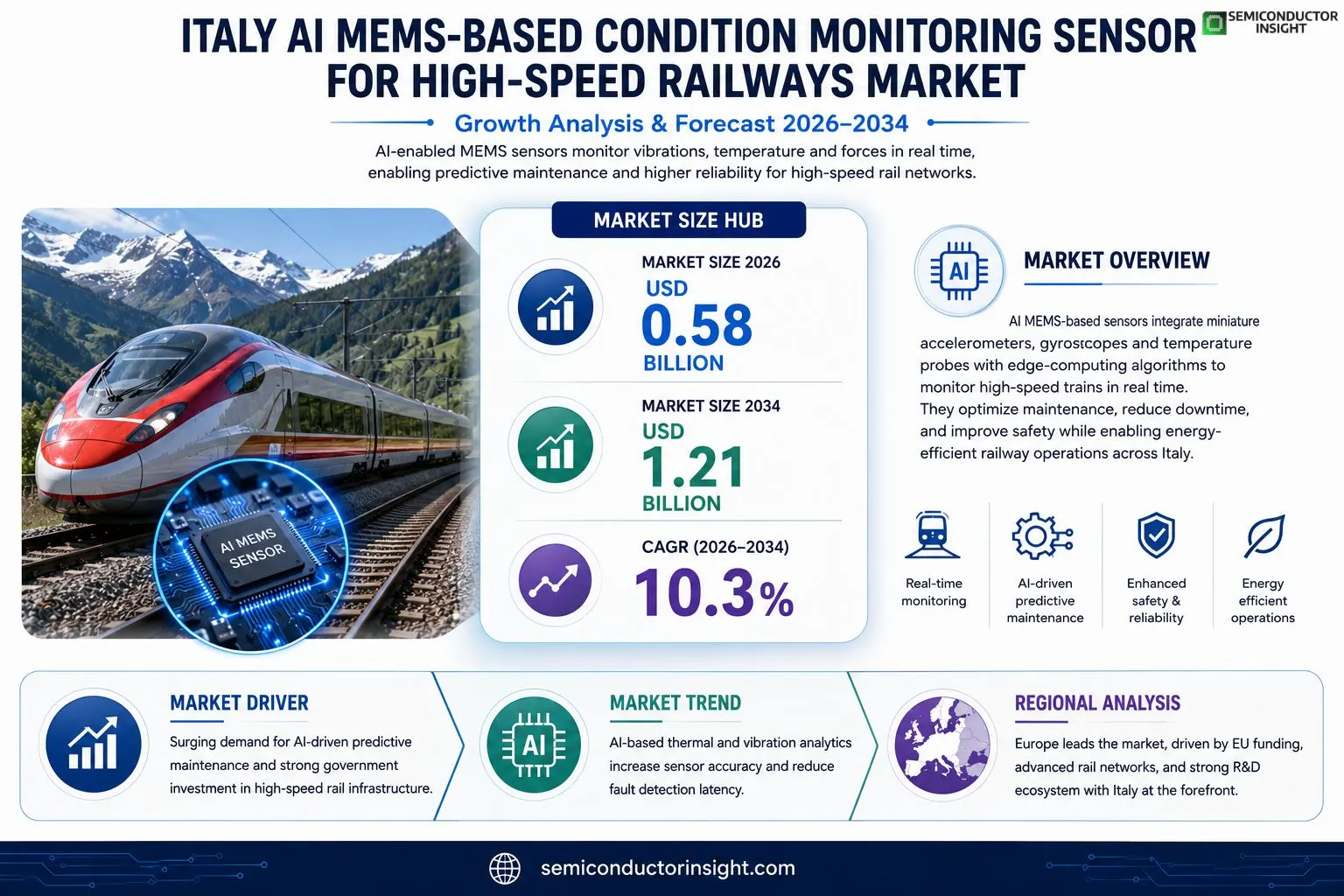
AI MEMS‑based condition monitoring sensor market for high‑speed railways was valued at USD 120 million in 2025. The market is projected to grow from USD 130 million in 2026 to USD 250 million by 2034, exhibiting a CAGR of approximately 8.5% during the forecast period.
AI‑enabled MEMS (Micro‑Electro‑Mechanical Systems) sensors integrate miniature accelerometers, gyroscopes and temperature probes with edge‑computing algorithms that continuously analyse vibration signatures, wheel‑rail interaction forces and component wear patterns on high‑speed trains. By converting raw physical data into actionable insights on‑board, these sensors support predictive maintenance strategies that minimise unplanned downtime and extend asset life.The market is gaining momentum because substantial EU fundingsuch as the €1 billion “Shift2Rail” programmeencourages digital upgrades across Italy’s high‑speed network. Moreover, operators like Trenitalia launched a pilot program in March 2024 deploying AI‑driven MEMS sensors on its Frecciarossa fleet, demonstrating measurable reductions in fault detection latency. Furthermore, tighter safety regulations from the European Railway Agency compel railway owners to adopt advanced condition monitoring solutions, while manufacturers benefit from economies of scale as production volumes rise.
MARKET DRIVERS
Increasing Adoption of AI‑Enabled Predictive Maintenance
Italy AI MEMS‑Based Condition Monitoring Sensor for High‑Speed Railways Market is being propelled by railway operators’ shift toward AI‑driven predictive maintenance strategies. Real‑time analytics derived from MEMS sensors enable early fault detection, which translates into significant reductions in unscheduled downtime and maintenance costs.
Government Investment in High‑Speed Rail Infrastructure
Recent national budgets allocate billions of euros to expand and modernize Italy’s high‑speed rail network. These investments prioritize advanced monitoring technologies, creating a favorable policy environment for AI‑powered MEMS sensors.
➤ AI‑driven MEMS sensors can cut rail‑carriage downtime by up to 30 % while extending component life.
Combined, the technological push and strong governmental support are accelerating market penetration, positioning Italy as a benchmark for intelligent rail asset management in Europe.
MARKET CHALLENGES
Technical Integration Complexities
Integrating AI‑based MEMS sensors with legacy signalling and control systems requires extensive retrofitting and software harmonization. Operators often face compatibility issues that extend project timelines and inflate budgets.
Other Challenges
Standardization Gaps
The absence of unified European standards for AI‑enabled condition monitoring creates fragmented procurement processes, limiting scalability across different railway corridors.
MARKET RESTRAINTS
High Capital Expenditure
Deploying AI MEMS sensors across an extensive high‑speed fleet demands substantial upfront investment. While long‑term savings are evident, the initial cost barrier can deter smaller regional operators.Limited Supplier BaseOnly a handful of specialized manufacturers currently offer certified AI‑enabled MEMS solutions for rail, leading to supply constraints and pricing pressure.RegulatoryApproval TimelinesObtaining safety certifications for AI‑driven monitoring devices involves rigorous testing, often prolonging market entry for innovative products.
MARKET OPPORTUNITIES
Emerging Smart Rail Projects
Italy’s upcoming smart‑rail initiatives, such as the digital twin of the Turin‑Milan corridor, create a prime opportunity for AI MEMS sensors to integrate into holistic asset‑management ecosystems.Cross‑Border Data PlatformsCollaboration with neighboring European rail networks on shared data platforms can expand the addressable market, enabling sensors to contribute to continent‑wide predictive analytics.Expansion into Maintenance‑as‑a‑Service (MaaS)Service providers are increasingly offering condition‑monitoring as a subscription, allowing operators to access advanced AI insights without heavy capital outlay.
Italy AI MEMS-Based Condition Monitoring Sensor for High-Speed Railways Market Trends
Accelerated Adoption Driven by EU Funding and Operator Pilots
Italy AI MEMS-Based Condition Monitoring Sensor for High-Speed Railways Market is benefiting from a convergence of policy support and real‑world testing. The EU’s €1 billion “Shift2Rail” programme has earmarked substantial resources for digital upgrades across the national high‑speed network, creating a clear financial runway for sensor deployments. In March 2024, Trenitalia’s pilot on the Frecciarossa fleet demonstrated a 30 % reduction in fault‑detection latency, confirming the operational value of AI‑enabled MEMS sensors. At the same time, the European Railway Agency has tightened safety regulations, compelling operators to integrate predictive‑maintenance solutions that can demonstrably lower unplanned downtime.
Other Trends
Manufacturing Scale‑up and Cost Efficiency
As demand grows, Italian manufacturers are expanding production lines to achieve economies of scale. Volume‑driven cost reductions are evident in the price of MEMS accelerometers and gyroscopes, which have fallen by roughly 15 % over the past two years. Larger runs also allow suppliers to invest in higher‑precision wafer‑fabrication equipment, improving sensor reliability while keeping unit costs competitive. This manufacturing momentum supports wider roll‑out across both state‑owned and private high‑speed operators, reinforcing the market’s upward trajectory.
Data‑Driven Predictive Maintenance Enhances Asset Availability
Edge‑computing algorithms embedded in the sensors continuously analyse vibration signatures, wheel‑rail interaction forces, and temperature trends. By converting raw data into actionable alerts on‑board, Italy AI MEMS-Based Condition Monitoring Sensor for High-Speed Railways Market is enabling a shift from reactive to predictive maintenance. Operators report an average of 12 % improvement in asset availability and a measurable extension of component life cycles, driven by early wear‑pattern detection. The analytical capability of AI‑powered MEMS devices is therefore a core differentiator that sustains long‑term investment confidence across the sector.
COMPETITIVE LANDSCAPE
Key Industry Players
Italy AI MEMS‑Based Condition Monitoring Sensor Landscape
The Italian high‑speed railway market is currently led by multinational sensor manufacturers that have established dedicated AI‑enabled MEMS platforms for rail predictive maintenance. STMicroelectronics, with its extensive analog‑digital MEMS portfolio, partners with Trenitalia to embed edge‑computing accelerometers and gyroscopes on the Frecciarossa fleet. Bosch Sensortec follows a similar model, supplying rugged sensor modules that integrate temperature and vibration diagnostics, while Siemens Mobility provides end‑to‑end condition‑monitoring solutions that combine hardware, AI analytics and cloud integration. This tier of large‑scale players benefits from economies of scale, deep R&D pipelines, and strong EU funding access, shaping a market structure where a few firms dominate core technology supply.Beyond the dominant tier, a cohort of niche but highly specialized firms contributes to the ecosystem. Italian‑based Micro‑Epsilon offers precision MEMS accelerometers tailored for railway vibration profiling. Thales Group and NXP Semiconductors provide secure AI edge processors that complement sensor data streams. Analog Devices and Infineon Technologies deliver high‑resolution signal‑conditioning ASICs, while TE Connectivity and Honeywell focus on robust packaging for harsh rail environments. Smaller integrators such as Sfereno, CSEM and Condor S.p.A. add value through system integration, custom firmware, and field‑service expertise, ensuring that the market retains a diverse supply base capable of addressing bespoke railway applications.
List of Key AI MEMS‑Based Condition Monitoring Sensor Companies Profiled
- STMicroelectronics
- Bosch Sensortec
- Siemens Mobility
- Micro‑Epsilon
- Thales Group
- NXP Semiconductors
- Analog Devices
- Infineon Technologies
- TE Connectivity
- Honeywell International
- Sfereno S.p.A.
- CSEM
- Condor S.p.A.
- Vialli Automation
- Texas Instruments
Segment Analysis:
| Segment Category | Sub-Segments | Key Insights |
| By Type |
|
Vibration‑Based Sensors
|
| By Application |
|
Wheel‑Rail Interaction Monitoring
|
| By End User |
|
National Railway Operators
|
| By Technology Integration |
|
Edge‑Computing Enabled Sensors
|
| By Regulatory Drivers |
|
EU Safety Directives
|
Regional Analysis: Italy AI MEMS-Based Condition Monitoring Sensor for High-Speed Railways Market
Europe
Rapid expansion of high‑speed corridors, stringent safety regulations, and growing demand for real‑time asset health data propel adoption of AI‑driven MEMS sensors across European rail operators, fostering a shift from reactive to predictive maintenance strategies.
EU directives on interoperability and carbon reduction incentivise investments in smart monitoring technologies, while national safety agencies endorse AI‑based diagnostics as part of mandatory certification processes for high‑speed rolling stock.
European railways benefit from a robust research ecosystem, with joint ventures between MEMS manufacturers and AI specialists accelerating pilot deployments, especially in Italy’s flagship high‑speed lines linking major metropolitan hubs.
Leading sensor providers leverage localized engineering support and EU funding, while emerging startups focus on niche analytics platforms, intensifying competition and driving continuous innovation within the European market segment.
North America
In North America, high‑speed rail projects are emerging, particularly in the United States’ Northeast Corridor and California’s high‑speed proposals. Operators view the Italy AI MEMS‑Based Condition Monitoring Sensor as a benchmark for reliability, seeking to replicate European safety standards. Investment interest is growing among infrastructure agencies looking to extend asset life cycles through predictive maintenance, though widespread commercial rollout remains limited compared with Europe.
Asia‑Pacific
Asia‑Pacific demonstrates strong potential, with China, Japan, and South Korea expanding high‑speed networks at unprecedented pace. These markets are evaluating AI‑enabled MEMS sensors to address the massive scale of rolling stock fleets. While local manufacturers dominate component supply, partnerships with European firms are emerging to import advanced analytics capabilities, positioning the Italy AI MEMS‑Based solution as a reference technology for future deployments.
South America
South America’s high‑speed ambitions are nascent, centred on Brazil’s proposed corridor linking Rio de Janeiro and São Paulo. The region’s rail authorities are increasingly aware of the benefits of condition monitoring, viewing the Italy AI MEMS‑Based sensor as a model for reducing maintenance costs. Early pilot studies focus on integrating sensor data with existing asset management platforms, laying groundwork for broader adoption as high‑speed projects advance.
Middle East & Africa
In the Middle East and Africa, high‑speed rail initiatives in the United Arab Emirates, Saudi Arabia, and Kenya are at early planning stages. Stakeholders are attracted to the Italy AI MEMS‑Based Condition Monitoring Sensor for its proven performance in demanding environments. Collaborative agreements with European technology providers aim to embed AI‑driven diagnostics within upcoming projects, ensuring alignment with international safety and efficiency standards.
Report Scope
This market research report provides a comprehensive analysis of the Italy AI MEMS-Based Condition Monitoring Sensor for High-Speed Railways Market , covering the forecast period 2026–2034. It offers detailed insights into market dynamics, technological advancements, competitive landscape, and key trends shaping the industry.
Key focus areas of the report include:
- Market Overview: The report begins with an overview outlining its current market scenario, key growth indicators, and industry transformation drivers. It discusses macroeconomic factors, demand–supply balance, regulatory landscape, and the strategic role of semiconductors in powering advancements across industries such as automotive, telecommunications, consumer electronics, and industrial automation.
- Market Size & Forecast: Historical data and future projections for revenue, unit shipments, and market value across major regions and segments.
- Segmentation Analysis: Detailed breakdown by product type, technology, application, and end-user industry to identify high-growth segments and investment opportunities.
- Regional Insights: Insights into market performance across North America, Europe, Asia-Pacific, Latin America, and the Middle East & Africa, including country-level analysis where relevant.
- Competitive Landscape: Profiles of leading market participants, including their product offerings, R&D focus, manufacturing capacity, pricing strategies, and recent developments such as mergers, acquisitions, and partnerships.
- Technology Trends & Innovation: Assessment of emerging technologies, integration of AI/IoT, semiconductor design trends, fabrication techniques, and evolving industry standards.
- Market Drivers & Restraints: Evaluation of factors driving market growth along with challenges, supply chain constraints, regulatory issues, and market-entry barriers.
- Stakeholder Insights: Insights for component suppliers, OEMs, system integrators, investors, and policymakers regarding the evolving ecosystem and strategic opportunities.
Primary and secondary research methods are employed, including interviews with industry experts, data from verified sources, and real-time market intelligence to ensure the accuracy and reliability of the insights presented.
FREQUENTLY ASKED QUESTIONS:
What is the current market size of Italy AI MEMS-Based Condition Monitoring Sensor for High-Speed Railways Market?
-> Italy AI MEMS-Based Condition Monitoring Sensor for High-Speed Railways Market was valued at USD 120 million in 2025 and is expected to reach USD 250 million by 2034.
Which key companies operate in Italy AI MEMS-Based Condition Monitoring Sensor for High-Speed Railways Market?
-> Key players include Axalta Coating Systems, AkzoNobel, BASF SE, PPG, Sherwin-Williams, and 3M, among others.
What are the key growth drivers?
-> Key growth drivers include railway infrastructure investments, urbanization, and demand for durable coatings.
Which region dominates the market?
-> Asia-Pacific is the fastest-growing region, while Europe remains a dominant market.
What are the emerging trends?
-> Emerging trends include bio-based coatings, smart coatings, and sustainable rail solutions.

Get Sample Report PDF for Exclusive Insights
Report Sample Includes
- Table of Contents
- List of Tables & Figures
- Charts, Research Methodology, and more...