Isolated delta-sigma modulator for voltage sensing in motor drives Market Insights
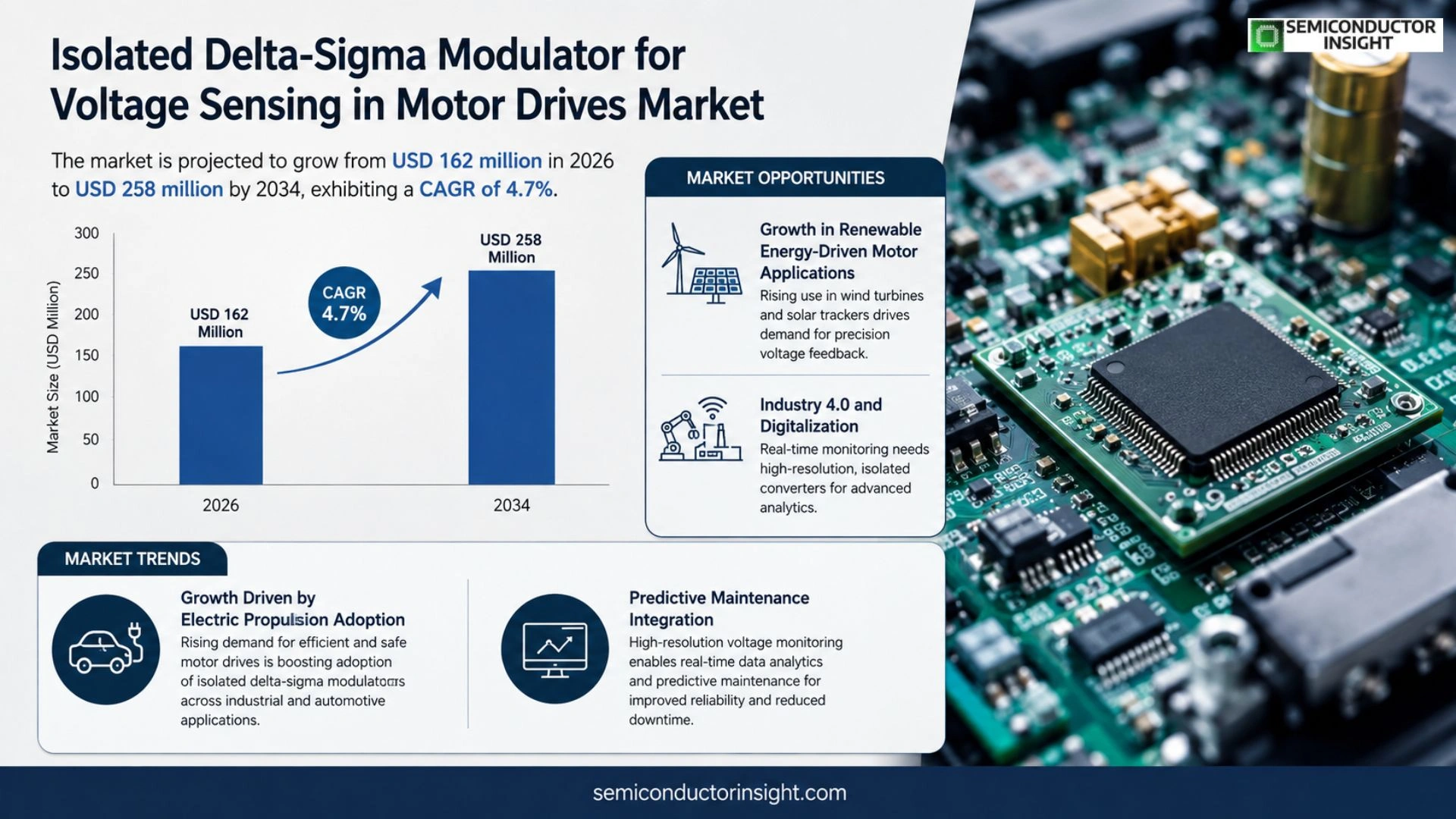
Global Isolated delta-sigma modulator for voltage sensing in motor drives market size was valued at USD 152 million in 2025. The market is projected to grow from USD 162 million in 2026 to USD 258 million by 2034, exhibiting a CAGR of 4.7% during the forecast period.
Isolated delta‑sigma modulators are high‑precision analog‑to‑digital converters that provide galvanic isolation while measuring motor‑drive voltages, enabling accurate feedback and fault detection in industrial drives and electric vehicles.
The market is experiencing steady growth because of rising adoption of electric propulsion systems, increasing demand for predictive maintenance, and advancements in semiconductor integration that reduce cost and power consumption. Furthermore, OEM collaborations and regulatory emphasis on safety standards are driving investment, while competition among silicon‑based sensor manufacturers fuels innovation.
MARKET DRIVERS
Rising Demand for High‑Precision Motor Control
The adoption of electric drives in automated factories has accelerated, creating a need for voltage‑sensing solutions that deliver sub‑millivolt resolution. Isolated delta‑sigma modulators provide the required noise shaping and linearity, enabling tighter torque control and lower vibration levels.
Shift Toward Energy‑Efficient Industrial Systems
Energy‑efficiency standards such as IEC 61800‑9 encourage manufacturers to implement sensor‑front‑ends with low power consumption. The inherently low‑power architecture of delta‑sigma modulators, combined with galvanic isolation, aligns with these regulatory pressures.
➤ “By 2028, isolated delta‑sigma solutions are projected to capture over 30 % of new motor‑drive sensor deployments in Europe.”
Overall, the convergence of tighter performance specifications and sustainability mandates is driving robust growth for Isolated delta‑sigma modulator market in voltage‑sensing applications.
MARKET CHALLENGES
Complex Integration with Existing Drive Architectures
Designers often face layout constraints when incorporating isolated converters and high‑order modulators into compact drive boards. The requirement for additional isolation barriers can increase bill‑of‑materials cost and lengthen development cycles.
Moreover, the need to calibrate offset and gain across temperature ranges adds engineering overhead, especially for OEMs transitioning from traditional ADCs.
Other Challenges
Supply‑Chain Volatility
Fluctuations in semiconductor wafer capacity for precision analog components have led to intermittent shortages, affecting lead times for delta‑sigma chips.
MARKET RESTRAINTS
High Initial Development Costs
Although the long‑term performance benefits are clear, the up‑front R&D investment for custom isolation topologies and firmware algorithms can deter small‑to‑mid‑size manufacturers.
Additionally, the necessity for rigorous electromagnetic compatibility (EMC) testing adds both time and expense, limiting rapid market entry for newer players.
MARKET OPPORTUNITIES
Growth in Renewable Energy‑Driven Motor Applications
Wind‑turbine pitch control and solar‑tracker drives increasingly rely on precision voltage feedback to maximize energy conversion efficiency. Isolated delta‑sigma modulators, with their superior linearity, are poised to become the preferred sensing technology in these expanding segments.
Furthermore, the rise of Industry 4.0 concepts, which demand real‑time condition monitoring, creates a market niche for high‑resolution, isolated converters that can feed data directly to cloud‑based analytics platforms.
Isolated delta-sigma modulator for voltage sensing in motor drives Market Trends
Growth Driven by Electric Propulsion Adoption
The shift toward electric propulsion across industrial and automotive sectors is creating a clear upward trajectory for Isolated delta-sigma modulator for voltage sensing in motor drives Market. End‑users are demanding higher precision in voltage feedback to meet tighter efficiency standards, and the inherent galvanic isolation of delta‑sigma converters satisfies safety requirements while delivering low‑noise measurements. As manufacturers integrate these converters into drive‑inverter platforms, the overall system cost declines, encouraging broader deployment in new equipment and retrofit projects. This trend is reinforcing a steady demand pattern that is expected to persist throughout the next decade.
Other Trends
Predictive Maintenance Integration
Predictive maintenance strategies rely on continuous, high‑resolution voltage monitoring to anticipate fault conditions before catastrophic failure. Isolated delta-sigma modulator for voltage sensing in motor drives Market is benefiting from tighter coupling with condition‑based monitoring software, where real‑time data streams enable machine‑learning algorithms to detect subtle drift in motor performance. OEMs are embedding these modulators directly into controller boards, reducing wiring complexity and improving diagnostic accuracy. As plant managers prioritize uptime and reduced maintenance costs, the demand for such integrated sensing solutions continues to rise.
Advancements in Semiconductor Isolation Technology
Recent progress in silicon‑on‑insulator (SOI) processes and advanced packaging has lowered the power consumption of isolated delta‑sigma converters while preserving high isolation voltage ratings. These semiconductor innovations are allowing designers to place the modulator closer to power stages, shortening signal paths and enhancing bandwidth. The resulting performance gains are attracting interest from both electric‑vehicle manufacturers and industrial drive suppliers seeking to meet stringent electromagnetic compatibility (EMC) regulations. Collaboration between sensor vendors and semiconductor foundries is accelerating product introductions that combine low‑power operation with robust isolation, further solidifying the market’s growth foundation.
COMPETITIVE LANDSCAPE
Key Industry Players
Isolated Delta‑Sigma Modulators for Voltage Sensing in Motor Drives – Global Competitive Overview
The market is currently dominated by a handful of large silicon‑based sensor manufacturers that combine high‑precision analog‑to‑digital conversion with galvanic isolation. Texas Instruments commands a leading share thanks to its extensive voltage‑sensing portfolio, aggressive pricing, and deep integration with motor‑drive reference designs sold to automotive OEMs. Analog Devices follows closely, leveraging its SigmaDSP expertise to deliver low‑noise, high‑resolution converters that meet emerging ISO‑26262 safety requirements. Infineon Technologies and STMicroelectronics round out the top tier, each offering modular solutions that integrate isolation barriers and digital filtering on a single die, thus reducing bill‑of‑materials and power consumption for electric‑vehicle and industrial drive applications. The concentration of R&D budgets among these four firms creates a competitive environment where feature‑rich product roadmaps and rapid silicon refresh cycles are essential to maintain market leadership.
Beyond the primary tier, a diverse set of niche players contributes specialized capabilities that address emerging use‑cases such as predictive maintenance and ultra‑low‑power sensor networks. NXP Semiconductors and Renesas Electronics focus on automotive‑grade reliability, while ON Semiconductor and Maxim Integrated (now part of Analog Devices) target cost‑sensitive industrial drives. Smaller innovators like Melexis, Rohm Semiconductor, and Power Integrations differentiate with compact, highly integrated modules that embed isolation, reference regulation, and digital diagnostics. Emerging entrants such as Skyworks Solutions and Cypress Semiconductor (now under Infineon) are leveraging advanced packaging to deliver higher bandwidth and tighter EMI performance, positioning themselves for growth as motor‑drive architectures evolve toward multi‑level inverter topologies.
List of Key Isolated Delta‑Sigma Modulator for Voltage Sensing in Motor Drives Companies Profiled
- Texas Instruments
- Analog Devices
- Infineon Technologies
- STMicroelectronics
- NXP Semiconductors
- Renesas Electronics
- ON Semiconductor
- Maxim Integrated
- Microchip Technology
- Cypress Semiconductor
- Cirrus Logic
- Rohm Semiconductor
- Skyworks Solutions
- Power Integrations
- Melexis
Segment Analysis:
| Segment Category | Sub-Segments | Key Insights |
| By Type |
|
Digital Isolated Modulators are favored for their ability to integrate sophisticated sigma‑delta architectures while maintaining galvanic isolation. Their digital core simplifies system interfacing and supports flexible firmware updates. Key qualitative drivers include:
|
| By Application |
|
Industrial Motor Drives remain the dominant application due to demanding precision and safety requirements. Qualitative insights highlight:
|
| By End User |
|
OEMs drive specification choices because they embed modulators directly into proprietary drive architectures. Observed qualitative themes include:
|
| By Integration Approach |
|
Standalone Isolated ICs are chosen for design flexibility when diverse power topologies are required. Qualitative considerations feature:
|
| By Functional Emphasis |
|
High‑Precision Sensing drives customer preference because it directly impacts motor efficiency and reliability. Core qualitative insights include:
|
Regional Analysis: Isolated delta-sigma modulator for voltage sensing in motor drives Market
The automotive and heavy‑equipment sectors in North America are embedding isolated delta‑sigma modulators to meet tighter emissions regulations and to enable predictive maintenance. This trend is reinforced by the rise of smart factories where precise voltage sensing supports adaptive motor control, reducing downtime and energy consumption.
Compliance with IEC 61800‑5‑1 and UL 61800‑5‑2 drives the adoption of high‑integrity sensing solutions. Regulatory bodies encourage the use of isolated architectures to mitigate electrical noise, fostering a market preference for robust delta‑sigma designs that meet safety certifications across diverse applications.
A handful of semiconductor leaders dominate, leveraging extensive IP portfolios and custom ASIC offerings. Their emphasis on low‑power, high‑resolution converters creates differentiation, while emerging niche players target specialized niches such as renewable‑energy‑driven motor drives.
Collaborative research programs between universities and industry accelerate advances in noise‑shaping algorithms and CMOS‑on‑SOI processes. These innovations underpin next‑generation modules capable of higher sampling rates and improved isolation without enlarging the form factor.
Europe
Europe’s market is shaped by a strong focus on sustainability and the European Green Deal, which encourages manufacturers to adopt energy‑efficient motor drives. Leading automotive clusters in Germany and France are integrating isolated delta‑sigma modulators to enhance fault detection and comply with stringent EMV directives. The presence of multiple standards bodies promotes uniformity in safety certifications, facilitating cross‑border component sourcing. However, price pressures from low‑cost Asian imports necessitate a balanced approach between performance and cost.
Asia‑Pacific
Asia‑Pacific exhibits rapid expansion of Isolated delta‑sigma modulator market, propelled by burgeoning industrialization in China, India, and Southeast Asia. The region’s growing demand for high‑efficiency motor drives in renewable‑energy installations and electric‑vehicle manufacturing drives adoption. Local semiconductor firms are scaling production capacities, often collaborating with global OEMs to tailor solutions for diverse voltage levels. Despite strong growth, fragmented supply chains and varying regulatory frameworks create challenges for consistent market penetration.
South America
In South America, market momentum stems from infrastructure upgrades and the adoption of motor‑driven pumps in mining and water‑treatment sectors. Countries such as Brazil and Chile are modernizing legacy systems, where isolated delta‑sigma modulators provide the necessary precision for variable‑speed drives. Limited local manufacturing leads to reliance on imported components, prompting regional distributors to focus on value‑added services such as technical support and system integration to differentiate offerings.
Middle East & Africa
The Middle East & Africa region is witnessing early-stage adoption, driven mainly by oil‑and‑gas facilities and emerging renewable‑energy projects. High ambient temperatures and stringent safety requirements underscore the need for robust isolation in voltage sensing modules. Market growth is supported by government initiatives encouraging energy‑efficient technologies, though overall penetration remains modest due to lower awareness and the need for skilled technical personnel to implement advanced motor‑drive solutions.
Report Scope
This market research report provides a comprehensive analysis of the Isolated delta-sigma modulator for voltage sensing in motor drives Market , covering the forecast period 2026–2034. It offers detailed insights into market dynamics, technological advancements, competitive landscape, and key trends shaping the industry.
Key focus areas of the report include:
- Market Overview: The report begins with an overview outlining its current market scenario, key growth indicators, and industry transformation drivers. It discusses macroeconomic factors, demand–supply balance, regulatory landscape, and the strategic role of semiconductors in powering advancements across industries such as automotive, telecommunications, consumer electronics, and industrial automation.
- Market Size & Forecast: Historical data and future projections for revenue, unit shipments, and market value across major regions and segments.
- Segmentation Analysis: Detailed breakdown by product type, technology, application, and end-user industry to identify high-growth segments and investment opportunities.
- Regional Insights: Insights into market performance across North America, Europe, Asia-Pacific, Latin America, and the Middle East & Africa, including country-level analysis where relevant.
- Competitive Landscape: Profiles of leading market participants, including their product offerings, R&D focus, manufacturing capacity, pricing strategies, and recent developments such as mergers, acquisitions, and partnerships.
- Technology Trends & Innovation: Assessment of emerging technologies, integration of AI/IoT, semiconductor design trends, fabrication techniques, and evolving industry standards.
- Market Drivers & Restraints: Evaluation of factors driving market growth along with challenges, supply chain constraints, regulatory issues, and market-entry barriers.
- Stakeholder Insights: Insights for component suppliers, OEMs, system integrators, investors, and policymakers regarding the evolving ecosystem and strategic opportunities.
Primary and secondary research methods are employed, including interviews with industry experts, data from verified sources, and real-time market intelligence to ensure the accuracy and reliability of the insights presented.
FREQUENTLY ASKED QUESTIONS:
What is the current market size of Isolated delta-sigma modulator for voltage sensing in motor drives Market?
-> Isolated delta-sigma modulator for voltage sensing in motor drives market is projected to grow from USD 162 million in 2026 to USD 258 million by 2034.
Which key companies operate in Isolated delta-sigma modulator for voltage sensing in motor drives Market?
-> Key players include Axalta Coating Systems, AkzoNobel, BASF SE, PPG, Sherwin-Williams, and 3M, among others.
What are the key growth drivers?
-> Key growth drivers include railway infrastructure investments, urbanization, and demand for durable coatings.
Which region dominates the market?
-> Asia-Pacific is the fastest-growing region, while Europe remains a dominant market.
What are the emerging trends?
-> Emerging trends include bio-based coatings, smart coatings, and sustainable rail solutions.
Get Sample Report PDF for Exclusive Insights
Report Sample Includes
- Table of Contents
- List of Tables & Figures
- Charts, Research Methodology, and more...