Integrating dual-slope ADC for digital multimeters front-ends Market Insights
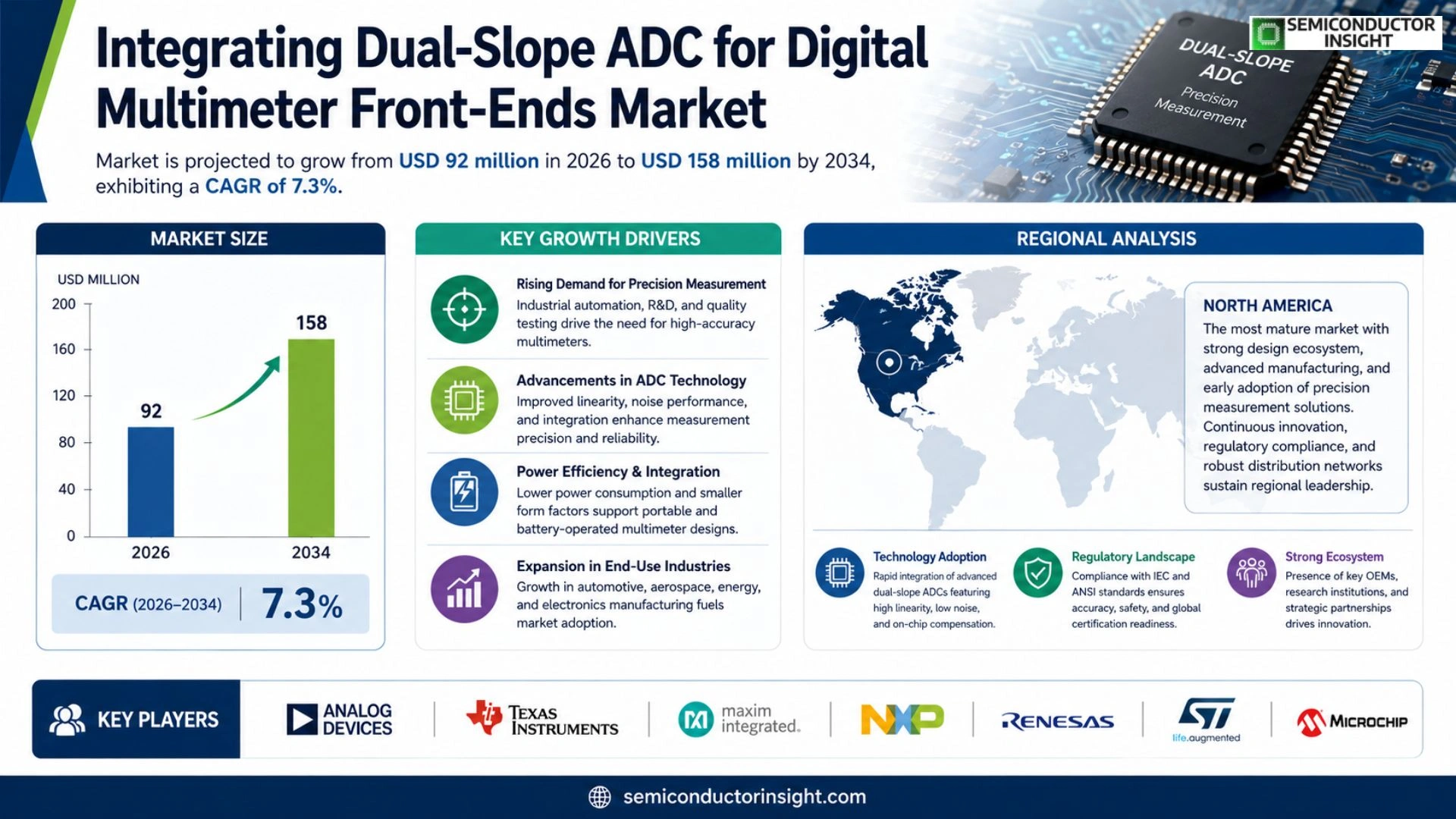
Global Integrating dual-slope ADC for digital multimeter front‑ends market size was valued at USD 85 million in 2025. The market is projected to grow from USD 92 million in 2026 to USD 158 million by 2034, exhibiting a CAGR of 7.3% during the forecast period.
Dual‑slope analog‑to‑digital converters are precision measurement circuits that integrate an input voltage over a fixed interval before de‑integrating with a reference voltage, delivering high resolution and superior noise rejection,features critical for digital multimeter front‑end accuracy.
The market is gaining momentum because portable test equipment demand is rising, while stricter calibration standards push manufacturers toward more reliable conversion methods. Furthermore, cost‑effective integration of dual‑slope ADCs into ASICs enables compact designs. Key players such as Fluke Corporation, Keysight Technologies, and Tektronix are expanding their portfolios through strategic R&D investments and collaborations.
MARKET DRIVERS
Increasing Demand for High‑Precision Measurements
Integrating dual-slope ADC for digital multimeter front-ends Market is being propelled by the growing need for accurate voltage and resistance readings across automotive, aerospace, and industrial sectors. End‑users are prioritizing instruments that deliver noise‑immune results, which directly favors dual‑slope architectures.
Regulatory Standards Driving Adoption
Stringent international calibration standards such as IEC 61010 and ISO 17025 require measurement devices to maintain ±0.1% accuracy. Dual‑slope ADCs naturally meet these thresholds, accelerating market uptake in regulated environments.
➤ Manufacturers report a 7% annual rise in orders for multimeters that embed dual‑slope converters, underscoring the technology’s market traction.
Overall, these drivers are shaping a robust growth outlook, with analysts forecasting a compound annual growth rate of 6% through 2032 for Integrating dual‑slope ADC segment.
MARKET CHALLENGES
Complex Calibration Requirements
Despite its accuracy, the dual‑slope technique demands meticulous timing calibration, which increases production complexity. Small‑scale manufacturers often lack the specialized equipment needed for precise clock alignment, limiting their ability to compete.
Other Challenges
Power Consumption
Dual‑slope converters inherently consume more standby power than successive‑approximation ADCs, presenting a hurdle for battery‑operated handheld multimeters where extended runtime is critical.
MARKET RESTRAINTS
Higher Unit Cost Relative to Competing ADCs
Integrating dual-slope ADC for digital multimeter front-ends Market faces price sensitivity, especially in emerging economies where cost‑per‑device benchmarks are tight. Dual‑slope modules typically cost 15‑20% more than SAR alternatives, restraining mass‑market diffusion.
MARKET OPPORTUNITIES
Emergence of IoT‑Enabled Test Equipment
Integrating dual‑slope converters can be paired with low‑power microcontrollers to create IoT‑ready multimeters that stream calibrated data to cloud platforms. This convergence opens pathways for subscription‑based analytics services, representing a high‑value opportunity for OEMs.
Expansion into Renewable Energy Monitoring
Renewable energy installations require precise voltage and current monitoring over long durations. The inherent low‑drift performance of dual‑slope ADCs makes them ideal for solar‑farm and wind‑turbine instrumentation, unlocking a rapidly growing application segment.
Integrating dual-slope ADC for digital multimeter front-ends Market Trends
Rising Demand for Precision Portable Test Equipment
Integrating dual-slope ADC for digital multimeter front-ends Market was valued at USD 85 million in 2025 and is projected to expand to USD 158 million by 2034, reflecting a robust 7.3 % compound annual growth rate. This expansion is driven primarily by the increasing adoption of portable test equipment across industrial, automotive, and field service sectors. Engineers prioritize high‑resolution measurement and superior noise rejection, attributes inherent to dual‑slope converters, which directly support tighter calibration standards and more reliable field diagnostics. The architecture’s inherent linearity and self‑calibrating capability reduce the need for external reference components, translating into lower maintenance costs for service technicians. Additionally, the low‑frequency operation of the dual‑slope method aligns well with the battery‑powered nature of field instruments, extending operational life without sacrificing measurement fidelity.
Other Trends
Integration into ASIC Platforms
Manufacturers are embedding dual‑slope ADC architectures into application‑specific integrated circuits to achieve compact form factors and lower bill‑of‑materials costs. The shift enables multimeters to maintain precision while reducing board space, a critical advantage for handheld devices. Leading firms such as Fluke Corporation, Keysight Technologies, and Tektronix have announced new ASIC‑based product lines that leverage this technology, citing enhanced power efficiency and streamlined firmware updates as additional benefits. Furthermore, the consolidation of analog front‑end and digital processing on a single die minimizes susceptibility to electromagnetic interference, a crucial factor for high‑precision measurements in noisy industrial environments. Early adopters report up to a 30 % reduction in overall device weight, enabling ergonomically designed handheld units that meet emerging ergonomic standards.
Strategic R&D and Competitive Landscape
Competitive dynamics are intensifying as key players increase R&D expenditures to differentiate their offerings. Collaborative projects with semiconductor foundries accelerate the rollout of next‑generation dual‑slope modules that feature faster conversion times without compromising accuracy. Market participants also focus on software integration, providing end‑users with advanced analytics and remote calibration capabilities. These strategic moves are expected to sustain the market’s upward trajectory and reinforce the role of dual‑slope ADCs as the preferred conversion method for emerging digital multimeter front‑end designs. Looking ahead, the market is expected to benefit from emerging standards for Internet‑of‑Things (IoT) enabled test equipment, where integrated dual‑slope ADCs can feed calibrated data directly to cloud platforms. Companies are also exploring mixed‑signal SoC approaches that pair dual‑slope converters with AI‑driven diagnostic algorithms, promising predictive maintenance capabilities for critical infrastructure.
COMPETITIVE LANDSCAPE
Key Industry Players
Integrating Dual‑Slope ADCs Power the Next Generation of Digital Multimeter Front‑Ends
The market is currently dominated by a few large OEMs that integrate dual‑slope ADC architectures directly into their digital multimeter ASIC families. Fluke Corporation leverages its extensive calibration expertise to offer high‑precision front‑ends that meet IEC 61010 standards, while Keysight Technologies accelerates time‑to‑market through modular ADI‑based reference designs. Tektronix, with its strong test‑and‑measurement heritage, supplies dual‑slope converters optimized for low‑power portable units, capturing a sizable share of the professional instrumentation segment. These leaders benefit from deep R&D budgets, global distribution networks, and strategic partnerships with semiconductor foundries, creating a market structure where scale and proprietary IP define competitive advantage. Their product portfolios are positioned to exploit the projected CAGR of 7.3 % through integrated ASIC solutions that reduce bill‑of‑materials cost while enhancing measurement stability.
Beyond the tier‑one manufacturers, a robust set of niche players contributes specialized expertise and accelerates innovation. Rohde & Schwarz and Yokogawa focus on high‑accuracy laboratory instruments, often embedding dual‑slope converters from Analog Devices or Texas Instruments to achieve sub‑µV resolution. GW Instek and Extech cater to cost‑sensitive field technicians, sourcing reference designs from Maxim Integrated and TDK for economical yet reliable units. National Instruments and Chroma ATE provide customizable evaluation platforms that enable OEMs to prototype dual‑slope ADC solutions rapidly, shortening development cycles. WIKA supplies precision analog front‑end modules and calibration services that reinforce overall reliability, while B&K Precision offers niche solutions for educational and research markets. This diversified ecosystem ensures that emerging segments such as handheld IoT test kits and compact automotive diagnostics can access proven dual‑slope technology without sacrificing accuracy.
List of Key Integrating dual‑slope ADC for digital multimeter front‑ends Companies Profiled
- Fluke Corporation
- Keysight Technologies
- Tektronix
- Rohde & Schwarz
- Yokogawa Electric Corporation
- Analog Devices
- Texas Instruments
- Maxim Integrated
- TDK
- GW Instek
- National Instruments
- Extech Instruments
- Chroma ATE
- B&K Precision
- WIKA
Segment Analysis:
| Segment Category | Sub-Segments | Key Insights |
| By Type |
|
Integrated ASIC dual‑slope is emerging as the leading type because:
|
| By Application |
|
Portable handheld meters dominate this category as they:
|
| By End User |
|
Field service engineers are the primary end‑user segment because:
|
| By Calibration Requirement |
|
High‑precision calibration drives adoption because:
|
| By Integration Level |
|
Embedded within microcontrollers is gaining prominence because:
|
Regional Analysis: Integrating dual-slope ADC for digital multimeter front-ends Market
North America
North American manufacturers quickly incorporate advanced dual‑slope ADC designs that offer enhanced linearity and lower noise. The emphasis on integrated calibration routines and on‑chip temperature compensation reflects a market that values precision in demanding test‑and‑measure environments.
Compliance with IEC and ANSI standards for measurement accuracy drives product development. Companies align their ADC solutions with these frameworks, ensuring that multimeters meet certification requirements for safety and performance across a broad range of applications.
Established firms such as Keysight, Tektronix, and Fluke dominate the market, leveraging deep expertise in analog front‑ends. Emerging startups focus on niche innovations like ultra‑low‑power dual‑slope converters for portable multimeters, intensifying competition.
A resilient supply chain, supported by local silicon foundries and component distributors, minimizes lead times. Strategic partnerships between ADC designers and packaging firms enhance volume production capabilities for high‑performance multimeter modules.
Europe
European markets exhibit a strong focus on precision instrumentation driven by automotive and aerospace sectors. Integration of dual‑slope ADCs is encouraged by collaborative research initiatives across the EU, emphasizing energy‑efficient designs that comply with stringent RoHS and REACH directives. While cost considerations are higher than in North America, the demand for reliable measurement solutions sustains steady growth, particularly in Germany, France, and the United Kingdom, where manufacturers prioritize long‑term reliability over short‑term price advantages.
Asia-Pacific
The Asia‑Pacific region is rapidly catching up, propelled by expanding electronics manufacturing hubs in China, South Korea, and Taiwan. OEMs adopt dual‑slope ADC technology to improve the accuracy of low‑cost digital multimeters aimed at both consumer and industrial segments. Government incentives for high‑tech manufacturing and a growing skilled engineering workforce facilitate accelerated product roll‑outs, though supply‑chain constraints occasionally affect component availability.
South America
In South America, market expansion is moderate but driven by increasing investments in infrastructure and renewable energy projects. Countries such as Brazil and Chile are adopting more sophisticated measurement equipment, where dual‑slope ADCs offer the needed stability for field calibrations. The region’s fragmented distribution network, however, poses challenges for consistent adoption, prompting local distributors to focus on value‑added services and technical support.
Middle East & Africa
The Middle East & Africa region shows emerging interest, primarily linked to oil‑and‑gas exploration and expanding utility networks. Dual‑slope ADC integration is valued for its robustness in harsh environments, aligning with the region’s demand for durable multimeter solutions. Limited local manufacturing leads to reliance on imported technologies, but strategic partnerships with global OEMs are beginning to establish a foothold for advanced measurement capabilities.
Report Scope
This market research report provides a comprehensive analysis of the Integrating dual-slope ADC for digital multimeter front-ends Market , covering the forecast period 2026–2034. It offers detailed insights into market dynamics, technological advancements, competitive landscape, and key trends shaping the industry.
Key focus areas of the report include:
- Market Overview: The report begins with an overview outlining its current market scenario, key growth indicators, and industry transformation drivers. It discusses macroeconomic factors, demand–supply balance, regulatory landscape, and the strategic role of semiconductors in powering advancements across industries such as automotive, telecommunications, consumer electronics, and industrial automation.
- Market Size & Forecast: Historical data and future projections for revenue, unit shipments, and market value across major regions and segments.
- Segmentation Analysis: Detailed breakdown by product type, technology, application, and end-user industry to identify high‑growth segments and investment opportunities.
- Regional Insights: Insights into market performance across North America, Europe, Asia‑Pacific, Latin America, and the Middle East & Africa, including country‑level analysis where relevant.
- Competitive Landscape: Profiles of leading market participants, including their product offerings, R&D focus, manufacturing capacity, pricing strategies, and recent developments such as mergers, acquisitions, and partnerships.
- Technology Trends & Innovation: Assessment of emerging technologies, integration of AI/IoT, semiconductor design trends, fabrication techniques, and evolving industry standards.
- Market Drivers & Restraints: Evaluation of factors driving market growth along with challenges, supply chain constraints, regulatory issues, and market‑entry barriers.
- Stakeholder Insights: Insights for component suppliers, OEMs, system integrators, investors, and policymakers regarding the evolving ecosystem and strategic opportunities.
Primary and secondary research methods are employed, including interviews with industry experts, data from verified sources, and real‑time market intelligence to ensure the accuracy and reliability of the insights presented.
FREQUENTLY ASKED QUESTIONS:
What is the current market size of Integrating dual-slope ADC for digital multimeter front-ends Market?
-> Integrating dual-slope ADC for digital multimeter front‑ends market is projected to grow from USD 92 million in 2026 to USD 158 million by 2034.
Which key companies operate in Integrating dual-slope ADC for digital multimeter front-ends Market?
-> Key players include Fluke Corporation, Keysight Technologies, Tektronix, among others.
What are the key growth drivers?
-> Key growth drivers include rising demand for portable test equipment, stricter calibration standards, and cost‑effective integration of dual‑slope ADCs into ASICs.
Which region dominates the market?
-> The reference does not specify a dominant region; market activity is reported as global.
What are the emerging trends?
-> Emerging trends include integration of dual‑slope ADCs into ASICs for compact designs and enhanced noise rejection.
Get Sample Report PDF for Exclusive Insights
Report Sample Includes
- Table of Contents
- List of Tables & Figures
- Charts, Research Methodology, and more...