Key Statistics
Key Takeaways
- Market size: The market is valued at USD 10.84 billion in 2025 and is projected to reach USD 24.94 billion by 2034, representing a 9.7% CAGR during 2026–2034.
- DFB lasers and EMLs are the strategic growth products because 800G, 1.6T and future optical links require higher modulation bandwidth, optical power and power efficiency.
- North America remains the leading 2025 market through hyperscale data-center demand and advanced photonics adoption, while Asia Pacific is the fastest growth region through optical-component manufacturing.
- AI infrastructure is the dominant demand catalyst, raising the number and performance of optical links between accelerators, switches and data-center clusters.
- Photonic integration is increasing value per device as InP lasers, modulators and photodiodes are combined with silicon photonics, co-packaged optics and integrated optical engines.
InP Optoelectronics Market Overview
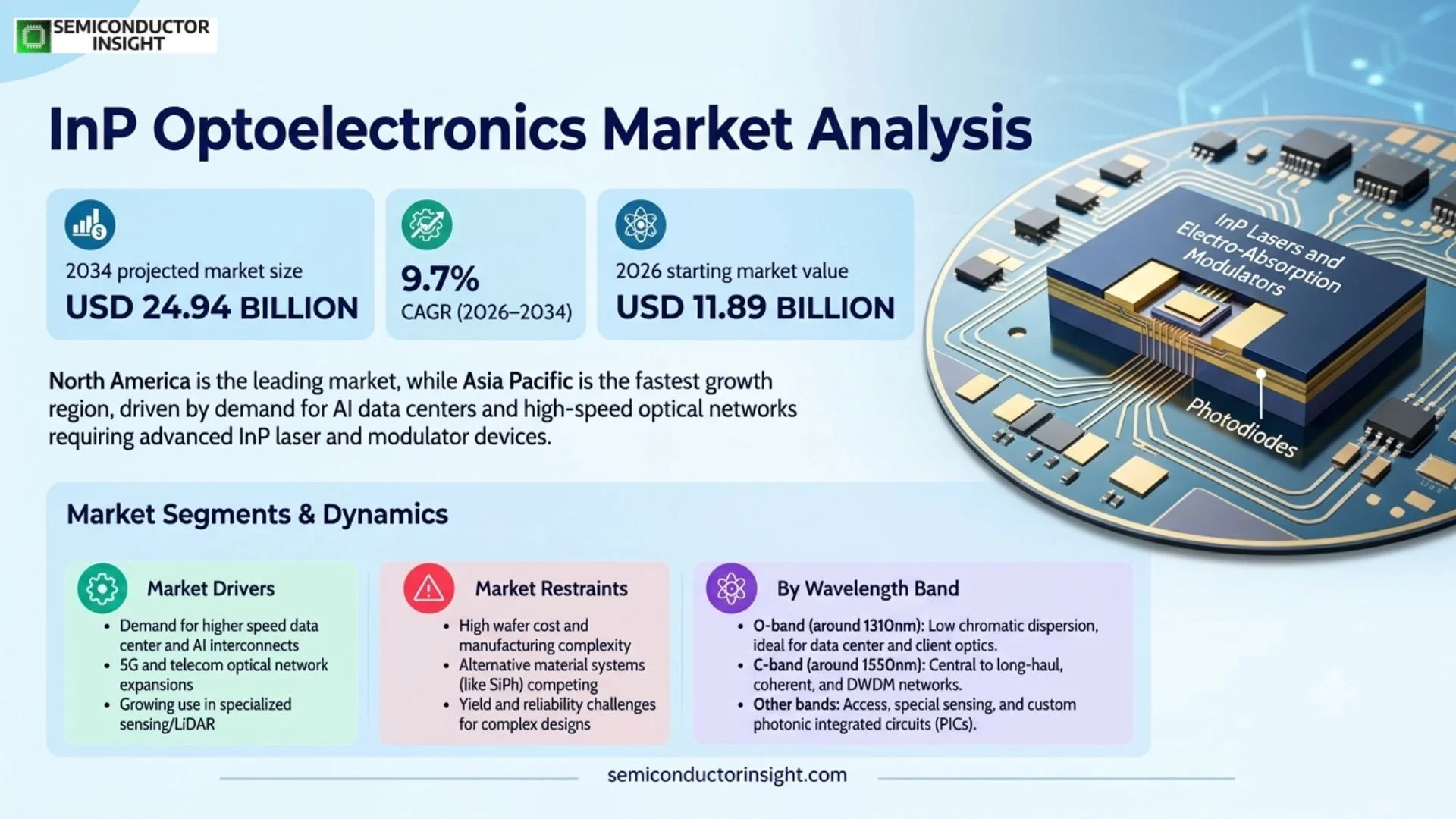
InP Optoelectronics Market is valued at USD 10.84 billion in 2025 and is projected to reach USD 24.94 billion by 2034, expanding at a 9.7% CAGR during 2026–2034. The 2026 market level is USD 11.89 billion. North America holds the leading 2025 market position, while Asia Pacific is the fastest growth region. Demand is accelerating through AI data centers, telecom networks and high-speed optical interconnects that require InP lasers, electro-absorption modulated lasers, photodiodes and integrated photonic components.
Indium phosphide optoelectronics includes laser diodes, electro-absorption modulated lasers, photodiodes, modulators and photonic integrated devices built on InP material systems. InP combines direct-bandgap light emission with high-speed electronic properties, making it particularly well suited to 1310nm and 1550nm optical communications. Commercial devices are differentiated by output power, linewidth, modulation bandwidth, temperature stability, wavelength control, coupling efficiency and compatibility with high-volume optical packaging.
AI and cloud infrastructure are changing the product mix. Coherent’s 2026 InP portfolio includes 200G EMLs for 1.6T transceivers, differential EMLs targeting 400G-per-lane operation and high-power CW lasers for co-packaged optics and silicon-photonics engines. This shifts demand away from conventional telecom-only growth and toward large volumes of high-speed datacenter links where energy per bit, laser power and packaging density are increasingly important.
The commercial value chain extends from InP substrate and epitaxial growth through wafer fabrication, laser processing, facet coatings, photonic integration and optical-module assembly. Qualification requires both device-level performance and module-level reliability because optical links must operate continuously at high data rates. Suppliers with vertically integrated epitaxy, wafer processing and packaging or strong partnerships can reduce yield risk and accelerate the transition from new laser designs into high-volume transceiver production.
Segment Analysis: By Type
By type, the market is segmented into Fabry-Perot laser diodes, distributed-feedback lasers and electro-absorption modulated lasers. FP devices serve cost-sensitive or shorter-reach applications, DFB lasers provide stable single-mode output for telecom and datacom, and EMLs combine a laser with an electro-absorption modulator to support very high-speed transmission over longer reaches. The fastest value growth is concentrated in DFB and EML products used in advanced data-center optics.
| Type | Commercial role |
|---|---|
| FP Laser Diode | Multi-mode or lower-complexity laser architecture for cost-sensitive optical links and selected access applications. |
| DFB Laser | Single-mode laser with stable wavelength and narrow linewidth for telecom, datacom and photonic integration. |
| EML | DFB laser integrated with an electro-absorption modulator for high-speed 100G/200G-per-lane and longer-reach links. |
Additional Segmentation: By Wavelength Band
Wavelength band is commercially important because optical-fiber loss, dispersion and transceiver architecture determine the preferred InP device. O-band around 1310nm is widely used in data-center and client optics because chromatic dispersion is low, while C-band around 1550nm is central to long-haul, coherent and dense wavelength-division multiplexing systems. Other bands serve access, sensing and specialty photonic applications.
| Wavelength Band | Demand characteristics |
|---|---|
| O-Band | 1310nm-class datacenter, client and short-to-medium reach optical links with low chromatic dispersion. |
| C-Band | 1550nm-class telecom, coherent, DWDM and longer-reach transmission applications. |
| Other Bands | Access, sensing, specialty photonics and application-specific wavelength requirements. |
Segment Analysis: By Application
By application, telecommunications remains a major installed market, while data centers are the strongest growth segment because AI clusters require rapidly increasing optical bandwidth between servers, switches and accelerators. Other applications include sensing, LiDAR, industrial lasers and specialized photonic systems. The data-center segment is driving product transitions toward 200G-per-lane and 400G-per-lane devices with higher optical power and lower energy consumption.
| Application | Demand characteristics |
|---|---|
| Telecommunications | Metro, long-haul, access and coherent optical networks using DFB, EML, tunable lasers and photodetectors. |
| Datacenters | 800G, 1.6T and emerging 3.2T optical transceivers and co-packaged optics for AI and cloud infrastructure. |
| Others | Sensing, LiDAR, industrial, medical and specialty photonic applications using InP emitters or detectors. |
Additional Segmentation: By Integration Level
Integration level ranges from discrete InP laser or detector die to photonic integrated circuits and complete optical sub-assemblies. Discrete devices offer flexibility, while PICs combine lasers, modulators, waveguides and detectors to reduce footprint and improve performance. Optical sub-assemblies add packaging, coupling and thermal control, capturing more system value and making component suppliers increasingly responsible for module-level yield and reliability.
| Integration Level | Commercial relevance |
|---|---|
| Discrete Devices | Individual lasers, photodiodes or modulators sold to module and photonic-system integrators. |
| Photonic Integrated Circuits | Multiple optical functions integrated on InP or hybrid platforms to reduce footprint and interconnect loss. |
| Optical Sub-Assemblies | Packaged laser, detector or modulator assemblies with coupling, thermal management and interfaces. |
Regional Analysis
North America remains a dominant market because U.S. hyperscalers, cloud infrastructure and advanced photonics companies are driving rapid adoption of higher-speed optical links. Asia Pacific is the fastest growth region through optical-component manufacturing in China, Japan and Southeast Asia. Europe maintains strong telecom, photonics and research demand, while South America and the Middle East & Africa remain smaller end markets.
Why does regional demand differ across the InP Optoelectronics market?
Regional demand reflects both optical-system consumption and where components are manufactured. North America drives high-value data-center specifications, Asia Pacific manufactures a large share of lasers, transceivers and modules, and Europe contributes telecom, photonic integration and research. The strongest supplier position therefore combines access to hyperscale customers with manufacturing scale and reliable InP epitaxy, wafer processing and packaging.
| Region | Position | Demand profile | Key commercial factor |
|---|---|---|---|
| North America | Largest | AI data centers, cloud, telecom | Hyperscale qualification and technology leadership |
| Asia Pacific | Fastest growth | Optical manufacturing, telecom | Scale manufacturing and supply-chain integration |
| Europe | Strategic | Telecom, photonics, research | High-reliability and integrated photonics |
| South America | Emerging | Telecom and cloud | Imported components and network investment |
| Middle East & Africa | Emerging | Telecom, data centers | Infrastructure expansion and supplier access |
Competitive Landscape
Lumentum, Coherent, Broadcom, Sumitomo Electric, Applied Optoelectronics, Furukawa Electric and MACOM are among the leading companies identified in the market. Competition spans InP epitaxy, lasers, EMLs, photodiodes, photonic integrated circuits and optical sub-assemblies. Scale, device yield, wavelength control and packaging integration are critical because customers need consistent performance across very large transceiver volumes.
AI infrastructure is changing competitive priorities. Coherent’s 2026 portfolio extends from high-power CW lasers for co-packaged optics to 200G and 400G-per-lane InP devices, while Veeco’s equipment orders show that laser manufacturers are adding substantial capacity. Suppliers that can scale wafer output and maintain low defect density will be positioned to benefit as 1.6T transceivers move into higher volume and 3.2T architectures emerge.
Customer relationships are sticky because optical components are qualified within transceiver, switch and networking platforms. A change in laser design can affect coupling efficiency, thermal behavior, firmware and link margins. Suppliers therefore compete on reliability data, multi-year product roadmaps and production consistency as much as peak bandwidth. Early wins in hyperscale platforms can create substantial recurring volume across several transceiver generations.
| Competitive tier | Representative companies | Primary differentiation |
|---|---|---|
| Integrated photonics leaders | Coherent, Lumentum, Broadcom | InP lasers, EMLs, detectors, optical engines and high-volume datacenter or telecom access. |
| Materials and device specialists | Sumitomo Electric, Furukawa Electric, MACOM | InP substrates, epitaxy, lasers, photodiodes and RF/optical semiconductor expertise. |
| Module / component specialists | Applied Optoelectronics and regional suppliers | Datacenter transceiver and laser integration with high-volume customer programs. |
Key companies profiled
Lumentum, Coherent, Broadcom, Sumitomo Electric, Applied Optoelectronics, Furukawa Electric and MACOM are included in the competitive scope, along with other InP photonics suppliers. Their roles differ across epitaxy, discrete lasers, electro-absorption modulated lasers, photodetectors, photonic integrated circuits and module integration, so competitive comparisons should be made by product function and target optical architecture.
Production Capacity Analysis
InP manufacturing capacity depends on substrate supply, epitaxial growth, wafer fabrication, laser cleaving, facet coating, wafer-level test, packaging and optical alignment. Yield at each step matters because a defect introduced in epitaxy or processing can be discovered only after substantial downstream value has been added. Capacity therefore expands through coordinated investment rather than a single factory bottleneck, particularly for high-power lasers and high-speed EMLs.
Veeco announced more than USD 250 million of equipment orders in May 2026 for manufacturing InP lasers used in 800G and 1.6T transceivers. The order mix included MOCVD, ion-beam deposition and wet processing, demonstrating that optical-capacity expansion requires multiple wafer-process steps. Equipment availability, larger wafer formats and automated optical assembly will all influence how quickly component suppliers can respond to hyperscale demand.
Market Dynamics
The InP optoelectronics market is expanding because AI and cloud infrastructure require more optical bandwidth at lower energy per bit, while telecom networks continue to need high-performance lasers and detectors. The main structural opportunity is the transition from 100G-per-lane toward 200G and 400G-per-lane optical devices and co-packaged optics. Yield, manufacturing capacity, coupling complexity and competition from silicon photonics remain the principal restraints.
Market Drivers
| Driver | Impact | Commercial mechanism |
|---|---|---|
| AI data-center bandwidth | High | 1.6T and future 3.2T links require faster InP lasers and modulators. |
| Co-packaged optics | High | CPO needs high-power external lasers and efficient optical engines. |
| Telecom network upgrades | Medium-High | Coherent and metro networks continue to require InP lasers and detectors. |
| Photonic integration | Medium | PICs reduce footprint and improve optical-system density. |
AI data-center bandwidth
AI clusters connect thousands of accelerators with increasingly dense optical networks. Higher switch radix and link speed drive demand for 200G-per-lane and future 400G-per-lane optical devices. InP EMLs and high-power lasers are central to these architectures because they combine high modulation bandwidth with wavelengths suited to low-loss fiber transmission. For commercial buyers in the InP Optoelectronics market, the practical decision therefore depends on qualification evidence, integration effort, operating reliability, lifecycle support, supply continuity and measurable system-level value rather than a single headline specification.
Co-packaged optics
Co-packaged optics moves optical interfaces closer to switching silicon to reduce electrical I/O power. This increases demand for reliable high-power InP continuous-wave lasers and integrated optical engines. Suppliers that can deliver stable laser power, coupling efficiency and long operating life can capture premium content as CPO deployment expands. For commercial buyers in the InP Optoelectronics market, the practical decision therefore depends on qualification evidence, integration effort, operating reliability, lifecycle support, supply continuity and measurable system-level value rather than a single headline specification.
Telecom network upgrades
5G backhaul, metro aggregation, coherent transport and access networks use InP tunable lasers, modulators and photodiodes across O-band and C-band systems. Telecom growth is slower than AI datacenter demand but provides a broad installed market with long product lifecycles and strict reliability requirements. For commercial buyers in the InP Optoelectronics market, the practical decision therefore depends on qualification evidence, integration effort, operating reliability, lifecycle support, supply continuity and measurable system-level value rather than a single headline specification.
Photonic integration
Integrating lasers, modulators, detectors and waveguides can reduce packaging complexity and optical loss while enabling higher channel density. Hybrid integration with silicon photonics allows each material platform to perform the function it does best, creating demand for InP light sources even when modulation and routing occur on silicon. For commercial buyers in the InP Optoelectronics market, the practical decision therefore depends on qualification evidence, integration effort, operating reliability, lifecycle support, supply continuity and measurable system-level value rather than a single headline specification.
Market Restraints
| Restraint | Impact | Commercial consequence |
|---|---|---|
| Manufacturing yield | High | Complex epitaxy and optical processing can limit good-die output. |
| Packaging complexity | Medium-High | Optical alignment and thermal control add cost beyond the semiconductor die. |
| Silicon photonics competition | Medium-High | Some optical functions migrate from InP to silicon-based platforms. |
| Customer concentration | Medium | Hyperscalers and large transceiver vendors have strong purchasing leverage. |
Manufacturing yield
InP devices require highly controlled epitaxial layers, lithography, cleaving, coatings and optical testing. Small defects can affect threshold current, wavelength or reliability, reducing usable yield. Rapid capacity expansion can therefore be constrained by process learning even when new equipment is installed. For commercial buyers in the InP Optoelectronics market, the practical decision therefore depends on qualification evidence, integration effort, operating reliability, lifecycle support, supply continuity and measurable system-level value rather than a single headline specification.
Packaging complexity
High-speed lasers must be coupled precisely to fiber or photonic circuits and maintained at stable temperature. Alignment tolerances, hermetic packaging and thermal design can dominate module cost. Co-packaged optics can reduce some electrical loss but creates new optical assembly and service challenges. For commercial buyers in the InP Optoelectronics market, the practical decision therefore depends on qualification evidence, integration effort, operating reliability, lifecycle support, supply continuity and measurable system-level value rather than a single headline specification.
Silicon photonics competition
Silicon photonics offers scale and compatibility with CMOS manufacturing for modulators, waveguides and integration. InP retains an advantage for efficient light generation, so the market is moving toward hybrid architectures rather than complete replacement. Suppliers must therefore optimize interfaces between InP lasers and silicon-photonic engines. For commercial buyers in the InP Optoelectronics market, the practical decision therefore depends on qualification evidence, integration effort, operating reliability, lifecycle support, supply continuity and measurable system-level value rather than a single headline specification.
Customer concentration
A small number of cloud and optical-equipment companies can account for very large unit volumes. Winning a platform can create substantial growth, but losing a design or experiencing a customer inventory correction can affect utilization quickly. Suppliers need diversified customers and flexible manufacturing to manage these cycles. For commercial buyers in the InP Optoelectronics market, the practical decision therefore depends on qualification evidence, integration effort, operating reliability, lifecycle support, supply continuity and measurable system-level value rather than a single headline specification.
Market Opportunities
200G and 400G-per-lane EMLs
The move from 800G to 1.6T and 3.2T optical modules increases the required modulation speed per lane. Suppliers with high-yield EML technology can capture premium value because fewer lanes and lower power simplify module design. For commercial buyers in the InP Optoelectronics market, the practical decision therefore depends on qualification evidence, integration effort, operating reliability, lifecycle support, supply continuity and measurable system-level value rather than a single headline specification.
External laser sources for CPO
Co-packaged optics requires high-power, reliable lasers located outside or adjacent to the switch package. InP is well suited to efficient continuous-wave light generation, creating a new high-value product category beyond conventional pluggable transceivers. For commercial buyers in the InP Optoelectronics market, the practical decision therefore depends on qualification evidence, integration effort, operating reliability, lifecycle support, supply continuity and measurable system-level value rather than a single headline specification.
Larger InP wafers
Moving more production from 3-inch or 4-inch toward 6-inch wafers can increase die output and improve automation. Equipment orders for 4-inch and 6-inch InP epitaxy indicate that manufacturers are investing in larger production formats to meet optical demand. For commercial buyers in the InP Optoelectronics market, the practical decision therefore depends on qualification evidence, integration effort, operating reliability, lifecycle support, supply continuity and measurable system-level value rather than a single headline specification.
Hybrid InP-silicon photonics
Combining InP lasers with silicon modulators and waveguides allows suppliers to use the best material for each function. Standardized integration and packaging could expand InP light-source volume even as other optical functions migrate to silicon platforms. For commercial buyers in the InP Optoelectronics market, the practical decision therefore depends on qualification evidence, integration effort, operating reliability, lifecycle support, supply continuity and measurable system-level value rather than a single headline specification.
Supply Chain Analysis
Materials and epitaxy. High-quality InP substrates and precisely grown epitaxial layers determine laser wavelength, efficiency and reliability. MOCVD and MBE suppliers must control composition and doping across multiple quantum-well structures. Larger wafers can improve economics but require uniform epitaxy and low defect density across a wider area. For commercial buyers in the InP Optoelectronics market, the practical decision therefore depends on qualification evidence, integration effort, operating reliability, lifecycle support, supply continuity and measurable system-level value rather than a single headline specification.
Wafer fabrication. Lithography, etch, metallization and passivation define laser cavities, modulators and photodiodes. High-speed devices require tight dimensional control because small variations can alter bandwidth and optical coupling. Wafer-level test screens electrical and optical performance before expensive packaging steps are added. For commercial buyers in the InP Optoelectronics market, the practical decision therefore depends on qualification evidence, integration effort, operating reliability, lifecycle support, supply continuity and measurable system-level value rather than a single headline specification.
Coating and integration. Laser facets receive low- or high-reflectivity coatings, then die are integrated with photonic circuits, fiber couplers or optical sub-assemblies. Alignment and thermal management are major cost drivers. Veeco’s 2026 equipment orders include ion-beam deposition for high-performance facet coatings, highlighting the importance of this stage. For commercial buyers in the InP Optoelectronics market, the practical decision therefore depends on qualification evidence, integration effort, operating reliability, lifecycle support, supply continuity and measurable system-level value rather than a single headline specification.
System deployment. Transceiver and networking companies qualify InP components within 800G, 1.6T and future optical modules. Hyperscale customers evaluate power, reliability and link performance at system level. Successful designs can generate very high recurring unit demand but also require continuous yield improvement and supply assurance. For commercial buyers in the InP Optoelectronics market, the practical decision therefore depends on qualification evidence, integration effort, operating reliability, lifecycle support, supply continuity and measurable system-level value rather than a single headline specification.
Recent Developments in the InP Optoelectronics Market
Developments tracked through September 2026 and limited to events that materially affect technology, capacity, adoption or competition.
- 17 March 2026
Coherent announced an expanded InP portfolio for OFC 2026, including 200G EML solutions for 1.6T transceivers, differential EMLs targeting 400G-per-lane operation, high-speed photodiodes and high-power CW lasers for co-packaged optics. Source - 5 May 2026
Veeco announced more than USD 250 million of equipment orders from multiple customers for manufacturing InP lasers used in 800G and 1.6T optical transceivers. Deliveries begin in 2026 and accelerate in 2027, indicating substantial capacity expansion. Source - 14 October 2025
Veeco received multiple Lumina MOCVD system orders from a leading optical-communications laser manufacturer for InP epitaxy on 4-inch and 6-inch wafers, showing the move toward higher-volume InP production formats. Source
Report Scope & Segmentation
| Attribute | Scope |
|---|---|
| Base year | 2025 |
| Estimated year | 2026 |
| Forecast period | 2026–2034 |
| 2025 market size | USD 10.84 billion |
| 2026 estimated size | USD 11.89 billion |
| 2034 projected size | USD 24.94 billion |
| CAGR (2026–2034) | 9.7% |
| Largest market in 2025 | North America |
| By Type | FP Laser Diode; DFB Laser; EML |
| By Application | Telecommunications; Datacenters; Others |
| By Wavelength Band | O-Band; C-Band; Other Bands |
| By Integration Level | Discrete Devices; Photonic Integrated Circuits; Optical Sub-Assemblies |
| Companies profiled | Lumentum; Coherent; Broadcom; Sumitomo Electric; Applied Optoelectronics; Furukawa Electric; MACOM and other InP photonics suppliers |
Frequently Asked Questions
What is the InP optoelectronics market size in 2025?
The global InP optoelectronics market is valued at USD 10.84 billion in 2025 and includes InP lasers, EMLs, photodiodes, modulators and integrated optical devices. The commercial implication is that buyers in the InP Optoelectronics market evaluate the complete operating context, including validation history, integration effort, reliability, lifecycle support, supply continuity and measurable system-level value rather than a single headline specification.
What is the market forecast for 2034?
The market is projected to reach USD 24.94 billion by 2034, representing a 9.7% CAGR during 2026–2034. The corresponding 2026 market level is USD 11.89 billion. The commercial implication is that buyers in the InP Optoelectronics market evaluate the complete operating context, including validation history, integration effort, reliability, lifecycle support, supply continuity and measurable system-level value rather than a single headline specification.
Which region leads the market?
North America remains the leading market because hyperscale data centers and advanced optical networks are driving adoption, while Asia Pacific is the fastest growth region through manufacturing scale. The commercial implication is that buyers in the InP Optoelectronics market evaluate the complete operating context, including validation history, integration effort, reliability, lifecycle support, supply continuity and measurable system-level value rather than a single headline specification.
Which InP device types are most important?
DFB lasers and EMLs are strategically important for high-speed telecom and datacenter links, while FP laser diodes serve more cost-sensitive and shorter-reach applications. The commercial implication is that buyers in the InP Optoelectronics market evaluate the complete operating context, including validation history, integration effort, reliability, lifecycle support, supply continuity and measurable system-level value rather than a single headline specification.
Why is AI increasing InP demand?
AI clusters require much more optical bandwidth between accelerators and switches. This increases demand for 800G, 1.6T and future 3.2T optical transceivers using InP lasers and modulators. The commercial implication is that buyers in the InP Optoelectronics market evaluate the complete operating context, including validation history, integration effort, reliability, lifecycle support, supply continuity and measurable system-level value rather than a single headline specification.
What is an EML?
An electro-absorption modulated laser combines a DFB laser with an integrated electro-absorption modulator, enabling high-speed transmission with compact packaging and strong optical performance. The commercial implication is that buyers in the InP Optoelectronics market evaluate the complete operating context, including validation history, integration effort, reliability, lifecycle support, supply continuity and measurable system-level value rather than a single headline specification.
How does silicon photonics affect InP?
Silicon photonics competes for modulation and routing functions but does not efficiently generate light. Hybrid architectures therefore continue to use InP lasers as optical sources alongside silicon-photonic engines. The commercial implication is that buyers in the InP Optoelectronics market evaluate the complete operating context, including validation history, integration effort, reliability, lifecycle support, supply continuity and measurable system-level value rather than a single headline specification.
Who are the major suppliers?
Major companies include Lumentum, Coherent, Broadcom, Sumitomo Electric, Applied Optoelectronics, Furukawa Electric and MACOM. The commercial implication is that buyers in the InP Optoelectronics market evaluate the complete operating context, including validation history, integration effort, reliability, lifecycle support, supply continuity and measurable system-level value rather than a single headline specification.
What limits market growth?
Manufacturing yield, optical packaging complexity, customer concentration and competition from silicon-photonics architectures are the main constraints. The commercial implication is that buyers in the InP Optoelectronics market evaluate the complete operating context, including validation history, integration effort, reliability, lifecycle support, supply continuity and measurable system-level value rather than a single headline specification.
What will drive growth through 2034?
AI data centers, 1.6T and 3.2T optics, co-packaged optics, higher-speed EMLs and hybrid InP-silicon photonics will drive market expansion. The commercial implication is that buyers in the InP Optoelectronics market evaluate the complete operating context, including validation history, integration effort, reliability, lifecycle support, supply continuity and measurable system-level value rather than a single headline specification.
Research Sources & Evidence Base
View research sources used in this market overview
- Coherent – InP Technology Innovation at OFC 2026. 2026 InP lasers, EMLs, photodiodes and CPO product evidence.
- Veeco – USD 250M+ InP manufacturing equipment orders. 2026 manufacturing-capacity evidence for 800G and 1.6T optics.
- Veeco – Lumina MOCVD orders for InP lasers. 4-inch and 6-inch InP epitaxy production evidence.
- Semiconductor Insight – InP Optoelectronics Market. Market anchors, type/application segmentation and company scope.

Get Sample Report PDF for Exclusive Insights
Report Sample Includes
- Table of Contents
- List of Tables & Figures
- Charts, Research Methodology, and more...