
Infrared Sensor Semiconductor Market Insights
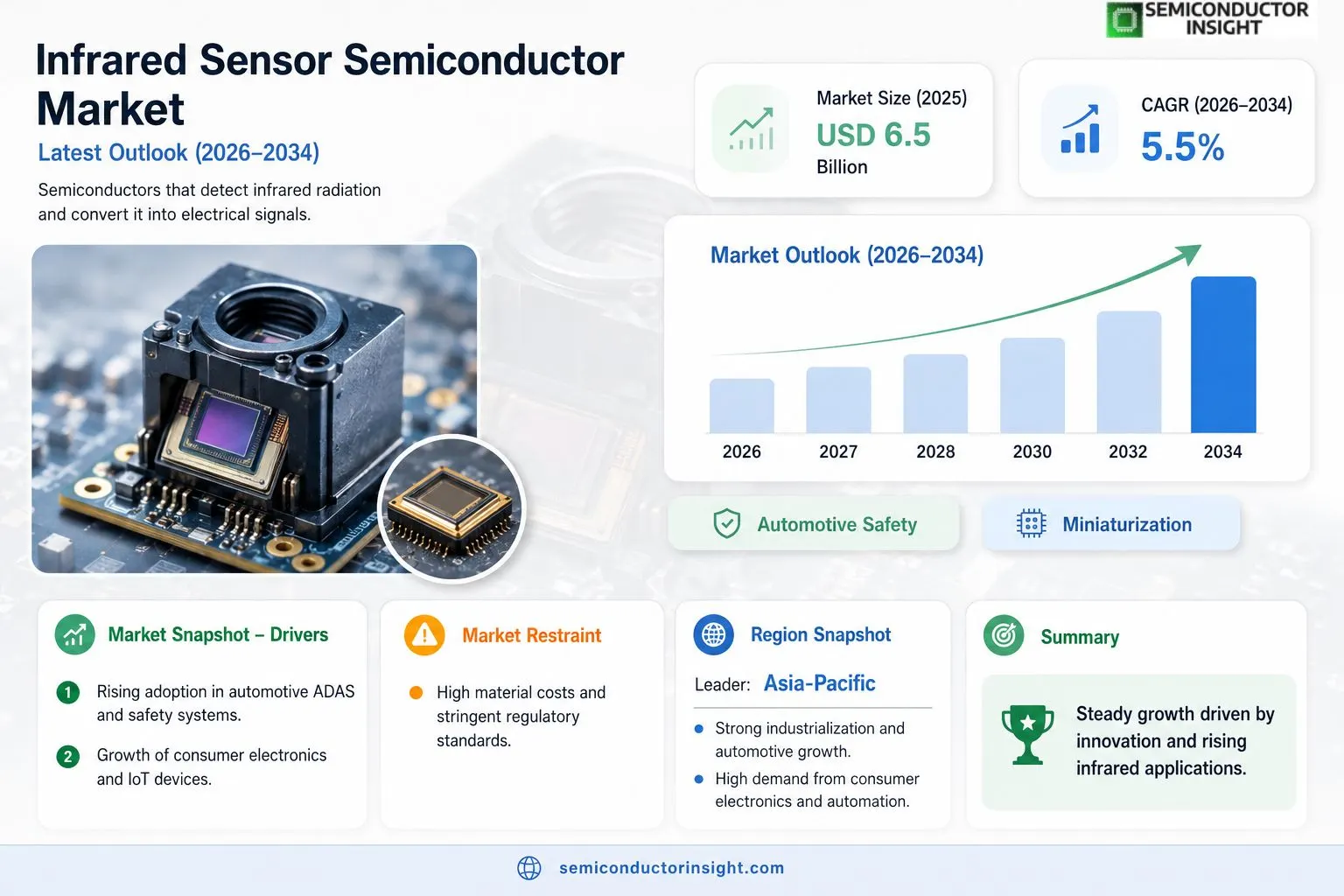
Global infrared sensor semiconductor market size was valued at USD 6.5 billion in 2025. The market is projected to grow from USD 7.0 billion in 2026 to USD 11.2 billion by 2034, exhibiting a CAGR of 5.5% during the forecast period.
Infrared sensor semiconductors are electronic components that detect and convert infrared radiation into electrical signals, enabling applications such as thermal imaging, motion detection, and non‑contact temperature measurement. These devices typically integrate materials like InGaAs, HgCdTe, or micro‑bolometer arrays on silicon substrates to achieve high sensitivity and fast response times.The market is experiencing robust expansion because automotive safety systems, industrial automation, and consumer electronics increasingly rely on reliable IR detection. Furthermore, advances in miniaturization and cost‑effective manufacturing are lowering barriers for adoption. Key players such as FLIR Systems, Sony, Honeywell, and AMS are accelerating development through strategic partnerships and new product launches, further fueling growth.
MARKET DRIVERS
Rising Adoption in Automotive Advanced Driver‑Assistance Systems (ADAS)
Infrared Sensor Semiconductor Market is experiencing rapid growth as automakers integrate infrared sensors for night‑vision, pedestrian detection, and lane‑keeping assistance. Global automotive production surged by 6% in 2023, pushing demand for high‑performance infrared components to an estimated 1.8 million units, a 14% year‑over‑year increase.
Growth of Consumer Electronics and IoT Devices
Smart home security cameras, wearables, and remote health monitors increasingly rely on compact infrared sensor semiconductors to enable reliable operation in low‑light conditions. Industry analysts project a compound annual growth rate of 9% for the sensor segment, driving revenues toward $4.2 billion by 2028.
➤ “Infrared technology is becoming the backbone of next‑generation safety and connectivity solutions, unlocking new revenue streams for semiconductor manufacturers.”
These drivers collectively position Infrared Sensor Semiconductor Market for sustained expansion, supported by strong investment in R&D and scaling of production capacities across Asia‑Pacific and North America.
MARKET CHALLENGES
High Production Costs and Material Constraints
Manufacturing infrared sensor semiconductors requires high‑purity substrates such as InGaAs and HgCdTe, which raise material costs by up to 30% compared with conventional silicon devices. The cost pressure limits price‑sensitive applications, slowing adoption in emerging markets.
Other Challenges
Supply Chain Volatility
Geopolitical tensions and limited furnace capacity have created lead‑time extensions of 8‑12 weeks for key photonic materials, disrupting timely product launches.
MARKET RESTRAINTS
Stringent Regulatory Standards
Regulators in Europe and North America enforce rigorous automotive safety standards (e.g., ISO 26262) that increase certification costs and time‑to‑market for infrared sensor solutions. Compliance requirements add an estimated $0.8 million per model for testing and documentation, restraining smaller players.
MARKET OPPORTUNITIES
Emergence of Non‑Contact Healthcare Monitoring
Post‑pandemic healthcare trends favor non‑invasive infrared thermography and oxygen‑saturation monitoring. The integration of infrared sensor semiconductors into portable diagnostic devices is projected to generate a $1.1 billion market segment by 2027, offering high‑margin growth avenues for incumbents.
Infrared Sensor Semiconductor Market Trends
Automotive Safety Integration
Infrared Sensor Semiconductor Market is being reshaped by the rapid adoption of advanced driver‑assistance systems (ADAS). OEMs are embedding infrared sensor chips into forward‑looking radar, pedestrian detection, and night‑vision modules to meet stringent safety regulations. The shift toward electric vehicles further accelerates demand, as manufacturers seek reliable, low‑power infrared detection to support thermal management and battery safety monitoring. Partnerships between sensor manufacturers and automotive tier‑1 suppliers are streamlining qualification processes, reducing time‑to‑market for new designs. As a result, design cycles are shortening and volume purchasing is increasing, creating a stable growth trajectory for suppliers that can deliver high‑sensitivity, automotive‑grade components.
Other Trends
Industrial Automation Advances
In the industrial sector, Infrared Sensor Semiconductor Market benefits from expanding use of infrared detection in robotic vision, predictive maintenance, and process control. Factories are integrating micro‑bolometer arrays and InGaAs detectors into conveyor‑belt monitoring systems to identify temperature anomalies before equipment failure occurs. The move toward Industry 4.0 standards encourages standardization of sensor interfaces, allowing easier integration with PLCs and edge‑computing platforms. Supply chain collaborations enable bulk production of cost‑effective modules, which in turn lowers the entry barrier for small‑ to medium‑size manufacturers adopting smart manufacturing solutions.
Consumer Electronics Miniaturization
Consumer electronics represent another focal point for Infrared Sensor Semiconductor Market as devices become increasingly compact and feature‑rich. Smartphones, wearable health monitors, and smart home appliances are incorporating miniature infrared photodiodes to enable gesture control, proximity sensing, and non‑contact temperature checks. Advances in wafer‑scale integration have reduced die size while preserving sensitivity, supporting the trend toward thinner form factors. OEMs are also leveraging shared silicon platforms to bundle infrared sensing with other functionalities, driving economies of scale and accelerating product refresh cycles. This convergence of miniaturization and multifunctionality positions infrared sensor technology as a core enabler for the next generation of connected consumer products.
COMPETITIVE LANDSCAPEKey Industry Players
Infrared Sensor Semiconductor Market Competitive Landscape
Infrared Sensor Semiconductor Market is anchored by a handful of global leaders that drive the majority of volume and technology direction. FLIR Systems, with its strong heritage in thermal imaging, commands a sizeable share of automotive safety and industrial inspection segments, leveraging proprietary micro‑bolometer architectures. Sony’s expertise in InGaAs and HgCdTe detector fabrication positions it as a key supplier for high‑performance consumer and defense applications, while Honeywell’s diversified sensor portfolio integrates infrared detection into building automation, aerospace, and aerospace safety solutions. AMS AG contributes advanced silicon‑based photonic sensors that enable low‑cost, high‑sensitivity modules for wearable and IoT devices, reinforcing a market structure where large OEMs capture high‑margin segments and set the roadmap for miniaturization and cost reduction.Beyond these dominant firms, a vibrant ecosystem of niche and regionally focused players enriches the competitive landscape. Bosch Sensortec offers compact, automotive‑grade IR sensors optimized for driver‑assistance systems, whereas TE Connectivity supplies ruggedized components for industrial automation. Omega Engineering concentrates on precision temperature measurement solutions for scientific instrumentation. Panasonic and Murata deliver consumer‑centric IR modules for smart home and mobile devices, while Himax and Osram Opto Semiconductors specialize in array-level integration for thermal cameras. STMicroelectronics and Vishay Intertechnology broaden the supply base with CMOS‑compatible IR detector technologies, and Texas Instruments and OmniVision expand the market with mixed‑signal and imaging solutions targeting emerging AI‑driven edge applications.
List of Key Infrared Sensor Semiconductor Companies Profiled
- FLIR Systems
- Sony
- Honeywell International
- AMS AG
- Bosch Sensortec
- TE Connectivity
- Omega Engineering
- Panasonic Corporation
- Murata Manufacturing
- Himax Technologies
- Osram Opto Semiconductors
- STMicroelectronics
- Vishay Intertechnology
- Texas Instruments
- OmniVision Technologies
Segment Analysis:
| Segment Category | Sub-Segments | Key Insights |
| By Type |
|
Photodiode
|
| By Application |
|
Automotive Safety
|
| By End User |
|
Vehicle Manufacturers
|
| By Sensor Architecture |
|
Microbolometer
|
| By Market Trend |
|
Miniaturization
|
Regional Analysis: Asia-Pacific
Asia-Pacific
The automotive sector is a primary driver for infrared sensor semiconductors in the Asia-Pacific region. These sensors are crucial for advanced driver-assistance systems (ADAS), night vision, and thermal imaging in vehicles, contributing to enhanced safety and performance. The increasing safety regulations and consumer preference for advanced features are propelling market growth in this segment.
The rapid expansion of manufacturing industries across Asia-Pacific is significantly boosting the demand for infrared sensors in automation processes. These sensors are used for non-contact temperature measurement, object detection, quality control, and process monitoring in diverse industrial applications.
Government investments in defense and security initiatives throughout the Asia-Pacific region are fueling the demand for infrared sensors used in surveillance systems, thermal imaging devices, and missile guidance systems. The strategic importance of these sensors in enhancing national security further drives market growth.
The growing consumer electronics market in Asia-Pacific, particularly in smartphones, wearable devices, and smart home appliances, is a significant consumer of infrared sensor semiconductors. These sensors enable functionalities such as gesture control, facial recognition, and ambient light sensing.
North America
North America represents a mature market for Infrared Sensor Semiconductor Market. While the growth rate is relatively slower compared to Asia-Pacific, it continues to be driven by strong demand from the automotive, industrial automation, and defense sectors. Technological advancements and the increasing adoption of infrared sensors in various applications are expected to sustain moderate growth in the region.
Europe
Europe exhibits a steady demand for Infrared Sensor Semiconductor Market, with a focus on high-performance sensors for automotive and industrial applications. Stringent environmental regulations and the emphasis on energy efficiency are driving the adoption of infrared sensors in various industrial processes. The region’s strong research and development capabilities contribute to innovation in this market.
South America
South America presents a growing market opportunity for Infrared Sensor Semiconductor Market, particularly in the industrial and agricultural sectors. The expansion of these industries and the increasing awareness of the benefits of infrared sensors are expected to drive moderate growth in the coming years.
Middle East & Africa
The Middle East & Africa region offers promising growth potential for Infrared Sensor Semiconductor Market, driven by investments in infrastructure development, defense spending, and increasing industrialization. The region’s focus on energy exploration and security applications presents significant opportunities for infrared sensor suppliers.
Report Scope
This market research report provides a comprehensive analysis of the Infrared Sensor Semiconductor Market , covering the forecast period 2026–2034. It offers detailed insights into market dynamics, technological advancements, competitive landscape, and key trends shaping the industry.
Key focus areas of the report include:
- Market Overview: The report begins with an overview outlining its current market scenario, key growth indicators, and industry transformation drivers. It discusses macroeconomic factors, demand–supply balance, regulatory landscape, and the strategic role of semiconductors in powering advancements across industries such as automotive, telecommunications, consumer electronics, and industrial automation.
- Market Size & Forecast: Historical data and future projections for revenue, unit shipments, and market value across major regions and segments.
- Segmentation Analysis: Detailed breakdown by product type, technology, application, and end-user industry to identify high-growth segments and investment opportunities.
- Regional Insights: Insights into market performance across North America, Europe, Asia-Pacific, Latin America, and the Middle East & Africa, including country-level analysis where relevant.
- Competitive Landscape: Profiles of leading market participants, including their product offerings, R&D focus, manufacturing capacity, pricing strategies, and recent developments such as mergers, acquisitions, and partnerships.
- Technology Trends & Innovation: Assessment of emerging technologies, integration of AI/IoT, semiconductor design trends, fabrication techniques, and evolving industry standards.
- Market Drivers & Restraints: Evaluation of factors driving market growth along with challenges, supply chain constraints, regulatory issues, and market-entry barriers.
- Stakeholder Insights: Insights for component suppliers, OEMs, system integrators, investors, and policymakers regarding the evolving ecosystem and strategic opportunities.
Primary and secondary research methods are employed, including interviews with industry experts, data from verified sources, and real-time market intelligence to ensure the accuracy and reliability of the insights presented.
FREQUENTLY ASKED QUESTIONS:
What is the current market size of Infrared Sensor Semiconductor Market?
-> Infrared Sensor Semiconductor Market was valued at USD 6.5 billion in 2025 and is expected to reach USD 11.2 billion by 2034, exhibiting a CAGR of 5.5% during the forecast period.
Which key companies operate in Infrared Sensor Semiconductor Market?
-> Key players include FLIR Systems, Sony, Honeywell, and AMS, among others.
What are the key growth drivers?
-> Key growth drivers include automotive safety systems, industrial automation, consumer electronics, and advances in miniaturization and cost‑effective manufacturing.
Which region dominates the market?
-> The provided data does not specify a single dominant region; growth is being observed globally across major markets.
What are the emerging trends?
-> Emerging trends include miniaturization, integration with AI/IoT, and development of cost‑effective manufacturing processes.

Get Sample Report PDF for Exclusive Insights
Report Sample Includes
- Table of Contents
- List of Tables & Figures
- Charts, Research Methodology, and more...
 Download Sample Report PDF


