
Infrared Photoconductive Detectors Market Insights
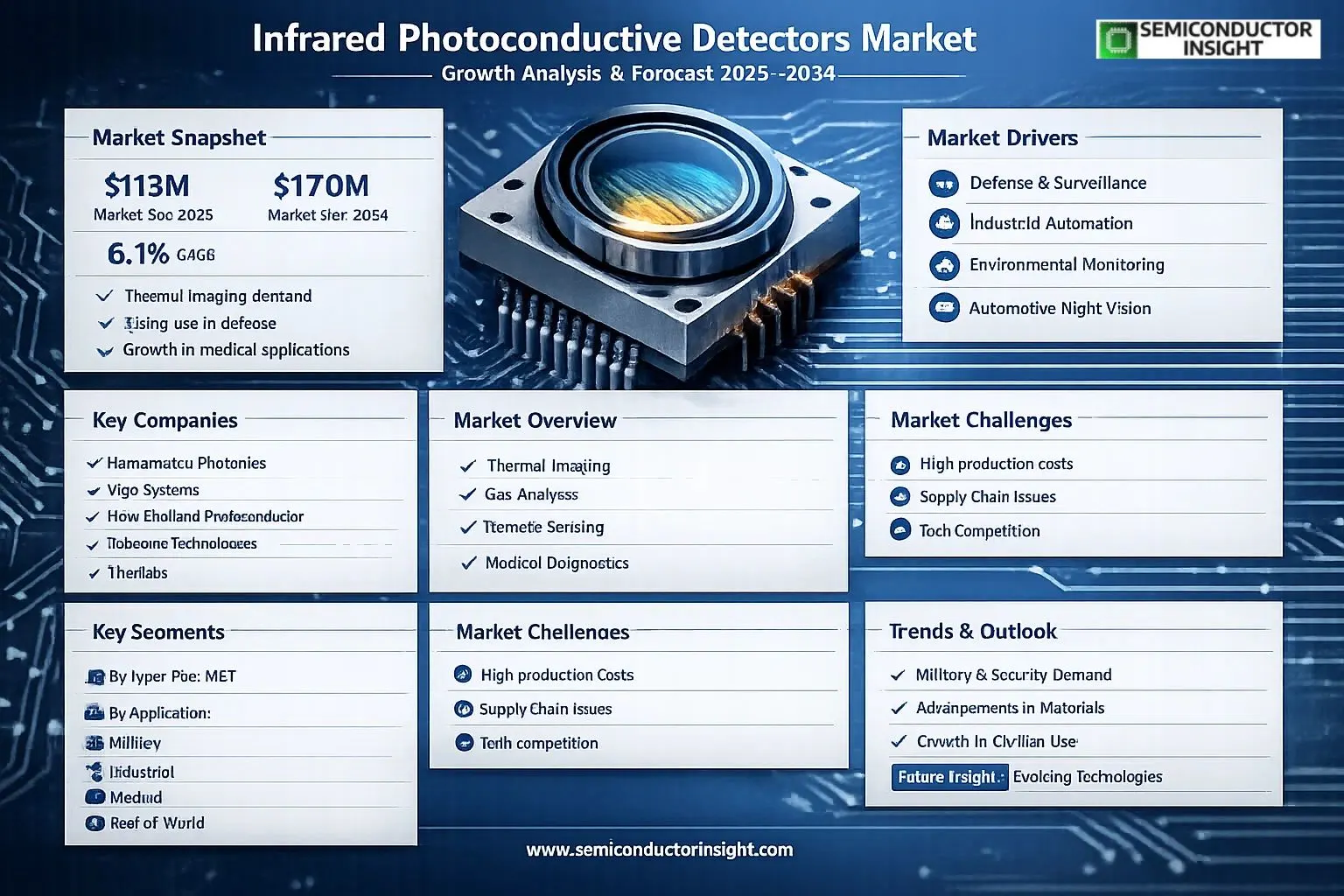
The global Infrared Photoconductive Detectors market size was valued at USD 113 million in 2025. The market is projected to grow from USD 119.9 million in 2026 to USD 170 million by 2034, exhibiting a CAGR of 6.1% during the forecast period.
Infrared Photoconductive Detectors are sensors designed to detect infrared radiation by utilizing the photoconductive effect, where the material’s electrical conductivity changes in response to incident infrared light. These detectors are highly sensitive and are commonly used in applications such as thermal imaging, gas analysis, and remote sensing. The materials used in these detectors, such as lead sulfide (PbS) or mercury cadmium telluride (MCT), are selected for their responsiveness to specific infrared wavelengths, enabling accurate and reliable detection in various scientific and industrial applications.
The market is witnessing steady growth driven by rising demand across defense, industrial automation, and environmental monitoring sectors. Increasing adoption of infrared detection technologies in civilian applications , particularly in medical diagnostics and automotive night-vision systems , is further broadening the addressable market. Furthermore, ongoing advancements in detector materials and cooling technologies are enhancing the sensitivity and operational range of these devices. Hamamatsu Photonics, Vigo Systems, Teledyne Technologies, Thorlabs, and New England Photoconductor are among the key players operating in the global Infrared Photoconductive Detectors market, each offering diversified product portfolios catering to both military and civilian end-use segments.
MARKET DRIVERS
Technological Advancements in Infrared Sensing
Infrared Photoconductive Detectors market is propelled by rapid improvements in semiconductor materials like lead sulfide and mercury cadmium telluride, enabling higher sensitivity and faster response times. These enhancements support applications in spectroscopy and thermal imaging, where demand has surged due to precision requirements in industrial monitoring.
Rising Demand from Defense and Surveillance Sectors
Government investments in military night vision and border security systems have boosted adoption, with global defense budgets increasing by approximately 4.5% annually. The integration of these detectors in unmanned aerial vehicles enhances detection capabilities, driving market expansion.
➤ In the automotive sector, advanced driver-assistance systems (ADAS) incorporating infrared photoconductive detectors for pedestrian detection are projected to grow at a 9% CAGR through 2030.
Additionally, healthcare applications such as non-invasive glucose monitoring and fever screening post-pandemic have further accelerated growth in Infrared Photoconductive Detectors market, underscoring its versatility across sectors.
MARKET CHALLENGES
High Manufacturing Complexity and Costs
Producing infrared photoconductive detectors involves sophisticated processes like epitaxial growth under vacuum conditions, leading to elevated costs that hinder widespread adoption in cost-sensitive markets. Yield rates remain below 85% for advanced variants, pressuring profit margins.
Other Challenges
Supply Chain Vulnerabilities
Geopolitical tensions disrupt rare earth material supplies essential for detector fabrication, causing price volatility and delays in delivery timelines across Infrared Photoconductive Detectors market.
Competition from alternative technologies like microbolometers poses integration difficulties, as they offer similar performance at potentially lower costs, challenging market share retention.
MARKET RESTRAINTS
Regulatory and Export Controls
Stringent export regulations on dual-use technologies limit international trade in Infrared Photoconductive Detectors market, particularly affecting sales to emerging economies. Compliance with ITAR and Wassenaar Arrangement adds administrative burdens for manufacturers.
Environmental concerns over toxic materials in detector production, such as cadmium compounds, enforce stricter disposal and recycling norms, increasing operational costs by up to 15% in regulated regions.
Market fragmentation due to diverse performance standards across regions slows standardization efforts, restraining scalability for global players in Infrared Photoconductive Detectors market.
MARKET OPPORTUNITIES
Expansion in Industrial IoT and Smart Manufacturing
Infrared Photoconductive Detectors market stands to benefit from Industry 4.0 initiatives, where real-time gas leak detection and process monitoring in petrochemical plants drive demand. Integration with AI analytics enhances predictive maintenance, opening new revenue streams.
Emerging applications in consumer electronics, like smart home security and wearable health devices, are projected to capture 20% additional market share by 2028, fueled by miniaturization trends.
Growth in Asia-Pacific, with manufacturing hubs investing over $10 billion in semiconductor facilities, presents untapped potential for localized production in Infrared Photoconductive Detectors market.
Infrared Photoconductive Detectors Market Trends
Rising Adoption in Military and Security Applications
In Infrared Photoconductive Detectors market, a prominent trend is the escalating demand from military and security sectors. These detectors, leveraging materials like lead sulfide and mercury cadmium telluride, excel in thermal imaging and remote sensing, critical for surveillance and defense systems. Industry surveys indicate that military use represents a significant segment, driven by the need for highly sensitive infrared detection in night vision and missile guidance technologies. Leading manufacturers such as Hamamatsu Photonics and Teledyne Technologies are innovating to enhance responsiveness across infrared wavelengths, supporting tactical operations worldwide.
Other Trends
Advancements in Detector Materials
Material innovations define key dynamics in Infrared Photoconductive Detectors market, with lead selenide and mercury cadmium telluride detectors gaining traction for their superior performance in specific wavelength bands. These developments improve electrical conductivity changes under infrared exposure, enabling precise gas analysis and scientific instrumentation. Surveys of suppliers highlight ongoing R&D to refine these materials, addressing challenges like temperature sensitivity and integration into compact devices.
Expansion in Civilian Applications
Civilian sectors are emerging as a growth area within Infrared Photoconductive Detectors market, particularly in industrial monitoring and medical diagnostics. Detectors from companies like Vigo Systems and New England Photoconductor support non-military uses such as environmental sensing and spectroscopy. This diversification reduces reliance on defense contracts and opens opportunities in automation and quality control processes.
Regional Market Shifts and Competitive Landscape
Infrared Photoconductive Detectors market is witnessing notable regional shifts, with North America and Asia-Pacific leading due to robust R&D investments. Key players including Opto Diode and Thorlabs hold substantial shares, fostering competition that drives product enhancements. Industry experts note increasing penetration in Europe and emerging markets through strategic partnerships, while challenges like supply chain obstacles for specialized materials are prompting localized production strategies. Overall, these trends underscore a maturing market poised for sustained evolution through technological and applicative diversification.
COMPETITIVE LANDSCAPE
Key Industry Players
Infrared Photoconductive Detectors Market Leaders and Strategic Contenders
Infrared Photoconductive Detectors market exhibits a moderately concentrated structure, dominated by a handful of established players holding significant revenue shares. In 2025, the global top five manufacturers accounted for a substantial portion of the market, with Hamamatsu Photonics emerging as a frontrunner due to its advanced PbS and PbSe detector technologies tailored for thermal imaging and spectroscopy. This leadership stems from Hamamatsu’s extensive R&D investments and broad product portfolio, enabling high sensitivity across mid-wave infrared wavelengths. Teledyne Technologies follows closely, leveraging acquisitions like Opto Diode to strengthen its position in military and civilian applications. The market’s growth at a 6.1% CAGR to US$170 million by 2034 underscores the competitive dynamics driven by demand in remote sensing and gas analysis.
Beyond the leaders, niche players contribute specialized innovations, particularly in materials like mercury cadmium telluride (MCT) for extended wavelength detection. Vigo Systems excels in PbSe detectors for industrial monitoring, while New England Photoconductor (NEP) focuses on cooled PbS variants for enhanced signal-to-noise ratios in scientific instrumentation. Thorlabs provides integrated solutions for photonics research, and Infrared Materials Inc. caters to custom OEM needs. Emerging challengers, including European and Asian firms, intensify competition through cost-effective alternatives and regional expansions, fostering incremental advancements in detector responsiveness and miniaturization amid evolving applications in defense and environmental monitoring.
List of Key Infrared Photoconductive Detectors Companies Profiled
- Hamamatsu Photonics
- Vigo Systems
- New England Photoconductor
- Infrared Materials Inc.
- Teledyne Technologies
- Thorlabs
- Excelitas Technologies
- Opto Diode (Teledyne Judson)
- Kolmar Technologies
- Boston Electronics
- Cal Sensors
- IAI North America
- Sensors Unlimited
- Fraunhofer Institute
Segment Analysis:
| Segment Category | Sub-Segments | Key Insights |
| By Type |
|
Lead Sulfide Detectors dominate due to their exceptional sensitivity in the short-wave infrared spectrum, enabling precise detection in low-light conditions.
|
| By Application |
|
Military Use leads as these detectors are integral to advanced defense systems requiring superior infrared detection capabilities.
|
| By End User |
|
Aerospace and Defense holds the forefront position owing to rigorous performance standards in critical missions.
|
| By Spectral Range |
|
Short-Wave Infrared (SWIR) emerges as the frontrunner, leveraging materials like lead sulfide for optimal performance in key detection scenarios.
|
| By Cooling Method |
|
Uncooled Detectors command leadership through practical advantages in deployment and maintenance.
|
Regional Analysis: Infrared Photoconductive Detectors Market
North America
Strong defense spending propels demand for high-sensitivity Infrared Photoconductive Detectors Market solutions, with aerospace firms pioneering uncooled variants for UAVs. Technological advancements in nanomaterials improve quantum efficiency, while industrial applications in predictive maintenance expand commercial uptake.
Supply chain vulnerabilities for rare-earth materials pose hurdles in Infrared Photoconductive Detectors market, alongside stringent export controls limiting technology transfer. High development costs challenge smaller players, necessitating strategic partnerships.
Emerging smart city initiatives drive Infrared Photoconductive Detectors Market growth in perimeter security and traffic monitoring. Healthcare innovations, like wearable thermal sensors, open new avenues amid rising chronic disease prevalence.
Shift toward hybrid detector architectures integrates photoconductive elements with focal plane arrays, enhancing Infrared Photoconductive Detectors Market versatility. Sustainability pushes eco-friendly manufacturing processes.
Europe
Europe exhibits steady growth in Infrared Photoconductive Detectors market, fueled by automotive and industrial automation sectors emphasizing advanced driver-assistance systems and quality control. Precision manufacturing hubs leverage these detectors for spectroscopy in pharmaceuticals and environmental monitoring, with EU-funded projects accelerating uncooled technology adoption. Collaborative R&D across borders strengthens material innovations, though fragmented regulations occasionally impede harmonized deployment. Business strategies focus on sustainability, integrating detectors into energy-efficient IoT frameworks for smart factories, positioning Europe as a key player in diversified Infrared Photoconductive Detectors Market applications through 2034.
Asia-Pacific
Asia-Pacific emerges as a dynamic force in Infrared Photoconductive Detectors market, propelled by rapid industrialization and electronics manufacturing booms in electronics and consumer devices. High-volume production capabilities lower costs, enabling widespread adoption in security cameras and mobile spectroscopy tools. Government incentives for semiconductor tech bolster local fabrication of photoconductive layers, while defense modernization in several nations heightens demand. Supply chain integration offers competitive edges, though intellectual property concerns persist. Strategic expansions by global firms tap into this vibrant ecosystem, forecasting robust Infrared Photoconductive Detectors Market trajectories.
South America
South America advances in Infrared Photoconductive Detectors market through agriculture and mining sectors, utilizing thermal imaging for crop health assessment and equipment monitoring. Infrastructure developments incorporate these detectors in border security and disaster management systems. Local innovations adapt technologies to tropical climates, enhancing reliability. Economic diversification strategies promote adoption in renewable energy inspections, mitigating import dependencies via regional partnerships. Growth potential remains strong as awareness rises, contributing to evolving Infrared Photoconductive Detectors Market dynamics.
Middle East & Africa
Middle East & Africa witness rising traction in Infrared Photoconductive Detectors market, driven by oil and gas operations requiring robust leak detection and pipeline surveillance amid harsh deserts. Security imperatives in conflict zones boost military procurements of portable infrared systems. Africa’s expanding telecom infrastructure integrates detectors for fiber optic fault location. Investments in vision tech for wildlife conservation add niche demand. Regional collaborations aim to build capacities, fostering self-reliance and steady Infrared Photoconductive Detectors Market penetration.
Report Scope
This market research report provides a comprehensive analysis of Infrared Photoconductive Detectors market, covering the forecast period 2025–2034. It offers detailed insights into market dynamics, technological advancements, competitive landscape, and key trends shaping the industry.
Key focus areas of the report include:
- Market Overview: The report begins with an overview outlining its current market scenario, key growth indicators, and industry transformation drivers. It discusses macroeconomic factors, demand–supply balance, regulatory landscape, and the strategic role of infrared photoconductive detectors in powering advancements across industries such as thermal imaging, gas analysis, remote sensing, military, and civilian applications.
- Market Size & Forecast: Historical data and future projections for revenue, unit shipments, and market value across major regions and segments.
- Segmentation Analysis: Detailed breakdown by product type, technology, application, and end-user industry to identify high-growth segments and investment opportunities.
- Regional Insights: Insights into market performance across North America, Europe, Asia-Pacific, Latin America, and the Middle East & Africa, including country-level analysis where relevant.
- Competitive Landscape: Profiles of leading market participants, including their product offerings, R&D focus, manufacturing capacity, pricing strategies, and recent developments such as mergers, acquisitions, and partnerships.
- Technology Trends & Innovation: Assessment of emerging technologies, integration of AI/IoT, semiconductor design trends, fabrication techniques, and evolving industry standards.
- Market Drivers & Restraints: Evaluation of factors driving market growth along with challenges, supply chain constraints, regulatory issues, and market-entry barriers.
- Stakeholder Insights: Insights for component suppliers, OEMs, system integrators, investors, and policymakers regarding the evolving ecosystem and strategic opportunities.
Primary and secondary research methods are employed, including interviews with industry experts, data from verified sources, and real-time market intelligence to ensure the accuracy and reliability of the insights presented.
FREQUENTLY ASKED QUESTIONS:
What is the current market size of Infrared Photoconductive Detectors Market?
-> Infrared Photoconductive Detectors market was valued at USD 113 million in 2025 and is expected to reach USD 170 million by 2034, at a CAGR of 6.1% during the forecast period.
Which key companies operate in Infrared Photoconductive Detectors Market?
-> Key players include Hamamatsu Photonics, Infrared Materials, Vigo Systems, New England Photoconductor, Opto Diode, Teledyne Technologies, Thorlabs, among others.
What are the key growth drivers?
-> Key growth drivers include demand for thermal imaging, gas analysis, remote sensing, and applications in military and civilian sectors.
Which region dominates the market?
-> North America holds a significant share, while Asia is a fast-growing region with key markets like China and Japan.
What are the emerging trends?
-> Emerging trends include advancements in materials such as lead sulfide (PbS) and mercury cadmium telluride (MCT), and expanding use in scientific and industrial detection.

Get Sample Report PDF for Exclusive Insights
Report Sample Includes
- Table of Contents
- List of Tables & Figures
- Charts, Research Methodology, and more...


