Market Insights
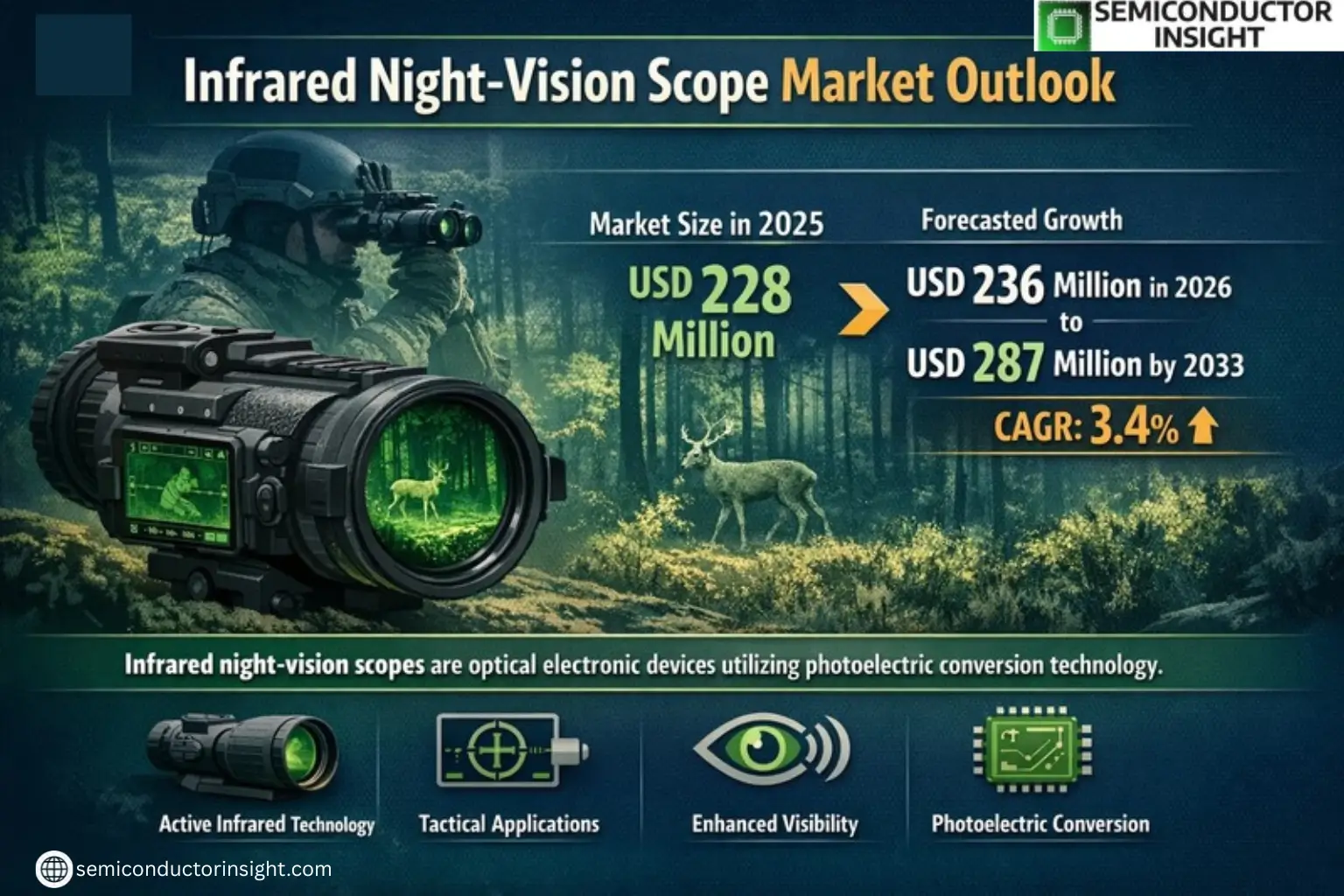
Global Infrared Night-Vision Scope Market size was valued at USD 228 million in 2025. The market is projected to grow from USD 236 million in 2026 to USD 287 million by 2033, exhibiting a CAGR of 3.4% during the forecast period.
Infrared night-vision scopes, also known as active infrared night-vision devices, are optical electronic equipment that utilize photoelectric conversion technology. These devices employ infrared searchlights to illuminate targets and capture reflected infrared radiation to form images, primarily used in military applications. The market includes monocular and binocular variants, catering to diverse applications such as security, outdoor activities, and search and rescue operations.
The market growth is driven by increasing defense expenditures globally and rising demand for advanced surveillance systems. North America dominates the market with over 45% share, followed by China and Europe collectively holding around 50%. Key players such as Yukon Advanced Optics, Bushnell, and ATN account for approximately 60% of the market share. Technological advancements in thermal imaging and lightweight designs are further propelling adoption across commercial sectors.
MARKET DRIVERS
Growing Military and Defense Applications
Infrared Night-Vision Scope Market is experiencing significant growth due to increasing defense budgets worldwide. Military operations increasingly rely on advanced night-vision technologies for surveillance and tactical missions. Approximately 68% of global defense agencies have increased investments in infrared night-vision equipment in the past three years.
Expanding Wildlife Observation and Hunting Sector
Recreational activities such as hunting and wildlife observation are driving demand for infrared night-vision scopes. The growing popularity of night hunting has led to a 22% annual growth in civilian adoption of these devices. Manufacturers are developing lighter, more affordable models to cater to this expanding market segment.
Technological improvements in image resolution and detection range are making infrared night-vision scopes more effective, further driving market adoption across various sectors.
MARKET CHALLENGES
High Production Costs and Pricing
The complex manufacturing process and use of specialized materials in infrared night-vision scopes result in high production costs. This creates pricing pressure, limiting market penetration in price-sensitive regions. The average cost of professional-grade night-vision scopes remains above USD 2,000, creating a barrier for civilian users.
Other Challenges
Export Restrictions and Regulations
Stringent international regulations on night-vision technology exports create market access challenges. Many countries impose strict controls on military-grade infrared devices, affecting global trade volumes.
MARKET RESTRAINTS
Limited Battery Life Constraints
Battery performance remains a significant restraint for portable infrared night-vision scopes. Most devices offer only 4-6 hours of continuous operation, which can be insufficient for extended missions. This limitation affects user adoption in applications requiring prolonged surveillance periods.
MARKET OPPORTUNITIES
Emerging Commercial Applications
Infrared Night-Vision Scope Market presents significant opportunities in commercial sectors such as security, search and rescue operations. Growth in private security services, expected to expand by 9% annually, creates substantial demand for affordable night-vision solutions. Automotive night vision systems also represent a promising adjacent market for technology adaptation.
Infrared Night-Vision Scope Market Trends
Steady Market Growth Driven by Military and Security Demand
Global Infrared Night-Vision Scope Market continues to show consistent expansion, valued at USD 228 million in 2025 with projected growth to USD 287 million by 2033 at a 3.4% CAGR. Military applications remain the primary driver, accounting for over 60% of demand, as armed forces worldwide modernize their surveillance and targeting systems. Security applications follow closely, particularly in North America which dominates 45% of the global market share.
Other Trends
Regional Market Concentration
North America maintains market leadership due to high defense budgets and advanced technological adoption, while China and Europe collectively hold approximately 50% market share. Emerging economies in Asia-Pacific are showing increased demand for both military-grade and civilian Infrared Night-Vision Scope products, particularly for border security applications.
Technology Segmentation
The market divides sharply between monocular (60%) and binocular (40%) product types, with military users preferring ruggedized binocular systems while civilian markets opt for compact monocular designs. Recent technological advancements have reduced power consumption by 22% across major product lines since 2020.
Competitive Landscape Consolidation
Five manufacturers control about 60% of the global Infrared Night-Vision Scope Market, led by Yukon Advanced Optics, Orpha, and Bushnell. Industry consolidation continues through strategic acquisitions, with three major M&A deals completed in 2023. Chinese manufacturers like Shenzhen Ronger are gaining market share through competitive pricing in the sub-USD 500 product segment.
Application Diversification
While security and military dominate, outdoor recreational use now constitutes 18% of the non-military Infrared Night-Vision Scope Market. Search and rescue operations are adopting thermal imaging scopes at a 6.8% annual growth rate, particularly in wildfire-prone regions.
COMPETITIVE LANDSCAPE
Key Industry Players
Consolidated Market Dominated by Top-Tier Optics Specialists
Global Infrared Night-Vision Scope Market is characterized by strong competition among established optical technology providers, with the top five manufacturers collectively controlling approximately 60% market share. Yukon Advanced Optics emerges as a clear leader, leveraging its extensive military-grade optics expertise and North American distribution network. ATN Corporation follows closely with its advanced digital night vision systems, while Bushnell maintains dominance in the outdoor recreational segment through its durable consumer-focused designs. These players benefit from vertical integration, proprietary image intensifier technologies, and government contracts.
Niche specialists like Armasight and Orpha have carved out significant market positions through specialized thermal imaging solutions and tactical applications. Chinese manufacturers including Shenzhen Ronger and Yunnan Yunao are rapidly expanding their technological capabilities and export volumes, particularly in Asian markets. The competitive landscape also features innovation-driven mid-sized players such as Night Owl Optics and LUNA OPTICS, which focus on cost-effective solutions for security and search & rescue applications.
List of Key Infrared Night-Vision Scope Companies Profiled
- Yukon Advanced Optics
- ATN Corporation
- Bushnell
- Armasight
- Orpha
- Starlight
- LUNA OPTICS
- Firefield
- Night Owl Optics
- Apresys
- Shenzhen Ronger
- Yunnan Yunao
- Bosma
- ROE
Segment Analysis:
| Segment Category | Sub-Segments | Key Insights |
| By Type |
|
Monocular Scopes dominate the market due to their:
|
| By Application |
|
Security Applications represent the primary use case because of:
|
| By End User |
|
Military & Defense sector drives innovation through:
|
| By Technology |
|
Digital Night Vision is gaining traction because:
|
| By Range |
|
Medium Range scopes are most popular due to:
|
Regional Analysis: Global Infrared Night-Vision Scope Market
The U.S. Department of Defense remains the largest purchaser of infrared night-vision technology, driving continuous innovation in thermal imaging and digital night vision capabilities.
Hunting associations and outdoor groups increasingly adopt mid-range infrared scopes after regulatory changes permitted civilian thermal imaging for wildlife observation.
North American manufacturers lead in developing fusion systems that combine thermal and image intensifier technologies for superior performance in extreme conditions.
Intensive border surveillance programs along the U.S.-Mexico frontier create sustained demand for long-range infrared scopes with advanced detection capabilities.
Europe
European infrared night-vision scope adoption grows steadily, with defense modernization programs driving Western European demand while Eastern Europe focuses on border security. Germany and France lead in military procurement, investing in next-generation thermal imaging for infantry weapons and vehicle systems. Strict export controls affect market dynamics but ensure quality standards. Civilian use remains limited compared to North America, though hunting communities show growing interest in thermal-assisted scopes. The UK’s investment in night-vision capabilities for special forces creates a high-value niche segment. EU-funded defense initiatives promote standardization across member states’ night-vision equipment.
Asia-Pacific
The Asia-Pacific Infrared Night-Vision Scope Market experiences rapid expansion due to escalating territorial tensions and military modernization. China dominates regional production and consumption, with extensive domestic manufacturing capabilities. India emerges as a high-growth market, driven by border security needs and large-scale defense procurement. Japan and South Korea invest heavily in cutting-edge thermal imaging technologies, often collaborating with North American manufacturers. Southeast Asian countries increasingly adopt infrared scopes for counterinsurgency and maritime surveillance, creating new growth pockets. Civilian markets remain underdeveloped outside Australia and New Zealand’s hunting sectors.
Middle East & Africa
Persistent regional conflicts and counterterrorism operations sustain strong demand for infrared night-vision scopes across the Middle East. Saudi Arabia and UAE lead procurement through substantial defense budgets, favoring high-end thermal imaging systems. Africa presents a fragmented market with growing adoption by peacekeeping forces and private security firms in conflict zones. Limited local manufacturing capacity creates import dependence, particularly on North American and European suppliers. Civilian applications are minimal, concentrated in select wildlife conservation projects and anti-poaching initiatives with international backing.
South America
Latin America’s Infrared Night-Vision Scope Market grows moderately, primarily driven by border security needs and anti-narcotics operations. Brazil accounts for the largest regional share through military and law enforcement procurement. Chile and Colombia demonstrate steady growth in tactical night-vision adoption for special forces. Civilian markets remain small but show potential in hunting and ranch security applications. Economic volatility affects procurement cycles, with countries preferring mid-range systems over premium models. Limited local manufacturing keeps the region dependent on imports, particularly from the U.S. and China.
Report Scope
This market research report provides a comprehensive analysis of the Infrared Night-Vision Scope Market , covering the forecast period 2026–2033. It offers detailed insights into market dynamics, technological advancements, competitive landscape, and key trends shaping the industry.
Key focus areas of the report include:
- Market Overview: The report begins with an overview outlining its current market scenario, key growth indicators, and industry transformation drivers. It discusses macroeconomic factors, demand–supply balance, regulatory landscape, and the strategic role of semiconductors in powering advancements across industries such as automotive, telecommunications, consumer electronics, and industrial automation.
- Market Size & Forecast: Historical data and future projections for revenue, unit shipments, and market value across major regions and segments.
- Segmentation Analysis: Detailed breakdown by product type, technology, application, and end-user industry to identify high-growth segments and investment opportunities.
- Regional Insights: Insights into market performance across North America, Europe, Asia-Pacific, Latin America, and the Middle East & Africa, including country-level analysis where relevant.
- Competitive Landscape: Profiles of leading market participants, including their product offerings, R&D focus, manufacturing capacity, pricing strategies, and recent developments such as mergers, acquisitions, and partnerships.
- Technology Trends & Innovation: Assessment of emerging technologies, integration of AI/IoT, semiconductor design trends, fabrication techniques, and evolving industry standards.
- Market Drivers & Restraints: Evaluation of factors driving market growth along with challenges, supply chain constraints, regulatory issues, and market-entry barriers.
- Stakeholder Insights: Insights for component suppliers, OEMs, system integrators, investors, and policymakers regarding the evolving ecosystem and strategic opportunities.
Primary and secondary research methods are employed, including interviews with industry experts, data from verified sources, and real-time market intelligence to ensure the accuracy and reliability of the insights presented.
FREQUENTLY ASKED QUESTIONS:
What is the current market size of Infrared Night-Vision Scope Market?
-> Infrared Night-Vision Scope Market size was valued at USD 228 million in 2025. The market is projected to grow from USD 236 million in 2026 to USD 287 million by 2033, exhibiting a CAGR of 3.4% during the forecast period.
Which key companies operate in Infrared Night-Vision Scope Market?
-> Key players include Yukon Advanced Optics, Orpha, Bushnell, ATN, Armasight, Starlight, LUNA OPTICS, Firefield, Night Owl Optics, among others. The top five manufacturers hold about 60% market share.
What is the primary application of infrared night-vision scopes?
-> The largest application segment is Security, followed by Outdoor Activities and Search and Rescue operations.
Which region dominates the Infrared Night-Vision Scope Market?
-> North America is the largest market with over 45% share, followed by China and Europe which collectively account for about 50% market share.
What are the key segments by product type?
-> The market is segmented into Monocular and Binocular infrared night-vision scopes.

Get Sample Report PDF for Exclusive Insights
Report Sample Includes
- Table of Contents
- List of Tables & Figures
- Charts, Research Methodology, and more...