
Industrial Vision Systems Market Insights
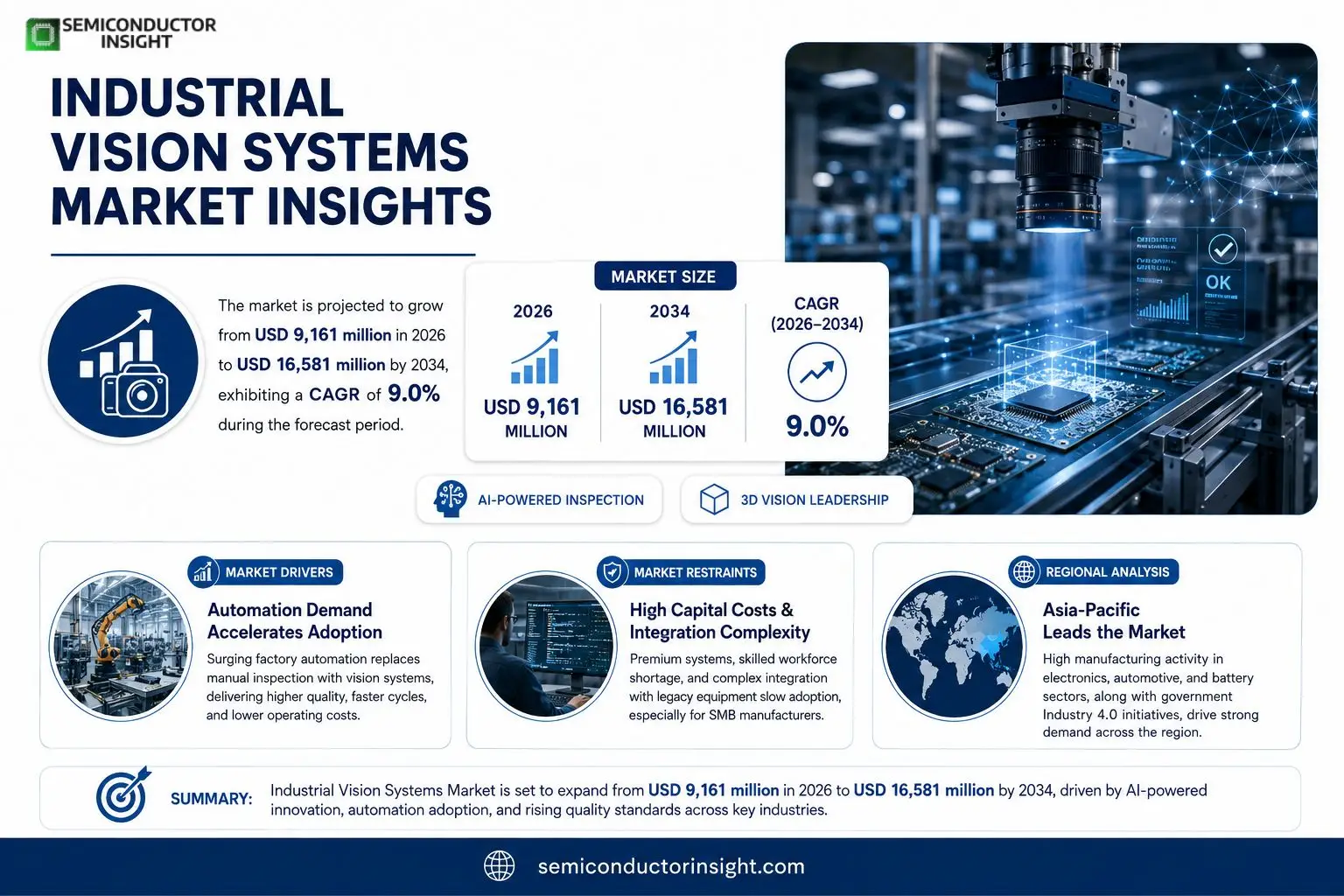
Industrial Vision Systems market size was valued at USD 9,161 million in 2025 and is projected to reach USD 16,581 million by 2034, exhibiting a CAGR of 9.0% during the forecast period.
Industrial vision systems combine optical imaging, high‑resolution image sensors, advanced algorithm processing and automated control functions to perform an “acquisition‑analysis‑decision‑execution” workflow on manufacturing lines. A typical solution includes industrial cameras, precision lenses, illumination sources, image acquisition cards or frame grabbers, processing units and dedicated software that enable dimensional measurement, defect detection, positioning guidance and character recognition across sectors such as electronics assembly, semiconductor fabrication, automotive production, lithium‑battery manufacturing and food‑packaging inspection.The expansion is fueled by manufacturers’ push for higher automation amid rising labor costs and tighter quality standards. Rapid progress in AI‑driven vision analytics and three‑dimensional imaging is moving applications from static rule‑based inspection toward self‑learning defect detection capable of handling complex product geometries. Leading suppliersincluding Cognex Corporation (USA), Basler AG (Germany), Keyence Corp. (Japan), Allied Vision Technologies (USA) and Hikrobot (China)are broadening integrated hardware‑software portfolios and targeting fragmented downstream markets such as automotive electronics, consumer devices and semiconductor equipment.
MARKET DRIVERS
Automation Demand Accelerates Adoption
The surge in factory automation reshapes production lines, compelling manufacturers to replace manual inspection with high‑speed cameras and smart software. Industrial Vision Systems Market participants benefit from tighter quality tolerances and the ability to keep pace with shorter batch cycles.
Advancements in AI‑Enabled Imaging
Deep‑learning algorithms now distinguish subtle texture variations that previously escaped rule‑based detectors. This technical leap translates into higher yield rates, prompting firms to upgrade legacy lenses with AI‑ready processors.
➤ Manufacturers report up to a 30 % improvement in defect detection speed after deploying AI‑enhanced vision cells.
Cost pressures further reinforce the shift; the marginal expense of a networked sensor is offset by reduced scrap and labor hours, making the investment financially compelling for midsize producers.
MARKET CHALLENGES
Integration Complexity Hinders Wider Rollout
Synchronizing vision hardware with existing PLCs and MES platforms often requires custom middleware, extending project timelines and inflating budgets. Companies lacking in‑house integration expertise may postpone deployment, slowing market momentum.
Other Challenges
Legacy Equipment Compatibility
Older assembly lines rely on analog signaling, making it difficult to attach digital cameras without extensive retrofitting. The incompatibility creates a barrier for firms that cannot justify a full production line overhaul.
MARKET RESTRAINTS
High Capital Expenditure Limits Entry
State‑of‑the‑art vision rigs, especially those equipped with 4K sensors and GPU accelerators, command premium pricing. Capital‑intensive projects deter small and medium enterprises, concentrating adoption among well‑funded players.
Skilled Workforce Shortage
Operating sophisticated inspection software requires personnel fluent in machine‑learning concepts and image‑processing pipelines. The talent gap forces firms to outsource support, adding recurring costs and limiting rapid scaling.
Data Security and IP Concerns
Vision systems generate granular visual records of proprietary products. Organizations anxious about cyber‑theft may impose restrictive policies, curbing the deployment of cloud‑linked analytics in sensitive sectors.
MARKET OPPORTUNITIES
Edge Computing Expands Deployment Scenarios
Embedding inference engines at the sensor level reduces latency and alleviates bandwidth constraints, opening pathways for vision solutions in remote or high‑throughput environments. Companies that bundle edge hardware with analytics platforms stand to capture a growing slice of Industrial Vision Systems Market.
Modular System Design Gains Traction
Standardized mounting frames and interchangeable optics enable manufacturers to tailor systems to specific line speeds without incurring a full redesign. This flexibility lowers the barrier for incremental upgrades, encouraging repeat purchases.
Emerging Markets Provide Fresh Demand
Automation initiatives in Southeast Asia and Eastern Europe drive new installations, as local governments incentivize digital transformation. Early entrants that align product roadmaps with regional standards can secure long‑term contracts.
Industrial Vision Systems Market Trends
AI‑Enabled 3D Vision Accelerates Adoption
The integration of artificial‑intelligence algorithms with three‑dimensional imaging is reshaping inspection strategies across high‑mix, low‑volume production lines. By 2025, manufacturers reported a noticeable shift from purely rule‑based detection toward models that learn defect patterns from historical data, reducing false‑reject rates by up to 12 %. This evolution is fueled by the need to handle increasingly complex product geometries, especially in semiconductor wafers and lithium‑ion cell assemblies. Operators now rely on AI‑augmented vision to reconcile surface topology with sub‑micron deviation tolerances, a capability that traditional 2D systems cannot deliver. The business impact manifests as higher first‑pass yields, tighter quality control loops, and a measurable lift in gross margins for firms that have upgraded their inspection lines.
Other Trends
Supply‑Chain Sensitivities Around Core Components
While demand for vision units climbs, the upstream segmentparticularly image sensors and precision opticsfaces capacity constraints tied to semiconductor fab cycles. In 2025, production capacity for camera modules reached 1.56 million units, yet utilization hovered near 80 % due to limited wafer outputs. This imbalance pushes OEMs to negotiate longer lead times and explore alternative suppliers in emerging regions. Companies that secure multi‑year component contracts gain a strategic edge, allowing them to maintain steady output and avoid price spikes that could erode the typical 35 % gross profit margin observed industry‑wide. The downstream effect is a more cautious rollout of new vision deployments, with buyers favoring modular upgrades over wholesale system replacements.
Edge‑Computing Turns Vision into Decision Hubs
Edge processing capabilities are converting vision stations from passive data collectors into autonomous decision points on the shop floor. By offloading inference workloads to localized processors, latency drops below 10 ms, enabling real‑time corrective actions such as robot path adjustments or immediate part segregation. This architecture aligns with the broader push for intelligent manufacturing, where visual inspection feeds directly into production control loops. As a result, firms are reallocating budget from legacy PLC upgrades to vision‑edge platforms, anticipating faster ROI through reduced scrap and shorter cycle times. The trend underscores a strategic pivot: vision systems are no longer an optional add‑on but a central pillar of Industrial Vision Systems Market’s evolution toward fully integrated, data‑driven factories.
COMPETITIVE LANDSCAPEKey Industry Players
Industrial Vision Systems – Competitive Overview
The market is anchored by a handful of integrators whose breadth of product portfolios and deep relationships with end‑users shape the overall competitive environment. Cognex and Keyence dominate the high‑margin segment that serves semiconductor fabs and automotive OEMs, leveraging proprietary algorithm libraries and extensive service networks. Their ability to bundle cameras, illumination, and AI‑driven software into turnkey solutions creates a barrier for smaller entrants. Parallel to this, Omron and National Instruments command the mid‑range segment by focusing on modular hardware that can be customized for 3C electronics and food‑packaging lines, a strategy that aligns with customers’ need for flexible expansion as production volumes fluctuate.Beyond the tier‑one group, a constellation of specialized firms occupies niche positions that collectively add depth to the ecosystem. Basler and Allied Vision excel in 2D imaging platforms tailored for precision measurement in medical device assembly, while Hikrobot and Lingyun Optoelectronics have built strong footholds in Chinese battery‑cell production through cost‑effective 3D scanners. Sony’s sensor expertise fuels high‑speed inspection in consumer‑electronics, whereas Opt Machine Vision and LMI Technologies differentiate themselves with software‑first approaches that accelerate deployment of AI‑vision in logistics automation. These players sustain a competitive pressure that drives continual innovation across sensor resolution, illumination techniques, and edge‑computing capabilities.
List of Key Industrial Vision Systems Companies Profiled
- Cognex Corporation
- Keyence Corporation
- Basler AG
- Allied Vision Technologies
- Omron Corporation
- Sick AG
- LMI Technologies
- Teledyne Technologies
- Hikrobot
- Sony Corporation
- Lingyun Optoelectronics
- Opt Machine Vision
- National Instruments
- ISRA Vision
- Baumer Group
Segment Analysis:
| Segment Category | Sub-Segments | Key Insights |
| By Type |
|
AI Vision is becoming the dominant technology due to its ability to learn complex patterns and adapt to new defect scenarios.
|
| By Application |
|
Electronics and Semiconductor drives the most sophisticated vision deployments, requiring ultra‑high precision and defect detection capabilities.
|
| By End User |
|
Electronics manufacturers prioritize high‑speed, high‑accuracy inspection to maintain product reliability.
|
| By Function |
|
Defect Detection continues to be the cornerstone function, especially as product complexity rises.
|
| By Integration Model |
|
System Integrators are pivotal in translating raw vision capabilities into turnkey solutions for end users.
|
Regional Analysis: Industrial Vision Systems Market
North America
High‑mix, low‑volume production lines in electronics and aerospace increasingly rely on real‑time inspection to sustain yield. Vision systems are embedded directly into robotic cells, providing instant feedback that trims rework cycles. This integration reduces labor intensity and aligns with lean principles, delivering measurable cost advantages for manufacturers scaling up complexity.
The automotive sector’s shift toward electric drivetrains heightens the need for precise component alignment and solder joint verification. Vision technology now underpins quality gates for battery modules and power electronics, where micro‑defects can compromise safety. Suppliers that embed advanced imaging into assembly lines capture a competitive edge by guaranteeing compliance with rigorous safety norms.
Sterile manufacturing imposes zero‑tolerance defect thresholds. Vision systems equipped with hyperspectral sensors detect minute particulate contamination that traditional methods miss. By automating visual checks, pharma firms accelerate batch release while preserving product integrity, a balance pivotal to market credibility and regulatory approval.
The infusion of machine‑learning models enables predictive quality analytics, turning raw image data into actionable insights. AI‑driven defect classification reduces false positives and shortens decision cycles, allowing operators to intervene before a fault propagates through the line. This capability reshapes how firms view vision as a strategic asset rather than a peripheral tool.
Europe
European manufacturers benefit from a strong tradition of precision engineering, especially in automotive and machinery sectors. Regional policy frameworks that incentivize energy efficiency push firms toward vision‑guided process optimization, curbing waste and energy consumption. Moreover, collaborative research hubs across Germany, France, and the Nordics accelerate the rollout of next‑generation sensors, making Europe a hotbed for niche applications such as additive manufacturing inspection and high‑speed rail component verification.
Asia‑Pacific
The Asia‑Pacific landscape is marked by rapid capacity expansion in electronics assembly and consumer goods production. While cost pressures dominate, manufacturers are increasingly recognizing the long‑term value of advanced vision tools to maintain product consistency across sprawling supply chains. In countries like China, South Korea, and Japan, government initiatives that promote Industry 4.0 standards are prompting mid‑tier suppliers to upgrade legacy inspection equipment, fostering a gradual shift toward higher‑resolution imaging and real‑time analytics.
South America
South American markets are emerging as viable venues for industrial vision adoption, primarily within the agribusiness equipment and automotive parts sectors. Local firms are leveraging vision systems to meet export‑oriented quality benchmarks, especially when accessing North American and European markets. Investments in regional technology parks are beginning to surface, offering a collaborative environment where smaller manufacturers can share expertise and access affordable imaging solutions.
Middle East & Africa
In the Middle East and Africa, the industrial vision narrative is intertwined with broader digital transformation efforts. Oil‑and‑gas refinements and petrochemical complexes are integrating vision inspection to safeguard critical pipelines and processing units. Simultaneously, a nascent manufacturing base in countries such as the United Arab Emirates and South Africa is exploring vision technology to streamline assembly processes and enhance product traceability, laying groundwork for future market maturation.
Report Scope
This market research report provides a comprehensive analysis of the Industrial Vision Systems Market , covering the forecast period 2026–2034. It offers detailed insights into market dynamics, technological advancements, competitive landscape, and key trends shaping the industry.
Key focus areas of the report include:
- Market Overview: The report begins with an overview outlining its current market scenario, key growth indicators, and industry transformation drivers. It discusses macroeconomic factors, demand–supply balance, regulatory landscape, and the strategic role of semiconductors in powering advancements across industries such as automotive, telecommunications, consumer electronics, and industrial automation.
- Market Size & Forecast: Historical data and future projections for revenue, unit shipments, and market value across major regions and segments.
- Segmentation Analysis: Detailed breakdown by product type, technology, application, and end-user industry to identify high-growth segments and investment opportunities.
- Regional Insights: Insights into market performance across North America, Europe, Asia-Pacific, Latin America, and the Middle East & Africa, including country-level analysis where relevant.
- Competitive Landscape: Profiles of leading market participants, including their product offerings, R&D focus, manufacturing capacity, pricing strategies, and recent developments such as mergers, acquisitions, and partnerships.
- Technology Trends & Innovation: Assessment of emerging technologies, integration of AI/IoT, semiconductor design trends, fabrication techniques, and evolving industry standards.
- Market Drivers & Restraints: Evaluation of factors driving market growth along with challenges, supply chain constraints, regulatory issues, and market-entry barriers.
- Stakeholder Insights: Insights for component suppliers, OEMs, system integrators, investors, and policymakers regarding the evolving ecosystem and strategic opportunities.
Primary and secondary research methods are employed, including interviews with industry experts, data from verified sources, and real-time market intelligence to ensure the accuracy and reliability of the insights presented.
FREQUENTLY ASKED QUESTIONS:
What is the current market size of Industrial Vision Systems Market?
-> Industrial Vision Systems Market was valued at USD 9,161 million in 2025 and is expected to reach USD 16,581 million by 2034, growing at a CAGR of 9.0% during the forecast period.
Which key companies operate in Industrial Vision Systems Market?
-> Key players include Allied Vision Technologies, Basler AG, Cognex Corporation, LMI Technologies, Omron, Keyence, National Instruments, Sick AG, Tordivel AS, Teledyne Technologies, ISRA Vision, Baumer, Sony, Hikrobot, Lingyun Optoelectronics, Opt Machine Vision.
What are the key growth drivers?
-> Key growth drivers include rising labor costs, increasing product complexity, stricter quality standards, automation upgrades in manufacturing, and the rapid development of AI‑based and 3D vision technologies enabling advanced defect detection and dimensional measurement.
Which region dominates the market?
-> Asia holds the largest market share, driven by high manufacturing activity and strong demand in electronics, semiconductors, automotive, and lithium‑battery production.
What are the emerging trends?
-> Emerging trends include integration of AI and edge computing, self‑learning adaptive algorithms, 3D vision expansion, and the shift of industrial vision systems from simple detection tools to intelligent decision‑making hubs.

Get Sample Report PDF for Exclusive Insights
Report Sample Includes
- Table of Contents
- List of Tables & Figures
- Charts, Research Methodology, and more...
