Industrial Analog Signal Chain Market Insights
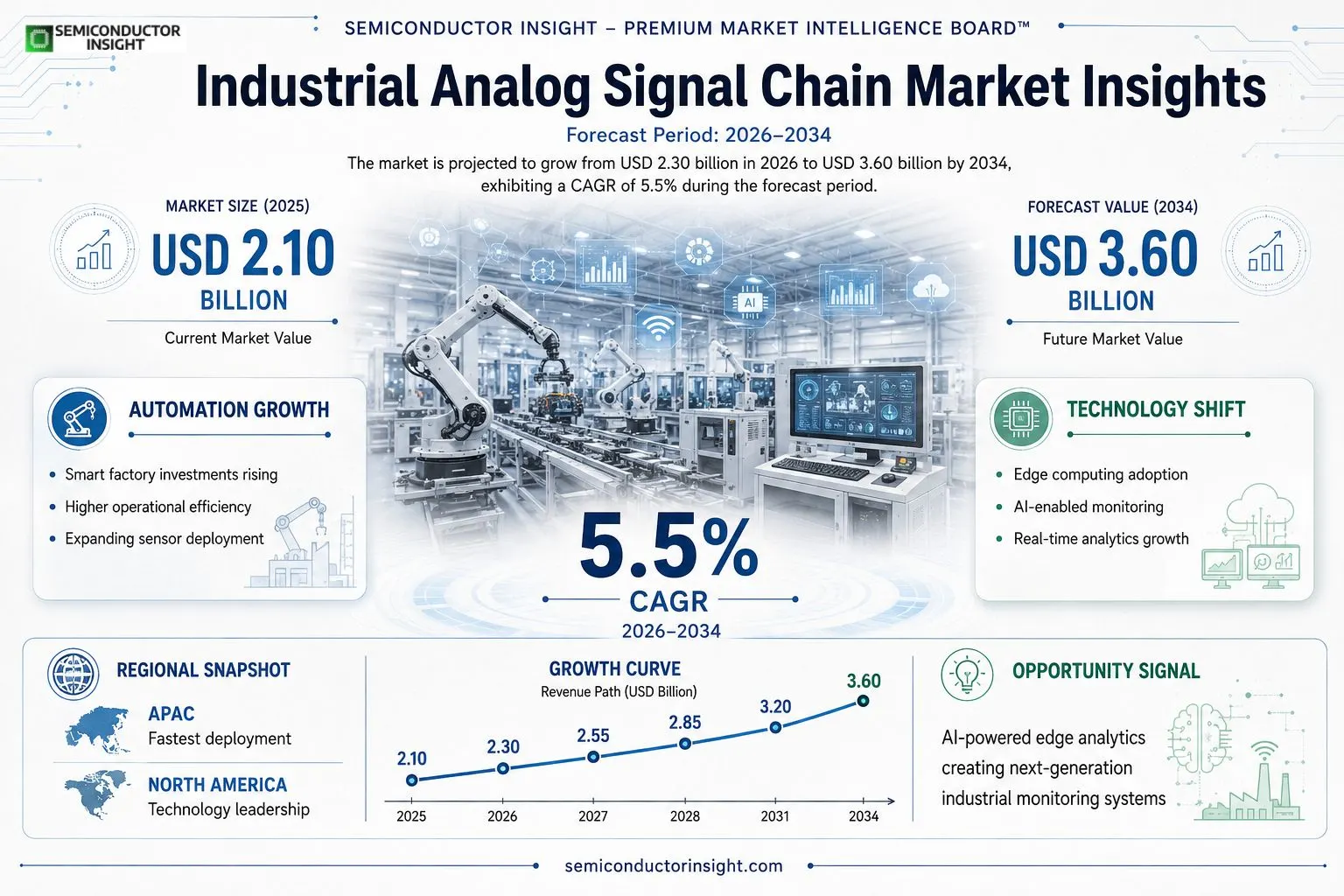
Industrial Analog Signal Chain Market size was valued at USD 2.10 billion in 2025. The market is projected to grow from USD 2.30 billion in 2026 to USD 3.60 billion by 2034, exhibiting a CAGR of 5.5% during the forecast period.
The Industrial Analog Signal Chain comprises precision sensors, low‑noise amplifiers, anti‑aliasing filters, analog‑to‑digital converters (ADCs), digital‑to‑analog converters (DACs), and signal conditioning modules that together enable accurate measurement and control in manufacturing equipment, process automation, and robotics.The market is experiencing robust expansion because Industry 4.0 initiatives drive demand for high‑resolution data acquisition and real‑time monitoring. Furthermore, rising adoption of IoT‑enabled factories and stricter regulatory standards for safety and quality are accelerating investments in advanced analog front‑ends. Key players such as Texas Instruments, Analog Devices, STMicroelectronics, and Maxim Integrated are launching next‑generation low‑power components that further fuel growth.
MARKET DRIVERS
Rising Automation Across Manufacturing
Industrial Analog Signal Chain Market is being propelled by manufacturers’ shift toward high‑speed, high‑precision automation. As production lines adopt advanced sensors and controllers, the need for reliable analog signal conditioning and transmission grows, ensuring accurate process monitoring and reduced downtime.
Growth of Edge Computing and IoT
Edge computing platforms require real‑time analog data conversion to support predictive maintenance and quality control. The convergence of IoT devices with analog front‑end technologies creates a demand for compact, low‑power signal chain solutions that can operate in harsh industrial environments.
➤ Industry analysts note that the integration of analog signal chains with digital analytics is a decisive factor for achieving operational excellence in the coming decade.
Additionally, expanding renewable energy installations and electric vehicle production are driving the adoption of robust analog signal interfaces that can handle wide temperature ranges and high electromagnetic interference, further bolstering market growth.
MARKET CHALLENGES
Stringent Regulatory Requirements
Compliance with safety and EMI standards across different regions adds complexity to product design. Manufacturers must invest in certification processes, which can increase time‑to‑market and elevate costs for analog signal chain components.
Other Challenges
Supply Chain Volatility
Fluctuations in the availability of high‑purity semiconductor materials and component lead times can disrupt production schedules, making it difficult for suppliers to meet the rising demand within Industrial Analog Signal Chain Market.Furthermore, the rapid evolution of digital sensor technologies creates competitive pressure on analog solution providers to continuously innovate while maintaining cost efficiency.
MARKET RESTRAINTS
High Initial Capital Expenditure
Implementing sophisticated analog signal chains often requires significant upfront investment in hardware, calibration tools, and specialized engineering expertise. Smaller firms may postpone upgrades, limiting overall market penetration despite the long‑term efficiency benefits.
MARKET OPPORTUNITIES
Modular and AI‑Enabled Signal Solutions
Emerging opportunities exist in developing modular analog signal chain platforms that integrate AI‑driven diagnostics. Such solutions can offer predictive health monitoring, reduce maintenance costs, and cater to the growing demand for flexible, upgradeable systems in Industrial Analog Signal Chain Market.
Industrial Analog Signal Chain Market Trends
Industry 4.0 Drives Analog Front‑End Demand
Industrial Analog Signal Chain Market is being reshaped by Industry 4.0 initiatives that require high‑resolution data acquisition and continuous real‑time monitoring. Manufacturing facilities are replacing legacy sensor suites with precision sensors, low‑noise amplifiers, and anti‑aliasing filters to meet tighter quality and safety regulations. The shift toward digitized production lines has heightened the need for reliable analog front‑ends that can operate under extreme temperature and vibration conditions. As a result, equipment manufacturers are prioritizing component selections that deliver superior signal‑to‑noise ratios while maintaining long‑term stability, thereby enhancing overall process efficiency and product consistency.
Other Trends
IoT Integration and Edge Computing
IoT‑enabled factories are extending analytics to the edge, which increases demand for compact, low‑power analog‑to‑digital converters (ADCs) and digital‑to‑analog converters (DACs). Component manufacturers such as Texas Instruments and Analog Devices have launched 12‑bit and higher ADCs that combine low power consumption with extended temperature ranges, facilitating decentralized monitoring and predictive maintenance. Edge nodes now process raw sensor data locally, reducing latency and bandwidth requirements, which in turn drives the adoption of high‑performance signal conditioning modules. This convergence of IoT and analog technology is reinforcing the importance of seamless data conversion as a strategic asset for Industrial Analog Signal Chain Market.
Power Efficiency and Miniaturization
Power efficiency has become a decisive factor as equipment moves toward smaller form factors and battery‑operated sensor nodes. Recent product releases focus on sub‑microwatt amplifiers and signal‑conditioning modules that retain high signal‑to‑noise ratios while drawing minimal power. The trend toward miniaturization supports robotic applications where space and weight constraints demand compact analog signal chains without compromising accuracy. Moreover, the growing emphasis on sustainability is prompting OEMs to select components that reduce overall energy consumption, aligning with corporate carbon‑reduction goals. Collectively, these drivers are positioning Industrial Analog Signal Chain Market for steady expansion, with manufacturers investing in next‑generation low‑power designs that meet the evolving needs of modern industrial ecosystems.
COMPETITIVE LANDSCAPEKey Industry Players
Industrial Analog Signal Chain Market: Competitive Overview
Industrial Analog Signal Chain Market is dominated by a handful of large semiconductor manufacturers that command the majority of revenue through broad product portfolios and deep R&D pipelines. Texas Instruments and Analog Devices lead the space with extensive low‑noise amplifiers, precision ADCs, and DACs that are integral to Industry 4.0 data acquisition. Their scale enables aggressive pricing and rapid feature roll‑outs, reinforcing a tier‑one market structure where these incumbents supply both original equipment manufacturers (OEMs) and system integrators. STMicroelectronics and Maxim Integrated (now part of Analog Devices) also hold significant shares, leveraging their mixed‑signal expertise to capture high‑growth segments such as robotics and IoT‑enabled factories. Collectively, these firms shape the technology road‑map, set performance benchmarks, and dictate supply dynamics across the analog front‑end ecosystem.Beyond the tier‑one leaders, a diverse set of niche players contributes specialized capabilities that enrich the overall value chain. NXP Semiconductors and Infineon Technologies focus on automotive‑grade signal conditioning, while Microchip Technology offers cost‑effective converters for mid‑range applications. ON Semiconductor and Renesas deliver ruggedized components for harsh industrial environments. Skyworks Solutions and Qorvo provide high‑frequency front‑ends that complement analog modules, whereas Circuits at Rohm Semiconductor and Skyworks address power‑efficient sensor interfaces. These companies, often agile in targeting emerging standards, create competitive pressure that drives innovation and expands the choice set for end‑users.
List of Key Industrial Analog Signal Chain Companies Profiled
- Texas Instruments
- Analog Devices
- STMicroelectronics
- Maxim Integrated
- NXP Semiconductors
- Infineon Technologies
- Microchip Technology
- ON Semiconductor
- Renesas Electronics
- Skyworks Solutions
- Qorvo
- Rohm Semiconductor
- Cirrus Logic
- Linear Technology (Analog Devices)
- Silicon Labs
Segment Analysis:
| Segment Category | Sub-Segments | Key Insights |
| By Type |
|
Precision Sensors
|
| By Application |
|
Process Automation
|
| By End User |
|
OEMs
|
| By Technology |
|
Low‑Power Integrated Circuits
|
| By Trend |
|
Industry 4.0 Integration
|
Regional Analysis: North America
North America
The manufacturing sector in North America is actively embracing digital transformation, with a growing emphasis on smart factories. This trend necessitates the integration of advanced sensing and control systems, driving demand for high-precision analog signal chains for process monitoring and automation. The focus on improving production efficiency and reducing downtime is a key factor influencing component selection.
The energy sector in North America, encompassing oil & gas, power generation, and renewable energy, relies heavily on reliable analog signal chains for monitoring critical parameters such as pressure, temperature, and flow rate. The increasing adoption of smart grids and the expansion of renewable energy sources are creating new opportunities for advanced analog signal processing solutions. Ensuring the safety and efficiency of energy operations remains a top priority, further driving demand.
The transportation industry in North America is witnessing significant advancements in autonomous vehicles and connected cars. These technologies require sophisticated analog signal chains for sensor data acquisition, control systems, and safety mechanisms. The development of electric vehicles (EVs) also contributes to the demand for specialized analog components for battery management and powertrain control.
The aerospace and defense sectors in North America maintain a strong demand for high-reliability analog signal chains used in flight control systems, navigation equipment, and electronic warfare systems. The stringent requirements for performance, durability, and security in these applications drive the need for specialized and robust analog components.
Europe
The European Industrial Analog Signal Chain Market is characterized by a strong emphasis on sustainability and energy efficiency. Driven by stringent environmental regulations and a growing focus on circular economy principles, European industries are increasingly investing in technologies that optimize resource utilization and minimize waste. The automation of manufacturing processes, particularly in sectors like automotive and pharmaceuticals, is a key driver of demand for advanced analog signal chain solutions. The rise of smart manufacturing initiatives and the adoption of Industry 4.0 technologies are further boosting the market’s growth potential.
Asia-Pacific
Asia-Pacific is emerging as the fastest-growing market for the Industrial Analog Signal Chain, propelled by rapid industrialization in countries like China and India. The region’s expanding manufacturing base, particularly in electronics, automotive, and consumer goods, is driving significant demand for these components. The increasing adoption of automation and robotics, coupled with government initiatives promoting technological innovation, are further fueling market growth. The focus on cost-effective solutions and the availability of local manufacturing capabilities are also contributing to the region’s attractiveness.
South America
South America presents a moderate growth opportunity for Industrial Analog Signal Chain Market. The region’s industrial sector is gradually expanding, with increasing investments in infrastructure, energy, and mining. The adoption of automation technologies is gaining traction, particularly in the mining and oil & gas industries. However, economic uncertainties and infrastructure bottlenecks can pose challenges to market growth.
Middle East & Africa
The Middle East & Africa region is witnessing a steady growth in Industrial Analog Signal Chain Market, driven by investments in infrastructure development, particularly in the oil & gas and construction sectors. The increasing focus on industrialization and the adoption of advanced technologies are contributing to the market’s expansion. The region’s growing urbanization and expanding manufacturing base are also creating new opportunities for analog signal chain solutions.
Report Scope
This market research report provides a comprehensive analysis of the Industrial Analog Signal Chain Market , covering the forecast period 2026–2034. It offers detailed insights into market dynamics, technological advancements, competitive landscape, and key trends shaping the industry.
Key focus areas of the report include:
- ✅ Market Overview: The report begins with an overview outlining its current market scenario, key growth indicators, and industry transformation drivers. It discusses macroeconomic factors, demand–supply balance, regulatory landscape, and the strategic role of semiconductors in powering advancements across industries such as automotive, telecommunications, consumer electronics, and industrial automation.
- ✅ Market Size & Forecast: Historical data and future projections for revenue, unit shipments, and market value across major regions and segments.
- ✅ Segmentation Analysis: Detailed breakdown by product type, technology, application, and end-user industry to identify high-growth segments and investment opportunities.
- ✅ Regional Insights: Insights into market performance across North America, Europe, Asia-Pacific, Latin America, and the Middle East & Africa, including country-level analysis where relevant.
- ✅ Competitive Landscape: Profiles of leading market participants, including their product offerings, R&D focus, manufacturing capacity, pricing strategies, and recent developments such as mergers, acquisitions, and partnerships.
- ✅ Technology Trends & Innovation: Assessment of emerging technologies, integration of AI/IoT, semiconductor design trends, fabrication techniques, and evolving industry standards.
- ✅ Market Drivers & Restraints: Evaluation of factors driving market growth along with challenges, supply chain constraints, regulatory issues, and market-entry barriers.
- ✅ Stakeholder Insights: Insights for component suppliers, OEMs, system integrators, investors, and policymakers regarding the evolving ecosystem and strategic opportunities.
Primary and secondary research methods are employed, including interviews with industry experts, data from verified sources, and real-time market intelligence to ensure the accuracy and reliability of the insights presented.
FREQUENTLY ASKED QUESTIONS:
What is the current market size of Industrial Analog Signal Chain Market?
-> Industrial Analog Signal Chain Market was valued at USD 2.10 billion in 2025 and is expected to reach USD 3.60 billion by 2034, representing a CAGR of 5.5% over the forecast period.
Which key companies operate in Industrial Analog Signal Chain Market?
-> Key players include Texas Instruments, Analog Devices, STMicroelectronics, and Maxim Integrated, among others.
What are the key growth drivers?
-> Key growth drivers include Industry 4.0 initiatives, adoption of IoT‑enabled factories, and stricter safety and quality regulatory standards.
Which region dominates the market?
-> The reference material does not specify a dominant region for Industrial Analog Signal Chain Market.
What are the emerging trends?
-> Emerging trends comprise development of low‑power analog components, tighter integration with digital IoT platforms, and advances in high‑resolution data acquisition for real‑time monitoring.
Get Sample Report PDF for Exclusive Insights
Report Sample Includes
- Table of Contents
- List of Tables & Figures
- Charts, Research Methodology, and more...