MARKET INSIGHTS
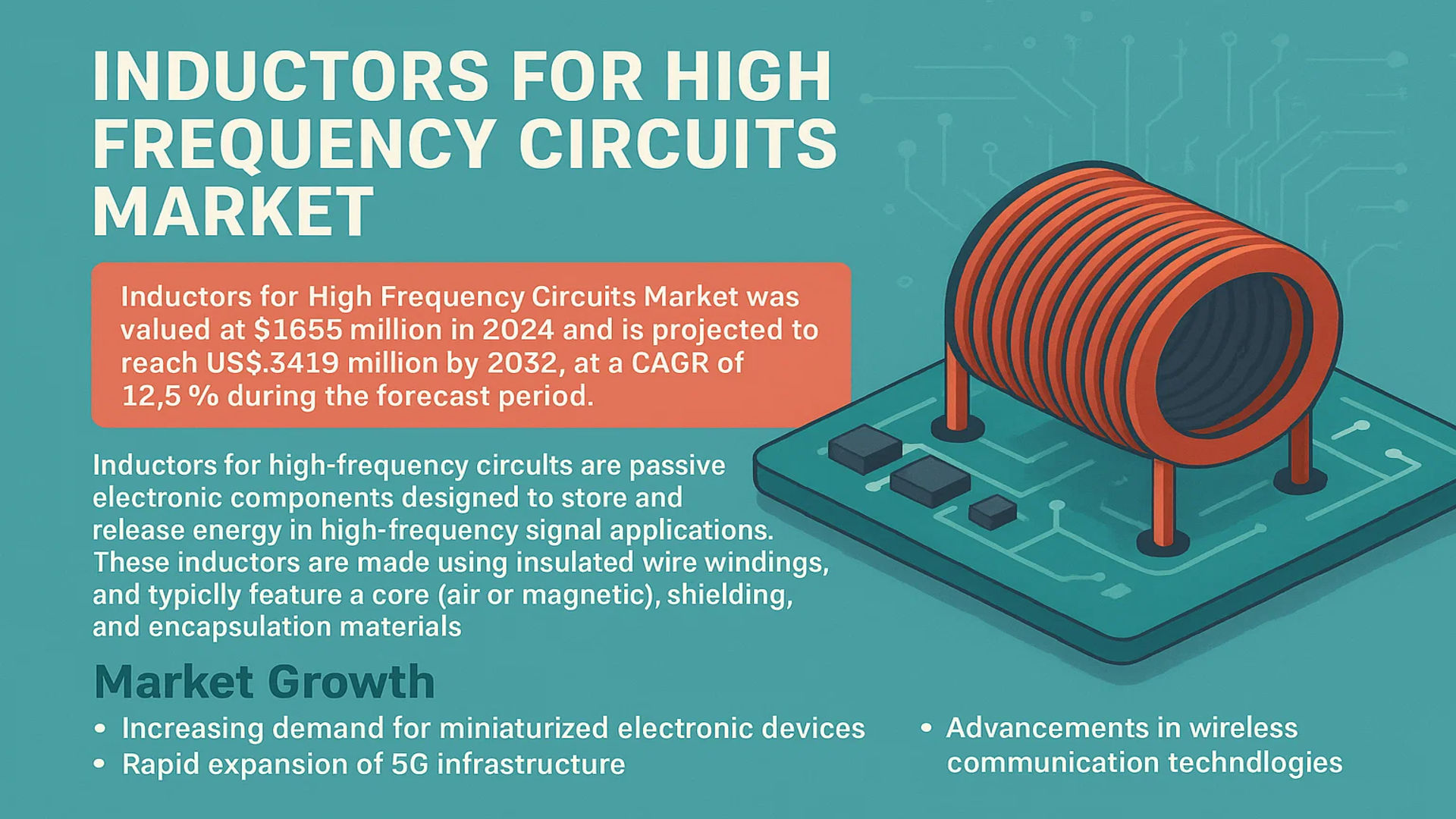
The global Inductors for High Frequency Circuits Market was valued at 1655 million in 2024 and is projected to reach US$ 3419 million by 2032, at a CAGR of 12.5% during the forecast period.
Inductors for high-frequency circuits are passive electronic components designed to store and release energy in high-frequency signal applications. These inductors are constructed using insulated wire windings and typically include a core (air or magnetic), shielding, and encapsulation materials. They play a critical role in managing signal integrity, filtering noise, and optimizing power efficiency in circuits operating at frequencies above 1 MHz.
The market growth is driven by increasing demand for miniaturized electronic devices, rapid expansion of 5G infrastructure, and advancements in wireless communication technologies. The rising adoption of IoT devices and automotive electronics further fuels demand. Key industry players like Murata, TDK Corporation, and Coilcraft are investing in R&D to develop high-performance inductors with improved thermal stability and lower losses, catering to next-generation applications in telecom, automotive, and consumer electronics.
MARKET DYNAMICS
MARKET DRIVERS
Expansion of 5G Infrastructure to Accelerate High-Frequency Inductor Demand
The global rollout of 5G networks continues to drive substantial demand for high-frequency inductors, which serve as critical components in RF filters, power amplifiers, and antenna tuning circuits. With over 300 commercial 5G networks deployed worldwide and penetration rates exceeding 45% in leading markets, component manufacturers face increasing pressure to deliver inductors capable of operating in the 3.5-28 GHz spectrum. These inductors must maintain stable inductance values while minimizing insertion loss – a performance requirement that’s pushing innovation in materials and winding technologies. The wireless communication segment accounted for 42% of high-frequency inductor applications in 2024, a figure projected to reach 51% by 2030 as millimeter-wave deployments expand.
Automotive Electrification to Fuel Growth in Power Electronics Applications
Electric vehicle production growth at 28% CAGR through 2032 is creating significant opportunities for high-frequency inductors used in DC-DC converters, onboard chargers, and battery management systems. Modern EVs contain approximately 35-45 high-frequency inductors per vehicle, with premium models requiring nearly double that amount for advanced power distribution networks. The transition to 800V architectures in next-generation EVs further intensifies requirements for compact, high-current inductors that can operate efficiently at switching frequencies above 2MHz. Automotive OEMs increasingly specify high-temperature composite-core inductors that maintain performance up to 150°C, driving material science innovations across the supply chain.
Miniaturization Trend Across Electronics to Spur Innovations
The relentless push for smaller, more powerful electronic devices continues to reshape inductor design paradigms. Consumer electronics manufacturers now demand chip inductors with package sizes below 0.6mm × 0.3mm while maintaining inductance values above 100nH – specifications that required bulky through-hole components just five years ago. Advanced thin-film deposition techniques and novel ferrite materials are enabling this miniaturization while reducing parasitic effects that plague high-frequency operation. The smartphone sector alone consumes over 18 billion high-frequency chip inductors annually, with premium models incorporating up to 45 discrete inductor components for RF and power management functions.
MARKET RESTRAINTS
Rare Earth Material Volatility Threatens Cost Stability
The high-frequency inductor market faces persistent challenges from fluctuating prices of rare earth elements used in specialized magnetic cores, particularly neodymium and samarium-cobalt alloys. Global supply chain disruptions in 2022-2023 caused price spikes exceeding 300% for certain high-performance core materials, forcing manufacturers to either absorb costs or implement unpopular price adjustments. While ferrite alternatives exist, they often trade off performance parameters like saturation current or quality factor (Q) values – compromises that are unacceptable for military and medical applications where component reliability is paramount.
Thermal Management Constraints Limit High-Power Designs
As switching frequencies exceed 10MHz in modern power electronics, inductor self-heating becomes a critical design limitation that affects both performance and longevity. Core losses escalate non-linearly with frequency, creating thermal management challenges that existing packaging technologies struggle to address. High-current applications in particular face trade-offs between inductor size and thermal dissipation, with many designs requiring supplemental cooling that adds cost and complexity. The industry has observed a 15-20% reduction in expected component lifespan for every 10°C increase above rated operating temperatures – a reliability concern that’s slowing adoption in mission-critical infrastructure.
MARKET CHALLENGES
Intellectual Property Barriers Constrain Market Entry
Established players maintain strong competitive advantages through extensive patent portfolios covering advanced inductor geometries, core compositions, and manufacturing processes. New market entrants face prohibitive R&D costs to develop non-infringing alternative designs, particularly for high-value applications in aerospace and telecommunications. The industry’s top five manufacturers collectively hold over 1,200 active patents related to high-frequency inductors, creating substantial barriers for companies seeking to develop differentiated products without licensing arrangements. This intellectual property landscape forces many smaller manufacturers to compete solely on price in low-margin segments, limiting their ability to fund next-generation development.
Automated Production Demands Accelerate Capital Expenditure Requirements
Modern inductor manufacturing increasingly requires sophisticated automation systems capable of handling micron-level precision while maintaining high throughput. A single automated winding machine for micro-inductors now represents a $2-4 million capital investment, while full SMT production lines can exceed $15 million. These escalating equipment costs concentrate production capacity among well-funded multinational corporations, making it increasingly difficult for regional players to maintain technical competitiveness. The shift to Industry 4.0 practices further compounds this challenge, as smart manufacturing implementations require additional investments in IoT sensors, data analytics platforms, and machine learning systems to optimize production quality.
MARKET OPPORTUNITIES
GaN and SiC Semiconductor Transition to Create New Design Requirements
The accelerating adoption of wide-bandgap semiconductors presents lucrative opportunities for inductor manufacturers to develop optimized solutions. Gallium nitride (GaN) and silicon carbide (SiC) devices operate at switching frequencies 5-10 times higher than traditional silicon, demanding inductors with fundamentally different characteristics. These next-generation power systems require ultra-low parasitic inductance components capable of handling fast current transitions while minimizing electromagnetic interference. Early movers developing application-specific inductors for GaN/SiC platforms have reported 35-50% premium pricing compared to standard offerings, creating strong incentives for continued innovation in this segment.
Integrated Passive Devices to Open New Application Frontiers
The emerging integrated passive device (IPD) market offers significant growth potential as designers seek to consolidate multiple discrete components into single packaged solutions. High-frequency inductors fabricated using thin-film or semiconductor processes can be combined with capacitors and resistors to create compact functional blocks for RF front-end modules. This integration trend is particularly impactful for space-constrained applications like wearable devices and IoT endpoints, where board real estate comes at a premium. Leading foundries report that IPD adoption is growing at 22% annually, with high-frequency inductors representing the most technically challenging element to integrate while maintaining performance specifications.
INDUCTORS FOR HIGH FREQUENCY CIRCUITS MARKET TRENDS
Miniaturization and High-Frequency Performance Demands Drive Market Growth
The increasing demand for compact and high-performance electronic devices is accelerating the adoption of advanced inductors optimized for high-frequency applications. As 5G networks expand globally, the requirement for inductors capable of operating in the millimeter-wave frequency range (24-100 GHz) has surged by approximately 28% year-over-year. Modern telecommunications infrastructure, including base stations and small cell networks, relies heavily on these components for efficient signal filtering and power regulation. Additionally, the automotive sector’s shift toward electrification and autonomous driving systems has created new opportunities, with high-frequency inductors playing a critical role in ADAS radar and in-vehicle networking modules.
Other Trends
Material Innovation for Enhanced Efficiency
Developments in magnetic core materials are significantly improving inductor performance in RF applications. Ferrite-based materials now achieve Q-factor improvements of 15-20% compared to conventional designs, while novel nanocomposite cores demonstrate superior temperature stability up to 200°C. These advancements enable inductors to maintain stable inductance values under varying load conditions, a critical requirement for power supplies in medical imaging equipment and industrial automation systems. Furthermore, air-core inductor designs are gaining preference in ultra-high frequency applications (>1 GHz) where minimal core losses and excellent linearity are paramount.
Rising Investment in Wireless Infrastructure Spurs Demand
The global push for 5G deployment and IoT expansion continues to be the primary growth driver for high-frequency inductors. With telecom operators investing over $250 billion annually in network upgrades, the market for RF components in base station equipment is expected to grow at a compound annual rate of nearly 14% through 2030. This infrastructure build-out creates parallel demand for compact power inductors in customer premises equipment, where space constraints and energy efficiency requirements demand components with lower DC resistance and higher current handling capacity. Emerging Wi-Fi 6E and upcoming Wi-Fi 7 standards will further intensify the need for specialized inductors capable of supporting broader bandwidths and higher data throughput.
COMPETITIVE LANDSCAPE
Key Industry Players
Market Leaders Focus on Innovation to Capitalize on Surging Demand for High-Frequency Components
The global inductors for high-frequency circuits market features a moderately consolidated structure where established multinational corporations hold dominant positions while regional players compete through niche offerings. Murata Manufacturing Co., Ltd. leads the industry with an estimated 18% revenue share in 2024, leveraging its vertically integrated production capabilities and extensive R&D investments exceeding 5% of annual sales.
Japanese and German manufacturers demonstrate particular strength in technical innovation, with TDK Corporation and Würth Elektronik eiSos GmbH & Co. KG introducing over 15 new inductor product lines annually to serve emerging 5G and automotive radar applications. Their success stems from precision engineering capabilities that meet stringent quality requirements for high-frequency operations above 1GHz.
North American firms maintain competitiveness through strategic acquisitions and partnerships. Coilcraft‘s 2023 acquisition of RF inductor specialist Dexmet Corporation strengthened its position in military/aerospace applications, while Abracon expanded its automotive-grade inductor portfolio through collaboration with major Tier 1 suppliers.
The competitive landscape continues evolving with Chinese manufacturers like INPAQ Technology Co., Ltd capturing growing domestic demand through cost-optimized solutions. However, international players counter with localized production – TDK’s new 50,000 sqm facility in Shanghai exemplifies this trend towards regional supply chain development.
List of Key Inductors for High Frequency Circuits Manufacturers
- Murata Manufacturing Co., Ltd. (Japan)
- TDK Corporation (Japan)
- Coilcraft, Inc. (U.S.)
- Würth Elektronik eiSos GmbH & Co. KG (Germany)
- Viking Tech Corporation (Taiwan)
- BLOCK Transformatoren-Elektronik GmbH (Germany)
- Abracon LLC (U.S.)
- Shinernegy (China)
- TE Connectivity (Switzerland)
- INPAQ Technology Co.,Ltd (China)
- Shah Electronics (India)
Segment Analysis:
By Type
Air Core Inductor Segment Leads the Market Owing to Superior High Frequency Performance
The market is segmented based on type into:
- Air Core Inductor
- Magnetic Core Inductor
By Application
Wireless Communication Field Dominates Due to Proliferation of 5G and IoT Technologies
The market is segmented based on application into:
- Wireless Communication Field
- Power Electronics Field
- Lighting Field
- Others
By End User
Telecommunications Industry Remains Key Consumer of High Frequency Inductors
The market is segmented based on end user into:
- Telecommunications Companies
- Automotive Electronics Manufacturers
- Consumer Electronics Producers
- Industrial Equipment Manufacturers
Regional Analysis: Inductors for High Frequency Circuits Market
Asia-Pacific
The Asia-Pacific region dominates the global inductors for high-frequency circuits market, accounting for approximately 45% of the total revenue share. This leadership position stems from rapid technological advancements in wireless communication infrastructure, particularly in China, Japan, and South Korea. China’s aggressive 5G rollout, with over 1.3 million 5G base stations deployed as of 2024, creates substantial demand for high-frequency inductors. Japan’s strong position in automotive electronics and South Korea’s leadership in semiconductor manufacturing further bolster regional growth. While cost competitiveness remains crucial, local manufacturers are increasingly focusing on product miniaturization and efficiency to meet evolving industry requirements.
North America
North America represents the second-largest market, driven by cutting-edge R&D in defense, aerospace, and telecommunication sectors. The United States, home to major players like Coilcraft and Abracon, leads innovation in high-frequency inductor technologies for military-grade applications. Stringent quality standards and the need for reliable components in mission-critical systems support premium product demand. The region’s focus on electric vehicles and renewable energy infrastructure is creating new application areas for high-frequency power inductors. However, higher manufacturing costs compared to Asian counterparts present ongoing challenges for local suppliers.
Europe
Europe maintains steady growth in the high-frequency inductor market, supported by the automotive industry’s transition to electric vehicles and advanced driver-assistance systems (ADAS). German automotive manufacturers and French telecom equipment providers constitute key demand drivers. The region emphasizes environmental sustainability, prompting development of lead-free and RoHS-compliant inductor solutions. While European firms like Würth Elektronik maintain strong technological capabilities, they face pricing pressure from Asian manufacturers. EU-funded research initiatives in 6G technology development present future growth opportunities for specialized high-frequency components.
South America
The South American market shows moderate but consistent growth, primarily serving consumer electronics and industrial applications. Brazil leads regional demand, with increasing investments in telecom infrastructure upgrades. The market remains price-sensitive, favoring cost-effective magnetic core inductors over premium alternatives. Limited local manufacturing capacity results in heavy reliance on imports from Asia and North America. While political and economic instability pose challenges, the gradual expansion of 4G networks and IoT applications creates steady demand growth potential for basic high-frequency inductors.
Middle East & Africa
This emerging market demonstrates growing potential, particularly in Gulf Cooperation Council (GCC) countries investing in smart city and 5G infrastructure projects. The United Arab Emirates and Saudi Arabia lead regional adoption of advanced electronic components. However, the broader African market remains constrained by limited local electronics manufacturing and infrastructure challenges. Most demand stems from telecommunications equipment imports and consumer electronics assembly plants. While the market currently represents a small fraction of global demand, strategic investments in technology hubs could accelerate future growth.
Report Scope
This market research report provides a comprehensive analysis of the Global Inductors for High Frequency Circuits market, covering the forecast period 2025–2032. It offers detailed insights into market dynamics, technological advancements, competitive landscape, and key trends shaping the industry.
Key focus areas of the report include:
- Market Size & Forecast: Historical data and future projections for revenue, unit shipments, and market value across major regions and segments. The market was valued at USD 1,655 million in 2024 and is projected to reach USD 3,419 million by 2032, growing at a CAGR of 12.5%.
- Segmentation Analysis: Detailed breakdown by product type (Air Core Inductor, Magnetic Core Inductor), application (Wireless Communication, Power Electronics, Lighting), and end-user industry to identify high-growth segments.
- Regional Outlook: Insights into market performance across North America, Europe, Asia-Pacific, Latin America, and Middle East & Africa. The U.S. and China are key markets with significant growth potential.
- Competitive Landscape: Profiles of leading market participants including Murata Manufacturing, TDK Corporation, Coilcraft, Würth Elektronik, and others, covering their product portfolios, market share, and strategic initiatives.
- Technology Trends & Innovation: Assessment of emerging materials, miniaturization trends, and performance enhancements in high-frequency inductor design.
- Market Drivers & Restraints: Evaluation of factors such as 5G deployment, IoT expansion, and power electronics growth versus supply chain constraints and raw material price volatility.
- Stakeholder Analysis: Strategic insights for component manufacturers, OEMs, suppliers, and investors regarding market opportunities and challenges.
The report employs primary and secondary research methodologies, including expert interviews and analysis of verified market data, to ensure accuracy and reliability.
FREQUENTLY ASKED QUESTIONS:
What is the current market size of Global Inductors for High Frequency Circuits Market?
-> Inductors for High Frequency Circuits Market was valued at 1655 million in 2024 and is projected to reach US$ 3419 million by 2032, at a CAGR of 12.5% during the forecast period.
Which key companies operate in Global Inductors for High Frequency Circuits Market?
-> Key players include Murata Manufacturing Co., Ltd., TDK Corporation, Coilcraft, Würth Elektronik eiSos GmbH & Co. KG, and Viking Tech Corporation, among others.
What are the key growth drivers?
-> Key growth drivers include 5G network expansion, increasing adoption of IoT devices, growth in power electronics, and demand for miniaturized components.
Which region dominates the market?
-> Asia-Pacific dominates the market due to strong electronics manufacturing presence, while North America shows significant growth in high-frequency applications.
What are the emerging trends?
-> Emerging trends include development of high-Q inductors, integration with advanced packaging technologies, and materials innovation for better high-frequency performance.

Get Sample Report PDF for Exclusive Insights
Report Sample Includes
- Table of Contents
- List of Tables & Figures
- Charts, Research Methodology, and more...