Indoor Digital Video Wall Market Insights
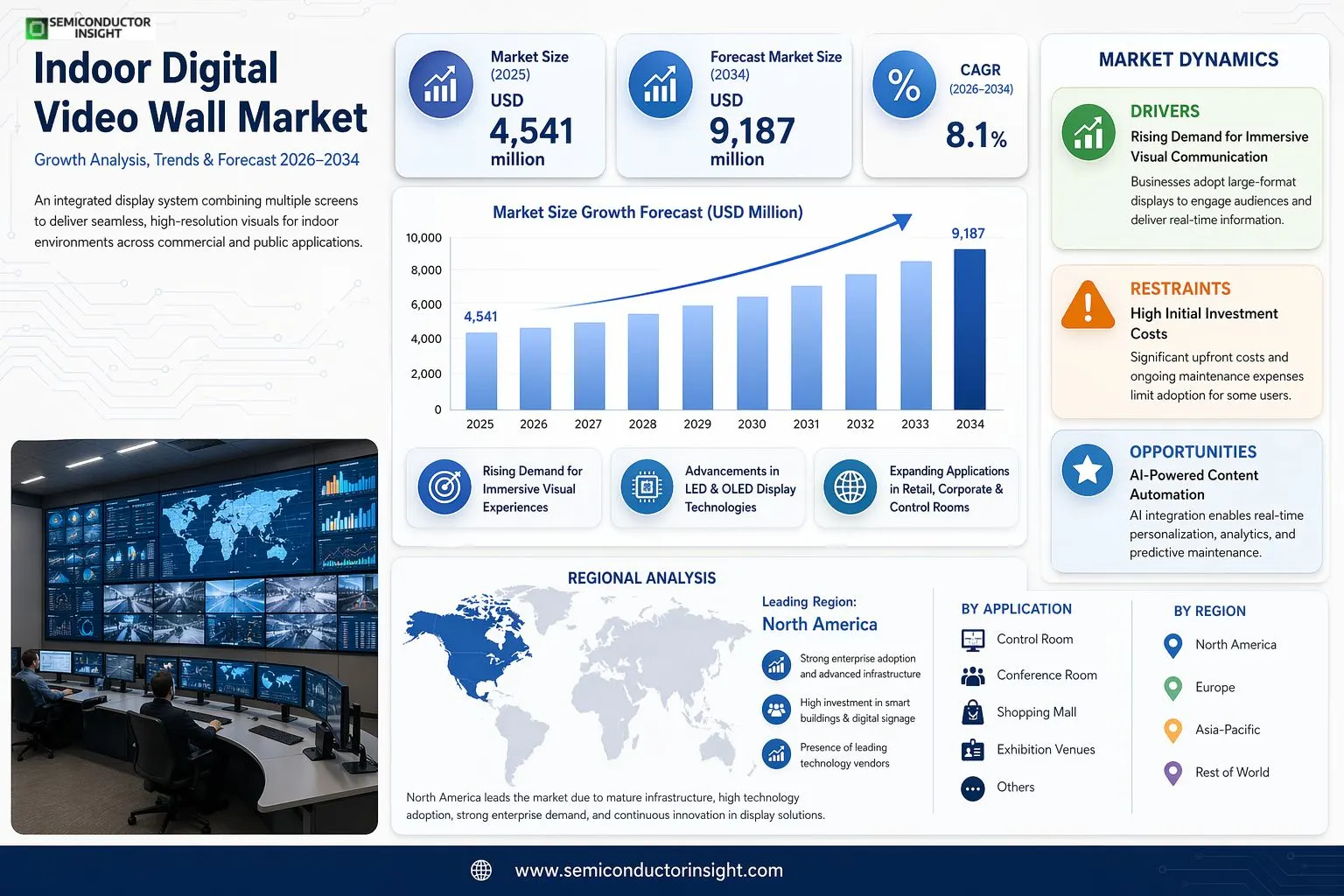
Global Indoor Digital Video Wall market size was valued at USD 4,541 million in 2025. The market is projected to grow from USD 4,922 million in 2026 to USD 9,187 million by 2034, exhibiting a CAGR of 8.1% during the forecast period.
An Indoor Digital Video Wall is a large-scale display system that combines multiple screens , such as LCD, LED, or OLED panels , to create a seamless and expansive viewing surface designed exclusively for indoor environments. These systems are capable of rendering high-resolution images and videos with exceptional clarity, color accuracy, and brightness, making them a preferred choice across a wide range of verticals. They are widely deployed in control rooms, conference rooms, shopping malls, exhibition venues, and entertainment spaces to deliver immersive, high-impact visual experiences.
The market is witnessing sustained growth driven by rising demand for advanced visual communication solutions, rapid adoption of digital signage across retail and corporate sectors, and continued technological advancements in display technologies such as fine-pitch LED and OLED. Furthermore, growing infrastructure investments in smart cities and command-and-control facilities globally are accelerating deployment. Key manufacturers operating in this space include Samsung Electronics, LG Electronics, NEC Display Solutions, Panasonic Corporation, Leyard Group, Christie Digital Systems, Barco, and Planar Systems, among others, each offering diverse product portfolios tailored to various end-use applications.
MARKET DRIVERS
Rising Demand for Immersive Visual Communication in Commercial Spaces
Indoor Digital Video Wall Market is experiencing robust growth driven by the accelerating need for dynamic, high-impact visual communication across commercial environments. Retail outlets, corporate offices, hospitality venues, and entertainment centers are increasingly deploying large-format video wall solutions to elevate customer engagement and deliver real-time information. The shift from static signage to interactive and LED- and LCD-based video wall displays reflects a broader transformation in how businesses communicate with audiences in enclosed environments. As organizations prioritize brand differentiation, the adoption of seamless, bezel-free multi-panel display systems continues to expand across sectors.
Technological Advancements in Display Resolution and Processing Capabilities
Continuous innovation in display technologies, including 4K and 8K ultra-high-definition panels, fine-pitch LED modules, and advanced video wall processors, is a significant catalyst propelling Indoor Digital Video Wall Market forward. Modern video wall controllers now support real-time content management, multi-source signal processing, and seamless content scaling, enabling operators to deliver highly customized visual experiences. The integration of OLED and MicroLED technologies is further enhancing contrast ratios, color accuracy, and energy efficiency, making these solutions increasingly viable for premium indoor applications such as command-and-control centers, broadcast studios, and luxury retail environments.
➤ The proliferation of smart building infrastructure and the growing emphasis on data visualization in control room environments are creating sustained, long-term demand for advanced indoor digital video wall installations globally.
Furthermore, the expansion of the retail, hospitality, and corporate sectors in emerging economies is opening new deployment avenues for indoor video wall systems. Organizations are channeling capital expenditure into digital transformation initiatives that encompass visual display infrastructure, recognizing that compelling in-venue displays directly correlate with consumer dwell time and purchasing behavior. Government investments in smart city projects, transportation hubs, and public information systems are also acting as structural growth drivers for Indoor Digital Video Wall Market.
MARKET CHALLENGES
High Initial Capital Investment and Total Cost of Ownership
One of the most prominent challenges facing Indoor Digital Video Wall Market is the substantial upfront investment required for procurement, installation, and integration of multi-panel display systems. Premium fine-pitch LED video walls and high-resolution LCD panel arrays involve significant hardware costs, which are further compounded by professional installation fees, structural modifications, and content management software licensing. For small and medium-sized enterprises, these cost barriers can delay or entirely preclude adoption, constraining overall market penetration. Additionally, ongoing maintenance requirements, including panel replacement, calibration services, and technical support contracts, contribute to elevated total cost of ownership over the product lifecycle.
Other Challenges
Content Management Complexity
Managing dynamic, multi-zone content across large-format indoor video wall configurations demands specialized software platforms and trained personnel. Organizations often struggle with content scheduling, real-time updates, and integration with existing enterprise systems such as digital signage networks, data feeds, and collaboration platforms. The lack of standardized interoperability between hardware from different manufacturers and content management systems adds layers of technical complexity that can hinder seamless operations and increase dependency on specialized vendors.
Heat Dissipation and Long-Term Reliability Concerns
Indoor video wall installations, particularly those utilizing high-brightness LED or LCD panels running continuously in commercial environments, generate considerable heat that must be effectively managed. Inadequate thermal management can accelerate component degradation, reduce panel lifespan, and increase energy consumption. Ensuring consistent luminance uniformity and color calibration across all display modules over extended operational periods remains a technical challenge, particularly in mission-critical environments such as security operations centers and broadcast facilities where display reliability is non-negotiable.
MARKET RESTRAINTS
Supply Chain Vulnerabilities and Component Availability Constraints
Indoor Digital Video Wall Market faces meaningful restraints stemming from global supply chain disruptions affecting the availability of key display components, including LED driver ICs, display panels, and video processing chipsets. Geopolitical tensions, trade policy shifts, and manufacturing concentration risks have exposed vulnerabilities in the supply networks that underpin the display technology ecosystem. Prolonged lead times for critical components can delay project deployments, inflate procurement costs, and create uncertainty for system integrators and end-users planning large-scale indoor video wall rollouts.
Stringent Regulatory and Environmental Compliance Requirements
Increasingly rigorous energy efficiency regulations and environmental compliance standards across major markets, including the European Union’s Ecodesign Directive and various regional energy labeling frameworks, are imposing design and performance constraints on indoor digital video wall manufacturers. Meeting these regulatory thresholds while maintaining competitive display brightness, resolution, and performance characteristics requires significant research and development investment. Compliance costs are disproportionately burdensome for smaller manufacturers, potentially consolidating market share among larger players while slowing the pace of product innovation for cost-sensitive market segments.
Additionally, the rapid pace of technological obsolescence in the display industry acts as a restraint on purchasing decisions. Organizations evaluating indoor video wall investments must weigh the risk of deploying current-generation technology that may be superseded by more capable and cost-effective solutions within a relatively short timeframe. This concern is particularly acute in sectors with long capital asset depreciation cycles, such as public infrastructure and institutional environments, where the flexibility to upgrade systems is structurally limited.
MARKET OPPORTUNITIES
Expansion of AI-Powered Content Automation and Analytics Integration
The convergence of artificial intelligence and indoor digital video wall technology is creating compelling growth opportunities for market participants. AI-driven content management platforms are enabling automated audience analytics, real-time content personalization, and predictive maintenance capabilities that significantly enhance the value proposition of video wall deployments. Retailers, transportation operators, and corporate campuses are increasingly seeking video wall solutions that can dynamically adapt displayed content based on audience demographics, dwell patterns, and contextual data inputs, driving demand for software-enriched display ecosystems.
Growth in Corporate, Healthcare, and Education Sector Deployments
Emerging demand from corporate collaboration environments, healthcare facilities, and educational institutions represents a significant untapped opportunity for Indoor Digital Video Wall Market. The post-pandemic redesign of hybrid workplaces has accelerated investment in large-format display walls for immersive video conferencing, data visualization, and collaborative workspaces. Similarly, hospitals and medical centers are deploying video wall systems for patient wayfinding, real-time operational dashboards, and clinical training environments. Higher education institutions are integrating video walls into auditoriums, learning centers, and research facilities, broadening the addressable market considerably beyond traditional retail and entertainment verticals.
The growing adoption of fine-pitch LED video walls in indoor environments , driven by declining per-unit costs as manufacturing scales , is making these premium solutions accessible to mid-market buyers for the first time. This democratization of high-resolution indoor video wall technology is expected to significantly expand the total addressable market, enabling system integrators and solution providers to target a wider spectrum of commercial customers across diverse geographies and industry verticals with scalable, modular display configurations tailored to varying budget and performance requirements.
Indoor Digital Video Wall Market Trends
Rising Demand for Immersive Visual Experiences Driving Indoor Digital Video Wall Market
Indoor Digital Video Wall Market is experiencing significant momentum as businesses across sectors increasingly adopt large-scale display systems to enhance audience engagement. The convergence of high-resolution display technology with declining hardware costs has made video wall installations more accessible to a broader range of end users, from corporate enterprises to retail environments. LED-based indoor digital video walls, in particular, are gaining considerable traction due to their superior brightness, energy efficiency, and ability to deliver seamless visuals across expansive surfaces. Key market participants such as Samsung Electronics, LG Electronics, Barco, and Leyard Group continue to invest in next-generation panel technologies, intensifying competition and accelerating product innovation across Indoor Digital Video Wall Market.
Other Trends
Expansion Across Diverse Application Segments
Application diversity remains one of the most defining characteristics of Indoor Digital Video Wall Market. Control rooms and command centers rely heavily on video wall solutions to monitor real-time data streams, while conference rooms increasingly incorporate these systems to facilitate collaborative communication and dynamic presentations. Shopping malls and retail spaces are deploying indoor digital video walls as powerful advertising tools, enabling targeted and visually compelling brand messaging. Exhibition venues are also leveraging these displays to create interactive and immersive visitor experiences. This breadth of application is sustaining demand across multiple verticals and reinforcing the market’s resilience against sectoral fluctuations.
Technology Shift Toward LED and OLED Panels
A notable technology transition is underway within Indoor Digital Video Wall Market, with LED indoor digital video walls progressively replacing traditional LCD configurations in high-visibility installations. OLED-based video walls are also emerging as a premium segment, offering exceptional contrast ratios and ultra-thin form factors suited for high-end retail and hospitality environments. Manufacturers are focusing on micro-LED development as a future-ready solution, with the potential to deliver pixel-level precision at reduced energy consumption. This technology evolution is reshaping procurement decisions and encouraging end users to upgrade existing display infrastructure.
Regional Dynamics and Competitive Landscape Shaping Market Trajectory
Geographically, North America and Asia , particularly China, Japan, and South Korea , represent the most mature and competitive regions within Indoor Digital Video Wall Market. Asia’s rapid urbanization, expanding retail infrastructure, and growing investments in smart city initiatives are fueling robust regional demand. Meanwhile, Europe is witnessing steady adoption in corporate and public sector applications. The competitive landscape remains concentrated, with Global top five players collectively commanding a substantial share of total market revenue in 2025. Strategic partnerships, product portfolio expansions, and targeted acquisitions are the primary growth strategies being pursued by leading companies such as NEC Display Solutions, Christie Digital Systems, and Planar Systems to consolidate their positions in this evolving market.
COMPETITIVE LANDSCAPE
Key Industry Players
Indoor Digital Video Wall Market , Competitive Dynamics and Leading Manufacturers Shaping Global Display Industry
Global Indoor Digital Video Wall market is characterized by intense competition among a mix of established electronics conglomerates and specialized display technology providers. Samsung Electronics and LG Electronics collectively command a significant portion of global market revenue, leveraging their vertically integrated manufacturing capabilities, expansive distribution networks, and continuous innovation in LED and OLED display technologies. Samsung, in particular, has reinforced its leadership position through its The Wall series and modular MicroLED solutions tailored for high-demand environments such as control rooms, retail spaces, and corporate conference rooms. LG Electronics closely follows with its dvLED and OLED-based video wall offerings, which are widely adopted across exhibition venues and premium commercial installations. As of 2025, Global Indoor Digital Video Wall market was valued at approximately USD 4,541 million and is projected to reach USD 7,904 million by 2032, registering a CAGR of 8.4% during the forecast period , a growth trajectory that continues to attract both incumbents and emerging challengers to invest heavily in product differentiation and geographic expansion.
Beyond the dominant players, several specialized and regionally influential companies have carved out strong competitive positions within Indoor Digital Video Wall Market. Leyard Group has emerged as a formidable force in fine-pitch LED video wall technology, particularly across Asia-Pacific and European markets, while Barco maintains a strong reputation in high-end visualization for control rooms and simulation environments. Christie Digital Systems and Planar Systems are well-regarded in enterprise, broadcast, and government segments, offering robust, purpose-built video wall solutions with advanced processing capabilities. NEC Display Solutions and Panasonic Corporation continue to serve large-scale commercial and institutional clients with reliable, scalable display infrastructures, while ViewSonic Corporation and Sharp Corporation address mid-market demand with competitively priced LCD and LED-based video wall configurations. The competitive landscape is further shaped by ongoing mergers, technology licensing agreements, and strategic alliances, as manufacturers race to integrate AI-driven content management, 8K resolution support, and energy-efficient panel technologies to meet evolving end-user requirements across shopping malls, transportation hubs, and enterprise environments.
List of Key Indoor Digital Video Wall Companies Profiled
- Samsung Electronics
- LG Electronics
- NEC Display Solutions
- Panasonic Corporation
- Sharp Corporation
- ViewSonic Corporation
- Leyard Group
- Christie Digital Systems
- Barco
- Planar Systems
- Absen Optoelectronic Co., Ltd.
- Unilumin Group
- Daktronics
- Scala (A STRATACACHE Company)
- Mitsubishi Electric Corporation
Segment Analysis:
| Segment Category | Sub-Segments | Key Insights |
| By Type |
|
LED Indoor Digital Video Wall continues to assert dominance in the overall type landscape, driven by its superior brightness levels, energy efficiency, and exceptional durability compared to competing technologies.
|
| By Application |
|
Control Room applications represent a critical and high-value segment within Indoor Digital Video Wall Market, driven by the need for real-time, mission-critical visual monitoring across sectors such as defense, utilities, transportation, and public safety.
|
| By End User |
|
Corporate & Commercial Enterprises represent the most expansive and rapidly evolving end-user segment, as businesses increasingly recognize indoor digital video walls as indispensable tools for internal communications, brand storytelling, and employee engagement.
|
| By Installation Type |
|
Fixed Installation dominates the installation type landscape, underpinned by demand from permanent deployments in corporate headquarters, control rooms, retail environments, and public venues where long-term, consistent performance is a primary requirement.
|
| By Resolution |
|
4K Ultra HD Video Walls are rapidly becoming the de facto resolution standard across Indoor Digital Video Wall Market, as buyers increasingly prioritize superior image fidelity, pixel density, and content versatility in their procurement decisions.
|
Regional Analysis: Indoor Digital Video Wall Market
North America
North American enterprises are rapidly integrating indoor digital video wall systems into their operational and branding frameworks. From executive boardrooms to expansive open-plan offices, high-resolution video walls are redefining corporate communication. The region’s tech-driven corporate culture and willingness to invest in premium visual solutions continue to make it a bellwether for global enterprise deployment trends in Indoor Digital Video Wall Market.
Retail chains, shopping malls, sports arenas, and entertainment complexes across North America are among the most active adopters of indoor digital video wall technology. These sectors leverage large-format displays to create compelling, immersive environments that engage audiences and drive commercial outcomes. The ongoing evolution of experiential retail is a particularly strong catalyst for continued indoor digital video wall market expansion across the region.
The availability of advanced AV-over-IP infrastructure, widespread 5G connectivity, and a well-developed supply chain for display components gives North America a significant technological edge. This environment enables seamless deployment and management of complex indoor digital video wall configurations, supporting both real-time content delivery and centralized remote management across multi-site enterprise networks.
North America is home to several leading innovators in display technology and content management software that directly shape Indoor Digital Video Wall Market. Continuous investment in research and development has yielded breakthroughs in ultra-narrow bezel design, LED pixel pitch reduction, and AI-powered content automation. This innovation pipeline ensures that the region remains at the forefront of product development and market evolution.
Europe
Europe represents a significant and steadily evolving region within Global indoor digital video wall market, characterized by a strong emphasis on design aesthetics, energy efficiency, and regulatory compliance. Western European nations , particularly Germany, the United Kingdom, France, and the Netherlands , lead in deploying indoor digital video wall solutions across sectors such as transportation hubs, retail, hospitality, and public institutions. The region’s commitment to sustainability has prompted demand for energy-efficient display technologies that align with corporate environmental, social, and governance objectives. Smart city initiatives across European urban centers are further accelerating the integration of digital signage and video wall infrastructure in public indoor spaces. Eastern Europe is gradually emerging as an area of growing opportunity, supported by infrastructure modernization programs and increasing foreign investment in commercial real estate. Indoor Digital Video Wall Market in Europe is also influenced by stringent data privacy regulations, which shape how content management platforms are designed and deployed across the region.
Asia-Pacific
Asia-Pacific is positioned as the fastest-growing region in Indoor Digital Video Wall Market, underpinned by rapid urbanization, expanding commercial real estate development, and significant government investment in smart infrastructure. China dominates regional activity, with large-scale deployments across retail megacomplexes, transportation terminals, and government facilities. Japan and South Korea contribute through their technology leadership and consumer electronics heritage, consistently introducing innovative indoor digital video wall applications in entertainment, education, and corporate sectors. India is emerging as a high-potential market, driven by the proliferation of modern retail formats, IT campuses, and hospitality infrastructure. Southeast Asian economies, including Singapore, Thailand, and Indonesia, are witnessing growing adoption as businesses seek to differentiate their customer experience through visually dynamic indoor environments. The competitive manufacturing landscape within Asia-Pacific also contributes to cost advantages that further stimulate market accessibility and growth.
South America
South America presents a developing yet increasingly promising landscape for Indoor Digital Video Wall Market. Brazil leads the region as the dominant adopter, with notable deployments in retail chains, banking institutions, corporate offices, and sports venues. The expansion of shopping malls and mixed-use commercial developments in major urban centers like São Paulo and Buenos Aires is creating consistent demand for sophisticated indoor display solutions. While economic volatility in certain South American economies has historically moderated large-scale capital investments, a growing recognition of the competitive advantages offered by immersive digital experiences is encouraging more businesses to invest in indoor digital video wall systems. Chile and Colombia are also showing increasing activity, particularly within the telecommunications and financial services sectors. As regional economies stabilize and infrastructure investment grows, South America is expected to become a more substantial contributor to global indoor digital video wall market revenues through the forecast period.
Middle East & Africa
The Middle East and Africa region occupies a unique position in Indoor Digital Video Wall Market, characterized by high-value landmark deployments alongside nascent but rapidly evolving commercial adoption across sub-Saharan Africa. The Gulf Cooperation Council countries , particularly the United Arab Emirates, Saudi Arabia, and Qatar , are among the most ambitious adopters of indoor digital video wall technology, driven by large-scale infrastructure projects, luxury hospitality developments, and smart city ambitions aligned with national vision programs. Iconic commercial and entertainment venues across the region routinely incorporate premium indoor digital video wall installations as centerpieces of their experiential design strategies. Africa, while still in early stages of broad commercial deployment, is witnessing growing interest from retail and banking sectors in South Africa and Nigeria. The region’s overall trajectory in Indoor Digital Video Wall Market is upward, supported by increasing foreign investment, tourism infrastructure expansion, and a young, tech-engaged consumer base.
Report Scope
This market research report provides a comprehensive analysis of Indoor Digital Video Wall Market, covering the forecast period 2026–2034. It offers detailed insights into market dynamics, technological advancements, competitive landscape, and key trends shaping the industry.
Key focus areas of the report include:
- Market Overview: The report begins with an overview outlining its current market scenario, key growth indicators, and industry transformation drivers. It discusses macroeconomic factors, demand–supply balance, regulatory landscape, and the strategic role of display technologies in powering advancements across industries such as advertising, education, entertainment, retail, and surveillance.
- Market Size & Forecast: Historical data and future projections for revenue, unit shipments, and market value across major regions and segments.
- Segmentation Analysis: Detailed breakdown by product type (LED, LCD, OLED), application, and end-user industry to identify high-growth segments and investment opportunities.
- Regional Insights: Insights into market performance across North America, Europe, Asia-Pacific, Latin America, and the Middle East & Africa, including country-level analysis where relevant.
- Competitive Landscape: Profiles of leading market participants, including their product offerings, R&D focus, manufacturing capacity, pricing strategies, and recent developments such as mergers, acquisitions, and partnerships.
- Technology Trends & Innovation: Assessment of emerging technologies, integration of AI/IoT, display design trends, fabrication techniques, and evolving industry standards.
- Market Drivers & Restraints: Evaluation of factors driving market growth along with challenges, supply chain constraints, regulatory issues, and market-entry barriers.
- Stakeholder Insights: Insights for component suppliers, OEMs, system integrators, investors, and policymakers regarding the evolving ecosystem and strategic opportunities.
Primary and secondary research methods are employed, including interviews with industry experts, data from verified sources, and real-time market intelligence to ensure the accuracy and reliability of the insights presented.
FREQUENTLY ASKED QUESTIONS:
What is the current market size of Indoor Digital Video Wall Market?
-> Global Indoor Digital Video Wall Market was valued at USD 4,541 million in 2025 and is projected to reach USD 7,904 million by 2032, growing at a CAGR of 8.4% during the forecast period.
Which key companies operate in Indoor Digital Video Wall Market?
-> Key players include Samsung Electronics, LG Electronics, NEC Display Solutions, Panasonic Corporation, Sharp Corporation, ViewSonic Corporation, Leyard Group, Christie Digital Systems, Barco, and Planar Systems, among others.
What are the key growth drivers?
-> Key growth drivers include rising demand for immersive visual experiences, increasing adoption in advertising, education, entertainment, and surveillance applications, as well as rapid urbanization and expanding retail and corporate infrastructure.
Which region dominates the market?
-> Asia-Pacific is among the fastest-growing regions driven by rapid digital infrastructure development, while North America remains a significant market with strong adoption across control rooms, conference rooms, and shopping malls.
What are the emerging trends?
-> Emerging trends include adoption of LED and OLED-based video wall technologies, integration of AI-powered content management, growth in fine-pitch LED displays, and expanding use cases in exhibition venues and smart control rooms.

Get Sample Report PDF for Exclusive Insights
Report Sample Includes
- Table of Contents
- List of Tables & Figures
- Charts, Research Methodology, and more...
 Download Sample Report PDF