SEMICONDUCTOR INSIGHT
MARKET RESEARCH REPORT

India Mobile Music Accessories Market

2026 to 2034
MARKET INTELLIGENCE
ACROSS KEY REGIONS
2026 EDITION
CONSUMER ELECTRONICS Semiconductor Market Research

India Mobile Music Accessories Market

◷
UPDATED 26 October 2026
▤
REPORT LENGTH Detailed Report
▣
REPORT CODE 0ead22c6d964
▯
FORMATS PDF

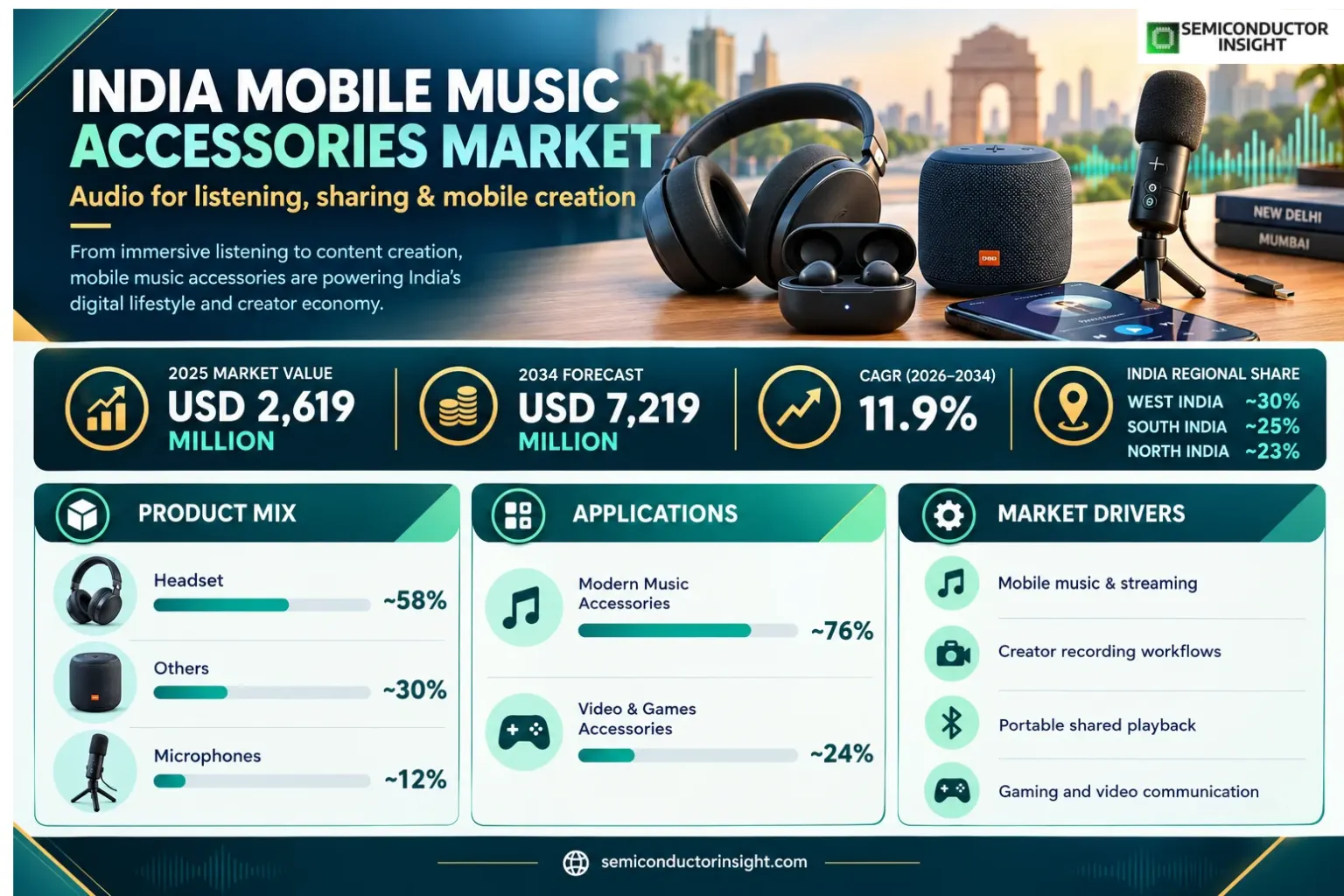
India mobile music accessories market was valued at USD 2,619 million in 2025 and is projected to reach USD 7,219 million by 2034, recording a CAGR of 11.9% over 2025–2034. West India accounts for an estimated ~30% of purchase value, South India ~25%, and North India ~23%, with differing preferences for headsets, speakers and creator microphones.

Get the sample PDF with study scope, segmentation and methodology details.

Key Statistics

2025 Market Size
USD 2,619 million
2034 Projected Size
USD 7,219 million
CAGR (2025–2034)
11.9%
Largest India Zone (2025)
West India (~30%)

Key Takeaways

  • India demand outlook: Finished mobile listening and recording accessories represent USD 2,619 million in 2025 and are forecast to reach USD 7,219 million by 2034 at 11.9% compound growth; spending combines personal headsets, portable speakers and phone-compatible microphones rather than smartphone hardware.
  • Category mix: Headset is the largest product type at a modeled ~58% of 2025 sales, followed by Others at ~30% and Microphones at ~12%; microphones grow fastest at a modeled ~14.2% as mobile video creation becomes more demanding.
  • Application distribution: Modern Music Accessories represents ~76% of demand and Video And Games Accessories ~24%; the latter grows at ~12.6% as voice chat, gaming, live streaming and short-form production require usable audio capture and monitoring.
  • Domestic geography: West India contributes a modeled ~30% of 2025 value, followed by South India at ~25% and North India at ~23%; the South has the fastest modeled growth at ~12.6%, supported by creator and technology-city channels.
  • Commercial dynamics: Brands compete on battery durability, microphone clarity, speaker portability, acoustic processing and distribution reach; warranty performance, promotional pricing and platform compatibility determine whether higher specifications translate into retained revenue.

India Mobile Music Accessories Market Overview

India mobile music accessories market was valued at USD 2,619 million in 2025 and is projected to reach USD 7,219 million by 2034, recording a CAGR of 11.9% over 2025–2034. West India accounts for an estimated ~30% of purchase value, South India ~25%, and North India ~23%, with differing preferences for headsets, speakers and creator microphones.

Base year: 2025 · Estimate: 2026 · Forecast: 2034 · Historical reference: 2021–2024 · Currency: USD million · Geography: India domestic demand

Mobile music accessories comprise finished audio devices that pair with, attach to or capture sound for mobile phones and similarly portable media sources. The product set includes headsets and earbuds for private listening, battery-powered Bluetooth speakers for shared playback, and compact microphones used with mobile recording applications. JBL portable speakers, Shure MV88 USB-C microphones and boAt audio headsets illustrate different hardware functions within this common demand boundary. Retail transaction value is assigned to the finished accessory, not to a Bluetooth chip or a phone in which audio software runs.

The market includes mobile-compatible headphones, microphones and the Others category, notably wireless portable speakers and related listening hardware. Phones, streaming memberships, generic semiconductors, unrelated charging adapters and fixed non-mobile hi-fi systems are outside scope. A headset purchased for music and gaming is allocated to its primary application rather than counted twice. The narrower India Music Bluetooth Headsets category has its own publisher monetary anchors and must not be added to or subtracted from the broader accessory total. The present denominator is defined by mobile music hardware purchases in India.

The technology proposition differs by device. JBL Flip 7 specifies IP68 protection, Auracast multi-speaker capability and up to 16 hours of rated playtime; Sony ULT FIELD speakers emphasize bass response and portable operation; Shure MV88 models address mobile microphone capture and directional recording. Headsets instead prioritize isolation, fit, latency and microphone processing. These specifications are supplier claims or technical descriptions, not audited India-wide sell-through figures. Product families vary widely in average selling price, so unit shipments and revenue mix should not be assumed to track each other.

A large connected-device population makes mobile audio a daily activity across commuting, informal gatherings, study, short-form video and casual games. India telecommunications performance statistics describe the potential connected audience, but they do not establish how many microphones or speakers were sold. Purchasing power, replacement intervals, online promotional cycles and warranty confidence influence realized revenue. West India has a broad retail and premium-audio base; southern cities contribute a strong technology and creator ecosystem; northern and eastern districts offer varied price and channel opportunities.

The forward mix is increasingly differentiated by use case rather than only by wireless connectivity. A content creator may value clean vocal pickup and USB-C compatibility, whereas a student may prioritize headset comfort and low-latency game communication. Portable speaker buyers assess splash resistance, stereo pairing and physical durability for outdoor use. Feature convergence complicates product classification: a party speaker may accept microphone input but remains in Others unless it is sold primarily as a standalone microphone. Transparent application assignment keeps the two publisher application groups commercially interpretable.

Segment Analysis: By Type

Headset contributes a modeled ~58% of 2025 mobile music accessory revenue, Others ~30%, and Microphones ~12%. Their respective modeled growth rates are ~11.6%, ~11.6% and ~14.2%; these are revenue allocations for India rather than disclosed manufacturer shipment shares. The category distinction follows the product function sold to a mobile user, not the accessory maker’s broader electronics portfolio.

Type Function Market position
Microphones Mobile microphones provide speech, singing and ambient-sound capture for smartphone video, interviews, podcasts and field recording. Shure MV88 USB-C and MV88+ accessories illustrate directional pickup and mobile-device integration, where connector compatibility, monitoring capability and handling noise influence product choice. Microphone demand includes external recording hardware rather than the tiny microphones embedded in every smartphone or wireless earbud. Creator workflows and software support help differentiate purpose-built recording products from ordinary hands-free call microphones. Microphones hold a modeled ~12% of 2025 value and grow at ~14.2% through 2034, the fastest of the three publisher types. The segment starts from a smaller base and is exposed to discretionary creator spending, but higher-value mobile recording kits can raise revenue per purchase. Sellers need to demonstrate practical phone compatibility and explain the difference between a simple clip-on microphone and a more capable stereo or directional recording device.
Headset The Headset type covers mobile-compatible in-ear, neckband and over-ear listening products, including wireless music headsets and qualifying mobile gaming headphones. Sony WH-1000XM6, JBL Tune 770NC and OnePlus Buds Pro 3 illustrate varied approaches to noise control, portability and ecosystem features. Headset revenue includes the finished listening device rather than an embedded audio processor, while wired models enter only where they are sold as mobile accessories. Fit, charging reliability and call intelligibility strongly affect repeat purchases. Headset is the largest modeled category at ~58% of 2025 sales and ~11.6% forecast CAGR. Its share reflects frequent private listening, commuting and entertainment use, but heavy online competition makes average selling prices volatile. Buyers compare battery ratings, active noise cancellation, wireless codecs, after-sales service and return policies. Retail assortment ranges from entry-level neckbands to premium over-ear models, so the mix matters more than a single representative headset price.
Others Others primarily comprises portable Bluetooth speakers and other mobile-compatible audio peripherals not classified as standalone microphones or headsets. Sony ULT FIELD, JBL Flip and boAt Stone products demonstrate music playback for groups, outdoor settings and informal gatherings. A speaker may provide microphone or karaoke connectivity without becoming a microphone category sale. Device portability, rated water resistance, pairing methods and battery maintenance influence buyer selection, while permanent living-room hi-fi installations are excluded from this mobile-accessory denominator. Others accounts for an estimated ~30% of 2025 revenue with ~11.6% modeled annual growth, reflecting portable-speaker spending across price tiers. Premium units support higher ticket values, while compact entry-level products broaden access. Speaker replacement can be less frequent than earbud replacement, and buying occasions include gifting, travel and small social events. Supplier positioning therefore depends on physical robustness and demonstrable playback quality as well as online discount visibility.

Segment Analysis: By Application

Modern Music Accessories represents ~76% of 2025 value and grows at a modeled ~11.7%; Video And Games Accessories represents ~24% and grows at ~12.6%. Both groups can use the same physical devices, but sales are allocated by principal buying purpose to avoid double counting. These exact publisher application names are retained rather than replaced with invented categories.

Application Demand characteristics
Modern Music Accessories Modern Music Accessories encompasses mobile music streaming, listening, shared portable playback and music-focused creator recording. It contributes ~76% of modeled 2025 value, supported by headphones, Bluetooth speakers and music-capture microphones. JBL portable speakers and Sony wireless listening devices are relevant examples of product capability, while Shure recording microphones serve more specialized needs. The modeled ~11.7% CAGR reflects replacement, premium features and wider retail reach, moderated by price-sensitive purchasing and competition from built-in smartphone audio.
Video And Games Accessories Video And Games Accessories covers mobile gaming headsets, voice communication, video recording, live streaming and accessory audio used while producing or consuming moving-image content. The category represents ~24% of modeled 2025 revenue and expands at ~12.6% annually, faster than the overall market. Microphone placement, low latency, app compatibility and reliable monitoring matter more here than maximum speaker loudness. A multi-purpose device is counted once according to primary demand, not separately for every compatible gaming or recording application.

Sales channels differ between applications. Music listeners commonly discover products through marketplaces, brand stores and electronics retailers, whereas video creators may seek specialist demonstrations of microphone connectors, gain handling and monitoring. Both channels must manage product returns caused by unrealistic battery claims, compatibility misunderstandings or poor fit. Higher engagement does not automatically guarantee higher accessory revenue because smartphone-integrated microphones and speakers remain substitutes for casual use.

The application split should be interpreted as a modeled primary-use allocation rather than a survey of all listening hours. A gaming headset can also play music, and a portable speaker can support a video call, yet neither secondary use creates a second product sale. Over the forecast, creator-oriented bundles may raise the Video And Games share, while everyday music listening continues to dominate total spending because of its broader audience and frequent replacement cycle.
India Mobile Music Accessories Market Size, Forecast, Opportunities, 2034

Regional Analysis

India demand is distributed across five domestic consumption zones rather than five international regions. West India leads at ~30%, followed by South India ~25%, North India ~23%, East India ~15%, and Central & Northeast India ~7%. South India has the highest modeled ~12.6% CAGR, compared with West India ~12.2% and North India ~11.7%. These estimates reflect purchase locations, channel coverage and price mix rather than factory output or audited regional retail sales.

How does the geographic mix influence product distribution and audio-accessory positioning?

The western and southern metropolitan corridors support comparatively broad ranges of mobile listening devices, including premium noise-cancelling headphones, water-resistant portable speakers and creator microphones. Northern demand combines dense Delhi NCR spending with a wider value-oriented catchment, while eastern and central distributors must balance inventory cost against service coverage. Product availability is not the same as regional revenue: online orders, brand warehouses and consumer residence can be located in different states, requiring a consistent demand-location convention.

The regional growth model uses distinct category mixes rather than uniform nationwide expansion. South India’s ~12.6% modeled CAGR is associated with creator workflows and gaming use; West India’s ~12.2% is supported by premium accessory spending; North India advances ~11.7% as channel breadth improves. East India and Central & Northeast India are modeled at ~11.1% and ~10.6%, respectively. These values are directional allocations, and vendor catalogues alone cannot substantiate exact state-level sales shares.

Region Position Growth outlook Demand profile What decides supplier selection
West India ~30% of 2025 demand ~12.2% CAGR premium portable speakers, high-value headsets and recording accessories service-center depth and multi-channel product authenticity
South India ~25% of 2025 demand ~12.6% CAGR technology-worker listening, mobile creator microphones and gaming audio connector support, latency transparency and warranty turnaround
North India ~23% of 2025 demand ~11.7% CAGR commuting headphones, value speakers and family entertainment purchases price clarity, stock availability and reliable product returns
East India ~15% of 2025 demand ~11.1% CAGR affordable mobile listening and compact shared-audio products genuine-product assurance and after-sales reach beyond capitals
Central & Northeast India ~7% of 2025 demand ~10.6% CAGR durable budget audio and portable listening for dispersed communities last-mile logistics, battery warranty and clear device compatibility

West India ~30% share · ~12.2% CAGR

Why does West India matter to mobile audio accessory suppliers?

West India accounts for an estimated ~30% of India mobile music accessory revenue in 2025 and follows a modeled ~12.2% annual growth path to 2034. The zone is characterized by metropolitan premium retail, coastal recreation and gifting, which shapes whether buyers choose premium speakers, mainstream headsets or specialist microphones. The ~30% share for West India represents consumer purchasing value rather than the location of electronics assembly. Within West India, channel breadth and after-sales execution influence whether interest becomes repeat purchasing and sustained accessory value.

Market positionLargest demand zone; ~30% share in 2025
Growth outlook~12.2% CAGR; 2026–2034 replacement and adoption
Demand profilepremium portable speakers, high-value headsets and recording accessories
Market access gateservice-center depth and multi-channel product authenticity
Country Position in region What drives demand
Maharashtra Major urban demand Maharashtra demand is concentrated around Mumbai and Pune, with listening, entertainment and occasional mobile recording purchases shaped by metropolitan premium retail, coastal recreation and gifting. Retailers serving Maharashtra carry headsets, portable speakers and recording microphones with different buyer requirements and stock turnover. The ~30% 2025 allocation for the wider West India zone and ~12.2% growth outlook are not independently verified figures for Maharashtra. In Maharashtra, practical supplier differentiators include service-center depth and multi-channel product authenticity, and cross-state online fulfillment can distort shipment-based comparisons.
Gujarat Mixed urban and regional Gujarat demand is concentrated around Ahmedabad and Surat, with listening, entertainment and occasional mobile recording purchases shaped by metropolitan premium retail, coastal recreation and gifting. Retailers serving Gujarat carry headsets, portable speakers and recording microphones with different buyer requirements and stock turnover. The ~30% 2025 allocation for the wider West India zone and ~12.2% growth outlook are not independently verified figures for Gujarat. In Gujarat, practical supplier differentiators include service-center depth and multi-channel product authenticity, and cross-state online fulfillment can distort shipment-based comparisons.
Goa Distribution extension Goa demand is concentrated around Panaji and coastal tourism corridors, with listening, entertainment and occasional mobile recording purchases shaped by metropolitan premium retail, coastal recreation and gifting. Retailers serving Goa carry headsets, portable speakers and recording microphones with different buyer requirements and stock turnover. The ~30% 2025 allocation for the wider West India zone and ~12.2% growth outlook are not independently verified figures for Goa. In Goa, practical supplier differentiators include service-center depth and multi-channel product authenticity, and cross-state online fulfillment can distort shipment-based comparisons.

Market instances

  • Portable-speaker placement JBL Flip portable speakers, Sony ULT FIELD models and mobile recording microphones provide examples of devices relevant to premium portable speakers, high-value headsets and recording accessories. Retail teams serving West India should demonstrate portability, charging and pairing rather than infer market-wide shipments from a product listing. A ~30% regional share is a demand model for 2025, while a ~12.2% growth rate expresses the expected direction of the regional revenue mix. For West India, warranty access and authentic supply affect purchase conversion at entry, middle and premium accessory price points.
  • Mobile capture and creator use The opportunity for phone-compatible microphones in West India depends on content production, connector choices and demonstration of clean speech recording. For West India, the Shure MV88 family illustrates a relevant technical class without documenting any zone-specific microphone sales. Educational video, event recording and creator demand in West India can favor external microphones, although basic phone capture remains a substitute. Supplier performance in West India depends on compatibility advice and demonstrable recording improvement for the intended mobile phone.
  • Channel and inventory economics The distribution structure in West India relies on specialist electronics shops, branded stores and large online marketplaces. Across West India, excessive near-identical headset stock raises aging risk, while too few speaker models can miss gifting and travel occasions. Sellers in West India can organize assortments by acoustic use, battery endurance and price rather than Bluetooth version alone. Service accessibility in West India matters because sealed batteries and vulnerable charging connectors can shorten perceived product life. Predictable warranty and return handling in West India can turn a device failure into a supported repeat purchase rather than lost trust.
  • Gaming and shared listening Audio demand tied to mobile games, video calls and social playback creates different buying priorities in West India. In West India, a gaming customer may prioritize low-latency voice chat, while a social group may favor rugged shared-playback speakers. For customers in West India, claimed features should be checked against the actual handset and app because codec support varies. The region’s modeled ~12.2% CAGR incorporates these use cases without counting a single device sale in two applications.
In the full report: City-by-city sales-channel mapping for West India, price-band splits for headsets and speakers, compatibility requirements for mobile microphones, 2025 share assumptions and 2034 growth sensitivity can be explored with individual distributor interviews.

South India ~25% share · ~12.6% CAGR

Why does South India matter to mobile audio accessory suppliers?

South India accounts for an estimated ~25% of India mobile music accessory revenue in 2025 and follows a modeled ~12.6% annual growth path to 2034. The zone is characterized by digital-content communities, campus buyers and technology employment, which shapes whether buyers choose premium speakers, mainstream headsets or specialist microphones. The ~25% share for South India represents consumer purchasing value rather than the location of electronics assembly. Within South India, channel breadth and after-sales execution influence whether interest becomes repeat purchasing and sustained accessory value.

Market positionFastest modeled expansion; ~25% share in 2025
Growth outlook~12.6% CAGR; 2026–2034 replacement and adoption
Demand profiletechnology-worker listening, mobile creator microphones and gaming audio
Market access gateconnector support, latency transparency and warranty turnaround
Country Position in region What drives demand
Karnataka Major urban demand Karnataka demand is concentrated around Bengaluru and Mysuru, with listening, entertainment and occasional mobile recording purchases shaped by digital-content communities, campus buyers and technology employment. Retailers serving Karnataka carry headsets, portable speakers and recording microphones with different buyer requirements and stock turnover. The ~25% 2025 allocation for the wider South India zone and ~12.6% growth outlook are not independently verified figures for Karnataka. In Karnataka, practical supplier differentiators include connector support, latency transparency and warranty turnaround, and cross-state online fulfillment can distort shipment-based comparisons.
Tamil Nadu Mixed urban and regional Tamil Nadu demand is concentrated around Chennai and Coimbatore, with listening, entertainment and occasional mobile recording purchases shaped by digital-content communities, campus buyers and technology employment. Retailers serving Tamil Nadu carry headsets, portable speakers and recording microphones with different buyer requirements and stock turnover. The ~25% 2025 allocation for the wider South India zone and ~12.6% growth outlook are not independently verified figures for Tamil Nadu. In Tamil Nadu, practical supplier differentiators include connector support, latency transparency and warranty turnaround, and cross-state online fulfillment can distort shipment-based comparisons.
Telangana and Kerala Distribution extension Telangana and Kerala demand is concentrated around Hyderabad, Kochi and Thiruvananthapuram, with listening, entertainment and occasional mobile recording purchases shaped by digital-content communities, campus buyers and technology employment. Retailers serving Telangana and Kerala carry headsets, portable speakers and recording microphones with different buyer requirements and stock turnover. The ~25% 2025 allocation for the wider South India zone and ~12.6% growth outlook are not independently verified figures for Telangana and Kerala. In Telangana and Kerala, practical supplier differentiators include connector support, latency transparency and warranty turnaround, and cross-state online fulfillment can distort shipment-based comparisons.

Market instances

  • Portable-speaker placement Shure MV88 microphones, OnePlus earbuds and Sony portable speakers provide examples of devices relevant to technology-worker listening, mobile creator microphones and gaming audio. Retail teams serving South India should demonstrate portability, charging and pairing rather than infer market-wide shipments from a product listing. A ~25% regional share is a demand model for 2025, while a ~12.6% growth rate expresses the expected direction of the regional revenue mix. For South India, warranty access and authentic supply affect purchase conversion at entry, middle and premium accessory price points.
  • Mobile capture and creator use The opportunity for phone-compatible microphones in South India depends on content production, connector choices and demonstration of clean speech recording. For South India, the Shure MV88 family illustrates a relevant technical class without documenting any zone-specific microphone sales. Educational video, event recording and creator demand in South India can favor external microphones, although basic phone capture remains a substitute. Supplier performance in South India depends on compatibility advice and demonstrable recording improvement for the intended mobile phone.
  • Channel and inventory economics The distribution structure in South India relies on creator retailers, regional distributors and manufacturer web stores. Across South India, excessive near-identical headset stock raises aging risk, while too few speaker models can miss gifting and travel occasions. Sellers in South India can organize assortments by acoustic use, battery endurance and price rather than Bluetooth version alone. Service accessibility in South India matters because sealed batteries and vulnerable charging connectors can shorten perceived product life. Predictable warranty and return handling in South India can turn a device failure into a supported repeat purchase rather than lost trust.
  • Gaming and shared listening Audio demand tied to mobile games, video calls and social playback creates different buying priorities in South India. In South India, a gaming customer may prioritize low-latency voice chat, while a social group may favor rugged shared-playback speakers. For customers in South India, claimed features should be checked against the actual handset and app because codec support varies. The region’s modeled ~12.6% CAGR incorporates these use cases without counting a single device sale in two applications.
In the full report: City-by-city sales-channel mapping for South India, price-band splits for headsets and speakers, compatibility requirements for mobile microphones, 2025 share assumptions and 2034 growth sensitivity can be explored with individual distributor interviews.

North India ~23% share · ~11.7% CAGR

Why does North India matter to mobile audio accessory suppliers?

North India accounts for an estimated ~23% of India mobile music accessory revenue in 2025 and follows a modeled ~11.7% annual growth path to 2034. The zone is characterized by dense urban retail, educational centers and diverse spending tiers, which shapes whether buyers choose premium speakers, mainstream headsets or specialist microphones. The ~23% share for North India represents consumer purchasing value rather than the location of electronics assembly. Within North India, channel breadth and after-sales execution influence whether interest becomes repeat purchasing and sustained accessory value.

Market positionLarge mixed-price market; ~23% share in 2025
Growth outlook~11.7% CAGR; 2026–2034 replacement and adoption
Demand profilecommuting headphones, value speakers and family entertainment purchases
Market access gateprice clarity, stock availability and reliable product returns
Country Position in region What drives demand
Delhi NCR Major urban demand Delhi NCR demand is concentrated around Delhi, Noida and Gurugram, with listening, entertainment and occasional mobile recording purchases shaped by dense urban retail, educational centers and diverse spending tiers. Retailers serving Delhi NCR carry headsets, portable speakers and recording microphones with different buyer requirements and stock turnover. The ~23% 2025 allocation for the wider North India zone and ~11.7% growth outlook are not independently verified figures for Delhi NCR. In Delhi NCR, practical supplier differentiators include price clarity, stock availability and reliable product returns, and cross-state online fulfillment can distort shipment-based comparisons.
Uttar Pradesh Mixed urban and regional Uttar Pradesh demand is concentrated around Lucknow, Kanpur and Varanasi, with listening, entertainment and occasional mobile recording purchases shaped by dense urban retail, educational centers and diverse spending tiers. Retailers serving Uttar Pradesh carry headsets, portable speakers and recording microphones with different buyer requirements and stock turnover. The ~23% 2025 allocation for the wider North India zone and ~11.7% growth outlook are not independently verified figures for Uttar Pradesh. In Uttar Pradesh, practical supplier differentiators include price clarity, stock availability and reliable product returns, and cross-state online fulfillment can distort shipment-based comparisons.
Rajasthan and Punjab Distribution extension Rajasthan and Punjab demand is concentrated around Jaipur, Ludhiana and Chandigarh, with listening, entertainment and occasional mobile recording purchases shaped by dense urban retail, educational centers and diverse spending tiers. Retailers serving Rajasthan and Punjab carry headsets, portable speakers and recording microphones with different buyer requirements and stock turnover. The ~23% 2025 allocation for the wider North India zone and ~11.7% growth outlook are not independently verified figures for Rajasthan and Punjab. In Rajasthan and Punjab, practical supplier differentiators include price clarity, stock availability and reliable product returns, and cross-state online fulfillment can distort shipment-based comparisons.

Market instances

  • Portable-speaker placement boAt Stone speakers, JBL Tune headsets and entry creator microphones provide examples of devices relevant to commuting headphones, value speakers and family entertainment purchases. Retail teams serving North India should demonstrate portability, charging and pairing rather than infer market-wide shipments from a product listing. A ~23% regional share is a demand model for 2025, while a ~11.7% growth rate expresses the expected direction of the regional revenue mix. For North India, warranty access and authentic supply affect purchase conversion at entry, middle and premium accessory price points.
  • Mobile capture and creator use The opportunity for phone-compatible microphones in North India depends on content production, connector choices and demonstration of clean speech recording. For North India, the Shure MV88 family illustrates a relevant technical class without documenting any zone-specific microphone sales. Educational video, event recording and creator demand in North India can favor external microphones, although basic phone capture remains a substitute. Supplier performance in North India depends on compatibility advice and demonstrable recording improvement for the intended mobile phone.
  • Channel and inventory economics The distribution structure in North India relies on shopping malls, electronics chains and local mobile-accessory dealers. Across North India, excessive near-identical headset stock raises aging risk, while too few speaker models can miss gifting and travel occasions. Sellers in North India can organize assortments by acoustic use, battery endurance and price rather than Bluetooth version alone. Service accessibility in North India matters because sealed batteries and vulnerable charging connectors can shorten perceived product life. Predictable warranty and return handling in North India can turn a device failure into a supported repeat purchase rather than lost trust.
  • Gaming and shared listening Audio demand tied to mobile games, video calls and social playback creates different buying priorities in North India. In North India, a gaming customer may prioritize low-latency voice chat, while a social group may favor rugged shared-playback speakers. For customers in North India, claimed features should be checked against the actual handset and app because codec support varies. The region’s modeled ~11.7% CAGR incorporates these use cases without counting a single device sale in two applications.
In the full report: City-by-city sales-channel mapping for North India, price-band splits for headsets and speakers, compatibility requirements for mobile microphones, 2025 share assumptions and 2034 growth sensitivity can be explored with individual distributor interviews.

East India ~15% share · ~11.1% CAGR

Why does East India matter to mobile audio accessory suppliers?

East India accounts for an estimated ~15% of India mobile music accessory revenue in 2025 and follows a modeled ~11.1% annual growth path to 2034. The zone is characterized by newer omnichannel coverage, student demand and smaller-city growth, which shapes whether buyers choose premium speakers, mainstream headsets or specialist microphones. The ~15% share for East India represents consumer purchasing value rather than the location of electronics assembly. Within East India, channel breadth and after-sales execution influence whether interest becomes repeat purchasing and sustained accessory value.

Market positionExpanding distribution footprint; ~15% share in 2025
Growth outlook~11.1% CAGR; 2026–2034 replacement and adoption
Demand profileaffordable mobile listening and compact shared-audio products
Market access gategenuine-product assurance and after-sales reach beyond capitals
Country Position in region What drives demand
West Bengal Major urban demand West Bengal demand is concentrated around Kolkata and Howrah, with listening, entertainment and occasional mobile recording purchases shaped by newer omnichannel coverage, student demand and smaller-city growth. Retailers serving West Bengal carry headsets, portable speakers and recording microphones with different buyer requirements and stock turnover. The ~15% 2025 allocation for the wider East India zone and ~11.1% growth outlook are not independently verified figures for West Bengal. In West Bengal, practical supplier differentiators include genuine-product assurance and after-sales reach beyond capitals, and cross-state online fulfillment can distort shipment-based comparisons.
Odisha Mixed urban and regional Odisha demand is concentrated around Bhubaneswar and Cuttack, with listening, entertainment and occasional mobile recording purchases shaped by newer omnichannel coverage, student demand and smaller-city growth. Retailers serving Odisha carry headsets, portable speakers and recording microphones with different buyer requirements and stock turnover. The ~15% 2025 allocation for the wider East India zone and ~11.1% growth outlook are not independently verified figures for Odisha. In Odisha, practical supplier differentiators include genuine-product assurance and after-sales reach beyond capitals, and cross-state online fulfillment can distort shipment-based comparisons.
Bihar and Jharkhand Distribution extension Bihar and Jharkhand demand is concentrated around Patna, Ranchi and Jamshedpur, with listening, entertainment and occasional mobile recording purchases shaped by newer omnichannel coverage, student demand and smaller-city growth. Retailers serving Bihar and Jharkhand carry headsets, portable speakers and recording microphones with different buyer requirements and stock turnover. The ~15% 2025 allocation for the wider East India zone and ~11.1% growth outlook are not independently verified figures for Bihar and Jharkhand. In Bihar and Jharkhand, practical supplier differentiators include genuine-product assurance and after-sales reach beyond capitals, and cross-state online fulfillment can distort shipment-based comparisons.

Market instances

  • Portable-speaker placement Zebronics Sound Feast, boAt portable speakers and budget wireless headsets provide examples of devices relevant to affordable mobile listening and compact shared-audio products. Retail teams serving East India should demonstrate portability, charging and pairing rather than infer market-wide shipments from a product listing. A ~15% regional share is a demand model for 2025, while a ~11.1% growth rate expresses the expected direction of the regional revenue mix. For East India, warranty access and authentic supply affect purchase conversion at entry, middle and premium accessory price points.
  • Mobile capture and creator use The opportunity for phone-compatible microphones in East India depends on content production, connector choices and demonstration of clean speech recording. For East India, the Shure MV88 family illustrates a relevant technical class without documenting any zone-specific microphone sales. Educational video, event recording and creator demand in East India can favor external microphones, although basic phone capture remains a substitute. Supplier performance in East India depends on compatibility advice and demonstrable recording improvement for the intended mobile phone.
  • Channel and inventory economics The distribution structure in East India relies on local distributors, marketplace fulfillment and neighborhood phone retailers. Across East India, excessive near-identical headset stock raises aging risk, while too few speaker models can miss gifting and travel occasions. Sellers in East India can organize assortments by acoustic use, battery endurance and price rather than Bluetooth version alone. Service accessibility in East India matters because sealed batteries and vulnerable charging connectors can shorten perceived product life. Predictable warranty and return handling in East India can turn a device failure into a supported repeat purchase rather than lost trust.
  • Gaming and shared listening Audio demand tied to mobile games, video calls and social playback creates different buying priorities in East India. In East India, a gaming customer may prioritize low-latency voice chat, while a social group may favor rugged shared-playback speakers. For customers in East India, claimed features should be checked against the actual handset and app because codec support varies. The region’s modeled ~11.1% CAGR incorporates these use cases without counting a single device sale in two applications.
In the full report: City-by-city sales-channel mapping for East India, price-band splits for headsets and speakers, compatibility requirements for mobile microphones, 2025 share assumptions and 2034 growth sensitivity can be explored with individual distributor interviews.

Central & Northeast India ~7% share · ~10.6% CAGR

Why does Central & Northeast India matter to mobile audio accessory suppliers?

Central & Northeast India accounts for an estimated ~7% of India mobile music accessory revenue in 2025 and follows a modeled ~10.6% annual growth path to 2034. The zone is characterized by regional retail penetration, college audiences and travel use, which shapes whether buyers choose premium speakers, mainstream headsets or specialist microphones. The ~7% share for Central & Northeast India represents consumer purchasing value rather than the location of electronics assembly. Within Central & Northeast India, channel breadth and after-sales execution influence whether interest becomes repeat purchasing and sustained accessory value.

Market positionSmaller geographically dispersed zone; ~7% share in 2025
Growth outlook~10.6% CAGR; 2026–2034 replacement and adoption
Demand profiledurable budget audio and portable listening for dispersed communities
Market access gatelast-mile logistics, battery warranty and clear device compatibility
Country Position in region What drives demand
Madhya Pradesh Major urban demand Madhya Pradesh demand is concentrated around Indore and Bhopal, with listening, entertainment and occasional mobile recording purchases shaped by regional retail penetration, college audiences and travel use. Retailers serving Madhya Pradesh carry headsets, portable speakers and recording microphones with different buyer requirements and stock turnover. The ~7% 2025 allocation for the wider Central & Northeast India zone and ~10.6% growth outlook are not independently verified figures for Madhya Pradesh. In Madhya Pradesh, practical supplier differentiators include last-mile logistics, battery warranty and clear device compatibility, and cross-state online fulfillment can distort shipment-based comparisons.
Chhattisgarh Mixed urban and regional Chhattisgarh demand is concentrated around Raipur and Bilaspur, with listening, entertainment and occasional mobile recording purchases shaped by regional retail penetration, college audiences and travel use. Retailers serving Chhattisgarh carry headsets, portable speakers and recording microphones with different buyer requirements and stock turnover. The ~7% 2025 allocation for the wider Central & Northeast India zone and ~10.6% growth outlook are not independently verified figures for Chhattisgarh. In Chhattisgarh, practical supplier differentiators include last-mile logistics, battery warranty and clear device compatibility, and cross-state online fulfillment can distort shipment-based comparisons.
Assam and northeastern states Distribution extension Assam and northeastern states demand is concentrated around Guwahati, Shillong and Imphal, with listening, entertainment and occasional mobile recording purchases shaped by regional retail penetration, college audiences and travel use. Retailers serving Assam and northeastern states carry headsets, portable speakers and recording microphones with different buyer requirements and stock turnover. The ~7% 2025 allocation for the wider Central & Northeast India zone and ~10.6% growth outlook are not independently verified figures for Assam and northeastern states. In Assam and northeastern states, practical supplier differentiators include last-mile logistics, battery warranty and clear device compatibility, and cross-state online fulfillment can distort shipment-based comparisons.

Market instances

  • Portable-speaker placement portable boAt and Zebronics audio, compact headsets and selected creator kits provide examples of devices relevant to durable budget audio and portable listening for dispersed communities. Retail teams serving Central & Northeast India should demonstrate portability, charging and pairing rather than infer market-wide shipments from a product listing. A ~7% regional share is a demand model for 2025, while a ~10.6% growth rate expresses the expected direction of the regional revenue mix. For Central & Northeast India, warranty access and authentic supply affect purchase conversion at entry, middle and premium accessory price points.
  • Mobile capture and creator use The opportunity for phone-compatible microphones in Central & Northeast India depends on content production, connector choices and demonstration of clean speech recording. For Central & Northeast India, the Shure MV88 family illustrates a relevant technical class without documenting any zone-specific microphone sales. Educational video, event recording and creator demand in Central & Northeast India can favor external microphones, although basic phone capture remains a substitute. Supplier performance in Central & Northeast India depends on compatibility advice and demonstrable recording improvement for the intended mobile phone.
  • Channel and inventory economics The distribution structure in Central & Northeast India relies on multi-brand dealers, e-commerce delivery and regional wholesalers. Across Central & Northeast India, excessive near-identical headset stock raises aging risk, while too few speaker models can miss gifting and travel occasions. Sellers in Central & Northeast India can organize assortments by acoustic use, battery endurance and price rather than Bluetooth version alone. Service accessibility in Central & Northeast India matters because sealed batteries and vulnerable charging connectors can shorten perceived product life. Predictable warranty and return handling in Central & Northeast India can turn a device failure into a supported repeat purchase rather than lost trust.
  • Gaming and shared listening Audio demand tied to mobile games, video calls and social playback creates different buying priorities in Central & Northeast India. In Central & Northeast India, a gaming customer may prioritize low-latency voice chat, while a social group may favor rugged shared-playback speakers. For customers in Central & Northeast India, claimed features should be checked against the actual handset and app because codec support varies. The region’s modeled ~10.6% CAGR incorporates these use cases without counting a single device sale in two applications.
In the full report: City-by-city sales-channel mapping for Central & Northeast India, price-band splits for headsets and speakers, compatibility requirements for mobile microphones, 2025 share assumptions and 2034 growth sensitivity can be explored with individual distributor interviews.

Competitive Landscape for India Mobile Music Accessories

Competition spans audio-focused manufacturers, mobile ecosystem brands and local mass-market suppliers. JBL, Sony, boAt and Zebronics supply relevant portable listening products; Shure provides specialist mobile microphone technology; Samsung, OnePlus and Xiaomi participate in phone-connected personal audio. Catalogued availability is evidence of category participation, not a verified national revenue ranking; product assortment and service access vary materially between retail channels.

JBL by Harman competes in portable speakers with ruggedness, sound tuning and connected playback features, while Sony combines ULT FIELD speaker models with established wireless headphone lines. Their product ranges target consumers willing to pay for acoustic design and brand support. At the same time, buyers compare claimed playtime, water protection and multi-speaker functions with actual use conditions. A premium product does not automatically capture the same share of unit shipments as it does of sales value.

boAt and Zebronics address broad Indian retail demand through portable speaker families and accessible personal audio. boAt Stone and Zebronics Sound Feast examples demonstrate that mobile-compatible speakers can be sold for casual gatherings, study environments and outdoor use. Retailers often prioritize clear product specifications and predictable stock replenishment because promotional cycles can rapidly alter the perceived value of a model. Warranty execution is a competitive variable when batteries and charging ports become the main failure points.

Shure occupies a distinct technical position in mobile-compatible recording microphones, where buyer criteria include USB-C connectivity, directional capture and monitoring workflows. This specialized category should not be confused with the microphone component embedded in every headset. Creator-oriented purchases may command higher prices but occur less frequently than mass-market listening purchases. Education, field reporting and video production generate differentiated demand, provided that the recording application and phone operating system are supported.

Samsung, OnePlus, Xiaomi, Sennheiser and Philips supply relevant headsets or earbuds in India, adding ecosystem compatibility and noise-control differentiation. Their presence illustrates why the broader accessory market cannot be represented solely by speaker brands. The profiled companies do not all manufacture every accessory type, and some participate only through a narrow product line. Tier placement reflects product reach and category breadth, not an assertion of audited market share or independent factory capacity.

Tier structure

Tier Companies Basis of competition
Tier 1 JBL by Harman; Sony India; boAt Lifestyle Multi-format portable audio or extensive Indian mobile listening catalogues, with broad retailer visibility and recognizable brand propositions.
Tier 2 Zebronics India; Sennheiser India; Samsung India; Xiaomi India Strong participation in selected portable speaker, wireless headset or ecosystem-led product categories rather than uniform coverage of all types.
Specialist / adjacent Shure India; Philips India; Skullcandy; Bose India; Bang & Olufsen Specialized mobile microphones, focused headset lines or premium audio presence; listing indicates relevant technology, not equal national volume.

Key companies profiled

  • boAt Lifestyle
  • JBL by Harman
  • Sennheiser Electronics India
  • Sony India
  • Philips India
  • Skullcandy
  • Bose India
  • Zebronics India
  • Bang & Olufsen
  • Xiaomi India
  • Shure India
  • Samsung India
  • OnePlus India

Production Capacity and Distribution Analysis

Indian accessory availability reflects imported finished hardware, local brand sourcing, assembly arrangements, distributors and direct-to-consumer fulfillment. Public product pages do not establish plant-level capacity or the domestic manufacturing share for each device. Production analysis therefore separates manufacturing capability from India consumption and avoids inferring factory output from marketplace listings; component sourcing and finished-product origin need separate model-level evidence.

The supply base spans acoustic drivers, molded housings, rechargeable cells, microphones, Bluetooth control electronics and finished-product assembly. Supplier specialization differs across headsets, portable speakers and mobile microphones. A speaker may need a larger acoustic enclosure and rugged seal, while a compact USB-C microphone needs stable digital audio integration. Neither bill of materials establishes whether final assembly occurs within India; country-of-origin and sourcing evidence must be evaluated by product model.

Inventory planning matters because music accessories have fast-changing model cycles and diverse price points. Regional distributors choose whether to stock entry-level headsets, midrange speakers and specialist microphones in different proportions. A product can be listed nationwide but unavailable in a smaller city, so online catalog breadth should not be treated as fulfilled unit volume. Replacement parts, battery service and reliable product identification are essential for maintaining customer confidence.

Capacity constraints are often commercial rather than purely factory related. Quality variation in lithium batteries, charging circuits, waterproof seals and wireless pairing can increase returns or require redesign. Mobile microphone products also face connector and operating-system transitions that can make old inventory less attractive. Suppliers able to validate compatibility, sustain firmware support and forecast promotion-driven demand can improve effective sell-through without necessarily increasing nominal assembly capacity.

Market Dynamics, Drivers, Restraints and Opportunities

Growth is shaped by three interacting behaviors: personal listening replacement, shared portable playback and mobile content production. The impact model allocates the 2025–2034 revenue growth rate across demand drivers and offsets, with higher contributions assigned to widespread purchase occasions. The allocations are modeled directional contributions rather than measured causal coefficients for individual companies.

MARKET DRIVERS

Drivers Impact Analysis*

Market Drivers Impact Rank CAGR Contribution (%) 2026–2028 2029–2031 2032–2034
Everyday mobile listening and headset replacement High +5.40% High High Medium
Portable speaker adoption for social playback High +4.10% High High High
Short-form video and creator microphone demand Medium-High +3.20% Medium High High
Gaming voice communication and content streaming Medium +2.40% Medium High High
Premium audio features and better durability Low-Medium +1.90% Medium Medium High
Others (distribution reach and gifting occasions) Low +0.80% Low Medium Medium

Daily listening makes replacement a recurring revenue stream

Mobile music accompanies commutes, study, exercise and home entertainment, producing many opportunities to replace an aging headset. Wireless earbuds and neckbands have compact batteries and charging cases that can become less convenient over time, while over-ear designs compete through comfort and noise control. This broad frequency of use gives Headset a modeled ~58% revenue share and supports the largest driver contribution of +5.40 percentage points. The estimate describes market influence, not a documented causal result from a consumer panel.

Shared playback expands the portable-speaker addressable market

Portable speakers serve informal gatherings, travel, small celebrations and outdoor recreation in situations where a phone’s built-in speaker is insufficient. JBL Flip and Sony ULT FIELD product families illustrate differences in enclosure protection, rated playtime and linked-speaker functions. Buyers consider battery endurance and durability before committing to higher-priced models. The social-playback driver contributes a modeled +4.10 points, with potential for premium mix growth even when individual speakers remain in use longer than inexpensive earbuds.

Mobile video raises demand for intelligible sound capture

Short-form video, educational clips, field interviews and livestreams increase the value of external microphones that connect directly to mobile devices. Shure MV88 USB-C products demonstrate a specialized recording route beyond ordinary hands-free calls. Creator purchases are still narrower than mainstream music listening, but higher-value kits and repeat accessories can increase microphone revenue. The modeled +3.20-point contribution recognizes creator demand while excluding smartphone-integrated microphones and unrelated camera equipment from accessory sales.

Gaming and higher feature expectations support value growth

Voice chat and mobile video gaming favor stable headset connections, practical microphone placement and acceptable audio delay. Meanwhile, noise cancellation, multi-device switching and improved app control can persuade listeners to move to higher-value models. The combined effects are represented through +2.40 points for gaming-related demand and +1.90 points for premium functionality. These are not claims that a particular codec or firmware revision guarantees better sound; the benefit depends on compatible phones, apps and individual product execution.

MARKET RESTRAINTS

Restraints Impact Analysis*

Market Restraints Impact Rank CAGR Contribution (%) 2026–2028 2029–2031 2032–2034
Aggressive discounting and price sensitivity High -2.20% High High High
Battery deterioration and after-sales service gaps Medium-High -1.80% Medium High High
Phone compatibility and wireless latency limits Medium -1.20% Medium Medium Medium
Others (counterfeit listings and channel inventory) Low -0.70% Medium Low Low
*CAGR contribution shows the percentage points each factor adds to or removes from the forecast CAGR for 2026–2034; driver contributions less restraint contributions equal the market CAGR. The three period columns identify the strength of each factor within the corresponding forecast interval.

Price competition limits the revenue captured per replacement

Online promotions allow shoppers to compare many apparently similar headphones and speakers within minutes, reducing the premium attached to basic wireless connectivity. Budget brands may gain units without comparable growth in rupee revenue, while higher-priced products face scrutiny over sound and warranty benefits. This price pressure is the largest modeled restraint at −2.20 percentage points. A supplier seeking higher realized prices needs credible differentiation, clear specifications and dependable service rather than relying on list prices or occasional discounts.

Battery and charging problems create return and reputation costs

Small rechargeable products depend on cell quality, charging-port robustness and software power management. Portable speakers also need seals that withstand real use without making repair prohibitively difficult. Battery wear can stimulate replacement sales but also discourage a customer from repurchasing the same brand. The modeled −1.80-point effect captures service friction and avoidable returns. Clear warranty policies and battery-life communication can help, although vendor-rated hours should never be presented as independently measured consumer endurance.

Compatibility gaps reduce the practical value of advanced features

Bluetooth audio capabilities vary by handset, operating system, application and accessory firmware. A feature advertised for one ecosystem may not work in the same way with another phone, and wireless delay can remain unsuitable for some interactive or recording tasks. External microphones introduce additional connector and power requirements. These limitations account for a modeled −1.20-point restraint. Retailers can reduce friction by testing representative phone combinations and explaining supported functions before purchase, particularly for creator microphones and gaming headsets.

Counterfeit exposure and excess inventory weaken confidence

Unofficial listings, ambiguous model identifiers and old-stock accessories can create confusion over warranty eligibility or expected functionality. A channel may also hold several generations of similar products while promotions shift consumer attention toward a newer model. These pressures contribute an estimated −0.70 points under other restraints. Clear serial identification, authorized distribution and careful inventory rotation can protect consumer confidence, especially in regions where buyers have fewer nearby service centers or opportunities for product demonstrations.

MARKET OPPORTUNITIES

Creator-ready microphone bundles

Mobile video creators need combinations of microphone, connector, windshield, mounting support and monitoring that work reliably with a particular phone. A carefully specified bundle can reduce trial-and-error purchases and increase average accessory value without including unrelated camera equipment. Specialist retailers could demonstrate voice clarity in real environments and identify where a built-in handset microphone is already adequate. This approach supports a smaller but faster-growing Microphones category with modeled ~14.2% annual expansion.

Durable speakers for travel and small gatherings

Rugged portable speakers can differentiate through waterproofing, carrying convenience, charge reliability and group playback. JBL Flip 7’s listed IP68 protection and Sony ULT FIELD products show different approaches to mobile shared listening, though published ratings are not guarantees against all damage. Vendors can develop use-specific assortments for travel, hostels and informal events, while avoiding unsupported claims about outdoor usage volumes. Demonstrations of portability and pairing may justify value premiums more effectively than wattage alone.

Improved service reach beyond the largest cities

Eastern, central and northeastern markets have modeled shares below the western and southern zones but remain commercially meaningful. Retailers can build trust by offering authentic products, transparent replacement procedures and accessible warranty channels. A regional strategy should account for longer delivery distances and different price sensitivity instead of copying the assortment of Mumbai or Bengaluru. Better support could help customers adopt portable speakers or creator microphones that currently seem too risky to purchase without in-person advice.

Audio ecosystems spanning entertainment and communication

Mobile accessories increasingly serve several tasks during the same day: music playback, gaming, video meetings and content creation. This encourages bundles or families that provide consistent app control, reliable Bluetooth switching and clear compatibility guidance. The opportunity is not to count each task as a separate sale but to capture higher satisfaction and reduce churn. Headset makers, speaker brands and microphone specialists can cooperate with retailers to explain complementary use cases without merging their distinct product categories.

Supply Chain Analysis for Mobile Audio Accessories

The accessory value chain begins with transducers, batteries, wireless electronics and enclosures, proceeds through finished-device design and assembly, and reaches Indian consumers through distributors, branded channels and online fulfillment. Different form factors require different testing and warranty processes, so a headset supply chain cannot be treated as identical to that of a portable speaker or USB-C recording microphone.

Upstream materialsAudio drivers, microphone capsules, lithium batteries, electronic controls, seals, connectors and plastic or metal housings.
Manufacturing and integrationAcoustic tuning, enclosure assembly, firmware, charging validation, Bluetooth interoperability and device quality checks.
Channel accessAuthorized distributors, brand-owned online stores, consumer electronics chains, marketplace sellers and specialist creator retailers.
Downstream useMusic listening, mobile video capture, social playback, gaming voice chat, education, travel and discretionary replacement.

Upstream components. Component choices affect perceived product quality in ways that may not be obvious from marketing descriptions. Speaker-driver geometry and housing resonance influence portable playback, while microphones need appropriate pickup patterns and electronic noise handling. Rechargeable battery quality determines how much rated endurance remains after repeated cycles. Because manufacturers source components differently by model, a shared brand name is insufficient evidence of common production origin or uniform reliability across every accessory category.

Design and assembly. Integration requires electrical, acoustic and mechanical validation. A waterproof portable speaker must maintain its seal around controls and charging points, while a headset must balance weight, microphone positioning and radio performance. A mobile microphone has a separate challenge of connector and app compatibility. Testing costs can be justified by lower return rates, but assembly location and domestic content should not be inferred from a manufacturer’s Indian retail website.

Distribution and inventory. Sales flow through brand stores, marketplaces, electronics retailers and local accessory dealers. Product assortment must reflect regional spending and whether buyers need immediate demonstration or are comfortable ordering from specifications. Promotions can clear old models but may compress margins on current lines. Authorized supply and reliable serial tracking are important where consumers face uncertainty over counterfeit products, especially when a failed battery or connector makes an accessory difficult to repair.

After-sales and renewal. Consumer experience continues after the initial transaction through software updates, replacement claims and battery maintenance. Sony’s dated firmware support for portable speakers demonstrates that an accessory may require continuing software attention after its original sale. Buyers also evaluate whether ear cushions, cables and charging components can be replaced economically. The business opportunity combines new-user adoption with repeat purchases, but replacement demand should not be mistaken for evidence that a manufacturer’s installed base has been independently measured.

Recent Developments in Mobile Music Accessories

  • 30 June 2026 Published
    Sony India posted a firmware support update for its WH-1000XM6 wireless headphones. The dated service record indicates continuing software maintenance for a premium mobile listening product, not the release date of the headphone hardware. For Indian accessory retailers, update availability affects customer expectations about compatibility, feature continuity and warranty communication. It is evidence of an ongoing support ecosystem rather than a quantified increase in local sales or a claim about the whole headset category. Source
  • 22 January 2026 Published
    Sony India released firmware version 4100 for the ULT FIELD 3 portable speaker, describing improved secure communication. This is a software maintenance event for an existing mobile-compatible speaker, not a new product launch. Continued device support can influence buyer confidence in app-connected accessories and suggests that software reliability belongs alongside battery and acoustic performance in purchasing decisions. The notice provides a verifiable date but no national speaker shipment or revenue figure. Source
  • 22 January 2026 Published
    Sony published version 5600 firmware for the ULT FIELD 5 wireless speaker, including a secure-communication improvement. The product belongs to portable shared playback, which is classified within Others rather than Headset or Microphones. A dated firmware notice confirms technical support for an installed product family; it does not independently establish Indian demand, manufacturing capacity or the date when the model first became available. Support continuity may nevertheless matter for consumers comparing premium mobile speakers. Source
  • 18 December 2025 Published
    Sony India issued firmware versions covering ULT FIELD 1, ULT FIELD 7 and ULT TOWER 10 devices, with connectivity and security improvements documented in the release history. The range includes portable and larger party-oriented speakers, but only mobile-compatible use belongs in the accessory boundary. The announcement concerns maintenance of existing products rather than a fresh hardware introduction. For channels, it underscores the importance of software instructions and compatible companion applications when assessing long-term product support. Source
  • 12 September 2025 Announced
    Samsung Newsroom India announced the Galaxy Buds3 FE for the Indian market, highlighting active noise cancellation, call processing and ecosystem functions. This is a dated product announcement for the headset portion of the broader accessory category, not evidence of portable speaker or microphone sales. The launch illustrates how phone-connected audio brands compete through software integration and midrange features. Listed pricing and offers describe launch positioning, not audited annual market revenue or supplier share. Source
  • 3 September 2025 Published
    The Telecom Regulatory Authority of India published performance indicators for the April–June 2025 quarter. The release supplies adjacent context on internet connectivity and the addressable population using mobile services, which can support music streaming and video communication. It does not report sales of headsets, Bluetooth speakers or external microphones and must not be used as a conversion factor for those products. The value lies in separating connected-device infrastructure from finished accessory demand. Source
  • 19 August 2025 Announced
    Samsung announced Galaxy Buds3 FE internationally, describing improved audio, microphone processing and device switching. The global introduction precedes its separately dated India-specific announcement and is not an independent second Indian shipment event. Its technical details show the growing role of ecosystem features in headset competition, while country availability and pricing need local confirmation. This distinction prevents global product news from being misrepresented as verified Indian sell-through or market-share evidence. Source
  • 13 July 2022 Published
    The Bluetooth Special Interest Group announced completion of the LE Audio specifications, establishing a technical framework for future wireless listening and broadcast-audio features. This standards milestone is adjacent to the accessory market rather than a new Indian product shipment or launch. Compatibility still depends on specific source devices, receivers, firmware and certification. Its commercial significance is the possibility of differentiated multi-device experiences, not a measurable increase in national accessory revenue on the announcement date. Source

REPORT SCOPE & SEGMENTATION

Attribute Details
Study Period 2021–2034
Base Year 2025
Estimate Year 2026
Forecast Year 2034
Historical Period 2021–2024
2025 Market Size USD 2,619 million
2026 Market Estimate USD 2,931 million
2034 Forecast USD 7,219 million
Growth Rate CAGR 11.9% over 2025–2034
Unit India finished mobile music accessory sales, USD million
Revenue Boundary Headsets, mobile microphones, portable speakers and qualifying other mobile-compatible audio hardware; excludes phones, streaming subscriptions, fixed non-mobile hi-fi and standalone semiconductor content
By Type Microphones · Headset · Others
By Application Modern Music Accessories · Video And Games Accessories
By Region Domestic Indian zones based on 2025 modeled consumer purchase value; these are not international regions or factory-output shares
West IndiaMaharashtra, Gujarat, Goa
South IndiaKarnataka, Tamil Nadu, Telangana, Kerala, Andhra Pradesh
North IndiaDelhi NCR, Uttar Pradesh, Punjab, Haryana, Rajasthan
East IndiaWest Bengal, Odisha, Bihar, Jharkhand
Central & Northeast IndiaMadhya Pradesh, Chhattisgarh, Assam and other northeastern states
Key Companies Profiled boAt Lifestyle; JBL by Harman; Sennheiser Electronics India; Sony India; Philips India; Skullcandy; Bose India; Zebronics India; Bang & Olufsen; Xiaomi India; Shure India; Samsung India; OnePlus India
Customization Scope Accessory-level revenue splits, city-zone retail mapping, headsets versus speakers versus microphones, creator and gaming use cases, price-band demand, channel inventory and supplier capability assessments are available for tailored commercial analysis.

Frequently Asked Questions

How large is the India mobile music accessories market and how fast is it growing?

The India mobile music accessories market is modeled at USD 2,619 million in 2025 and is projected to reach USD 7,219 million by 2034, a 11.9% compound annual increase. The revenue includes finished mobile-compatible headphones, portable speakers and external microphones rather than smartphones or streaming subscriptions. The projection extends the publisher’s 2024 and 2030 headline values with consistent annual compounding. It should be interpreted as a defined market forecast, not a manufacturer shipment audit.

Which part of India accounts for the most accessory revenue?

West India leads with a modeled ~30% of 2025 value, ahead of South India at ~25% and North India at ~23%. East India contributes ~15%, while Central & Northeast India accounts for ~7%. The zones refer to consumer purchase locations and are not estimates of where devices are assembled. Premium speaker and headset spending in Mumbai and Pune supports western value, while creator and technology-city demand gives the South a faster modeled growth profile.

How is the market divided between microphones, headsets and other products?

Headset represents an estimated ~58% of 2025 accessory revenue, Others ~30% and Microphones ~12%. Others includes portable speakers that connect to mobile devices, while Microphones refers to external recording products rather than tiny components built into handsets. The modeled growth rates are ~11.6% for headsets, ~11.6% for Others and ~14.2% for microphones. Product mix is based on finished hardware value, so unit shipments can follow a different distribution.

What is included in Modern Music Accessories versus Video And Games Accessories?

Modern Music Accessories accounts for ~76% of modeled 2025 demand and includes everyday music listening, portable playback and music-related capture. Video And Games Accessories represents ~24%, covering gaming voice communication, video recording and streaming use. The corresponding modeled annual growth rates are ~11.7% and ~12.6%. A multi-purpose headset is assigned to the principal buying use instead of being counted in both applications, preventing inflated totals from overlapping functionality.

Are portable Bluetooth speakers part of the Indian mobile accessory market?

Yes. Mobile-compatible portable Bluetooth speakers belong in the Others product type when sold primarily for shared listening with phones or similar portable sources. JBL Flip, Sony ULT FIELD, boAt Stone and Zebronics Sound Feast are relevant product families. Permanently installed non-mobile hi-fi equipment is excluded. Technical descriptions such as water protection and rated battery life help explain product differentiation, but catalogue presence alone does not establish Indian revenue or the supplier’s national market share.

Why are external mobile microphones a distinct growth opportunity?

External microphones address creators who need clearer voice pickup, directional recording or mobile video audio beyond a handset’s built-in microphone. Shure MV88 USB-C products illustrate relevant device integration and specialist functionality. The category contributes a modeled ~12% of 2025 value but grows faster at ~14.2% annually because of its smaller base and creator use cases. Buyers still need to verify connector, operating-system and recording-app compatibility before assuming that a microphone will improve every workflow.

Does the broader market include the separate India Bluetooth music headsets market?

Bluetooth music headsets are a product family within broader mobile audio hardware, but the separate India Music Bluetooth Headsets study uses its own publisher monetary anchors and narrower boundary. The two published market totals should not be added, subtracted or forced to reconcile because their coverage and classification rules differ. The broader market includes portable speakers and external microphones as well as headsets. The correct comparison focuses on use cases and product scope rather than an assumed common denominator.

What is driving the fastest regional growth in India?

South India is the fastest modeled domestic zone at ~12.6% CAGR, compared with West India at ~12.2% and North India at ~11.7%. Technology employment, gaming communities, student populations and mobile creator activity support diverse accessory demand around Bengaluru, Chennai and Hyderabad. These rates are directional regional revenue allocations, not official state-level forecasts. Service coverage and practical compatibility demonstrations can influence which device categories gain traction across the southern retail network.

Which factors could constrain mobile music accessory revenue?

Intense price promotions are the leading modeled restraint, followed by battery-related returns, wireless compatibility issues and unofficial distribution. A headset may sell in greater unit numbers while its average selling price falls, and a portable speaker’s battery or charging problem can undermine confidence in the brand. Retailers can reduce these risks with accurate specifications, authorized supply, clear warranty support and realistic use-case demonstrations. Bluetooth version numbers alone do not guarantee superior acoustics or low latency.

What period and geography does the analysis cover?

The study uses 2025 as its base year, 2026 as the estimate and 2034 as the forecast endpoint, with 2021–2024 as historical context. The publisher’s types are Microphones, Headset and Others; applications are Modern Music Accessories and Video And Games Accessories. Regional coverage comprises West, South, North, East, and Central & Northeast India. Market value is finished mobile-compatible audio accessory revenue, excluding handsets, subscriptions, unrelated power accessories and generic chip sales.

Research Sources & Evidence Base

View research sources used for this overview
  1. JBL India. JBL India official mobile-compatible Bluetooth speaker category including Flip 6 and Flip 7, Direct product evidence: JBL India official mobile-compatible Bluetooth speaker category including Flip 6 and Flip 7.
  2. Sony India. Sony India ULT FIELD 3 portable Bluetooth speaker, Direct product evidence: Sony India ULT FIELD 3 portable Bluetooth speaker, bass and party connection features.
  3. Sony India. Sony India ULT FIELD 1 portable speaker, Direct product evidence: Sony India ULT FIELD 1 portable speaker, IP67 and 12-hour rated battery.
  4. Sony India. Sony India ULT FIELD 7 portable wireless speaker, Direct product evidence: Sony India ULT FIELD 7 portable wireless speaker, karaoke and guitar features.
  5. boAt Lifestyle. boAt Stone 352 10W Bluetooth portable speaker, Direct product evidence: boAt Stone 352 10W Bluetooth portable speaker, IPX7 and stereo pairing, India manufacturer listing.
  6. Zebronics India. Zebronics India Sound Feast 100 portable wireless speaker with microphone, Direct product evidence: Zebronics India Sound Feast 100 portable wireless speaker with microphone.
  7. Zebronics India. Zebronics India Sound Feast 200 wireless speaker, Direct product evidence: Zebronics India Sound Feast 200 wireless speaker, 30W and Bluetooth 5.3 specifications.
  8. Zebronics India. Zebronics India Sound Feast 550 mobile compatible Bluetooth speaker with microphone input, Direct product evidence: Zebronics India Sound Feast 550 mobile compatible Bluetooth speaker with microphone input.
  9. Shure India. Shure India MV88 USB-C microphone for mobile audio creation, Direct product evidence: Shure India MV88 USB-C microphone for mobile audio creation.
  10. Shure India. Shure India MV88+ stereo mobile compatible microphone, Direct product evidence: Shure India MV88+ stereo mobile compatible microphone.
  11. Shure India. Shure India MV88+ video kit for mobile content creation, Direct product evidence: Shure India MV88+ video kit for mobile content creation.
  12. Sony India. Sony India WH-1000XM6 wireless headphones as mobile music accessory, Direct product evidence: Sony India WH-1000XM6 wireless headphones as mobile music accessory.
  13. boAt Lifestyle. boAt Rockerz 110 neckband music headset with mobile Bluetooth connection, Direct product evidence: boAt Rockerz 110 neckband music headset with mobile Bluetooth connection.
  14. JBL India. JBL India Tune 770NC mobile wireless headset, Direct product evidence: JBL India Tune 770NC mobile wireless headset, adaptive ANC and rated battery.
  15. Sennheiser India. Sennheiser India MOMENTUM 4 wireless headphones, Direct product evidence: Sennheiser India MOMENTUM 4 wireless headphones.
  16. Philips India. Philips India wireless over-ear headphones, Direct product evidence: Philips India wireless over-ear headphones, mobile listening.
  17. OnePlus India. OnePlus India Buds Pro 3 mobile audio earbuds, Direct product evidence: OnePlus India Buds Pro 3 mobile audio earbuds, Bluetooth 5.4 and dual drivers.
  18. Xiaomi India. Xiaomi India Redmi Buds 6 wireless music earbuds, Direct product evidence: Xiaomi India Redmi Buds 6 wireless music earbuds.
  19. Bluetooth SIG. Bluetooth SIG LE Audio specification completion 13 July 2022, Adjacent industry context: Bluetooth SIG LE Audio specification completion 13 July 2022, connectivity technology context.
  20. Telecom Regulatory Authority of India. TRAI April-June 2025 internet subscriptions, Adjacent industry context: TRAI April-June 2025 internet subscriptions, adjacent connected-device audience not accessories sales.
  21. Samsung India. Samsung India Galaxy Buds3 Pro wireless mobile music earbuds, Direct product evidence: Samsung India Galaxy Buds3 Pro wireless mobile music earbuds.
  22. Sony India. Sony India 30 June 2026 WH-1000XM6 software update and dated features, Direct product evidence: Sony India 30 June 2026 WH-1000XM6 software update and dated features, not a product launch.
  23. Sony India. Sony India 22 January 2026 ULT FIELD 3 firmware update, Direct product evidence: Sony India 22 January 2026 ULT FIELD 3 firmware update, maintenance rather than launch.
  24. Sony India. Sony India 22 January 2026 ULT FIELD 5 firmware update, Direct product evidence: Sony India 22 January 2026 ULT FIELD 5 firmware update.
  25. Sony India. Sony India 18 December 2025 ULT FIELD firmware versions and prior compatibility improvements, Direct product evidence: Sony India 18 December 2025 ULT FIELD firmware versions and prior compatibility improvements.
  26. Samsung India. Samsung India 12 September 2025 Galaxy Buds3 FE launch, Direct product evidence: Samsung India 12 September 2025 Galaxy Buds3 FE launch.
  27. Telecom Regulatory Authority of India. TRAI 3 September 2025 Indian telecom performance indicators April to June 2025, Adjacent industry context: TRAI 3 September 2025 Indian telecom performance indicators April to June 2025.
  28. Samsung India. Samsung 19 August 2025 Galaxy Buds3 FE global introduction, Direct product evidence: Samsung 19 August 2025 Galaxy Buds3 FE global introduction.
India Mobile Music Accessories Market

Get Sample Report PDF for Exclusive Insights

Report Sample Includes

  • Table of Contents
  • List of Tables & Figures
  • Charts, Research Methodology, and more...

PDF Icon Download Sample Report PDF

Download Sample Report

Table of Content

1 STUDY COVERAGE

1.1 Mobile Music Accessories Product Introduction

1.2 Market by Type

1.2.1 Indian Mobile Music Accessories Market Size Growth Rate by Type, 2019 VS 2023 VS 2030
1.2.2 Microphones
1.2.3 Headset
1.2.4 Others

1.3 Market by Application

1.3.1 India Mobile Music Accessories Market Size Growth Rate by Application, 2019 VS 2023 VS 2030
1.3.2    Modern Music Accessories
1.3.3    Video And Games Accessories
1.4 India Mobile Music Accessories Sales Estimates and Forecasts 2026-2034
1.5 India Mobile Music Accessories Hydrocephalus Shunts Revenue Estimates and Forecasts 2026-2034
1.6 Study Objectives
1.7 Years Considered

2 COMPETITION BY MANUFACTURERS

2.1 India Mobile Music Accessories Sales by Manufacturers
2.1.1 India Mobile Music Accessories Sales by Manufacturers (2019-2024)
2.1.2 India Mobile Music Accessories Sales Market Share by Manufacturers (2019-2024)
2.1.3 Top Largest Manufacturers of Mobile Music Accessories in 2023 in India
2.2 India Mobile Music Accessories Revenue by Manufacturers
2.2.1 India Mobile Music Accessories Revenue by Manufacturers (2019-2024)
2.2.2 India Mobile Music Accessories Revenue Market Share by Manufacturers (2019-2024)
2.2.3 India Top Companies by Mobile Music Accessories Revenue in 2023
2.3 India Mobile Music Accessories Sales Price by Manufacturers (2019-2024)
2.4 Analysis of Competitive Landscape
2.4.1 Manufacturers Market Concentration Ratio (CR3 and HHI)
2.4.2 India Mobile Music Accessories by Company Type (Tier 1, Tier 2, and Tier 3)
2.4.3 India Mobile Music Accessories Manufacturers Geographical Distribution
2.5 Mergers & Acquisitions, Expansion Plans

3 India Mobile Music Accessories MARKET SIZE BY REGION

3.1 Mobile Music Accessories Market Size by Region: 2026-2034
3.1.1 India Mobile Music Accessories Sales by Region: 2019-2024
3.1.2 India Mobile Music Accessories Sales Forecast by Region (2025-2030)
3.1.3 India Mobile Music Accessories Revenue by Region: 2019-2024
3.1.4 India Mobile Music Accessories Revenue Forecast by Region (2025-2030)

4 MARKET SIZE BY TYPE

4.1 India Mobile Music Accessories Sales by Type
4.1.1 India Mobile Music Accessories Historical Sales by Type (2019-2024)
4.1.2 India Mobile Music Accessories Forecasted Sales by Type (2025-2030)
4.1.3 India Mobile Music Accessories Sales Market Share by Type (2026-2034)
4.2 India Mobile Music Accessories Revenue by Type
4.2.1 India Mobile Music Accessories Historical Revenue by Type (2019-2024)
4.2.2 India Mobile Music Accessories Forecasted Revenue by Type (2025-2030)
4.2.3 India Mobile Music Accessories Revenue Market Share by Type (2026-2034)
4.3 India Mobile Music Accessories Price by Type
4.3.1 India Mobile Music Accessories Price by Type (2019-2024)
4.3.2 India Mobile Music Accessories Price Forecast by Type (2025-2030)

5 MARKET SIZE BY APPLICATION

5.1 India Mobile Music Accessories Sales by Application
5.1.1 India Mobile Music Accessories Historical Sales by Application (2019-2024)
5.1.2 India Mobile Music Accessories Forecasted Sales by Application (2025-2030)
5.1.3 India Mobile Music Accessories Sales Market Share by Application (2026-2034)
5.2 India Mobile Music Accessories Revenue by Application
5.2.1 India Mobile Music Accessories Historical Revenue by Application (2019-2024)
5.2.2 India Mobile Music Accessories Forecasted Revenue by Application (2025-2030)
5.2.3 India Mobile Music Accessories Revenue Market Share by Application (2026-2034)
5.3 India Mobile Music Accessories Price by Application
5.3.1 India Mobile Music Accessories Price by Application (2019-2024)
5.3.2 India Mobile Music Accessories Price Forecast by Application (2025-2030)

6.    CORPORATE PROFILE

6.1 BoAt Lifestyle
6.1.1 BoAt Lifestyle Corporation Information
6.1.2 BoAt Lifestyle Overview
6.1.3 BoAt Lifestyle in India: Mobile Music Accessories Sales, Price, Revenue and Gross Margin (2019-2024)
6.1.4 BoAt Lifestyle Mobile Music Accessories Product Introduction
6.1.5 BoAt Lifestyle Recent Developments

6.2 JBL by Harman
6.2.1 JBL by Harman Corporation Information
6.2.2 JBL by Harman Overview
6.2.3 JBL by Harman in India: Mobile Music Accessories Sales, Price, Revenue and Gross Margin (2019-2024)
6.2.4 JBL by Harman Mobile Music Accessories Product Introduction
6.2.5 JBL by Harman Recent Developments

6.3 Sennheiser Electronics India
6.3.1 Sennheiser Electronics India Corporation Information
6.3.2 Sennheiser Electronics India Overview
6.3.3 Sennheiser Electronics India in India: Mobile Music Accessories Sales, Price, Revenue and Gross Margin (2019-2024)
6.3.4 Sennheiser Electronics India Mobile Music Accessories Product Introduction
6.3.5 Sennheiser Electronics India Recent Developments

6.4 Sony India
6.4.1 Sony India Corporation Information
6.4.2 Sony India Overview
6.4.3 Sony India in India: Mobile Music Accessories Sales, Price, Revenue and Gross Margin (2019-2024)
6.4.4 Sony India Mobile Music Accessories Product Introduction
6.4.5 Sony India Recent Developments

6.5 Philips India Ltd
6.5.1 Philips India Ltd Corporation Information
6.5.2 Philips India Ltd Overview
6.5.3 Philips India Ltd in India: Mobile Music Accessories Sales, Price, Revenue and Gross Margin (2019-2024)
6.5.4 Philips India Ltd Mobile Music Accessories Product Introduction
6.5.5 Philips India Ltd Recent Developments

6.6 Skullcandy
6.6.1 Skullcandy Corporation Information
6.6.2 Skullcandy Overview
6.6.3 Skullcandy in India: Mobile Music Accessories Sales, Price, Revenue and Gross Margin (2019-2024)
6.6.4 Skullcandy Mobile Music Accessories Product Introduction
6.6.5 Skullcandy Recent Developments

6.7 Bose Corporation India
6.7.1 Bose Corporation India Corporation Information
6.7.2 Bose Corporation India Overview
6.7.3 Bose Corporation India in India: Mobile Music Accessories Sales, Price, Revenue and Gross Margin (2019-2024)
6.7.4 Bose Corporation India Mobile Music Accessories Product Introduction
6.7.5 Bose Corporation India Recent Developments

6.8 Zebronics India Pvt Ltd
6.8.1 Zebronics India Pvt Ltd Corporation Information
6.8.2 Zebronics India Pvt Ltd Overview
6.8.3 Zebronics India Pvt Ltd in India: Mobile Music Accessories Sales, Price, Revenue and Gross Margin (2019-2024)
6.8.4 Zebronics India Pvt Ltd Mobile Music Accessories Product Introduction
6.8.5 Zebronics India Pvt Ltd Recent Developments

6.9 Bang & Olufsen
6.9.1 Bang & Olufsen Corporation Information
6.9.2 Bang & Olufsen Overview
6.9.3 Bang & Olufsen in India: Mobile Music Accessories Sales, Price, Revenue and Gross Margin (2019-2024)
6.9.4Bang & Olufsen Mobile Music Accessories Product Introduction
6.9.5 Bang & Olufsen Recent Developments

6.10 Mi India (Xiaomi)
6.10.1 Mi India (Xiaomi) Corporation Information
6.10.2 Mi India (Xiaomi) Overview
6.10.3 Mi India (Xiaomi) in India: Mobile Music Accessories Sales, Price, Revenue and Gross Margin (2019-2024)
6.10.4 Mi India (Xiaomi) Mobile Music Accessories Product Introduction
6.10.5 Mi India (Xiaomi) Recent Developments

7 INDUSTRY CHAIN AND SALES CHANNELS ANALYSIS

7.1 Mobile Music Accessories Industry Chain Analysis
7.2 Mobile Music Accessories Key Raw Materials
7.2.1 Key Raw Materials
7.2.2 Raw Materials Key Suppliers
7.3 Mobile Music Accessories Production Mode & Process
7.4 Mobile Music Accessories Sales and Marketing
7.4.1 Mobile Music Accessories Sales Channels
7.4.2 Mobile Music Accessories Distributors
7.5 Mobile Music Accessories Customers

8 Mobile Music Accessories MARKET DYNAMICS

8.1.1 Mobile Music Accessories Industry Trends
8.1.2 Mobile Music Accessories Market Drivers
8.1.3 Mobile Music Accessories Market Challenges
8.1.4 Mobile Music Accessories Market Restraints

9 KEY FINDINGS IN THE India Mobile Music Accessories STUDY

10 APPENDIX

10.1 Research Methodology
10.1.1 Methodology/Research Approach
10.1.2 Data Source
10.2 Author Details
10.3 Disclaimer