India AI Chip Manufacturing Market Insights
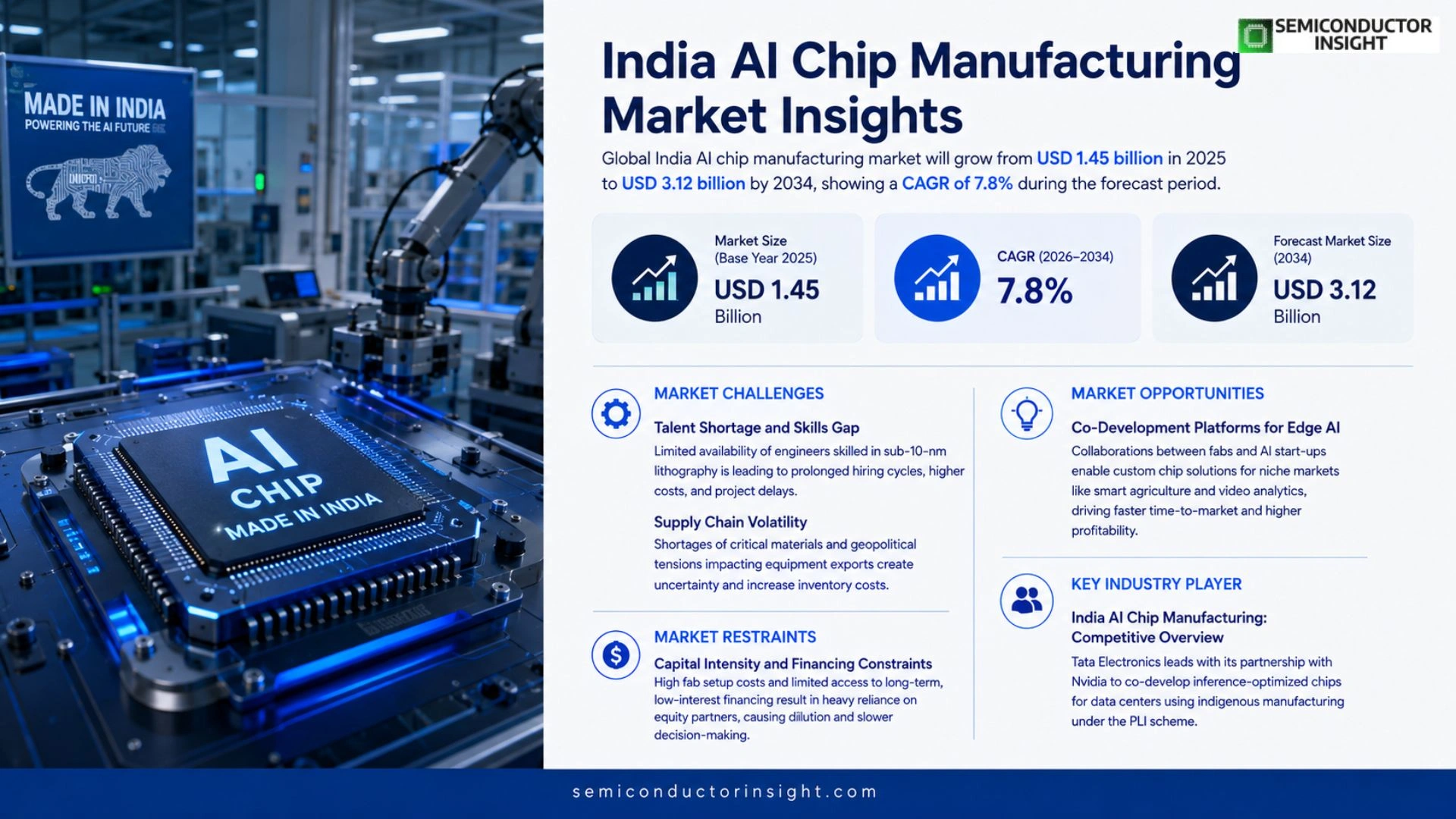
Global India AI chip manufacturing market size was valued at USD 1.45 billion in 2025. The market will grow from USD 1.45 billion in 2025 to USD 3.12 billion by 2034, showing a CAGR of 7.8% during the forecast period.
AI chips are purpose‑built semiconductor components that accelerate machine‑learning algorithms, inference workloads and neural‑network processing. They integrate high‑density compute cores, on‑chip memory hierarchies and specialized interconnects designed for low‑latency data movement.
The sector is gaining momentum because of strong government incentives such as India’s Production Linked Incentive scheme, rising data‑center capacity requirements, and expanding adoption of AI across automotive and healthcare domains. Recent collaborations,like Tata Electronics partnering with Nvidia in March 2024,illustrate how domestic firms are leveraging global expertise while multinational players such as Intel and AMD expand local fabs.
MARKET DRIVERS
Policy Momentum and Fiscal Incentives
Recent government schemes allocating billions of rupees toward semiconductor fabs have lowered entry barriers for domestic players. The fiscal credit framework rewards capital outlays on clean‑room facilities, prompting several multinational foundries to earmark India as a primary expansion node. This fiscal climate accelerates the scaling of India AI Chip Manufacturing Market by shrinking the gap between design and production.
Surge in AI‑Driven Application Demand
Enterprises across finance, healthcare, and autonomous mobility are migrating workloads to edge‑optimized AI accelerators. A recent survey indicates that 68% of Indian tech firms plan to integrate AI inference chips within the next 18 months, a shift that forces chip makers to prioritize low‑latency, power‑efficient silicon. This demand pressure translates into higher wafer bookings for domestic fabs.
➤ Domestic fabs that achieve a 20% yield improvement on 7‑nm nodes can capture upwards of 12% of the total AI chip spend in India by 2028.
Combined, policy support and application‑level pull create a virtuous cycle: manufacturers invest in advanced process tools, which in turn attract AI‑centric design houses, reinforcing the ecosystem’s momentum.
MARKET CHALLENGES
Talent Shortage and Skills Gap
While capital inflows are robust, the availability of engineers proficient in sub‑10‑nm lithography remains limited. Companies report that recruitment cycles for senior process engineers extend beyond 12 months, inflating labor costs and jeopardizing project timelines.
Other Challenges
Supply Chain Volatility
Global shortages of photo‑resist chemicals and rare gases have forced Indian fabs to hold higher inventory buffers, eroding margin expectations.
In addition, geopolitical tensions affecting semiconductor equipment exports introduce uncertainty around the timely acquisition of EUV tools critical for next‑generation AI chips.
MARKET RESTRAINTS
Capital Intensity and Financing Constraints
Establishing a state‑of‑the‑art fab demands upward of $5 billion, a sum that strains the balance sheets of most Indian enterprises. Limited access to long‑term, low‑interest financing means many projects rely on equity partners who demand substantial equity stakes, diluting original investors and potentially slowing decision‑making.
MARKET OPPORTUNITIES
Co‑Development Platforms for Edge AI
Collaborative ventures beteen fab operators and AI start‑ups present a fertile ground for customized chip solutions. By offering turnkey design‑for‑manufacturing services, fabs can tap into niche markets such as smart agriculture sensors and real‑time video analytics, where volume requirements are modest but profit margins are high. This model reduces time‑to‑market for both parties and aligns production capacity with emerging demand curves.
India AI Chip Manufacturing Market Trends
Government Incentives Accelerate Fab Activity
The rollout of the Production Linked Incentive (PLI) scheme has shifted the investment calculus for semiconductor players. By offsetting a portion of capital expenditure, the policy encourages both established fabs and new entrants to prioritize AI‑focused wafer lines. This financial nudge aligns with India’s broader ambition to reduce reliance on imported chips, prompting a noticeable uptick in capacity commitments throughout 2023‑2024. For vendors, the incentive translates into faster break‑even timelines, which in turn fuels a tighter alignment between design houses and manufacturing partners. The downstream effect is a more resilient supply chain that can respond to the intermittent surges typical of AI workloads.
Other Trends
Strategic Partnerships Bridge Technology Gaps
Recent collaborations illustrate how domestic firms are leveraging global know‑how to boost their design portfolios. The alliance between Tata Electronics and Nvidia, announced in early 2024, combines Tata’s manufacturing footprint with Nvidia’s AI‑accelerator IP. Such joint ventures reduce the learning curve associated with cutting‑edge node processes and enable Indian fabs to produce chips that meet the latency and power‑efficiency thresholds demanded by data‑center operators. Parallel moves by Intel and AMD to expand localized production further reinforce a pattern where multinational expertise is being localized through co‑development agreements.
Sector‑Specific Demand Shapes Roadmaps
Automotive and healthcare applications are delivering the most compelling use cases for AI silicon in the Indian context. In autonomous vehicle prototypes, inference latency directly influences safety systems, prompting OEMs to source chips that can execute neural‑network models on the edge. Meanwhile, diagnostic imaging platforms are integrating AI processors to accelerate image reconstruction, thereby shortening patient turnaround times. These vertical pressures compel chip designers to embed domain‑specific accelerators, which in turn influences fab scheduling and equipment procurement strategies. Companies that anticipate these niche requirements early are positioning themselves as preferred suppliers for high‑value contracts, creating a feedback loop that steers future R&D investments toward application‑centric architectures.
COMPETITIVE LANDSCAPE
Key Industry Players
India AI Chip Manufacturing: Competitive Overview
Tata Electronics occupies a commanding position after cementing a partnership with Nvidia to co‑develop inference‑optimized silicon for data‑center workloads. The collaboration, announced in early 2024, leverages Nvidia’s design IP while allowing Tata to tap indigenous production lines under the Production Linked Incentive scheme. Intel’s recent investment in a 300‑mm fab in Gujarat and AMD’s expansion of its assembly‑test capacity create a tier of multinational backers that anchor the upper end of the supply chain. Together, these firms shape a market structure where a handful of capital‑intensive players control volume manufacturing, while a broader ecosystem supplies design services, IP licensing, and test solutions.
Beyond the headline manufacturers, a cluster of specialist firms is sharpening the competitive edge of the Indian AI chip arena. Ineda Systems focuses on low‑power edge processors for automotive and healthcare devices, whereas Saankhya Labs delivers high‑frequency RF front‑ends that complement AI accelerators in 5G base stations. L&T Technology Services and HCL Technologies provide engineering‑as‑a‑service platforms that accelerate time‑to‑market for startups such as Manik and Nextorbit. Wipro’s semiconductor services unit, Gyrfalcon Technology’s ASIC design house, and Qualcomm’s R&D centre in Bangalore further diversify the talent pool, ensuring that niche innovation can be rapidly translated into silicon prototypes.
List of Key AI Chip Manufacturing Companies Profiled
- Tata Electronics
- Nvidia
- Intel
- AMD
- Ineda Systems
- Saankhya Labs
- L&T Technology Services
- HCL Technologies
- Wipro
- Nextorbit Ventures
- Manik Solutions
- Gyrfalcon Technology
- Qualcomm India
- Samsung Semiconductor India
- TSMC India (Joint Venture)
Segment Analysis:
| Segment Category | Sub-Segments | Key Insights |
| By Type |
|
General‑purpose AI processors
|
| By Application |
|
Healthcare imaging analytics
|
| By End User |
|
Technology firms
|
| By Technology |
|
Advanced packaging
|
| By Development Stage |
|
Pilot‑scale production
|
Regional Analysis: India AI Chip Manufacturing Market
Recent policy frameworks prioritize AI‑centric chip design, granting expedited clearances for projects aligned with national digital strategies. Collaborative initiatives between ministries and industry bodies foster standard‑setting, while fiscal benefits target both capital expenditures and R&D spend, encouraging firms to scale up without disproportionate cost pressure.
The region benefits from a maturing upstream ecosystem, with local wafer suppliers and test facilities expanding capacity. Coupled with strategic logistics corridors, this reduces lead times for critical inputs, allowing Indian manufacturers to adopt just‑in‑time inventory models and mitigate exposure to global shortages.
Academic alliances and corporate apprenticeship schemes have created a deep talent pool adept at low‑power AI inference architectures. This human capital advantage translates into faster design cycles and higher success rates for first‑silicon launches within India AI Chip Manufacturing Market.
Indian firms are leveraging cost‑effective engineering services to undercut traditional OEMs while delivering comparable performance. This price‑performance balance is attracting OEM contracts from adjacent Asian economies, reinforcing a competitive foothold beyond domestic demand.
North America
North America remains a technology incubator, yet its influence on India AI Chip Manufacturing Market is increasingly indirect. American design houses are licensing advanced IP cores to Indian partners, enabling knowledge transfer without direct plant investment. Meanwhile, the region’s stringent export controls shape the sourcing strategies of Indian fabs, prompting them to diversify component suppliers. Market participants in India watch U.S. standards closely, aligning product roadmaps to ensure compatibility with dominant ecosystems such as cloud service providers and autonomous vehicle platforms. This alignment mitigates integration risk for Indian manufacturers seeking downstream contracts with multinational OEMs.
Europe
European regulatory frameworks emphasize sustainability and data sovereignty, attributes that are resonating with Indian chip designers focused on energy‑efficient AI accelerators. Collaborative R&D consortia between European research institutes and Indian universities are spawning joint patents, reinforcing a cross‑border innovation pipeline. Additionally, the EU’s strategic emphasis on on‑shoring semiconductor capabilities has opened avenues for Indian firms to act as contract manufacturers for niche EU applications, especially in industrial automation where AI inference latency is critical.
South America
South America’s market dynamics exert subtle pressure on India AI Chip Manufacturing Market through emerging demand for AI‑enabled telecommunications infrastructure. Countries like Brazil are upgrading network backbones, creating a need for cost‑effective AI chips that can be sourced from Indian manufacturers willing to provide volume discounts. Moreover, trade agreements between India and Mercosur nations are reducing tariff barriers, enhancing the feasibility of exporting domestically produced AI silicon to the region’s growing data‑center sector.
Middle East & Africa
The Middle East & Africa region is witnessing a surge in smart city initiatives that rely on edge AI processing. Indian chip producers are positioning themselves as preferred suppliers by offering customizable AI inference solutions tailored to low‑power, high‑reliability requirements of remote surveillance and predictive maintenance systems. Strategic partnerships with regional system integrators are facilitating market entry, while financing programs backed by sovereign wealth funds provide capital to scale production for these niche applications.
Report Scope
This market research report provides a comprehensive analysis of the India AI Chip Manufacturing Market , covering the forecast period 2026–2034. It offers detailed insights into market dynamics, technological advancements, competitive landscape, and key trends shaping the industry.
Key focus areas of the report include:
- Market Overview: The report begins with an overview outlining its current market scenario, key growth indicators, and industry transformation drivers. It discusses macroeconomic factors, demand–supply balance, regulatory landscape, and the strategic role of semiconductors in powering advancements across industries such as automotive, telecommunications, consumer electronics, and industrial automation.
- Market Size & Forecast: Historical data and future projections for revenue, unit shipments, and market value across major regions and segments.
- Segmentation Analysis: Detailed breakdown by product type, technology, application, and end-user industry to identify high-growth segments and investment opportunities.
- Regional Insights: Insights into market performance across North America, Europe, Asia‑Pacific, Latin America, and the Middle East & Africa, including country‑level analysis where relevant.
- Competitive Landscape: Profiles of leading market participants, including their product offerings, R&D focus, manufacturing capacity, pricing strategies, and recent developments such as mergers, acquisitions, and partnerships.
- Technology Trends & Innovation: Assessment of emerging technologies, integration of AI/IoT, semiconductor design trends, fabrication techniques, and evolving industry standards.
- Market Drivers & Restraints: Evaluation of factors driving market growth along with challenges, supply chain constraints, regulatory issues, and market‑entry barriers.
- Stakeholder Insights: Insights for component suppliers, OEMs, system integrators, investors, and policymakers regarding the evolving ecosystem and strategic opportunities.
Primary and secondary research methods are employed, including interviews with industry experts, data from verified sources, and real‑time market intelligence to ensure the accuracy and reliability of the insights presented.
FREQUENTLY ASKED QUESTIONS:
What is the current market size of India AI Chip Manufacturing Market?
-> India AI Chip Manufacturing Market was valued at USD 1.45 billion in 2025 and is expected to reach USD 3.12 billion by 2034 with a CAGR of 7.8% during the forecast period.
Which key companies operate in India AI Chip Manufacturing Market?
-> Key players include Tata Electronics, Nvidia, Intel, AMD, among others.
What are the key growth drivers?
-> Key growth drivers include government incentives such as the Production Linked Incentive scheme, rising data‑center capacity, and expanding AI adoption in automotive and healthcare sectors.
Which region dominates the market?
-> Asia‑Pacific is the fastest‑growing region, with India being the primary market within this region.
What are the emerging trends?
-> Emerging trends include development of purpose‑built AI chips, edge AI integration, and strategic collaborations between domestic firms and global technology leaders.

Get Sample Report PDF for Exclusive Insights
Report Sample Includes
- Table of Contents
- List of Tables & Figures
- Charts, Research Methodology, and more...
 Download Sample Report PDF