IGBT Wire Bonding Equipment Market Insights
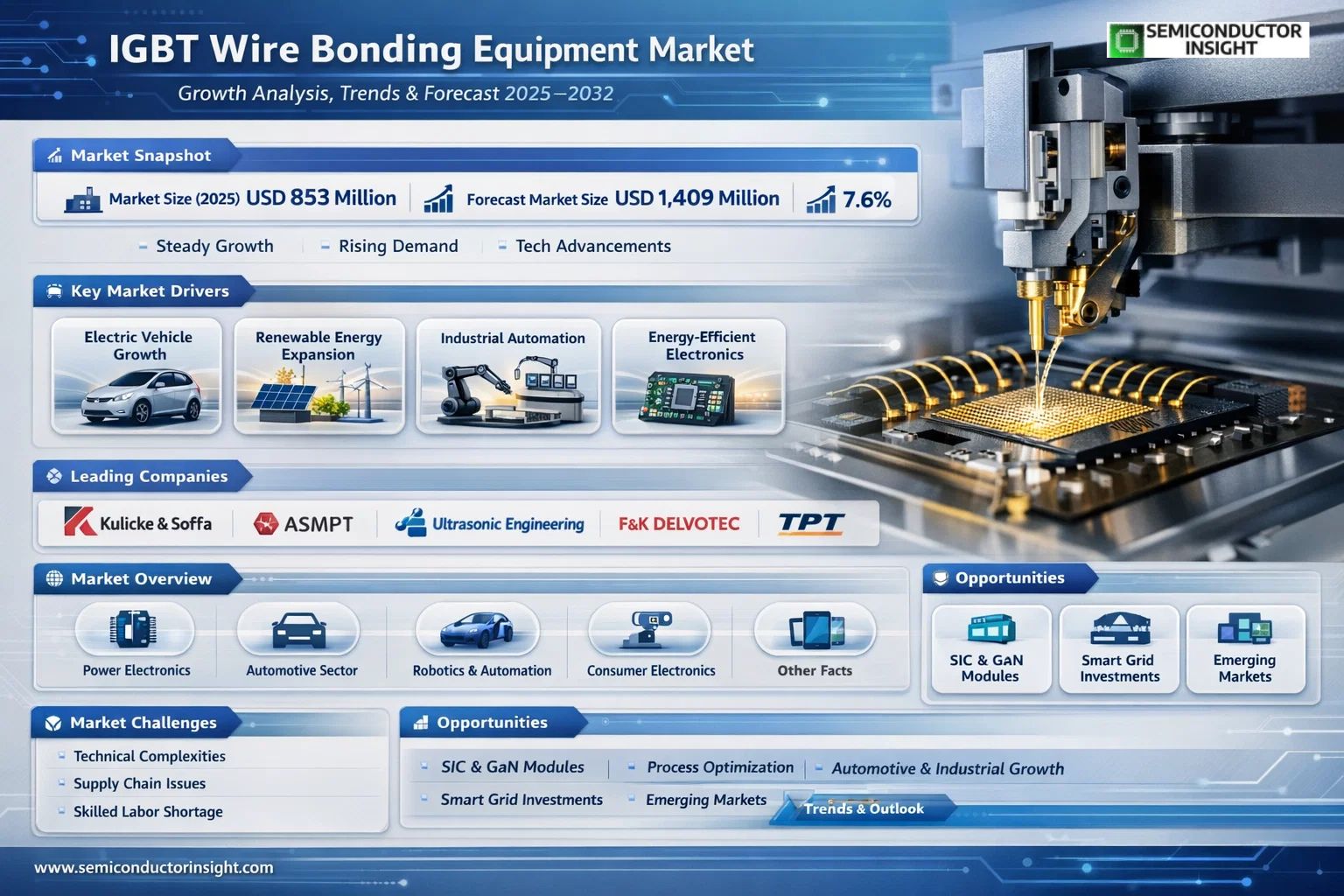
Global IGBT Wire Bonding Equipment market size was valued at USD 853 million in 2025. The market is projected to reach USD 1,409 million by 2032, exhibiting a CAGR of 7.6% during the forecast period.
IGBT wire bonding equipment is specialized machinery used to connect small electrodes on IGBT chips with external circuits through metal wires such as aluminum, copper, or aluminum-clad copper, forming reliable internal electrical connections within modules. This process demands precise control over wire diameter, length, bonding pressure, time, and temperature to ensure optimal electrical performance, mechanical strength, and long-term reliability, as suboptimal parameters can lead to parasitic inductance or weak bonds.
The market is experiencing steady growth driven by rising demand in power electronics, automotive applications like electric vehicles, and industrial automation. Advancements in semiconductor packaging further bolster expansion. Key players such as Kulicke & Soffa, ASM Pacific Technology, Ultrasonic Engineering, F & K Delvotec, TPT, Hesse GmbH, West Bond, Hybond, KAIJO Corporation, and Palomar Technologies dominate, holding significant revenue shares and innovating to meet evolving industry needs.
MARKET DRIVERS
Rising Demand from Electric Vehicles
IGBT Wire Bonding Equipment Market is propelled by the surge in electric vehicle (EV) production, where IGBT modules are essential for power conversion systems. Global EV sales reached over 10 million units in 2023, driving the need for high-reliability wire bonding processes to ensure efficient thermal management and electrical performance in inverters.
Expansion in Renewable Energy Sector
Renewable energy installations, particularly solar inverters and wind turbine converters, heavily rely on IGBTs bonded with precision equipment. The sector’s growth to 510 GW of new solar capacity in 2023 underscores the increasing adoption of advanced wire bonding technologies for higher power densities.
➤ Industrial automation and robotics applications contribute to a projected 8.5% CAGR for IGBT Wire Bonding Equipment Market through 2030.
Additionally, the push for energy-efficient industrial motors and consumer electronics further accelerates demand, as manufacturers seek equipment capable of handling fine wires and complex bonding patterns for next-generation IGBTs.
MARKET CHALLENGES
Technical Complexities in High-Power Bonding
Producing wire bonds for high-voltage IGBTs presents significant hurdles due to the need for ultra-fine wire diameters and precise ultrasonic energy control, often leading to defects like cratering or non-sticks. Achieving consistent bond quality at speeds exceeding 10 wires per second remains a persistent issue in IGBT Wire Bonding Equipment Market.
Other Challenges
Supply Chain Disruptions
Geopolitical tensions and raw material shortages for gold and copper wires have inflated costs by up to 20% in recent years, compelling equipment makers to innovate in alternative materials while maintaining compatibility with existing IGBT production lines.
Skilled labor shortages exacerbate these issues, as operating advanced wire bonders requires specialized training in process optimization and failure analysis.
MARKET RESTRAINTS
High Capital Investment Requirements
IGBT Wire Bonding Equipment Market faces constraints from substantial upfront costs, with advanced systems priced between $500,000 and $2 million, deterring small-to-medium enterprises from upgrading to models supporting 300μm wires for high-power modules.
Longer amortization periods due to intricate maintenance needs and downtime for recalibration further strain budgets, particularly in emerging markets where ROI timelines extend beyond 3 years.
Regulatory compliance for cleanroom operations and environmental standards on wire materials adds layers of complexity and expense, slowing market penetration.
MARKET OPPORTUNITIES
Advancements in SiC and GaN Hybrid Modules
Integration of IGBTs with wide-bandgap semiconductors opens avenues for hybrid wire bonding equipment, capable of handling diverse wire types and bond forces, potentially capturing a 15% share of the evolving power electronics segment by 2028.
Growing investments in smart grid infrastructure worldwide, valued at $100 billion annually, demand robust IGBT packaging solutions, where upgraded wire bonders can enhance reliability under variable loads.
Emerging markets in Asia-Pacific, with EV adoption rates climbing 25% yearly, present untapped potential for localized manufacturing of IGBT wire bonding systems tailored to regional supply chains.
IGBT Wire Bonding Equipment Market Trends
Shift to Copper Wire Bonding Technologies
In IGBT Wire Bonding Equipment Market, a prominent trend is the increasing adoption of copper wire bonding over traditional aluminum wires. Copper wires offer superior electrical conductivity and reduced parasitic inductance, enhancing high-frequency performance in IGBT modules. Manufacturers are optimizing wire diameters and bonding parameters to balance mechanical strength and reliability, as improper sizing can compromise module durability. Leading equipment providers like Kulicke & Soffa and ASM Pacific Technology are advancing ultrasonic bonding systems tailored for copper, ensuring uniform bonding points and consistent electrical connections between chip electrodes and external circuits.
Other Trends
Advancements in Process Optimization
Equipment innovations focus on precise control of bonding pressure, time, and temperature to improve wire bonding quality in IGBT applications. Aluminum-clad copper wires are gaining traction as a hybrid solution, combining cost-effectiveness with performance benefits. These developments address challenges in power electronics, where reliable internal module connections are critical for long-term operation.
Growth in Automotive and Industrial Applications
IGBT Wire Bonding Equipment Market sees rising demand from automotive electronics and industrial automation sectors. IGBT modules require robust wire bonds to withstand harsh environments, driving equipment upgrades for higher throughput and precision. Key players such as Hesse GmbH and KAIJO Corporation are introducing systems compatible with diverse wire types, supporting expansion into consumer electronics and power modules. This trend reflects broader industry shifts toward efficient semiconductor packaging, with Asia-Pacific regions like China and Japan leading in production scale.
COMPETITIVE LANDSCAPE
Key Industry Players
Top Manufacturers in IGBT Wire Bonding Equipment Market
IGBT Wire Bonding Equipment Market features a moderately concentrated competitive landscape, led by established global leaders such as Kulicke & Soffa and ASM Pacific Technology. These top players command a substantial revenue share, with the global top five manufacturers collectively holding a significant portion of the market in 2025. Kulicke & Soffa, a pioneer in semiconductor assembly equipment, excels in high-precision wire bonding solutions optimized for IGBT modules, supporting materials like copper, aluminum, and aluminum-clad copper wires. ASM Pacific Technology complements this dominance with advanced automation technologies tailored for power electronics applications. The market structure is driven by demand in sectors like automotive electronics, industrial automation, and renewable energy, where reliable wire bonding ensures optimal electrical performance and module reliability. Intense R&D focus on process parameters such as wire diameter, bonding pressure, and temperature underscores the competitive edge of these leaders in delivering equipment that minimizes parasitic inductance and enhances high-frequency performance.
Beyond the frontrunners, a cadre of specialized niche players contributes to innovation and regional market dynamics, including Ultrasonic Engineering, Hesse GmbH, and West Bond, which offer customized ultrasonic wire bonding systems for high-reliability IGBT applications. Companies like TPT, F & K Delvotec, and KAIJO Corporation provide versatile equipment addressing diverse needs in consumer electronics and power modules. Emerging Asian players such as Hanxiantech, Wuxi Autowell Technology, and Ningbo Advance Automation Technology are gaining traction through cost-effective solutions and rapid localization strategies, particularly in China’s expanding IGBT production base. These firms focus on challenges like bonding strength and wire length uniformity, fostering competition that propels market growth at a projected CAGR of 7.6% through 2032. The surveyed manufacturers highlight ongoing mergers, product developments, and adaptations to regional demands in North America, Europe, and Asia-Pacific as key competitive strategies.
List of Key IGBT Wire Bonding Equipment Companies Profiled
- Kulicke & Soffa
- ASM Pacific Technology
- West Bond
- Ultrasonic Engineering
- F & K Delvotec
- Hesse GmbH
- TPT
- KAIJO Corporation
- Palomar Technologies
- Hybond
- SBT Ultrasonic
- Hanxiantech
- Wuxi Autowell Technology
- Green Intelligent Equipment
- Teda
- Ningbo Advance Automation Technology
Segment Analysis:
| Segment Category | Sub-Segments | Key Insights |
| By Type |
|
Copper Wire Bonding Equipment
|
| By Application |
|
Power Electronics
|
| By End User |
|
Electric Vehicle Manufacturers
|
| By Bonding Technology |
|
Ultrasonic Wedge Bonding
|
| By Automation Level |
|
Fully Automatic
|
Regional Analysis: IGBT Wire Bonding Equipment Market
Asia-Pacific
Dense clusters of semiconductor foundries in Taiwan and China drive demand for precision wire bonding equipment tailored for IGBT devices. These hubs emphasize high-volume production with automated systems, ensuring consistent bond quality for power modules in EVs and solar inverters.
Booming electric vehicle assembly lines in Japan and South Korea necessitate advanced wire bonding technologies for robust IGBT powertrains. Emphasis on lightweight, efficient modules spurs equipment upgrades focused on speed and precision.
Asia-Pacific’s aggressive shift to wind and solar power plants requires durable IGBT modules, prompting investments in wire bonding equipment that supports high-current handling and thermal cycling endurance.
Strong university-industry partnerships in the region advance wire bonding techniques, such as ultrasonic and thermosonic methods, optimizing IGBT performance for emerging applications like high-speed rail systems.
North America
North America exhibits steady growth in IGBT Wire Bonding Equipment Market, fueled by innovation in power electronics for data centers and aerospace. Leading manufacturers focus on high-end equipment for custom IGBT packaging, emphasizing reliability in harsh environments. The region’s strength lies in advanced R&D, with firms developing equipment for wide-bandgap semiconductor integration alongside traditional IGBTs. Automotive electrification, particularly in hybrid vehicles, drives demand for precise wire bonding solutions. Collaborative ecosystems between chip designers and equipment suppliers enhance process control, reducing defects in high-power applications. Investments in smart grid technologies further support market dynamics, as utilities upgrade inverters requiring superior bonding integrity.
Europe
Europe’s IGBT Wire Bonding Equipment Market thrives on stringent quality standards and a focus on sustainable manufacturing. Key markets in Germany and Italy prioritize equipment for industrial motors and railway traction systems, where IGBT modules must withstand extreme thermal stresses. Regulatory pressures for energy efficiency spur adoption of automated wire bonding lines with real-time monitoring. Strong automotive sector, especially in electric drivetrains, integrates advanced bonding technologies for compact, high-density designs. Regional players emphasize customization for legacy silicon carbide hybrids, bolstering competitiveness through precision engineering and eco-friendly processes.
South America
South America presents emerging opportunities in IGBT Wire Bonding Equipment Market, centered on industrial expansion and renewable projects in Brazil and Chile. Growing hydropower and mining sectors demand robust IGBT-based drives, prompting imports of reliable wire bonding equipment. Local assemblers adapt global technologies for cost-sensitive applications, focusing on throughput improvements. Infrastructure modernization initiatives accelerate equipment deployment for variable frequency drives, enhancing energy management in remote operations. Partnerships with international vendors support skill development, laying foundations for indigenous capabilities.
Middle East & Africa
The Middle East & Africa region shows potential in IGBT Wire Bonding Equipment Market, driven by oil-to-renewables transition and urbanization. Gulf countries invest in solar farms requiring high-efficiency IGBT inverters, necessitating advanced wire bonding for desert-condition durability. African industrial growth in South Africa targets manufacturing upgrades with imported equipment optimized for power electronics. Focus on desalination plants and smart cities amplifies demand for reliable bonding processes. Strategic alliances bridge technology gaps, fostering gradual market maturation through targeted capacity building.
Report Scope
This market research report provides a comprehensive analysis of the IGBT Wire Bonding Equipment Market , covering the forecast period 2026–2034. It offers detailed insights into market dynamics, technological advancements, competitive landscape, and key trends shaping the industry.
Key focus areas of the report include:
- Market Overview: The report begins with an overview outlining its current market scenario, key growth indicators, and industry transformation drivers. It discusses macroeconomic factors, demand–supply balance, regulatory landscape, and the strategic role of semiconductors in powering advancements across industries such as automotive, telecommunications, consumer electronics, and industrial automation.
- Market Size & Forecast: Historical data and future projections for revenue, unit shipments, and market value across major regions and segments.
- Segmentation Analysis: Detailed breakdown by product type, technology, application, and end-user industry to identify high-growth segments and investment opportunities.
- Regional Insights: Insights into market performance across North America, Europe, Asia-Pacific, Latin America, and the Middle East & Africa, including country-level analysis where relevant.
- Competitive Landscape: Profiles of leading market participants, including their product offerings, R&D focus, manufacturing capacity, pricing strategies, and recent developments such as mergers, acquisitions, and partnerships.
- Technology Trends & Innovation: Assessment of emerging technologies, integration of AI/IoT, semiconductor design trends, fabrication techniques, and evolving industry standards.
- Market Drivers & Restraints: Evaluation of factors driving market growth along with challenges, supply chain constraints, regulatory issues, and market-entry barriers.
- Stakeholder Insights: Insights for component suppliers, OEMs, system integrators, investors, and policymakers regarding the evolving ecosystem and strategic opportunities.
Primary and secondary research methods are employed, including interviews with industry experts, data from verified sources, and real-time market intelligence to ensure the accuracy and reliability of the insights presented.
FREQUENTLY ASKED QUESTIONS:
What is the current market size of IGBT Wire Bonding Equipment Market?
-> Global IGBT Wire Bonding Equipment Market was valued at USD 853 million in 2025 and is projected to reach USD 1409 million by 2032, at a CAGR of 7.6% during the forecast period.
Which key companies operate in IGBT Wire Bonding Equipment Market?
-> Key players include Kulicke & Soffa, ASM Pacific Technology, Ultrasonic Engineering, F & K Delvotec, TPT, Hesse GmbH, West Bond, Hybond, KAIJO Corporation, Palomar Technologies, among others.
What are the key growth drivers?
-> Key growth drivers include demand for reliable IGBT modules in power electronics, automotive electronics, industrial automation, consumer electronics, and optimization of wire bonding processes for enhanced electrical performance and reliability.
Which region dominates the market?
-> Asia dominates the market, with significant contributions from China, Japan, and South Korea, while North America, particularly the U.S., represents a key regional market.
What are the emerging trends?
-> Emerging trends include adoption of copper wire bonding equipment, aluminum wire bonding, aluminum clad copper wires, and advancements in process parameters such as wire diameter, bonding pressure, time, and temperature to improve module reliability and high-frequency performance.

Get Sample Report PDF for Exclusive Insights
Report Sample Includes
- Table of Contents
- List of Tables & Figures
- Charts, Research Methodology, and more...
 Download Sample Report PDF