Market Insights
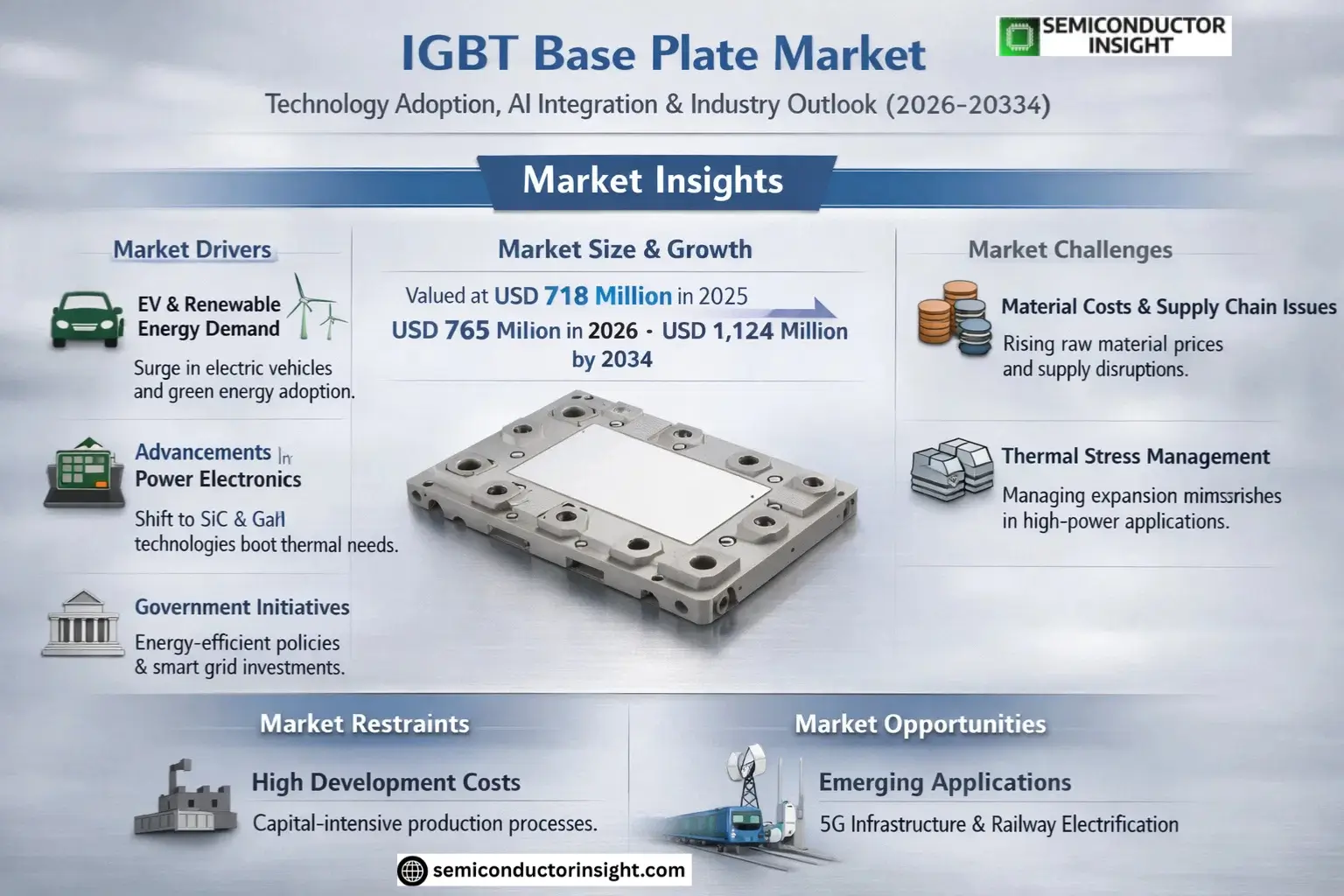
Global IGBT Base Plate Market size was valued at USD 718 million in 2025. The market is projected to grow from USD 765 million in 2026 to USD 1,124 million by 2034, exhibiting a CAGR of 6.2% during the forecast period.
An IGBT base plate (heat spreader/bottom plate) serves as a critical component in power modules, providing lateral heat dissipation and mechanical stability for DBC/DCB/AMB substrate stacks. These plates are predominantly made of copper due to its superior thermal conductivity, though advanced materials like AlSiC composites and controlled-expansion alloys (Cu-Mo, W/Cu) are gaining traction for high-reliability applications such as electric vehicles and industrial inverters.
The market growth is driven by rising demand for energy-efficient power electronics, electrification in automotive and industrial sectors, and increasing adoption of renewable energy systems. Innovations in thermal management solutions such as pin-fin designs and direct-cooling integration are further propelling advancements. Key players like Infineon, Semikron Danfoss, and Plansee lead the competitive landscape through material innovations and strategic collaborations.
MARKET DRIVERS
Growing Demand in EV and Renewable Energy
IGBT Base Plate Market is witnessing significant growth due to increasing adoption in electric vehicles and renewable energy systems. With EV sales projected to reach 45 million units annually by 2030, the demand for high-performance thermal management solutions like IGBT base plates is accelerating rapidly. These components play a critical role in power modules used in inverters and converters.
Advancements in Power Electronics
Technological innovations in power electronics are driving the need for more efficient IGBT base plates. The shift towards wide-bandgap semiconductors like SiC and GaN requires accompanying improvements in thermal dissipation capabilities. IGBT base plates with direct-bonded-copper (DBC) technology are gaining traction as they offer better thermal conductivity and reliability compared to traditional designs.
Government initiatives promoting energy-efficient technologies and smart grid development are further stimulating market expansion. Countries investing heavily in high-voltage direct current transmission systems create additional demand for robust IGBT base plate solutions.
MARKET CHALLENGES
Material Cost and Supply Chain Constraints
IGBT Base Plate Market faces challenges from fluctuating raw material costs, particularly for copper and ceramic substrates. Recent supply chain disruptions have led to price volatility in these critical components, impacting manufacturing costs. The specialized nature of DBC technology also creates bottlenecks in production scaling.
Other Challenges
Thermal Stress Management
Managing thermal expansion mismatches between different materials in IGBT base plates remains a persistent engineering challenge, particularly for high-power applications with frequent thermal cycling.
MARKET RESTRAINTS
High Development Costs
The capital-intensive nature of IGBT base plate manufacturing acts as a significant market restraint. The need for specialized equipment and precise manufacturing processes creates high barriers to entry, limiting market expansion among smaller players. Quality control requirements for aerospace and medical applications add further complexity to production.
MARKET OPPORTUNITIES
Emerging Applications in 5G Infrastructure
The rollout of 5G networks presents new opportunities for IGBT base plate manufacturers. High-power RF amplifiers in 5G base stations require efficient thermal management solutions. This emerging application sector could account for nearly 15% of market revenue by 2026. Additionally, increasing investments in railway electrification systems across developed nations offer substantial growth potential.
IGBT Base Plate Market Trends
Material Innovation Driving Thermal Performance
IGBT Base Plate Market is witnessing significant advancements in material technology to address thermal management challenges. Copper remains dominant due to its excellent thermal conductivity, but alternatives like AlSiC composites are gaining traction in applications requiring better coefficient of thermal expansion (CTE) matching. Controlled-expansion materials such as Cu-Mo and W/Cu alloys are increasingly adopted in high-power IGBT modules to reduce thermo-mechanical stress.
Other Trends
Thermal Integration and Cooling Solutions
Design innovations are focusing on integrating cooling mechanisms directly into base plates. Pin-fin designs and direct-cooling approaches are replacing traditional flat copper plates to enhance heat dissipation in high-power-density applications. This trend aligns with the growing demand for compact power modules in electric vehicles and renewable energy systems.
Rising Demand in Electrification Applications
The push for electrification across transportation and energy sectors is accelerating IGBT Base Plate adoption. Automotive electrification, particularly in EV powertrains and charging infrastructure, is creating robust demand for reliable thermal management solutions. Industrial motor drives and grid conversion applications continue to require high-performance base plate designs to ensure system longevity.
Other Trends
Base-Plate-Less Alternatives Gaining Ground
While base-plate configurations remain standard for medium-to-high power modules, some applications are shifting toward base-plate-less designs where cost and size optimization outweigh thermal performance requirements. This trend is particularly notable in consumer electronics and certain industrial applications where power densities are lower.
Manufacturing and Supply Chain Developments
The IGBT Base Plate supply chain is becoming more specialized, with material suppliers developing tailored solutions for specific power module requirements. Advanced joining techniques such as sintering are improving thermal interface performance, while OEMs are working closely with material specialists to qualify new composite solutions.
COMPETITIVE LANDSCAPE
Key Industry Players
Strategic Positioning in the Evolving IGBT Base Plate Market
IGBT Base Plate Market is characterized by a mix of established material science specialists and vertically integrated power module manufacturers. Infineon Technologies and Semikron Danfoss lead through direct module packaging expertise while maintaining strong partnerships with base plate material suppliers. Plansee Group dominates the refractory metal segment (WCu/Mo) for high-reliability applications, leveraging decades of experience in controlled-expansion composites. Chinese manufacturers like Huangshan Googe and Kunshan Gootage have gained traction by offering cost-competitive copper solutions for industrial motor drives and renewable energy applications.
Niche players focus on specialized material formulations – CPS Technologies and Amulaire Thermal Technology lead in AlSiC composites for automotive traction, while Dana Incorporated and Wieland Microcool excel in integrated cooling solutions. Emerging suppliers like SITRI Material Technologies are innovating with nano-engineered thermal interfaces, particularly for EV charging infrastructure. The market also sees strong regional specialization, with Japanese firms (A.L.M.T.corp, TAIWA) maintaining leadership in precision-machined components for railway and industrial applications.
List of Key IGBT Base Plate Companies Profiled
- Denka
- Huangshan Googe
- Jiangyin Saiying Electron
- Kunshan Gootage Thermal Technology
- Jentech Precision Industrial
- Plansee
- A.L.M.T.corp
- Amulaire Thermal Technology
- Dana Incorporated
- TAIWA CO., Ltd.
- CPS Technologies
- Kawaso Texcel
- Wieland Microcool
- SITRI Material Technologies
- Suzhou Haoli Electronic Technology
Segment Analysis:
| Segment Category | Sub-Segments | Key Insights |
| By Type |
|
Copper Flat Base Plate
|
| By Application |
|
Automotive/Traction
|
| By End User |
|
IGBT Module Manufacturers
|
| By Material Innovation |
|
AlSiC Composites
|
| By Cooling Integration |
|
Pin-Fin Designs
|
Regional Analysis: Asia-Pacific IGBT Base Plate Market
China benefits from comprehensive industrial clusters integrating IGBT base plate production with adjacent components. Major OEMs maintain vertically integrated facilities that combine material processing, machining, and testing under one roof. This consolidated approach reduces lead times while improving thermal performance consistency.
The world’s largest electric vehicle market drives continuous innovation in high-power IGBT base plate designs. Local automakers collaborate closely with component suppliers to develop customized thermal solutions for next-generation 800V battery systems, creating a competitive advantage in power density.
Strategic national initiatives like Made in China 2025 prioritize domestic IGBT supply chain development. Provincial governments offer tax incentives for base plate manufacturers adopting AI-driven quality inspection systems, accelerating technology upgrades across the industry.
Chinese research institutions collaborate with manufacturers on advanced composite materials, particularly in aluminum matrix composites. Recent breakthroughs include nanostructured interfaces that enhance thermal conductivity while maintaining mechanical stability under high thermal cycling conditions.
South Korea
South Korea’s IGBT Base Plate Market benefits from close cooperation between semiconductor giants and specialized material suppliers. The country’s focus on premium thermal solutions for high-frequency power modules creates demand for precision-machined base plates with sub-micron flatness requirements. Local manufacturers leverage expertise in ceramic-metal bonding technologies originally developed for memory chip packaging, adapting these processes for power electronics applications.
Japan
Japanese companies maintain leadership in high-reliability IGBT base plates for industrial and rail applications. The market emphasizes long-term durability, with manufacturers developing novel surface treatment techniques to prevent degradation in harsh operating environments. Aging infrastructure modernization projects drive demand for upgraded power electronics with enhanced thermal management capabilities.
India
India’s emerging IGBT Base Plate Market shows remarkable growth potential, fueled by renewable energy expansion and local production incentives. Domestic manufacturers are scaling up direct bonded copper production capacity while developing cost-effective alternatives suitable for tropical climates. Government policies promoting domestic power electronics manufacturing attract foreign investments in base plate production facilities.
ASEAN
ASEAN countries experience growing IGBT base plate demand from consumer electronics and industrial automation sectors. Malaysia and Thailand serve as regional hubs with improving technical capabilities in metal matrix composite processing. The region benefits from tariff advantages when exporting to Western markets, though technological capabilities still lag behind Northeast Asian competitors.
Report Scope
This market research report provides a comprehensive analysis of the IGBT Base Plate Market, covering the forecast period 2025–2034. It offers detailed insights into market dynamics, technological advancements, competitive landscape, and key trends shaping the industry.
Key focus areas of the report include:
- Market Overview: The report begins with an overview outlining its current market scenario, key growth indicators, and industry transformation drivers. It discusses macroeconomic factors, demand–supply balance, regulatory landscape, and the strategic role of power modules in enabling advancements across industries such as automotive, industrial automation, renewable energy, and power grid infrastructure.
- Market Size & Forecast: Historical data and future projections for revenue, unit shipments, and market value across major regions and segments.
- Segmentation Analysis: Detailed breakdown by product type, IGBT type, application, and end-user industry to identify high-growth segments and investment opportunities.
- Regional Insights: Insights into market performance across North America, Europe, Asia-Pacific, South America, and Middle East & Africa, including country-level analysis where relevant.
- Competitive Landscape: Profiles of leading market participants, including their product offerings, R&D focus, manufacturing capacity, pricing strategies, and recent developments such as mergers, acquisitions, and partnerships.
- Technology Trends & Innovation: Assessment of emerging materials (CuMo/WCu, AlSiC), cooling technologies (pin-fin designs), and base-plate-less module adoption trends.
- Market Drivers & Restraints: Evaluation of factors driving market growth along with challenges, supply chain constraints, regulatory issues, and market-entry barriers.
- Stakeholder Insights: Insights for component suppliers, module OEMs, system integrators, investors, and policymakers regarding the evolving ecosystem and strategic opportunities.
Primary and secondary research methods are employed, including interviews with industry experts, data from verified sources, and real-time market intelligence to ensure the accuracy and reliability of the insights presented.
FREQUENTLY ASKED QUESTIONS:
What is the current market size of IGBT Base Plate Market?
-> IGBT Base Plate Market size was valued at USD 718 million in 2025. The market is projected to grow from USD 765 million in 2026 to USD 1,124 million by 2034, exhibiting a CAGR of 6.2% during the forecast period.
What is the growth rate of IGBT Base Plate Market?
-> The market is expected to grow at a CAGR of 6.2% during the forecast period (2025-2034).
Which key companies operate in IGBT Base Plate Market?
-> Key players include Denka, Huangshan Googe, Jiangyin Saiying electron, Kunshan Gootage Thermal Technology, Plansee, A.L.M.T.corp, Amulaire Thermal Technology, and Dana Incorporated, among others.
What are the key growth drivers?
-> Key growth drivers include electrification trends, renewable energy integration, power grid modernization, and demand for high-reliability power conversion solutions.
Which region dominates the market?
-> Asia currently leads the market with significant contributions from China, Japan, and South Korea, driven by strong industrial and renewable energy sectors.
What are the emerging trends?
-> Emerging trends include adoption of advanced materials (AlSiC, Cu-Mo composites), cooling-integration designs, and base-plate-less solutions for cost optimization.
Get Sample Report PDF for Exclusive Insights
Report Sample Includes
- Table of Contents
- List of Tables & Figures
- Charts, Research Methodology, and more...
 Download Sample Report PDF