MARKET INSIGHTS
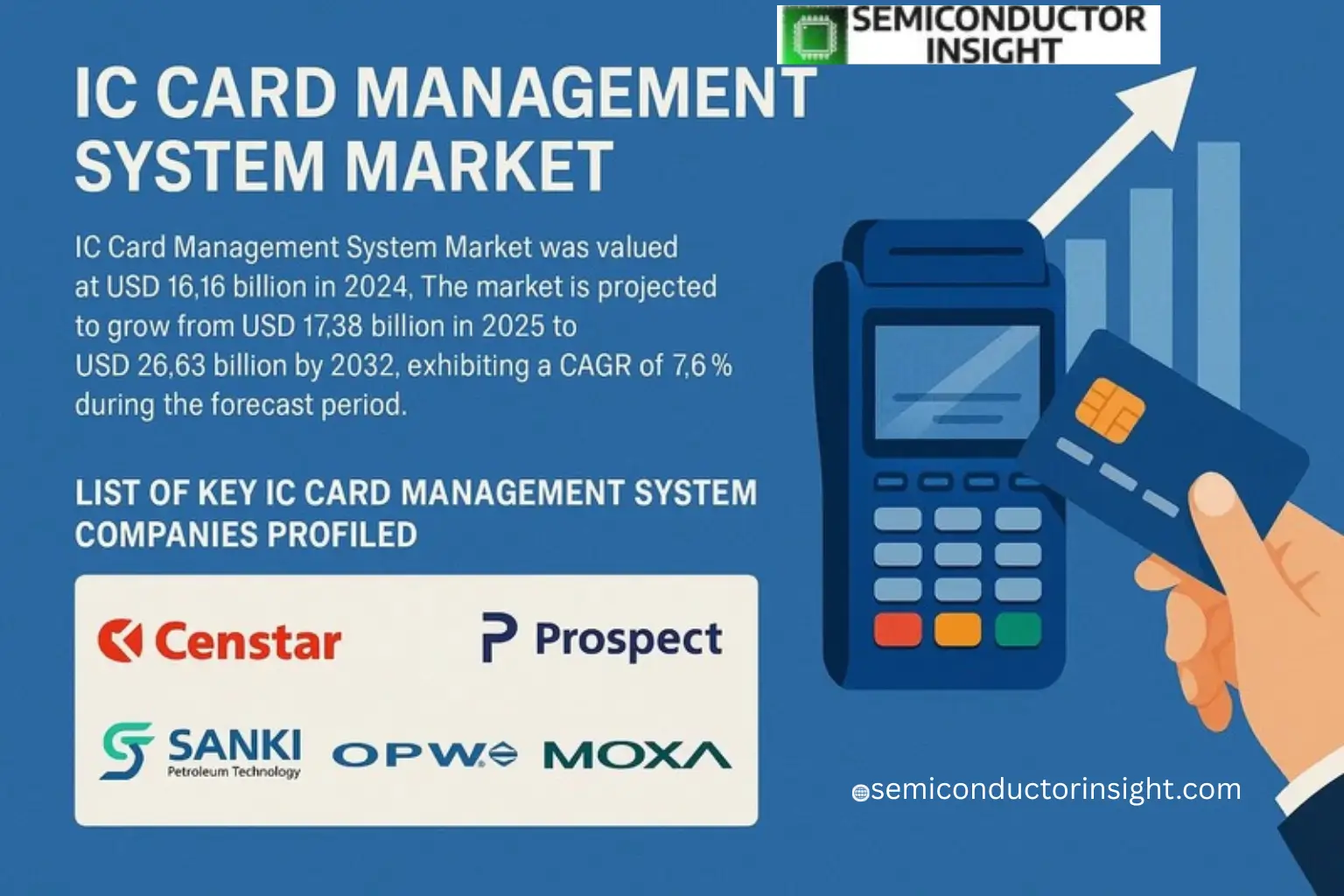
Global IC Card Management System Market was valued at USD 16.16 billion in 2024. The market is projected to grow from USD 17.38 billion in 2025 to USD 26.63 billion by 2032, exhibiting a CAGR of 7.6% during the forecast period.
An IC Card Management System is a comprehensive platform for managing access control, transactions, and user data through integrated circuit (IC) cards. These systems are crucial for automating and securing operations across various facilities by integrating hardware like card readers and dispensers with central management software. Key applications include smart door locks, fuel management at gas stations, and identity verification systems.
The market is experiencing steady growth due to several factors, including the rising demand for secure and automated access control in corporate and government sectors, alongside the modernization of fuel retail infrastructure globally. Furthermore, the increasing adoption of cashless transactions and the need for robust security against unauthorized access are contributing to market expansion. Initiatives by key players in the market are also expected to fuel growth through technological advancements and strategic partnerships. For instance, companies are increasingly integrating contactless technology and biometric verification to enhance system security and user convenience. Censtar, Prospect, Sanki Petroleum Technology, OPW, and Moxa are some of the key players that operate in the market with a wide range of portfolios.
MARKET DRIVERS
Global Push for Enhanced Security and Digital Identity Solutions
The increasing need for robust security protocols across corporate, government, and financial sectors is a primary driver. IC card systems offer superior authentication and data protection compared to traditional methods, leading to widespread adoption for physical access control, secure payments, and employee identification. This demand is amplified by stricter regulatory requirements for identity verification and data privacy globally.
Integration with Smart City and IoT Infrastructure
The expansion of smart city initiatives worldwide is creating significant demand for integrated management systems. IC cards are becoming central to public transportation, municipal services, and smart building management, requiring sophisticated software to manage issuance, permissions, and data analytics. The proliferation of IoT devices further necessitates unified platforms to control access and monitor usage across interconnected systems.
Furthermore, the transition from magnetic stripe and proprietary card technologies to more secure and versatile chip-based IC cards is a continuous driver. This technology upgrade cycle ensures a steady demand for new management systems capable of handling advanced encryption, multi-application support, and lifecycle management for millions of cards.
MARKET CHALLENGES
High Initial Investment and Integration Complexities
The deployment of a comprehensive IC card management system requires significant upfront investment in hardware, software, and infrastructure. Integrating these systems with existing enterprise resource planning (ERP), human resources (HR), and physical security infrastructure can be technically challenging and costly, often acting as a barrier for small and medium-sized enterprises.
Other Challenges
Cybersecurity Threats and Data Privacy Concerns
As IC cards store sensitive personal and financial data, the management systems are prime targets for cyberattacks. Ensuring end-to-end encryption, preventing data breaches, and complying with evolving data protection regulations like GDPR require continuous investment in security, posing a significant operational challenge.
Interoperability and Standardization Issues
The lack of universal standards across different card technologies and reader systems can lead to interoperability problems. Managing a diverse fleet of cards from various manufacturers within a single system requires custom solutions, increasing complexity and maintenance costs for organizations operating across different regions or with multiple vendors.
MARKET RESTRAINTS
Rise of Mobile-First and Biometric Alternatives
The growing adoption of mobile credentials using smartphones and wearables, along with biometric authentication methods like facial recognition and fingerprints, presents a restraint to the traditional IC card market. These alternatives offer greater convenience and can reduce the need for physical card issuance and management infrastructure, particularly in consumer-facing applications.
Market Saturation in Developed Regions
Mature markets in North America and Europe have seen high penetration rates of IC card systems for access control and payment. This saturation leads to a market that is largely replacement- and upgrade-driven, limiting the potential for high growth rates compared to emerging economies where initial adoption is still underway.
MARKET OPPORTUNITIES
Expansion in Emerging Economies and New Verticals
Significant growth opportunities exist in emerging markets across Asia-Pacific, Latin America, and Africa, where urbanization, government ID projects, and banking expansion are driving the initial adoption of IC card technologies. Furthermore, new verticals such as healthcare for patient ID and records access, and education for campus management, are untapped markets for advanced card management solutions.
Adoption of Cloud-Based and AI-Powered Management Platforms
The shift toward cloud-based Software-as-a-Service (SaaS) models for card management reduces upfront costs for customers and creates recurring revenue streams for vendors. Integrating artificial intelligence and machine learning into these platforms offers opportunities for predictive analytics, anomaly detection in card usage, and automated lifecycle management, adding significant value for enterprise clients.
Convergence with Digital Wallets and Multi-Application Cards
There is a growing opportunity to develop management systems that seamlessly bridge physical IC cards and digital wallets, allowing users to manage credentials across both platforms. Supporting multi-application cards that combine access, payment, loyalty, and identity functions on a single chip requires sophisticated management software, opening a premium segment in the market.
IC Card Management System Market Trends
Sustained Growth Driven by Operational Efficiency and Security Demands
Global IC Card Management System Market is on a robust growth trajectory, valued at USD 16160 million in 2024 and projected to reach USD 26630 million by 2032, expanding at a compound annual growth rate (CAGR) of 7.6% during the forecast period. The primary driver for this expansion is the escalating demand for secure and efficient operational management across various sectors. IC card systems provide a comprehensive solution for managing access control, personnel, and transactions in environments such as corporate buildings and fuel stations, thereby reducing operational costs and enhancing security protocols.
Other Trends
Fuel and Gas Segment as a Key Growth Engine
The application of IC Card Management Systems in fuel and gas filling stations represents a significant and growing market segment. These systems are crucial for managing fuel dispensation, tracking attendant and driver activities, and preventing operational losses. The integration of network-based management software is becoming standard, enabling real-time monitoring and centralized control, which is a key trend among leading industry players.
Consolidated Market with Strong Regional Production
Global market is characterized by a high degree of concentration. China and North America are the largest producers, each holding approximately 30% of the market share. The competitive landscape is dominated by a few key players, with the top five manufacturers Censtar, Prospect, Sanki Petroleum Technology, OPW, and Moxa collectively accounting for nearly 50% of the market. This consolidation points towards a mature market where technological innovation and strategic partnerships are critical for maintaining a competitive edge.
Increasing Adoption Across Diverse Verticals
While fuel management remains a core application, there is a clear trend towards diversification. The market is segmented by type into smart door locks, fingerprint readers, fuel management, and other systems. The adoption of these systems is expanding into corporate and government buildings for secure access control and into other areas requiring reliable identity and transaction management. This broadening of applications is expected to fuel continued market growth as organizations worldwide prioritize security and automation.
COMPETITIVE LANDSCAPE
Key Industry Players
Market Consolidated Among Established Global Leaders and Specialized Technology Providers
Global IC Card Management System Market is characterized by a notable degree of concentration, particularly in key manufacturing regions. Market leadership is held by a group of top-tier companies, with Censtar, Prospect, Sanki Petroleum Technology, OPW, and Moxa identified as the top five manufacturers that collectively command nearly 50% of the global market share. These established players have solidified their positions through robust product portfolios, extensive distribution networks, and deep integration within critical application sectors such as fuel management systems and secure access control. China and North America are the dominant production hubs, each accounting for approximately 30% of the market, reinforcing the strategic importance of these players who are headquartered or have significant operations in these regions. Their dominance is built on offering comprehensive solutions that manage stations, convenience stores, storage tanks, dispensers, and personnel, catering primarily to the fuel and gas filling station segment.
Beyond the market leaders, the competitive landscape includes a range of significant niche players and global technology giants that bring expertise from adjacent fields. Companies like Samsung, ASSA ABLOY, and Allegion leverage their vast experience in electronics and security systems to offer advanced IC card solutions for corporate and government buildings, particularly in the smart door lock and access control segments. Other specialized manufacturers, such as DHC, Jun Internationals, and Scheidt & Bachmann, focus on specific applications like parking management and public transportation, carving out substantial market positions. The market also features competitive regional suppliers and technology providers such as ZKTeco, Gallagher, Gunnebo, and Gemalto (Thales), who contribute to the diversity of solutions available, ensuring competition across different price points and technological sophistication levels globally.
List of Key IC Card Management System Companies Profiled
- Censtar
- Prospect
- Sanki Petroleum Technology
- OPW
- Moxa
- Jun Internationals
- Samsung
- ASSA ABLOY
- Allegion
- DHC
- Scheidt & Bachmann
- ZKTeco
- Gallagher
- Gunnebo
- Gemalto (Thales)
Segment Analysis:
| Segment Category | Sub-Segments | Key Insights |
| By Type |
|
Fuel Management systems represent the most mature and widely adopted type, forming the backbone of the market due to their critical role in secure and efficient fuel dispensing at gas stations, managing access for drivers and tracking inventory. While Smart Door Locks and Fingerprint Readers are experiencing strong growth driven by the demand for enhanced physical security in corporate environments, the established infrastructure and recurring operational demand for fuel management solutions cement its leadership position. |
| By Application |
|
Fuel and Gas Filling Stations constitute the dominant application segment, as the core function of IC card systems for secure payment, access control, and operational management originated in this sector. The extensive global network of fueling stations and the critical need to prevent fuel theft and streamline fleet operations create sustained, high-volume demand. Corporate and Government Buildings are a significant and rapidly evolving segment, increasingly adopting these systems for integrated access control and employee identification to enhance security protocols. |
| By End User |
|
Commercial Enterprises are the primary end users, leveraging IC card systems predominantly for fleet management at fuel stations and for secure access control in office buildings. This segment’s leadership is driven by the widespread need for operational efficiency, cost control, and asset security across various commercial sectors. Government Entities represent a highly significant segment with stringent security requirements for building access and identification, while Industrial Facilities utilize these systems for managing personnel access to restricted zones and tracking resource consumption. |
| By System Component |
|
Hardware components, including card readers and system controllers, form the foundational and leading segment, as they represent the essential physical interface for user interaction and system operation. The initial deployment of any IC card management system necessitates significant hardware investment. However, the software and platform segment is increasingly critical, offering the intelligence for data management, access rule configuration, and integration with other security or operational systems, creating recurring value. Services ensure long-term system reliability and performance. |
| By Deployment Model |
|
On-Premises deployment remains the dominant model, particularly for applications with high-security sensitivity such as in government and critical infrastructure, where organizations prefer to maintain direct control over their data and systems. The Cloud-Based model is witnessing accelerated adoption due to its advantages in scalability, remote management capabilities, and lower upfront costs, making it attractive for multi-site commercial enterprises. Hybrid models are emerging to offer a balanced approach, combining the control of on-premises systems with the flexibility of the cloud. |
Regional Analysis: IC Card Management System Market
National programs for digital identity, public transportation modernization, and social welfare distribution are the primary drivers. These large-scale, mandatory roll-outs create a consistent and high-volume demand for sophisticated IC card management platforms to handle millions of users securely and efficiently.
There is a strong trend towards integrating payment functionality into transit, identity, and access cards. The management systems are evolving to handle these complex, multi-application profiles, requiring robust security protocols and seamless interoperability between different service providers.
Many markets in the region are skipping older technologies and directly adopting advanced, contactless IC card standards. This leapfrogging effect fuels demand for modern management systems that are cloud-native, scalable, and capable of supporting future technologies like biometric integration.
Massive investments in urban public transport networks across megacities rely heavily on IC card ticketing systems. The management platforms must ensure high availability, rapid transaction processing, and integration with various transit operators, making this a critical and high-growth segment.
North America
The North American market for IC Card Management Systems is characterized by its maturity and a strong emphasis on security and interoperability. The region has a well-established base in access control for corporate and government facilities, with systems evolving to incorporate more sophisticated identity management and multi-tenant capabilities. The contactless payment infrastructure is highly developed, driving demand for management systems that can securely handle financial transactions linked to cards. A significant trend is the consolidation of physical and logical access, requiring management platforms that can seamlessly control door entry, computer login, and payment authentication from a single card credential. The market is also seeing growth in the education sector for student ID cards that combine access, payment, and library services.
Europe
Europe represents a highly regulated and technologically advanced market for IC Card Management Systems. The region’s leadership is heavily influenced by strong data protection laws, such as GDPR, which dictate stringent security and privacy requirements for any system managing personal data associated with cards. There is a mature and widespread adoption of bank-issued contactless payment cards, creating a demand for backend management systems that ensure compliance and fraud prevention. Furthermore, national e-ID schemes and standardized public transportation cards across many countries foster a need for interoperable management solutions. The market is increasingly focused on open-loop systems, where standard bank cards can be used for transit and other services, pushing management system providers to develop platforms that can interface with diverse payment networks.
South America
The South American market is experiencing steady growth, primarily fueled by urbanization and initiatives to modernize public services and reduce cash dependency. Major cities are implementing IC card-based systems for public transportation to improve efficiency and revenue collection. National governments are also exploring digital identity cards that can integrate various public services. The banking sector is a key driver, issuing EMV chip cards to enhance security, which in turn requires robust management systems. While the market is growing, it often faces challenges related to infrastructure investment and the need for solutions that are cost-effective and scalable to accommodate varying economic conditions across the continent.
Middle East & Africa
The Middle East & Africa region presents a market of contrasts, with significant growth potential. Wealthy Gulf Cooperation Council (GCC) countries are at the forefront, deploying advanced IC card systems for national ID, resident permits, and high-tech access control in smart city projects. These initiatives demand sophisticated, secure management platforms. In other parts of the region, growth is driven by financial inclusion efforts, where simple, reloadable payment cards are being distributed to unbanked populations, requiring basic but reliable management systems. The overall market is characterized by a blend of cutting-edge implementations in specific economic hubs and more foundational, growth-oriented deployments in developing nations, creating diverse opportunities for system providers.
Report Scope
This market research report provides a comprehensive analysis of the Global IC Card Management System Market, covering the forecast period 2025–2032. It offers detailed insights into market dynamics, technological advancements, competitive landscape, and key trends shaping the industry.
Key focus areas of the report include:
- Market Overview: The report begins with an overview outlining its current market scenario, key growth indicators, and industry transformation drivers. It discusses macroeconomic factors, demand–supply balance, regulatory landscape, and the strategic role of IC card systems in managing operations across industries such as fuel and gas stations, corporate and government buildings, and other access-controlled environments.
- Market Size & Forecast: Historical data and future projections for revenue, unit shipments, and market value across major regions and segments.
- Segmentation Analysis: Detailed breakdown by product type (e.g., Fuel Management, Smart Door Lock), application, and end-user industry to identify high-growth segments and investment opportunities.
- Regional Insights: Insights into market performance across North America, Europe, Asia, South America, and the Middle East & Africa, including country-level analysis where relevant.
- Competitive Landscape: Profiles of leading market participants, including their product offerings, R&D focus, manufacturing capacity, pricing strategies, and recent developments such as mergers, acquisitions, and partnerships.
- Technology Trends & Innovation: Assessment of emerging technologies, integration of networked management software, and evolving industry standards for station and facility management.
- Market Drivers & Restraints: Evaluation of factors driving market growth along with challenges, supply chain constraints, regulatory issues, and market-entry barriers.
- Stakeholder Insights: Insights for component suppliers, OEMs, system integrators, investors, and policymakers regarding the evolving ecosystem and strategic opportunities.
Primary and secondary research methods are employed, including interviews with industry experts, data from verified sources, and real-time market intelligence to ensure the accuracy and reliability of the insights presented.
FREQUENTLY ASKED QUESTIONS:
What is the current market size of IC Card Management System Market?
-> IC Card Management System Market was valued at USD 16.16 billion in 2024. The market is projected to grow from USD 17.38 billion in 2025 to USD 26.63 billion by 2032, exhibiting a CAGR of 7.6% during the forecast period.
Which key companies operate in IC Card Management System Market?
-> Key players include Censtar, Prospect, Sanki Petroleum Technology, OPW, and Moxa, among others. These top 5 manufacturers held a combined market share of nearly 50% in 2024.
What are the key growth drivers?
-> Key growth drivers include increasing adoption for managing fuel stations and corporate buildings, advancements in networked management software, and the need for integrated solutions for attendants and drivers.
Which region dominates the market?
-> China and North America are the largest producers of IC Card Management Systems, each holding nearly 30% market share.
What are the emerging trends?
-> Emerging trends include the integration of IC card systems with storage tank and dispenser management, and the expansion of applications in convenient stores and other secured facilities.

Get Sample Report PDF for Exclusive Insights
Report Sample Includes
- Table of Contents
- List of Tables & Figures
- Charts, Research Methodology, and more...
 Download Sample Report PDF