MARKET INSIGHTS
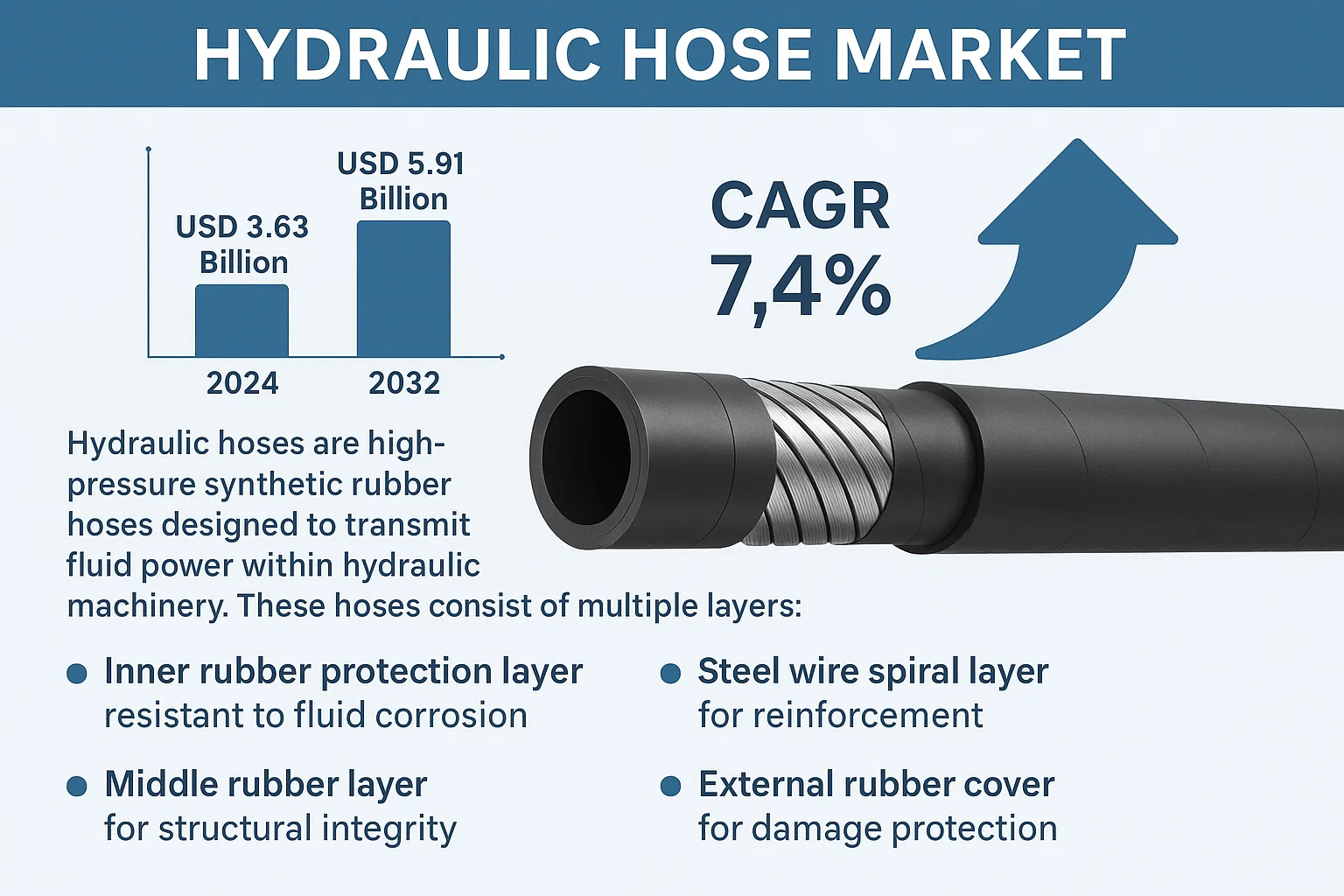
Global Hydraulic Hose Market size was valued at USD 3.63 billion in 2024 to USD 5.91 billion by 2032, exhibiting a CAGR of 7.4% during the forecast period.
Hydraulic hoses are high-pressure synthetic rubber hoses designed to transmit fluid power within hydraulic machinery. These hoses consist of multiple layers: an inner rubber protection layer resistant to fluid corrosion, a middle rubber layer for structural integrity, a steel wire spiral layer for reinforcement (acting as the core strength component), and an external rubber cover for damage protection. The steel wire reinforcement enables these hoses to withstand extreme pressures while maintaining flexibility.
The market growth is driven by increasing industrialization, expanding construction and mining activities, and rising demand for hydraulic systems in automotive and heavy machinery applications. Wire reinforced products dominate the market with over 70% share due to their superior pressure resistance. Geographically, Asia-Pacific leads with 37% market share, followed by Europe (32%) and North America (26%). Key players like Sumitomo Riko, Parker, and Yokohama Rubber collectively hold about 40% of the global market revenue.
MARKET DRIVERS
Infrastructure Development Projects
Global infrastructure development continues to drive demand for hydraulic hoses as construction equipment, mining machinery, and heavy equipment rely on hydraulic systems for operation. Major projects in emerging economies require extensive hydraulic applications.
Industrial Automation Growth
Manufacturing sectors are increasingly adopting automated machinery that utilizes hydraulic systems for precision control. This trend is particularly strong in automotive, aerospace, and heavy machinery manufacturing sectors where hydraulic hoses are critical components.
➤ Market studies indicate a 7.2% compound annual growth rate in industrial automation applications requiring hydraulic components between 2023-2028.
Advancements in hydraulic system technology continue to create new applications across industries, from robotics to renewable energy systems, ensuring steady market growth.
MARKET CHALLENGES
Raw Material Price Volatility
Fluctuations in raw material prices, particularly for synthetic rubber, steel, and other composites used in hydraulic hose production, create significant challenges for manufacturers in maintaining consistent pricing and profit margins.
Other Challenges
Supply Chain Disruptions
Global supply chain challenges continue to affect the availability of specialized components and materials needed for hydraulic hose production, leading to extended lead times and increased costs.
Technical Expertise Gap
The industry faces a shortage of qualified technicians and engineers specializing in hydraulic systems, making it challenging to maintain quality standards and innovation pace.
MARKET RESTRAINTS
Environmental Regulations Compliance
Stringent environmental regulations regarding the production, use, and disposal of hydraulic hoses continue to impact market growth. Regulations on per- and polyfluoroalkyl substances (PFAS) and other chemicals used in manufacturing present compliance challenges.
MARKET OPPORTUNITIES
Emerging Markets Expansion
Rapid industrialization in developing economies presents significant growth opportunities. Countries in Asia-Pacific and Latin America are investing heavily in infrastructure, manufacturing, and mining, all requiring hydraulic systems and replacement parts.
Advanced Material Development
Innovations in composite materials and manufacturing techniques are creating opportunities for more durable, efficient, and environmentally friendly hydraulic hoses. Developments in thermoplastic and fluoropolymer technologies offer enhanced performance characteristics.
Hydraulic Hose Market Trends
Asia-Pacific Leads in Hydraulic Hose Consumption with 37% Market Share
The hydraulic hose market demonstrates robust growth, driven by increasing industrialization and infrastructure development globally. Asia-Pacific emerges as the dominant consumer, accounting for 37% of global demand, followed by Europe at 32% and North America at 26%. This distribution reflects the concentration of manufacturing and heavy industries in the Asia-Pacific region, particularly in countries like China, India, and Japan, where rapid industrialization continues to drive demand for hydraulic components.
Other Trends
Material Innovation and Durability Enhancements
Manufacturers are increasingly focusing on developing advanced polymer compounds and steel alloys that enhance hose durability and pressure resistance. Recent innovations include multi-layer reinforcement structures that extend product lifespan by up to 40% while reducing weight. These advancements address the growing demand from industries requiring higher pressure ratings and longer service intervals, particularly in mining, construction, and oil & gas applications.
Market Consolidation and Strategic Partnerships
The hydraulic hose market has seen significant consolidation through mergers and acquisitions, with top 5 manufacturers (Sumitomo Riko, Alfagomma, Yokohama Rubber, Parker, and Semperit) collectively holding approximately 40% revenue market share. This consolidation enables economies of scale in manufacturing and distribution while fostering technological exchange. Concurrently, leading manufacturers are establishing strategic partnerships with OEMs across automotive, construction, and industrial machinery sectors to secure long-term supply agreements and co-develop application-specific solutions.
Environmental regulations continue to shape product development, with manufacturers investing heavily in developing eco-friendly and recyclable materials. The latest generation of hydraulic hoses feature improved chemical resistance while reducing environmental impact through longer service life and reduced material usage per pressure unit. Regulatory pressures in Europe and North America are accelerating the adoption of sustainable manufacturing practices across the industry.
COMPETITIVE LANDSCAPE
Key Industry Players
Leading Manufacturers in Hydraulic Hose Manufacturing
The hydraulic hose market is characterized by the dominance of global manufacturers with extensive distribution networks and strong R&D capabilities. Sumitomo Riko leads the market with its comprehensive product portfolio and strong presence across all major regions, followed by Parker Hannifin which maintains significant market share through its diverse industrial applications and strong brand recognition. These top players collectively account for approximately 40% of the global hydraulic hose market revenue.
Beyond the market leaders, several significant players have established strong regional presence and specialized market segments. Alfagomma maintains strong positioning in European markets with its specialized industrial hose solutions, while Yokohama Rubber has expanded significantly in Asian markets with competitively priced, high-performance products. Semperit and Manuli Hydraulics maintain strong positions in specific application segments, particularly in construction and mining equipment where durability requirements are highest.
List of Key Hydraulic Hose Companies
- Sumitomo Riko
- Parker Hannifin Corporation
- Alfagomma S.p.A.
- Yokohama Rubber Company Limited
- Semperit AG
- Manuli Hydraulics
- Gates Corporation
- Continental AG
- Eaton Corporation
- Bridgestone Corporation
- Trelleborg AB
- Bosch Rexroth AG
- Hansa-Flex International GmbH
Segment Analysis:
| Segment Category | Sub-Segments | Key Insights |
| By Type |
|
Spiral Reinforced hoses dominate due to superior flexibility and pressure resistance in complex hydraulic systems, while braided variants are preferred for space-constrained applications. |
| By Application |
|
Construction Machinery represents the largest segment due to extensive hydraulic system requirements in excavators, loaders, and cranes, with industrial machinery following closely due to manufacturing automation needs. |
| By End User |
|
OEMs (Original Equipment Manufacturers) lead in consumption as hydraulic hoses are integral components in new machinery production, though replacement markets show consistent growth due to maintenance cycles. |
| By Material |
|
Thermoplastic Hoses show strongest growth due to their lightweight nature and chemical resistance, while traditional rubber maintains dominance in high-temperature applications. |
| By Pressure Rating |
|
Medium Pressure (3000-6000 psi) applications are most common as they cover the majority of industrial and mobile equipment, while high-pressure variants cater to specialized heavy machinery. |
Regional Analysis: Hydraulic Hose Market
North America’s construction and mining industries operate some of the world’s largest hydraulic machinery fleets, creating massive demand for high-pressure hoses. The region’s harsh working environments accelerate hose replacement cycles, particularly in mining and oil extraction applications where equipment faces extreme pressure and abrasion challenges.
The continent’s vast agricultural lands require extensive use of hydraulic systems in farming equipment. The seasonal nature of agricultural work creates predictable replacement cycles, with spring and fall being peak seasons for hydraulic hose replacements as farmers prepare equipment for intense usage periods.
North American standards organizations set global benchmarks for hydraulic system safety and performance. This drives continuous improvement in hose technology as manufacturers compete to meet or exceed ISO and SAE standards. The region’s focus on worker safety drives innovation in hose burst protection and connection systems.
North America’s mature distribution network ensures hydraulic hoses are available even in remote locations. This is particularly crucial for mining and forestry operations where equipment downtime is extremely costly. The region’s distribution network supports just-in-time delivery even for specialized and custom-configured hoses.
Europe
Europe’s hydraulic hose market is characterized by its focus on sustainability and recycling. The region leads in developing biodegradable hydraulic fluids and eco-friendly hose materials. European manufacturers prioritize longevity and reliability, with many hydraulic systems operating for decades in industrial settings. The market is moving toward standardized connections and modular designs that reduce installation time and minimize leaks.
Asia-Pacific
Asia-Pacific represents the fastest-growing hydraulic hose market, driven by massive infrastructure development and manufacturing expansion. The region’s diverse climate conditions from tropical to arctic create demand for hoses with extreme temperature tolerance. Local manufacturing capabilities have improved dramatically, with several countries now producing world-class hydraulic components at competitive prices while meeting international quality standards.
South America
South America’s hydraulic hose market is primarily driven by mining and agricultural activities. The region’s challenging terrain and climate conditions require durable hose solutions. Market growth is supported by infrastructure development projects and the continued expansion of mining operations, particularly in Chile, Peru, and Brazil, where hydraulic systems operate under extreme pressure and environmental conditions.
Middle East & Africa
The Middle East and African markets show strong growth in hydraulic hose demand, particularly in oil-producing nations and emerging economies. The region’s development of ports, infrastructure, and energy projects drives demand for high-quality hydraulic components. Market growth is particularly notable in nations undergoing rapid industrialization, where equipment modernization creates replacement demand alongside new project requirements.
Report Scope
This market research report provides a comprehensive analysis of the Hydraulic Hose Market , covering the forecast period 2025–2032. It offers detailed insights into market dynamics, technological advancements, competitive landscape, and key trends shaping the industry.
Key focus areas of the report include:
- Market Overview: The report begins with an overview outlining its current market scenario, key growth indicators, and industry transformation drivers. It discusses macroeconomic factors, demand–supply balance, regulatory landscape, and the strategic role of semiconductors in powering advancements across industries such as automotive, telecommunications, consumer electronics, and industrial automation.
- Market Size & Forecast: Historical data and future projections for revenue, unit shipments, and market value across major regions and segments.
- Segmentation Analysis: Detailed breakdown by product type, technology, application, and end-user industry to identify high-growth segments and investment opportunities.
- Regional Insights: Insights into market performance across North America, Europe, Asia-Pacific, Latin America, and the Middle East & Africa, including country-level analysis where relevant.
- Competitive Landscape: Profiles of leading market participants, including their product offerings, R&D focus, manufacturing capacity, pricing strategies, and recent developments such as mergers, acquisitions, and partnerships.
- Technology Trends & Innovation: Assessment of emerging technologies, integration of AI/IoT, semiconductor design trends, fabrication techniques, and evolving industry standards.
- Market Drivers & Restraints: Evaluation of factors driving market growth along with challenges, supply chain constraints, regulatory issues, and market-entry barriers.
- Stakeholder Insights: Insights for component suppliers, OEMs, system integrators, investors, and policymakers regarding the evolving ecosystem and strategic opportunities.
Primary and secondary research methods are employed, including interviews with industry experts, data from verified sources, and real-time market intelligence to ensure the accuracy and reliability of the insights presented.
FREQUENTLY ASKED QUESTIONS:
What is the current market size of the Hydraulic Hose Market?
-> Hydraulic Hose Market was valued at USD 3626 million in 2024 and is projected to reach USD 5910 million by 2032.
What is the growth rate of the Hydraulic Hose Market?
-> The market is expected to grow at a compound annual growth rate (CAGR) of 7.4% during the forecast period 2024-2032.
Which are the key manufacturers in the Hydraulic Hose Market?
-> Key players include Sumitomo Riko, Alfagomma, Yokohama Rubber, Parker, Semperit, Manuli Hydraulics, Gates, Continental, Bridgestone, Hansa-Flex, Eaton, Trelleborg, Bosch Rexroth, Foscarin, Kurt, LETONE-FLEX, Dagong, YuTong, Ouya Hose, and JingBo, among others.
What is the largest application segment for Hydraulic Hose?
-> The automotive sector represents the largest application segment, followed by construction & mining machinery.
Which region has the largest market share in Hydraulic Hose Market?
-> Asia-Pacific holds the largest market share, accounting for approximately 37% of the global market, followed by Europe and North America.

Get Sample Report PDF for Exclusive Insights
Report Sample Includes
- Table of Contents
- List of Tables & Figures
- Charts, Research Methodology, and more...
 Download Sample Report PDF