Hybrid optical-RF unified link for indoor wireless backhaul Market Insights
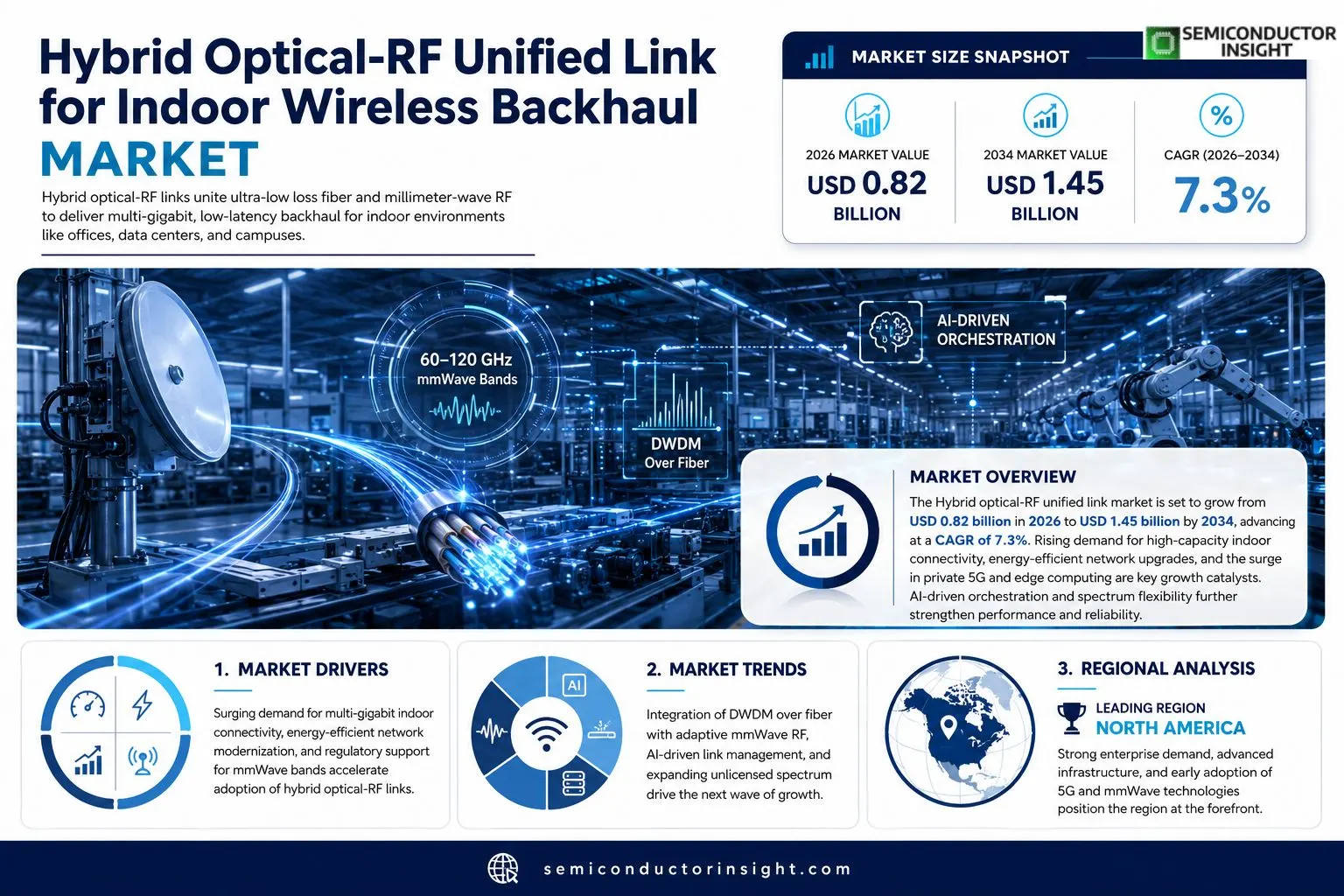
Hybrid optical‑RF unified link for indoor wireless backhaul market size was valued at USD 0.78 billion in 2025. The market is projected to grow from USD 0.82 billion in 2026 to USD 1.45 billion by 2034, exhibiting a CAGR of 7.3% during the forecast period.
Hybrid optical‑RF unified links combine fiber‑optic transmission’s ultra‑low loss with millimeter‑wave radio frequency’s flexibility to create a single conduit capable of delivering multi‑gigabit capacity within office complexes, data centers, and campus environments. The solution integrates dense wavelength division multiplexing (DWDM) over single‑mode fiber with adaptive beamforming RF front‑ends that dynamically allocate spectrum between 60 GHz and 120 GHz bands, enabling seamless handover between wired and wireless segments while maintaining sub‑millisecond latency.The market is accelerating because enterprises are expanding high‑density Wi‑Fi 6E deployments and edge computing workloads demand reliable backhaul that fits existing building infrastructure. Furthermore, regulatory relaxations on unlicensed millimeter‑wave bands worldwide are spurring adoption. Key players such as Nokia, Ericsson, Huawei Technologies, Samsung Networks, and Juniper Networks are actively developing integrated modules and offering turnkey solutions that leverage AI‑driven network orchestration to optimize link performance.
MARKET DRIVERS
Rising Demand for High‑Capacity Indoor Connectivity
Hybrid optical‑RF unified link for indoor wireless backhaul Market is being propelled by the exponential growth of data‑intensive applications within enterprise campuses, hospitals, and large‑scale venues. Organizations are shifting from legacy copper solutions to integrated optical‑RF architectures to accommodate bandwidth requirements that now routinely exceed 10 Gbps per link.
Energy‑Efficient Network Modernization
Hybrid solutions combine the low‑loss, long‑reach characteristics of optical fiber with the flexibility of RF transmission, enabling significant power savings compared with parallel fiber deployments. Operators report up to 30 % lower energy consumption per backhaul node, driving cost‑effective upgrades in densely packed indoor environments.
➤ “Integrating optical and RF layers reduces OPEX while delivering carrier‑grade reliability for indoor backhaul.” – Senior Network Analyst
Regulatory incentives for spectrum sharing and the availability of ready‑to‑deploy modular kits further accelerate adoption, positioning the hybrid architecture as the preferred pathway for next‑generation indoor wireless infrastructure.
MARKET CHALLENGES
Complex Integration and Skill Gaps
Deploying a unified optical‑RF link demands expertise in both photonic and radio‑frequency domains. Many enterprises lack in‑house talent capable of designing, calibrating, and maintaining these converged systems, leading to extended project timelines and higher initial integration costs.
Other Challenges
Interference Management
The RF component must coexist with existing Wi‑Fi, IoT, and 5G signals. Without rigorous site‑specific planning, adjacent‑channel interference can degrade throughput, requiring advanced spectrum‑analysis tools that add to overall expenditure.
MARKET RESTRAINTS
High Capital Expenditure for Legacy Upgrades
Although the hybrid approach promises long‑term savings, the upfront investment remains a restraint. Retrofitting older building infrastructures with optical fiber pathways and RF antenna mounts often incurs substantial capital outlays, prompting some operators to postpone large‑scale rollouts.
MARKET OPPORTUNITIES
Growth of Private 5G and Edge Computing
The surge in private 5G deployments and edge‑computing nodes within factories and campuses creates a fertile opportunity for the hybrid optical‑RF backhaul market. By delivering ultra‑low latency and high‑throughput connectivity, these solutions can become the backbone for mission‑critical applications such as real‑time analytics, autonomous robotics, and high‑definition video surveillance.
Hybrid optical-RF unified link for indoor wireless backhaul Market Trends
Increasing Adoption of Integrated DWDM‑RF Backhaul Solutions
Hybrid optical-RF unified link for indoor wireless backhaul Market is witnessing a clear shift toward integrated dense wavelength division multiplexing (DWDM) over single‑mode fiber paired with adaptive millimeter‑wave (mmWave) radio front‑ends. This hybrid architecture delivers multi‑gigabit capacity while preserving sub‑millisecond latency, a combination that directly addresses the bandwidth demands of modern edge‑computing workloads and high‑density Wi‑Fi 6E deployments in office complexes and data‑center campuses. Enterprises favor the unified conduit because it leverages existing fiber plant, reduces the need for parallel cabling, and enables dynamic spectrum allocation between the 60 GHz and 120 GHz bands, facilitating seamless handover between wired and wireless segments. Vendor road‑maps from Nokia, Ericsson, Huawei Technologies, Samsung Networks and Juniper Networks emphasize AI‑driven orchestration, which continuously optimizes link parameters based on traffic patterns, further strengthening the value proposition for Hybrid optical‑RF unified link for indoor wireless backhaul Market.
Other Trends
Regulatory Evolution of Millimeter‑Wave Bands
Recent regulatory relaxations in key regions have opened additional unlicensed spectrum in the 60 GHz–120 GHz range, reducing barriers for indoor deployments of hybrid solutions. Authorities in Europe and North America have aligned spectrum allocation policies to support higher power limits for indoor use, allowing network operators to expand coverage without incurring additional licensing costs. This regulatory momentum accelerates rollout timelines and encourages vendors to invest in more flexible RF front‑ends that can opportunistically exploit newly available channels, reinforcing the upward trajectory of Hybrid optical‑RF unified link for indoor wireless backhaul Market.
AI‑Driven Link Management Boosts Network Efficiency
Artificial‑intelligence algorithms embedded in the control plane are now standard in Hybrid optical‑RF unified link for indoor wireless backhaul Market. These AI modules monitor real‑time traffic, link quality and environmental interference, automatically adjusting beamforming vectors and wavelength channels to sustain optimal throughput. The result is a measurable reduction in outage incidents and a consistent latency envelope below one millisecond, which is critical for latency‑sensitive applications such as augmented reality and real‑time analytics. As enterprises prioritize operational continuity and cost efficiency, AI‑enabled management becomes a decisive differentiator, driving further adoption of integrated optical‑RF backhaul architectures across indoor environments.
COMPETITIVE LANDSCAPE
Key Industry Players
Hybrid optical‑RF unified link for indoor wireless backhaul Market – Competitive Overview
The market is currently anchored by a handful of large telecommunications equipment vendors that have leveraged their existing fiber‑optic and millimeter‑wave portfolios to launch integrated hybrid solutions. Nokia leads the segment with its “AirFiber‑Hybrid” platform, combining DWDM‑based fiber transport with adaptive 60‑120 GHz RF front‑ends and AI‑driven orchestration for enterprise campuses. Ericsson follows closely, deploying its “Radio‑Fiber Convergence” kit that targets data‑center backhaul with sub‑millisecond latency. Huawei Technologies capitalises on its extensive optical networking heritage, offering a cost‑efficient hybrid module for dense office environments. Samsung Networks and Juniper Networks each provide turnkey end‑to‑end solutions that integrate with existing Wi‑Fi 6E deployments, reinforcing the market’s shift toward unified link architectures. These incumbents benefit from strong R&D pipelines, extensive channel ecosystems, and the ability to meet the regulatory relaxation of unlicensed millimeter‑wave bands, positioning them as the primary drivers of projected CAGR‑7.3% growth through 2034.Beyond the dominant five, a cohort of specialised and regional players is expanding the competitive set. Ciena’s “HybridLink” targets high‑performance data‑center interconnects, while Corning’s optical‑RF convergence modules focus on building‑infrastructure retrofit projects. Infonet (now part of Fujitsu) supplies modular hybrid units for Japanese enterprise markets, and ADVA Optical Networking offers a flexible DWDM‑RF solution for European campuses. Companies such as Cambium Networks and Poynting (acquired by Nokia) add value with low‑cost, compact units for midsize offices. Additional niche contributors include Fiberhome, Viavi Solutions, Viasat (through its RF backhaul division), and Xnet (a joint venture between Intel and Cisco) that experiment with AI‑enhanced spectrum management. Collectively, these players deepen the ecosystem, foster innovation, and provide customers with a broad spectrum of pricing and performance options, reinforcing a fragmented yet increasingly collaborative market landscape.
List of Key Hybrid optical‑RF Unified Link for Indoor Wireless Backhaul Companies Profiled
- Nokia
- Ericsson
- Huawei Technologies
- Samsung Networks
- Juniper Networks
- Ciena
- Corning
- Infonet (Fujitsu)
- ADVA Optical Networking
- Cambium Networks
- Poynting
- Fiberhome
- Viavi Solutions
- Viasat
- Xnet
Segment Analysis:
| Segment Category | Sub-Segments | Key Insights |
| By Type |
|
Hybrid Fiber‑RF Links
|
| By Application |
|
Enterprise Campus Backhaul
|
| By End User |
|
Large Enterprises
|
| By Architecture |
|
Integrated Fiber‑RF Modules
|
| By Deployment Scenario |
|
Retrofitting Existing Buildings
|
Regional Analysis: North America
North America
The demand for high-speed, low-latency wireless connectivity within enterprise environments is a primary driver in North America. Businesses are increasingly relying on wireless for various applications, including VoIP, video conferencing, and data access, making hybrid optical-RF backhaul a crucial component for network infrastructure upgrades.
The proliferation of Internet of Things (IoT) devices across various industries, such as manufacturing, healthcare, and retail, is fueling the need for reliable and scalable wireless backhaul solutions. Hybrid optical-RF links provide an efficient way to connect a large number of IoT devices, enabling data transmission and control.
Government initiatives aimed at expanding broadband access and improving network infrastructure, particularly in underserved areas, are creating significant opportunities for hybrid optical-RF unified link deployment. These initiatives often prioritize cost-effective and efficient solutions for connecting remote locations.
Data centers are increasingly relying on high-bandwidth, low-latency wireless connectivity for various purposes, including remote access, disaster recovery, and edge computing. Hybrid optical-RF offers a viable solution for extending network reach and ensuring data connectivity in these critical environments.
Europe
Europe is witnessing steady growth in Hybrid optical-RF unified link for indoor wireless backhaul Market. The region’s diverse telecommunications landscape and varying levels of technological adoption present both opportunities and challenges. While some European countries are at the forefront of wireless technology advancements, others are still in the process of upgrading their infrastructure. The emphasis on energy efficiency and environmental sustainability is influencing the choice of backhaul solutions, with a growing interest in solutions that minimize power consumption. The integration of unified link technologies is gaining traction as operators seek to optimize their network performance and reduce operational costs. The increasing deployment of 5G networks is further driving demand for flexible and scalable hybrid optical-RF backhaul solutions.
Asia-Pacific
The Asia-Pacific region is projected to be the fastest-growing market for Hybrid optical-RF unified link for indoor wireless backhaul Market. Rapid urbanization, a burgeoning middle class, and the widespread adoption of mobile devices are driving the demand for high-speed wireless connectivity. The region’s significant investments in network infrastructure development, coupled with government support for digital transformation initiatives, are creating a favorable environment for hybrid optical-RF backhaul deployment. The increasing adoption of IoT devices in industries like manufacturing and logistics is also contributing to market growth. The need for robust and reliable connectivity in remote areas and challenging terrains further fuels the demand for unified link technologies.
South America
South America presents a promising, yet developing market for Hybrid optical-RF unified link for indoor wireless backhaul Market. The region’s growing focus on digital inclusion and expanding broadband access is creating opportunities for wireless backhaul solutions. However, infrastructure limitations and economic factors can pose challenges to market growth. The increasing adoption of mobile technologies and the rise of IoT applications are driving demand for reliable and cost-effective backhaul solutions. Hybrid optical-RF offers a compelling alternative to traditional wired infrastructure in many areas, particularly where deploying fiber optic cables is difficult or expensive.
Middle East & Africa
The Middle East & Africa region is experiencing significant growth in Hybrid optical-RF unified link for indoor wireless backhaul Market, driven by increasing investments in telecommunications infrastructure and the expansion of digital services. Rapid urbanization and a growing population are fueling the demand for high-speed wireless connectivity. The region’s strategic focus on smart city initiatives and the deployment of 5G networks are creating substantial opportunities for hybrid optical-RF solutions. The need for reliable connectivity in remote areas and challenging environments further supports the adoption of unified link technologies. Government initiatives aimed at promoting digital transformation and economic diversification are also contributing to market growth.
Report Scope
This market research report provides a comprehensive analysis of the Hybrid optical-RF unified link for indoor wireless backhaul Market , covering the forecast period 2026–2034. It offers detailed insights into market dynamics, technological advancements, competitive landscape, and key trends shaping the industry.
Key focus areas of the report include:
- ✅ Market Overview: The report begins with an overview outlining its current market scenario, key growth indicators, and industry transformation drivers. It discusses macroeconomic factors, demand–supply balance, regulatory landscape, and the strategic role of semiconductors in powering advancements across industries such as automotive, telecommunications, consumer electronics, and industrial automation.
- ✅ Market Size & Forecast: Historical data and future projections for revenue, unit shipments, and market value across major regions and segments.
- ✅ Segmentation Analysis: Detailed breakdown by product type, technology, application, and end-user industry to identify high-growth segments and investment opportunities.
- ✅ Regional Insights: Insights into market performance across North America, Europe, Asia-Pacific, Latin America, and the Middle East & Africa, including country-level analysis where relevant.
- ✅ Competitive Landscape: Profiles of leading market participants, including their product offerings, R&D focus, manufacturing capacity, pricing strategies, and recent developments such as mergers, acquisitions, and partnerships.
- ✅ Technology Trends & Innovation: Assessment of emerging technologies, integration of AI/IoT, semiconductor design trends, fabrication techniques, and evolving industry standards.
- ✅ Market Drivers & Restraints: Evaluation of factors driving market growth along with challenges, supply chain constraints, regulatory issues, and market-entry barriers.
- ✅ Stakeholder Insights: Insights for component suppliers, OEMs, system integrators, investors, and policymakers regarding the evolving ecosystem and strategic opportunities.
Primary and secondary research methods are employed, including interviews with industry experts, data from verified sources, and real-time market intelligence to ensure the accuracy and reliability of the insights presented.
FREQUENTLY ASKED QUESTIONS:
What is the current market size of Hybrid optical-RF unified link for indoor wireless backhaul Market?
-> Hybrid optical-RF unified link for indoor wireless backhaul Market was valued at USD 0.78 billion in 2025 and is expected to reach USD 1.45 billion by 2034, with a projected CAGR of 7.3 % over the forecast period.
Which key companies operate in Hybrid optical-RF unified link for indoor wireless backhaul Market?
-> Key players include Nokia, Ericsson, Huawei Technologies, Samsung Networks, and Juniper Networks, among others.
What are the key growth drivers?
-> Key growth drivers include high‑density Wi‑Fi 6E deployments, edge‑computing workload demands, and regulatory relaxations on unlicensed millimeter‑wave bands worldwide.
Which region dominates the market?
-> The reference material does not specify a dominant region for this market.
What are the emerging trends?
-> Emerging trends include AI‑driven network orchestration, adaptive beamforming across 60 GHz‑120 GHz bands, and integration of DWDM over single‑mode fiber for seamless wired‑wireless handover.

Get Sample Report PDF for Exclusive Insights
Report Sample Includes
- Table of Contents
- List of Tables & Figures
- Charts, Research Methodology, and more...
 Download Sample Report PDF