Human Body Sensing Detection Millimeter Wave Radar Market Insights
Global Human Body Sensing Detection Millimeter Wave Radar market size was valued at USD 192 million in 2025. The market is projected to reach USD 738 million by 2032, exhibiting a CAGR of 21.8% during the forecast period.
Human Body Sensing Detection Millimeter Wave Radar is a high-frequency radar system, typically operating in the millimeter wave frequency range (30 GHz to 300 GHz), specifically designed to detect human presence, monitor motion, and measure physiological signals. By using millimeter wave technology, this radar can capture subtle movements, such as breathing and heartbeat, and track larger movements without physical contact. It finds applications in fields like smart homes, healthcare, elderly care, and security, offering high precision, privacy protection, and non-invasive monitoring. Key types include 60GHz, 24GHz, and others.
The market is experiencing rapid growth due to several factors, including surging demand for contactless sensing in smart security and home automation, rising needs in healthcare and elderly care, and advancements in all-weather detection technologies. Additionally, the integration of AI and 5G is contributing to market expansion by enabling more accurate vital sign monitoring and behavior analysis. Initiatives by the key players in the market are also expected to fuel the market growth. Vayyar, Hikvision, bitsensing, and Miaomi Technology are some of the key players that operate in the market with a wide range of portfolios.
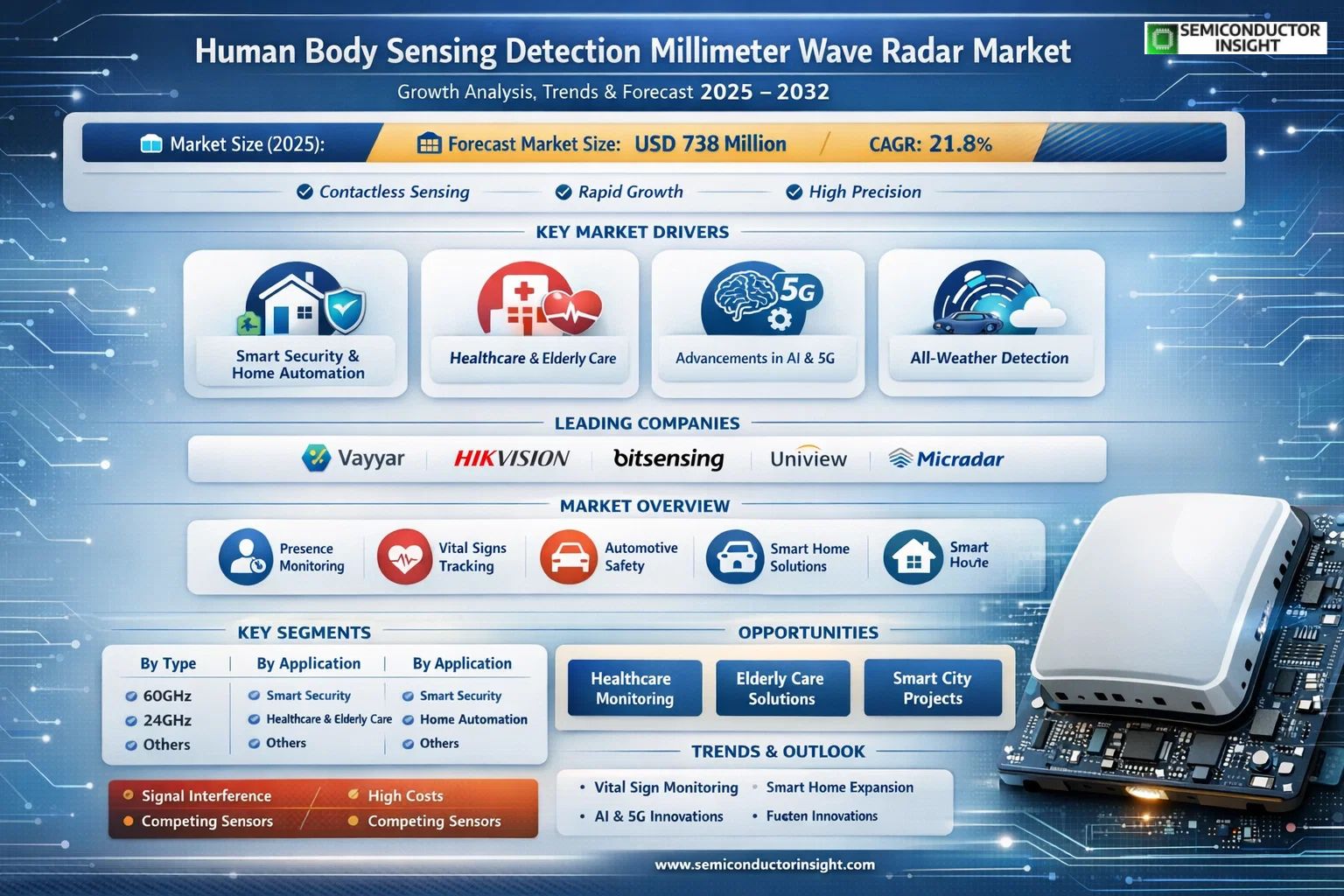
MARKET DRIVERS
Advancements in Non-Contact Sensing Technologies
Human Body Sensing Detection Millimeter Wave Radar Market is propelled by rapid improvements in radar resolution and sensitivity, enabling precise detection of human presence, motion, and vital signs without physical contact. This technology excels in privacy-preserving applications compared to camera-based systems, fostering adoption across sectors like healthcare and security.
Growing Demand in Smart Homes and Automotive
Integration into smart home devices for occupancy detection and energy management has surged, with the sector expected to contribute significantly to market expansion at a CAGR of around 18% through 2030. In automotive ADAS, millimeter wave radar enhances gesture recognition and driver monitoring, aligning with global safety regulations.
➤ IoT and 5G proliferation is accelerating deployment, with over 25 billion connected devices projected by 2025 boosting radar sensor integration.
Post-pandemic emphasis on touchless interfaces further drives innovation, positioning Human Body Sensing Detection Millimeter Wave Radar Market for sustained growth amid rising consumer safety awareness.
MARKET CHALLENGES
Technical Complexity in Signal Processing
Developing algorithms to accurately distinguish human movements from environmental clutter remains a key hurdle in Human Body Sensing Detection Millimeter Wave Radar Market, requiring advanced AI to mitigate false positives in cluttered indoor settings.
Other Challenges
High Manufacturing Costs
Premium components and calibration processes elevate production expenses, limiting scalability for mass-market consumer devices and pressuring profit margins for vendors.Competition from ultrasonic and PIR sensors adds pricing pressure, while supply chain disruptions for specialized semiconductors hinder timely market entry and innovation cycles.
MARKET RESTRAINTS
Regulatory and Spectrum Allocation Issues
Strict regulations on millimeter wave frequency bands by bodies like FCC and ETSI constrain deployment in Human Body Sensing Detection Millimeter Wave Radar Market, particularly in densely populated regions where interference risks are high.
Power efficiency challenges in battery-operated devices limit applications in wearables and portables, with current systems consuming up to 30% more energy than optical alternatives under similar conditions.
Integration difficulties with legacy systems in automotive and building automation further slow adoption, as retrofitting demands substantial redesign efforts and validation testing.
MARKET OPPORTUNITIES
Expansion in Healthcare and Elderly Care
Human Body Sensing Detection Millimeter Wave Radar Market holds promise in remote vital signs monitoring for aging populations, with applications in fall detection and sleep analysis projected to grow at 22% CAGR amid global elderly demographics shifting.Smart city initiatives offer avenues for public safety through crowd monitoring without privacy invasions, leveraging radar’s all-weather performance over traditional sensors.AI-driven enhancements for multi-target tracking open doors in industrial automation, while partnerships with 5G infrastructure providers could unlock edge computing synergies for real-time human detection analytics.
Human Body Sensing Detection Millimeter Wave Radar Market Trends
Advancements in Vital Sign Monitoring Driving Healthcare Adoption
Human Body Sensing Detection Millimeter Wave Radar Market is experiencing significant momentum from its capability to monitor vital signs like breathing and heartbeat in real-time without physical contact. This non-invasive technology excels in healthcare and elderly care applications, where it detects subtle micro-motions even when individuals are stationary. Unlike infrared sensors or cameras, millimeter wave radar maintains privacy by avoiding visual imaging, making it suitable for sensitive environments such as bedrooms and restrooms.
Other Trends
Expansion in Smart Security and Home Automation
In smart security, Human Body Sensing Detection Millimeter Wave Radar provides reliable intruder detection and motion tracking across all weather conditions, unaffected by light, fog, or dust. Its integration into home automation systems enables precise control of lighting, HVAC, and personalized settings based on human presence. The privacy-friendly nature and all-weather reliability position it as a superior alternative to traditional sensors, fostering broader adoption in residential and commercial spaces.
AI Integration and Frequency Band Innovations
Key developments in Human Body Sensing Detection Millimeter Wave Radar Market include AI enhancements to reduce false alarms and improve human behavior recognition, alongside optimizations in 60GHz and 24GHz bands for higher precision. Leading players like Vayyar, Hikvision, and bitsensing are advancing these technologies for applications in industrial automation, fall detection, and autonomous systems. Future synergies with 5G and cloud computing promise more sophisticated analysis, addressing challenges like power consumption while expanding into regions like Asia and North America.
COMPETITIVE LANDSCAPE
Key Industry Players
Leading Innovators in Human Body Sensing Detection Millimeter Wave Radar Technology
Human Body Sensing Detection Millimeter Wave Radar Market exhibits a moderately fragmented competitive landscape, dominated by a mix of established security technology giants and specialized radar sensor innovators. Vayyar Imaging emerges as a frontrunner, leveraging advanced 4D imaging radar capabilities to deliver high-precision, contactless human detection and vital signs monitoring solutions across smart homes, healthcare, and security applications. Hikvision, a global leader in video surveillance, has aggressively expanded into mmWave radar integration, capturing significant market share through scalable deployments in smart security systems. The market structure is characterized by rapid innovation driven by demand for privacy-preserving, all-weather sensing, with top players holding approximately 40-50% combined revenue share in 2025, while intense R&D investments fuel differentiation in 60GHz and 24GHz frequency bands.
Beyond the leaders, a robust ecosystem of niche players contributes specialized expertise in vital sign detection, elderly care, and industrial automation. Companies like Tsingray Technology and bitsensing focus on AI-enhanced micro-motion analysis for breathing and heartbeat tracking, gaining traction in healthcare segments. Talius Group and Miaomi Technology emphasize compact, low-power modules for home automation, addressing challenges like false alarms and power efficiency. Regional dynamics see strong Asian presence from Hikvision, Uniview, and CQ-S Net, alongside emerging innovators such as Micradar and Quanthium pushing boundaries in vital signs and fall detection. This competitive intensity fosters mergers, partnerships, and technological advancements, positioning the market for sustained growth at a 21.8% CAGR through 2032.
List of Key Human Body Sensing Detection Millimeter Wave Radar Companies Profiled
- Vayyar
- Tsingray Technology
- Talius Group
- Hikvision
- Uniview
- CQ-S Net
- bitsensing
- Miaomi Technology
- Fusion
- Livy Care
- Quanthium
- Microbrain Intelligent Technology
- ifLabe
- Micradar
Segment Analysis:
| Segment Category | Sub-Segments | Key Insights |
| By Type |
|
60GHz dominates due to its superior resolution capabilities.
|
| By Application |
|
Healthcare & Elderly Care leads with its non-invasive monitoring strengths.
|
| By End User |
|
Residential Users are at the forefront driven by smart home integration.
|
| By Deployment Type |
|
Ceiling-Mounted excels in comprehensive coverage applications.
|
| By Functionality |
|
Vital Signs Monitoring stands out for advanced health applications.
|
Regional Analysis: Human Body Sensing Detection Millimeter Wave Radar Market
Asia-Pacific
Rapid evolution in millimeter wave radar chips enhances resolution for human body sensing, with focus on miniaturization and low-power designs. Japanese firms excel in AI-enhanced signal processing, distinguishing vital signs remotely, while Chinese manufacturers scale production for cost-effective modules integrated into wearables and appliances.
Automotive and smart home sectors dominate, using radars for gesture control and intrusion detection. Healthcare applications thrive in aging populations, enabling non-contact vital monitoring, complemented by industrial uses in hazardous area safety protocols.
Regional leaders form strategic alliances, with South Korean conglomerates advancing automotive radars and Indian startups targeting affordable smart city solutions. Global partnerships amplify local innovation ecosystems.
Smart city expansions and IoT convergence offer vast potential, alongside rising demand for privacy-focused sensing amid data regulations. Export growth to emerging markets further strengthens regional positioning.
North America
North America exhibits robust dynamics in Human Body Sensing Detection Millimeter Wave Radar Market, fueled by innovation hubs in the United States and Canada. Emphasis on automotive safety and healthcare drives adoption, with radars enabling precise occupant detection for autonomous vehicles. Business strategies prioritize R&D investments in fusion with LiDAR for enhanced accuracy. Smart building applications gain traction for energy management through occupancy sensing, while defense sectors explore advanced motion tracking. Trends toward privacy-centric technologies align with stringent data protection norms, positioning firms for leadership in high-value integrations. Collaborative ventures between startups and established players accelerate deployment in consumer devices.
Europe
Europe’s Human Body Sensing Detection Millimeter Wave Radar Market thrives on regulatory frameworks promoting sustainable tech and privacy. Germany and France lead in industrial automation, deploying radars for machine-human interaction safety. Automotive giants integrate these for next-gen ADAS, focusing on pedestrian detection. Smart home trends emphasize energy-efficient lighting control via presence sensing. Business strategies involve EU-funded projects for cross-border standardization, enhancing interoperability. Challenges like spectrum allocation are addressed through innovative frequency modulation, supporting growth in healthcare for remote patient monitoring amid aging demographics.
South America
South America shows emerging potential in Human Body Sensing Detection Millimeter Wave Radar Market, with Brazil and Mexico at the forefront. Urban security applications drive initial adoption, using radars for perimeter monitoring in high-crime areas. Automotive sectors adapt for affordable safety features, while smart agriculture explores vital sign detection for livestock. Business strategies focus on cost reduction through local assembly, partnering with Asian suppliers. Infrastructure investments in smart cities foster gradual expansion, though challenges like economic volatility temper pace, offering opportunities in public health monitoring systems.
Middle East & Africa
The Middle East & Africa region witnesses nascent growth in Human Body Sensing Detection Millimeter Wave Radar Market, propelled by Gulf smart city visions and African urbanization. UAE and Saudi Arabia prioritize oil & gas safety with human detection in hazardous zones. Hospitality sectors adopt touchless controls, aligning with hygiene trends. Business strategies leverage sovereign funds for tech imports and localization. Limited infrastructure poses hurdles, yet rising IoT interest in security and healthcare signals promising trajectories through strategic international collaborations.
Report Scope
This market research report provides a comprehensive analysis of Human Body Sensing Detection Millimeter Wave Radar Market, covering the forecast period 2025–2032. It offers detailed insights into market dynamics, technological advancements, competitive landscape, and key trends shaping the industry.
Key focus areas of the report include:
- Market Overview: The report begins with an overview outlining its current market scenario, key growth indicators, and industry transformation drivers. It discusses macroeconomic factors, demand–supply balance, regulatory landscape, and the strategic role of millimeter wave radar in powering advancements across industries such as smart security, home automation, healthcare, elderly care, and industrial control.
- Market Size & Forecast: Historical data and future projections for revenue, unit shipments, and market value across major regions and segments.
- Segmentation Analysis: Detailed breakdown by product type, technology, application, and end-user industry to identify high-growth segments and investment opportunities.
- Regional Insights: Insights into market performance across North America, Europe, Asia-Pacific, Latin America, and the Middle East & Africa, including country-level analysis where relevant.
- Competitive Landscape: Profiles of leading market participants, including their product offerings, R&D focus, manufacturing capacity, pricing strategies, and recent developments such as mergers, acquisitions, and partnerships.
- Technology Trends & Innovation: Assessment of emerging technologies, integration of AI/IoT, semiconductor design trends, fabrication techniques, and evolving industry standards.
- Market Drivers & Restraints: Evaluation of factors driving market growth along with challenges, supply chain constraints, regulatory issues, and market-entry barriers.
- Stakeholder Insights: Insights for component suppliers, OEMs, system integrators, investors, and policymakers regarding the evolving ecosystem and strategic opportunities.
Primary and secondary research methods are employed, including interviews with industry experts, data from verified sources, and real-time market intelligence to ensure the accuracy and reliability of the insights presented.
FREQUENTLY ASKED QUESTIONS:
What is the current market size of Human Body Sensing Detection Millimeter Wave Radar Market?
-> Global Human Body Sensing Detection Millimeter Wave Radar market was valued at USD 192 million in 2025 and is projected to reach USD 738 million by 2032, at a CAGR of 21.8% during the forecast period.
Which key companies operate in Human Body Sensing Detection Millimeter Wave Radar Market?
-> Key players include Vayyar, Tsingray Technology, Hikvision, Uniview, bitsensing, Micradar, among others.
What are the key growth drivers?
-> Key growth drivers include demand for contactless sensing, vital sign monitoring in healthcare and elderly care, smart home automation, and privacy-friendly security solutions.
Which region dominates the market?
-> Asia-Pacific is the fastest-growing region, while North America remains a dominant market.
What are the emerging trends?
-> Emerging trends include AI integration for enhanced analysis, 5G and cloud computing advancements, precise human behavior recognition, and all-weather reliable sensing.
Get Sample Report PDF for Exclusive Insights
Report Sample Includes
- Table of Contents
- List of Tables & Figures
- Charts, Research Methodology, and more...
 Download Sample Report PDF