Market Insights
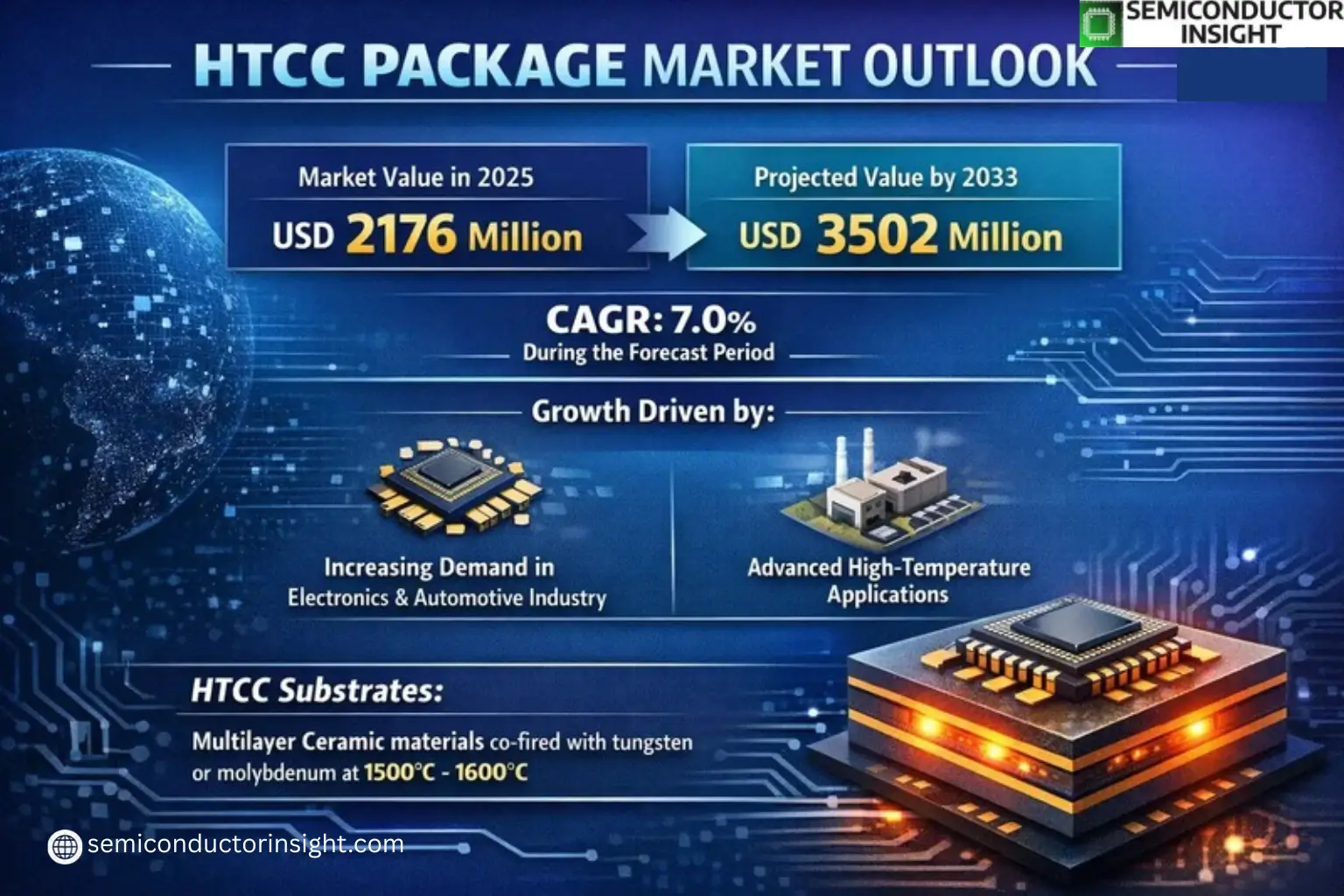
Global HTCC Package Market was valued at USD 2176 million in 2025 and is projected to reach USD 3502 million by 2033, exhibiting a CAGR of 7.0% during the forecast period.
HTCC (High-Temperature Co-fired Ceramic) substrates are multilayer ceramic materials co-fired with high-melting-point metals like tungsten or molybdenum at temperatures between 1500°C and 1600°C. These substrates offer exceptional properties such as high mechanical strength, superior thermal dissipation, and reliability, making them ideal for demanding applications in aerospace, military electronics, MEMS, microprocessors, and RF components.
The market growth is driven by increasing demand for advanced electronic packaging solutions in high-performance industries. Japan dominates production with a 69% market share in 2025, while China follows at 24.7%, expected to grow to 32.3% by 2033 with a CAGR of 10.7%. Key players like Kyocera, Maruwa, and NGK/NTK collectively hold an 82.9% revenue share globally. HTCC Ceramic Shell/Housings lead product segments (70.6% share), followed by SMD Ceramic Packages (22.5%).
MARKET DRIVERS
Growing Demand in Electronics & Semiconductor Industries
HTCC (High-Temperature Co-fired Ceramic) Package Market is experiencing significant growth due to increasing demand in the electronics and semiconductor sectors. These packages provide excellent thermal stability and reliability, making them ideal for high-performance applications. Global semiconductor market’s expansion is driving over 7.8% annual growth in HTCC adoption.
Advancements in 5G and IoT Technologies
With the rapid deployment of 5G networks and IoT devices, HTCC packages are becoming essential for high-frequency, high-power applications. These packages maintain signal integrity at elevated temperatures, with industry reports indicating a 12% increase in usage for 5G base station components since 2022.
Automotive electrification trends are further propelling market growth, with EV power modules increasingly adopting HTCC solutions for their superior thermal management capabilities.
MARKET CHALLENGES
High Manufacturing Costs and Complex Processes
HTCC package manufacturing process involves complex procedures and specialized materials, leading to production costs that are 35-45% higher than conventional packages. This price premium limits adoption in cost-sensitive consumer electronics applications.
Other Challenges
Material Availability Constraints
Supply chain disruptions for key ceramic materials like alumina and aluminum nitride have caused lead time extensions of up to 12 weeks, impacting production schedules.
Technical Design Limitations
While excellent for high-temperature applications, HTCC packages face challenges in miniaturization compared to emerging LTCC (Low-Temperature Co-fired Ceramic) alternatives.
MARKET RESTRAINTS
Competition from Alternative Packaging Technologies
HTCC Package Market faces growing competition from LTCC and advanced plastic packaging solutions that offer lower production costs and design flexibility. Industry analysis shows a 9% annual growth in LTCC adoption where extreme temperature resistance isn’t critical.
MARKET OPPORTUNITIES
Expansion in Renewable Energy Applications
The renewable energy sector presents significant growth potential for HTCC packages, particularly in solar power converters and wind turbine control systems. Market projections indicate a potential 18% CAGR in this application segment through 2028. The ability to withstand outdoor environmental extremes makes HTCC ideal for these installations.
Global HTCC Package Market Trends
Strong Market Growth Projected Through 2033
Global HTCC Package Market, valued at USD 2176 million in 2025, is projected to reach USD 3502 million by 2033, growing at a CAGR of 7.0%. This growth is fueled by increasing demand in military electronics, MEMS, and RF applications due to HTCC’s high strength and thermal reliability. Japan currently leads production with 69% market share, while China is expanding rapidly with 24.7% share in 2025 expected to reach 32.3% by 2033.
Other Trends
Dominance of Key Product Segments
HTCC Ceramic Shell/Housings hold 70.6% market share, followed by HTCC SMD Ceramic Packages at 22.5%. Kyocera, NGK/NTK, and Hebei Sinopack dominate ceramic shell production with 83% combined share, while Kyocera and Chaozhou Three-Circle control 90% of SMD package market.
Regional Market Developments
Asia-Pacific remains the epicenter of HTCC production and consumption, with China’s growth outpacing Japan’s established sector. North America and Europe maintain strong demand for aerospace and military applications, contributing to stable regional market shares.
Supply Chain and Competitive Landscape Trends
HTCC Package Market remains highly consolidated, with the top four players holding 82.9% revenue share. Kyocera leads across multiple product segments, while Chinese manufacturers like CETC 13 and Chaozhou Three-Circle are gaining ground through technology advancements and domestic market penetration.
Application Sector Growth Patterns
Aerospace and military applications accounted for 42% of 2025 demand, followed by communication packages (28%) and automotive electronics (15%). Emerging applications in 5G infrastructure and electric vehicles are expected to drive future growth at above-average rates.
COMPETITIVE LANDSCAPE
Key Industry Players
Global HTCC Package Market Dominated by Japanese and Chinese Manufacturers
Global HTCC Package Market is highly consolidated, with the top four players Kyocera, Maruwa, NGK Spark Plug, and Hebei Sinopack Electronic Tech & CETC 13 controlling 82.9% of market revenue in 2025. Japan leads production with 69% market share, though China is rapidly expanding with 24.7% share and projected 10.7% CAGR through 2033. Kyocera maintains technology leadership across all product segments, holding dominant positions in HTCC Ceramic Shell/Housings (83% with NGK and Sinopack) and HTCC SMD Ceramic Packages (90% share with Chaozhou Three-Circle).
Specialized manufacturers like Egide and NEO Tech cater to aerospace/military applications, while regional players such as CETC 43 and Fujian Minhang Electronics are gaining traction in Asian markets. The industry faces supply chain challenges due to U.S.-China trade policies and rare earth material access. Recent investments in China’s domestic production capabilities particularly by Hebei Sinopack and Chaozhou Three-Circle are reshaping regional competitive dynamics.
List of Key HTCC Package Companies Profiled
- Kyocera
- Maruwa
- NGK/NTK
- Egide
- NEO Tech
- AdTech Ceramics
- AMETEK Aegis
- Electronic Products, Inc. (EPI)
- CETC 43 (Shengda Electronics)
- Chaozhou Three-Circle (Group)
- Hebei Sinopack Electronic Tech & CETC 13
- Beijing BDStar Navigation (Glead)
- Fujian Minhang Electronics
- RF Materials (METALLIFE)
- CETC 55
Segment Analysis:
| Segment Category | Sub-Segments | Key Insights |
| By Type |
|
HTCC Ceramic Shell/Housings
|
| By Application |
|
Aerospace and Military
|
| By End User |
|
Defense Contractors
|
| By Production Technology |
|
Multilayer HTCC
|
| By Material Composition |
|
Alumina-based HTCC
|
Regional Analysis: Global HTCC Package Market
Asia-Pacific
HTCC packages in Asia-Pacific primarily serve automotive radar modules, power electronics, and RF devices. The region sees growing utilization in LED packaging and MEMS sensors for consumer electronics.
Local availability of raw materials and established ceramic processing facilities give Asian manufacturers cost advantages. Cluster-based production enables faster time-to-market for customized HTCC solutions.
Regional players are investing in multilayer HTCC designs with improved thermal conductivity. Advanced via-filling techniques and shrinkage control methods enhance product reliability for high-frequency applications.
Competition from low-temperature co-fired ceramic (LTCC) alternatives and rising material costs present challenges. Manufacturers focus on differentiating through superior hermetic sealing and thermal performance.
North America
The North American HTCC package market benefits from strong aerospace and defense sector demand, particularly for radar and satellite communication systems. Established semiconductor companies drive innovation in high-reliability packaging solutions. The region maintains technological leadership in designing HTCC packages for extreme environment applications, though production capacities are more limited compared to Asia. Research institutions collaborate with manufacturers to develop next-generation ceramic packages with enhanced RF performance.
Europe
Europe shows steady demand for HTCC packages in industrial and medical electronics applications. German and Swiss manufacturers specialize in precision ceramic packaging for measurement equipment and implantable devices. The automotive sector’s transition to electric vehicles creates new opportunities for power electronics packaging. Strict environmental regulations influence material selection and manufacturing processes for ceramic packages across European markets.
South America
South America’s HTCC package market remains nascent but shows growth potential in telecommunications infrastructure. Brazil leads regional adoption with increasing investments in base station equipment. Local manufacturers focus on cost-effective solutions for consumer electronics imports while facing challenges in establishing full-scale ceramic packaging production capabilities.
Middle East & Africa
The Middle East sees growing HTCC package use in oil & gas sensing equipment and renewable energy systems. African markets show limited penetration but demonstrate potential in telecommunications infrastructure projects. Both regions rely heavily on imports but show increasing interest in local assembly partnerships with global ceramic packaging suppliers.
Report Scope
This market research report provides a comprehensive analysis of the HTCC Package Market , covering the forecast period 2025–2033. It offers detailed insights into market dynamics, technological advancements, competitive landscape, and key trends shaping the industry.
Key focus areas of the report include:
- Market Overview: The report begins with an overview outlining its current market scenario, key growth indicators, and industry transformation drivers. It discusses macroeconomic factors, demand–supply balance, regulatory landscape, and the strategic role of semiconductors in powering advancements across industries such as automotive, telecommunications, consumer electronics, and industrial automation.
- Market Size & Forecast: Historical data and future projections for revenue, unit shipments, and market value across major regions and segments.
- Segmentation Analysis: Detailed breakdown by product type, technology, application, and end-user industry to identify high-growth segments and investment opportunities.
- Regional Insights: Insights into market performance across North America, Europe, Asia-Pacific, Latin America, and the Middle East & Africa, including country-level analysis where relevant.
- Competitive Landscape: Profiles of leading market participants, including their product offerings, R&D focus, manufacturing capacity, pricing strategies, and recent developments such as mergers, acquisitions, and partnerships.
- Technology Trends & Innovation: Assessment of emerging technologies, integration of AI/IoT, semiconductor design trends, fabrication techniques, and evolving industry standards.
- Market Drivers & Restraints: Evaluation of factors driving market growth along with challenges, supply chain constraints, regulatory issues, and market-entry barriers.
- Stakeholder Insights: Insights for component suppliers, OEMs, system integrators, investors, and policymakers regarding the evolving ecosystem and strategic opportunities.
Primary and secondary research methods are employed, including interviews with industry experts, data from verified sources, and real-time market intelligence to ensure the accuracy and reliability of the insights presented.
FREQUENTLY ASKED QUESTIONS:
What is the current market size of HTCC Package Market?
-> HTCC Package Market was valued at USD 2176 million in 2025 and is projected to reach USD 3502 million by 2033, exhibiting a CAGR of 7.0% during the forecast period.
What is the growth rate of HTCC Package Market?
-> The market is projected to grow at a CAGR of 7.0% during the forecast period 2025-2033.
Which key companies operate in HTCC Package Market?
-> Key players include Kyocera, Maruwa, NGK/NTK, Hebei Sinopack Electronic Tech & CETC 13, and Chaozhou Three-Circle, among others. Global four largest players hold an 82.9% market share in 2025.
Which regions dominate the HTCC Package Market?
-> Japan is the largest producer of HTCC with 69% market share in 2025, followed by China (24.7%). China is projected to reach 32.3% market share by 2033 with a CAGR of 10.7%.
What are the major product segments?
-> The market is segmented into HTCC Ceramic Shell/Housings (70.6% share), HTCC SMD Ceramic Packages (22.5% share), and HTCC Ceramic Substrates.
What are the key applications of HTCC Package?
-> Major applications include Communication Package, Industrial, Aerospace and Military, Consumer Electronics, Automotive Electronics, and others.

Get Sample Report PDF for Exclusive Insights
Report Sample Includes
- Table of Contents
- List of Tables & Figures
- Charts, Research Methodology, and more...
 Download Sample Report PDF