Market Insights
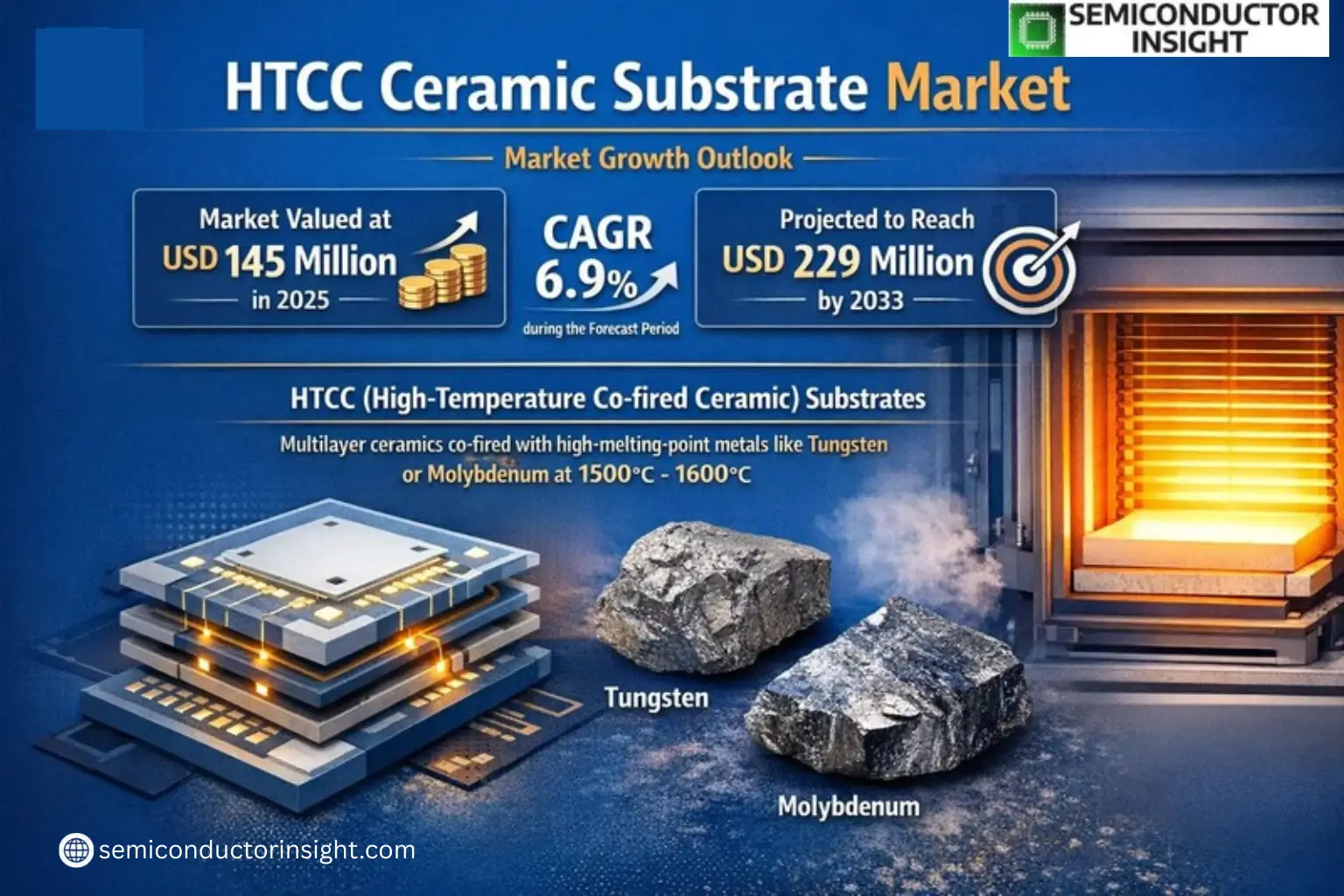
Global HTCC Ceramic Substrate Market was valued at USD 145 million in 2025 and is projected to reach USD 229 million by 2033, exhibiting a CAGR of 6.9% during the forecast period.
HTCC (High-Temperature Co-fired Ceramic) substrates are multilayer ceramic materials co-fired with high-melting-point metals like tungsten or molybdenum at temperatures between 1500°C and 1600°C. These substrates offer exceptional mechanical strength, thermal dissipation, and reliability, making them ideal for demanding applications in electronics packaging. Key uses include military electronics, MEMS (Micro-Electro-Mechanical Systems), microprocessors, and RF (Radio Frequency) components.
The market growth is driven by increasing demand for miniaturized and high-performance electronic devices, particularly in aerospace, automotive, and telecommunications sectors. Japan dominates the market with a 70% share, followed by China and the United States. The top three manufacturers Kyocera, Maruwa, and NGK Spark Plug collectively hold approximately 80% of the global market. Recent advancements in 5G technology and electric vehicles are further accelerating adoption of HTCC substrates due to their superior thermal management capabilities.
MARKET DRIVERS
Growing Demand in Electronics Industry
HTCC Ceramic Substrate Market is experiencing significant growth due to increasing demand from the electronics sector. These substrates are widely used in high-temperature applications such as power electronics, LED packaging, and semiconductor devices. The superior thermal conductivity and mechanical strength of HTCC ceramics make them indispensable for advanced electronic components.
Automotive Sector Adoption
Automotive manufacturers are increasingly adopting HTCC ceramic substrates for electric vehicle power modules and sensors. The shift toward electric mobility has accelerated the need for reliable, high-performance materials that can withstand extreme operating conditions. This trend is projected to drive market growth at a CAGR of approximately 6.8% over the next five years.
Emerging 5G infrastructure development is creating additional demand for HTCC substrates in RF components, further fueling market expansion.
MARKET CHALLENGES
High Production Costs
The manufacturing process for HTCC ceramic substrates involves complex sintering techniques and requires specialized equipment, leading to significantly higher production costs compared to alternative materials. This cost factor remains a major barrier for widespread adoption, particularly among small and medium-sized electronics manufacturers.
Other Challenges
Material Brittleness Concerns
Despite their thermal advantages, HTCC substrates are inherently brittle, which can lead to cracking during assembly processes. This limitation requires additional engineering solutions that increase overall system costs.
MARKET RESTRAINTS
Competition from Alternative Technologies
HTCC Ceramic Substrate Market faces growing competition from LTCC (Low-Temperature Cofired Ceramic) and DBC (Direct Bonded Copper) alternatives. These technologies offer different advantages in terms of processing temperature and thermal performance, creating segmentation pressure in certain application areas.
MARKET OPPORTUNITIES
Aerospace and Defense Applications
The aerospace sector presents significant growth potential for HTCC ceramic substrates, particularly in satellite communication systems and avionics. These applications require materials that can perform reliably in harsh environments, creating a specialized niche for high-performance ceramics. Market analysts project aerospace applications to grow at 7.2% annually through 2028.
Medical Device Integration
Advancements in medical imaging and diagnostic equipment are opening new opportunities for HTCC substrates in the healthcare sector. Their biocompatibility and precision engineering capabilities make them suitable for next-generation medical electronics.
HTCC Ceramic Substrate Market Trends
Steady Market Growth Driven by Electronics Demand
Global HTCC Ceramic Substrate Market is projected to grow at 6.9% CAGR, reaching USD 229 million by 2033. This growth is fueled by increasing applications in LED packaging, automotive ECUs, and RF communication devices. The market demonstrates resilience despite global supply chain challenges, with Japan dominating 70% of current production.
Other Trends
Regional Manufacturing Concentration
Japan accounts for 70% of global HTCC ceramic substrate production, with Kyocera, Maruwa and NGK Spark Plug collectively controlling 80% market share. China and the U.S. are emerging as alternative manufacturing hubs, particularly for military electronics and 5G infrastructure applications.
Technology Advancements Driving New Applications
HTCC substrates are gaining traction in high-reliability applications due to their thermal stability (withstand 1500-1600°C firing temperatures) and superior electrical insulation. The market sees growing adoption in MEMS packaging and optical communication systems, where material durability is critical.
Other Trends
Material Composition Developments
Alumina (Al2O3) substrates currently dominate the market segment, while Aluminum Nitride (AlN) variants are gaining share in high-power applications. The material selection trend reflects specific thermal conductivity requirements across different electronic packaging applications.
Supply Chain and Tariff Impacts
U.S. tariff policies and international trade responses are reshaping HTCC substrate supply chains, with companies diversifying manufacturing locations. This trend is particularly noticeable in the automotive electronics sector, where regional production clusters are emerging to mitigate geopolitical risks.
COMPETITIVE LANDSCAPE
Key Industry Players
Japan Dominates 70% Market Share in HTCC Ceramic Substrate Industry
Kyocera, Maruwa, and NGK/NTK collectively command nearly 80% of the global HTCC ceramic substrate market, leveraging their advanced manufacturing capabilities and long-standing expertise in high-temperature co-fired ceramics. The industry remains highly concentrated with Japanese players benefiting from early-mover advantages in precision ceramic technologies. These leaders primarily supply to military electronics, automotive ECUs, and optical communication sectors where reliability and thermal stability are critical.
Emerging Chinese manufacturers like CETC 43 and Beijing BDStar Navigation are gaining traction through government-supported semiconductor initiatives, particularly in LED packaging applications. Niche players such as NEO Tech and SoarTech focus on specialized applications in MEMS packaging, while Zhuzhou Ascendus New Material Technology emphasizes novel material formulations for improved thermal conductivity. The market sees increasing competition in the mid-range segment as regional players expand production capacities.
List of Key HTCC Ceramic Substrate Companies Profiled
- Kyocera
- Maruwa
- NGK/NTK
- NIKKO COMPANY
- NEO Tech
- CETC 43 (Shengda Electronics)
- Hebei Sinopack Electronic Tech & CETC 13
- Beijing BDStar Navigation (Glead)
- Zhuzhou Ascendus New Material Technology Co.,Ltd
- SoarTech
- Hitachi Chemical
- TDK Corporation
- Murata Manufacturing
- Rogers Corporation
- KOA Corporation
Segment Analysis:
| Segment Category | Sub-Segments | Key Insights |
| By Type |
|
Al2O3/Alumina HTCC Substrate dominates the market due to:
|
| By Application |
|
Sensor/MEMS Package shows strongest growth potential due to:
|
| By End User |
|
Military & Aerospace remains the key demand driver because:
|
| By Material Property |
|
Thermal Conductivity is the most valued property as:
|
| By Manufacturing Process |
|
Multilayer Co-fired technology remains dominant due to:
|
Regional Analysis: HTCC Ceramic Substrate Market
China’s mature electronics supply chain and aggressive investments in semiconductor capabilities position it as the primary HTCC ceramic substrate consumer. Domestic manufacturers focus on cost-competitive solutions while gradually improving technical specifications.
Japanese firms lead in high-performance HTCC solutions for automotive and aerospace applications, leveraging advanced materials science expertise. The market benefits from strong R&D collaborations between corporations and academic institutions.
Korean manufacturers emphasize miniaturization and thermal performance optimization in HTCC substrates, catering to next-generation consumer electronics and 5G infrastructure requirements.
Countries like Malaysia and Thailand are developing HTCC substrate capabilities, supported by investment incentives and growing electronics manufacturing bases, though still reliant on imports for advanced solutions.
North America
The North American HTCC ceramic substrate market benefits from strong demand in aerospace, defense, and medical equipment sectors. U.S.-based companies focus on high-reliability applications, with significant R&D investments in thermal management solutions. The region maintains technological leadership in specialized HTCC formulations but faces cost pressures from Asian competitors. Recent reshoring initiatives and government incentives for semiconductor manufacturing are creating new growth opportunities for domestic HTCC substrate suppliers.
Europe
Europe’s HTCC ceramic substrate market is driven by automotive electrification and industrial automation trends. German and Swiss manufacturers excel in precision-engineered solutions for harsh environment applications. The region’s strict environmental regulations have prompted innovations in sustainable manufacturing processes for HTCC materials. While European firms maintain strong positions in niche applications, they face challenges scaling production to compete with Asian volume manufacturers on price.
Middle East & Africa
The MEA region represents a smaller but growing market for HTCC ceramic substrates, primarily serving oil & gas sensor applications and telecommunications infrastructure. Local production remains limited, with most demand met through imports. Emerging industrial automation initiatives in Gulf countries and infrastructure development across Africa are creating new opportunities for market expansion.
South America
South America’s HTCC ceramic substrate market is in early development stages, with Brazil being the primary consumption center. The automotive sector drives most demand, supplemented by medical equipment manufacturing. Limited local production capabilities result in heavy reliance on imports from North America and Asia. Infrastructure challenges and economic volatility remain barriers to faster market growth.
Report Scope
This market research report provides a comprehensive analysis of the HTCC Ceramic Substrate Market , covering the forecast period 2025–2033. It offers detailed insights into market dynamics, technological advancements, competitive landscape, and key trends shaping the industry.
Key focus areas of the report include:
- Market Overview: The report begins with an overview outlining its current market scenario, key growth indicators, and industry transformation drivers. It discusses macroeconomic factors, demand–supply balance, regulatory landscape, and the strategic role of semiconductors in powering advancements across industries such as automotive, telecommunications, consumer electronics, and industrial automation.
- Market Size & Forecast: Historical data and future projections for revenue, unit shipments, and market value across major regions and segments.
- Segmentation Analysis: Detailed breakdown by product type, technology, application, and end-user industry to identify high-growth segments and investment opportunities.
- Regional Insights: Insights into market performance across North America, Europe, Asia-Pacific, Latin America, and the Middle East & Africa, including country-level analysis where relevant.
- Competitive Landscape: Profiles of leading market participants, including their product offerings, R&D focus, manufacturing capacity, pricing strategies, and recent developments such as mergers, acquisitions, and partnerships.
- Technology Trends & Innovation: Assessment of emerging technologies, integration of AI/IoT, semiconductor design trends, fabrication techniques, and evolving industry standards.
- Market Drivers & Restraints: Evaluation of factors driving market growth along with challenges, supply chain constraints, regulatory issues, and market-entry barriers.
- Stakeholder Insights: Insights for component suppliers, OEMs, system integrators, investors, and policymakers regarding the evolving ecosystem and strategic opportunities.
Primary and secondary research methods are employed, including interviews with industry experts, data from verified sources, and real-time market intelligence to ensure the accuracy and reliability of the insights presented.
FREQUENTLY ASKED QUESTIONS:
What is the current market size of HTCC Ceramic Substrate Market?
-> HTCC Ceramic Substrate Market was valued at USD 145 million in 2025 and is projected to reach USD 229 million by 2033, exhibiting a CAGR of 6.9% during the forecast period.
Which key companies operate in HTCC Ceramic Substrate Market?
-> Key players include Kyocera, Maruwa, NGK/NTK, NIKKO COMPANY, NEO Tech, CETC 43 (Shengda Electronics), and Hebei Sinopack Electronic Tech & CETC 13, among others. The top 3 manufacturers hold about 80% of market share.
What are the key growth drivers?
-> Key growth drivers include rising demand in military electronics, MEMS applications, microprocessor packaging, and RF applications, along with the material’s properties of high strength and heat dissipation.
Which region dominates the market?
-> Japan is the largest market with about 70% share, followed by China and the United States.
What are the emerging trends?
-> Emerging trends include increased adoption in automotive ECUs, optical communication packages, and advanced LED packaging solutions.

Get Sample Report PDF for Exclusive Insights
Report Sample Includes
- Table of Contents
- List of Tables & Figures
- Charts, Research Methodology, and more...
 Download Sample Report PDF