
HPC Interconnect Semiconductor Market Insights
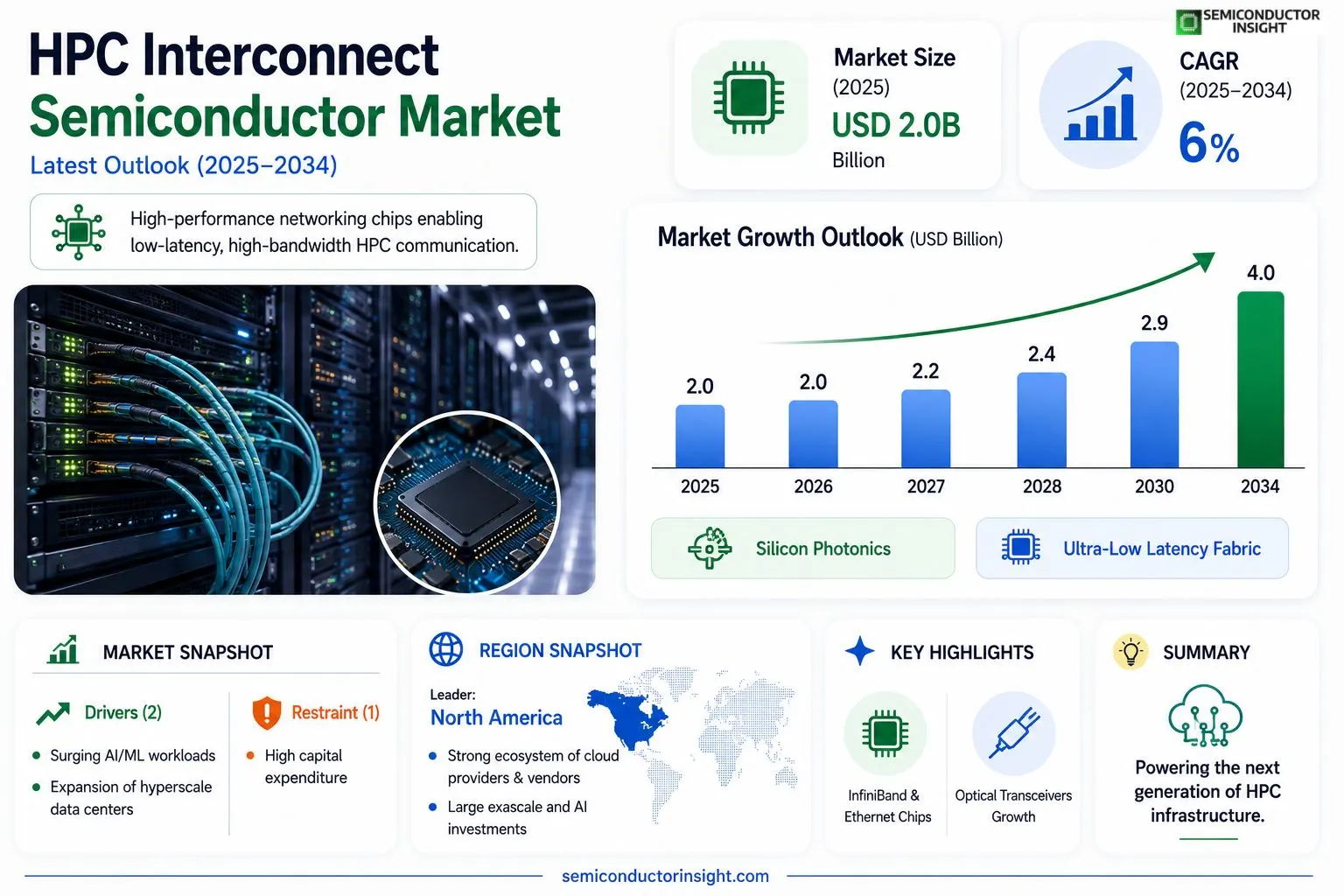
Global HPC interconnect semiconductor market size was valued at USD 2 billion in 2025.The market is projected to grow from USD 2 billion in 2025 to USD 4 billion by 2034, exhibiting a CAGR of approximately 6% during the forecast period.HPC interconnect semiconductors comprise high‑performance networking chips,including InfiniBand ASICs, Ethernet PHYs and optical transceivers,designed to enable low‑latency, high‑bandwidth communication between compute nodes in supercomputers and data‑center clusters.
The market is accelerating because cloud providers are expanding AI training workloads, governments are funding exascale supercomputing, and demand for real‑time analytics is rising across scientific research and finance.
Recent collaborations such as NVIDIA’s integration of its Mellanox portfolio with ARM‑based processors announced in March 2024 are further driving adoption of next‑generation silicon fabrics.
MARKET DRIVERS
Rising AI and ML Workloads
The surge in artificial‑intelligence (AI) and machine‑learning (ML) applications has forced HPC interconnect semiconductor Market to prioritize ultra‑low latency and high‑throughput solutions. Enterprises deploying large language models require interconnects that can move petabytes of data efficiently, driving adoption of advanced silicon‑based adapters and switch fabrics.
Expansion of Hyperscale Data Centers
Hyperscale cloud providers are rapidly expanding their data‑center footprints, with each new facility demanding scalable interconnect architectures. The demand for high‑bandwidth, low‑power interconnect semiconductors is therefore accelerating, as operators seek to maximize compute density while controlling energy costs.
➤ Seamless bandwidth scaling is essential for next‑gen exascale systems.
Government funding programs focused on national supercomputing capabilities are also injecting capital into the sector, encouraging R&D in photonic and electrical interconnect technologies that reinforce market growth.
MARKET CHALLENGES
Complexity of Integration
Integrating cutting‑edge interconnect semiconductors into existing HPC clusters often requires extensive redesign of motherboard layouts and firmware, raising implementation costs and lengthening time‑to‑market for new deployments.
Other Challenges
Supply Chain Constraints
Limited fab capacity for advanced node silicon interconnects creates bottlenecks, leading to longer lead times and price volatility for critical components.
MARKET RESTRAINTS
High Capital Expenditure
Deploying state‑of‑the‑art interconnect solutions involves substantial upfront investment in both hardware and supporting infrastructure, which can deter smaller research institutions from upgrading their HPC platforms.
Thermal Management Constraints
Increased bandwidth and signaling speeds generate higher thermal loads, compelling system designers to adopt more sophisticated cooling techniques that further raise overall system cost.
Regulatory Compliance Hurdles
Export controls and cybersecurity regulations in key regions can limit the free flow of advanced interconnect technologies, creating market entry barriers for some vendors.
MARKET OPPORTUNITIES
Adoption of Silicon Photonics
Silicon‑photonic interconnects promise dramatically higher data rates with lower power consumption, positioning them as a prime growth avenue for HPC interconnect semiconductor Market as designers target exascale performance.
Edge Computing Acceleration
The rise of edge‑based AI inference workloads is creating demand for compact, high‑speed interconnect chips that can be embedded in distributed compute nodes, opening new revenue streams for semiconductor manufacturers.
Strategic Partnerships and M&A Activity
Collaborations between traditional semiconductor firms and specialized IP providers are accelerating the development of next‑generation interconnect solutions, while mergers and acquisitions consolidate expertise and expand market reach.
HPC Interconnect Semiconductor Market Trends
AI‑Driven Demand for Low‑Latency Fabric
The rapid expansion of cloud‑based artificial‑intelligence training workloads is reshaping HPC interconnect semiconductor Market. Major cloud providers are deploying larger clusters that require sub‑microsecond latency and bandwidths that exceed traditional Ethernet limits. This pressure is prompting vendors to prioritize InfiniBand ASICs and high‑speed Ethernet PHYs that can sustain the data‑intensive exchange patterns typical of deep‑learning models. As AI workloads scale, the market observes a clear shift toward fabrics that integrate compute and networking functions, delivering deterministic latency while preserving power efficiency. The convergence of these requirements reinforces the strategic importance of interconnect semiconductors in next‑generation data centers.
Other Trends
Integration of ARM‑Based Processors
Recent collaborations, such as the partnership announced in early 2024 between NVIDIA’s Mellanox portfolio and ARM‑based processor architectures, illustrate a growing emphasis on heterogeneous compute ecosystems. By aligning high‑performance networking chips with ARM’s energy‑efficient cores, designers can achieve tighter silicon‑to‑silicon coupling, reducing packet‑processing overhead and improving overall system throughput. This integration supports exascale initiatives where power budgets are a critical constraint and demonstrates how the market is moving beyond isolated networking components toward unified silicon fabrics.
Shift Toward Optical Interconnects
Parallel to the silicon‑based advances, operators are adopting optical transceiver technologies to address the bandwidth ceiling of copper‑based links. Optical solutions provide wavelength‑division multiplexing capabilities that enable multiple terabits per second over a single fiber, a requirement for real‑time analytics in scientific research and high‑frequency finance. The transition to optical interconnects also mitigates signal integrity challenges associated with long‑distance connections in large‑scale supercomputing installations. Vendors are therefore expanding their product portfolios to include silicon‑photonic modules that can be co‑packaged with existing ASICs, delivering a seamless path from electrical to optical domains.
COMPETITIVE LANDSCAPEKey Industry Players
HPC Interconnect Semiconductor Market – Competitive Overview
HPC interconnect semiconductor Market is anchored by a small group of dominant vendors that supply the high‑performance networking ASICs, Ethernet PHYs, and optical transceiver modules essential for low‑latency, high‑bandwidth fabric architectures. NVIDIA’s Mellanox portfolio remains the market leader, leveraging its InfiniBand and Ethernet silicon to secure the majority of exascale and AI‑driven data‑center contracts. Intel follows closely with its Omni‑Path and Ethernet solutions, benefiting from deep integration with its Xeon processors. Broadcom, through its acquisition of Brocade’s networking assets, commands a substantial share of the Ethernet PHY and switch ASIC segments, while Marvell’s recent roadmap of silicon‑photonic interconnects positions it as a fast‑growing challenger. Collectively, these firms shape a tiered structure where a few Tier‑1 players dominate volume shipments, and a broader ecosystem of niche suppliers fills specialized low‑power or optical niches.Beyond the Tier‑1 cohort, several niche but strategically important companies contribute differentiated technology to the interconnect stack. Samsung Electronics provides advanced silicon‑photonic transceivers that enable ultra‑low latency links in emerging supercomputers. AMD, after acquiring Xilinx, offers programmable interconnect solutions that target customizable AI workloads. Huawei’s HiSilicon continues to develop proprietary Ethernet and InfiniBand chips for the domestic Chinese market. Qualcomm, Texas Instruments, and Analog Devices supply high‑speed serial interfaces and power‑management ICs that complement the core networking silicon. Lattice Semiconductor and Cerebras focus on ultra‑low‑power and AI‑specific interconnect fabrics, respectively, underscoring a diversified supply chain that supports both commodity and specialized HPC deployments.
List of Key HPC Interconnect Semiconductor Companies Profiled
- NVIDIA (Mellanox)
- Intel
- Broadcom
- Marvell Technology
- Samsung Electronics
- Advanced Micro Devices (AMD)
- Huawei HiSilicon
- Qualcomm
- Texas Instruments
- Analog Devices
- Lattice Semiconductor
- Cerebras Systems
- Microchip Technology
- Inphi Corporation
- ON Semiconductor
Segment Analysis:
| Segment Category | Sub-Segments | Key Insights |
| By Type |
|
InfiniBand ASICs
|
| By Application |
|
AI training clusters
|
| By End User |
|
Cloud service providers
|
| By Architecture |
|
Chiplet‑based fabrics
|
| By Deployment Model |
|
Hybrid edge‑data‑center deployments
|
Regional Analysis: North America
United States
The data center segment is a primary consumer of HPC interconnect semiconductors, driven by the exponential growth of cloud computing and the increasing demand for data storage and processing. The need for efficient and scalable interconnect solutions to support high-density computing environments is paramount.
Scientific research institutions heavily rely on HPC systems for complex simulations and data analysis. The demand for high-performance interconnects to facilitate data sharing and accelerate computational workflows is a key factor in this segment.
The financial services sector utilizes HPC for risk management, algorithmic trading, and fraud detection. Reliable and low-latency interconnects are crucial for processing large volumes of financial data in real-time.
The automotive industry is increasingly leveraging HPC for autonomous driving, advanced driver-assistance systems (ADAS), and vehicle simulation. High-bandwidth interconnects are essential for processing sensor data and enabling real-time decision-making.
Europe
Europe represents a significant and growing market for HPC Interconnect Semiconductors, characterized by strong government support for research and development. Countries like Germany, France, and the UK are investing heavily in supercomputing infrastructure and high-performance computing initiatives. The European Union’s focus on digital sovereignty and technological independence is further driving demand for domestically produced interconnect solutions. The automotive sector is another key driver, with increasing adoption of autonomous driving technologies. The market is witnessing a shift towards energy-efficient interconnects to address environmental concerns. Strategic partnerships between European semiconductor companies and research institutions are fostering innovation in this space. While the European market is more fragmented compared to the US, it offers substantial growth opportunities.
Asia-Pacific
Asia-Pacific is emerging as the fastest-growing region in HPC interconnect semiconductor Market. China is investing aggressively in HPC infrastructure to support its growing digital economy and technological ambitions. Other key markets in the region include Japan, South Korea, and India. The demand for HPC interconnects is driven by the expansion of cloud computing, the growth of artificial intelligence, and increasing investments in scientific research. The Asia-Pacific market is characterized by a strong focus on cost-effectiveness and rapid deployment. Local semiconductor manufacturers are gaining prominence, challenging established players. The increasing adoption of 5G and edge computing technologies is further fueling demand for high-bandwidth interconnect solutions.
South America
South America represents a smaller but steadily growing market for HPC Interconnect Semiconductors. Brazil and Argentina are the primary markets in the region, with increasing investments in data centers and scientific research facilities. The demand for high-performance computing is driven by the expansion of e-commerce, financial services, and the growing adoption of cloud services. The market is characterized by a relatively immature ecosystem and limited local manufacturing capabilities. Government initiatives to promote technological development are expected to drive future growth.
Middle East & Africa
The Middle East & Africa region is an emerging market for HPC Interconnect Semiconductors, driven by investments in infrastructure development and the growth of digital economies. Countries like Saudi Arabia, UAE, and South Africa are witnessing increasing demand for high-performance computing solutions. The demand for interconnects is fueled by the expansion of data centers, the adoption of 5G technology, and the growing focus on artificial intelligence. The market is still in its early stages of development, with significant potential for growth.
Report Scope
This market research report provides a comprehensive analysis of the HPC Interconnect Semiconductor Market , covering the forecast period 2026–2034. It offers detailed insights into market dynamics, technological advancements, competitive landscape, and key trends shaping the industry.
Key focus areas of the report include:
- Market Overview: The report begins with an overview outlining its current market scenario, key growth indicators, and industry transformation drivers. It discusses macroeconomic factors, demand–supply balance, regulatory landscape, and the strategic role of semiconductors in powering advancements across industries such as automotive, telecommunications, consumer electronics, and industrial automation.
- Market Size & Forecast: Historical data and future projections for revenue, unit shipments, and market value across major regions and segments.
- Segmentation Analysis: Detailed breakdown by product type, technology, application, and end-user industry to identify high-growth segments and investment opportunities.
- Regional Insights: Insights into market performance across North America, Europe, Asia-Pacific, Latin America, and the Middle East & Africa, including country-level analysis where relevant.
- Competitive Landscape: Profiles of leading market participants, including their product offerings, R&D focus, manufacturing capacity, pricing strategies, and recent developments such as mergers, acquisitions, and partnerships.
- Technology Trends & Innovation: Assessment of emerging technologies, integration of AI/IoT, semiconductor design trends, fabrication techniques, and evolving industry standards.
- Market Drivers & Restraints: Evaluation of factors driving market growth along with challenges, supply chain constraints, regulatory issues, and market-entry barriers.
- Stakeholder Insights: Insights for component suppliers, OEMs, system integrators, investors, and policymakers regarding the evolving ecosystem and strategic opportunities.
Primary and secondary research methods are employed, including interviews with industry experts, data from verified sources, and real-time market intelligence to ensure the accuracy and reliability of the insights presented.
FREQUENTLY ASKED QUESTIONS:
What is the current market size of HPC Interconnect Semiconductor Market?
-> HPC interconnect semiconductor Market was valued at USD 2 billion in 2025 and is expected to reach USD 4 billion by 2034, reflecting a CAGR of approximately 6 % over the forecast period.
Which key companies operate in HPC Interconnect Semiconductor Market?
-> Key players include NVIDIA (Mellanox), Intel, AMD, Broadcom, Marvell, and Xilinx, among others.
What are the key growth drivers?
-> Growth is driven by expanding AI training workloads, government funding for exascale supercomputing, increasing demand for real‑time analytics in scientific research and finance, and strategic collaborations such as NVIDIA’s integration of Mellanox with ARM‑based processors.
Which region dominates the market?
-> North America currently leads in market share due to the concentration of cloud service providers and semiconductor manufacturers, while Asia‑Pacific shows the fastest growth trajectory.
What are the emerging trends?
-> Emerging trends include the adoption of silicon photonics for ultra‑low latency fabrics, development of ARM‑based interconnect solutions, and tighter integration of networking chips with AI accelerators to support next‑generation high‑performance computing workloads.
Get Sample Report PDF for Exclusive Insights
Report Sample Includes
- Table of Contents
- List of Tables & Figures
- Charts, Research Methodology, and more...
 Download Sample Report PDF


