MARKET INSIGHTS
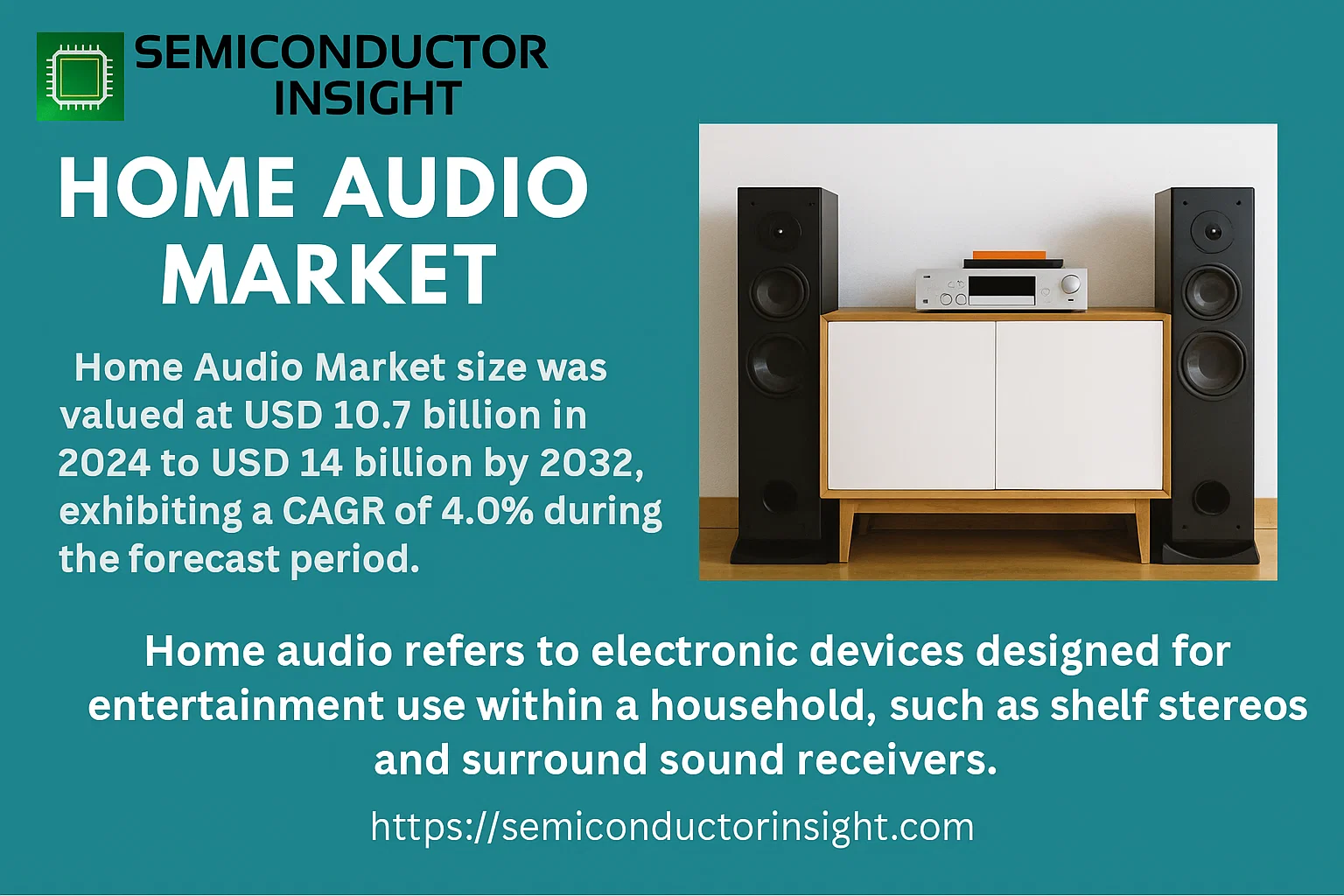
Global Home Audio Market size was valued at USD 10.7 billion in 2024 to USD 14 billion by 2032, exhibiting a CAGR of 4.0% during the forecast period.
Home audio refers to electronic devices designed for entertainment use within a household, such as shelf stereos and surround sound receivers. These systems typically comprise a series of accessory equipment intended to enhance or replace standard audio outputs, like built-in television speakers. Because surround sound receivers, which significantly improve movie-watching experiences, are the most popular category, the primary application for home audio is home cinema.
The market is experiencing steady growth due to several factors, including rising consumer disposable income and the increasing integration of smart technology and voice assistants into audio products. Furthermore, the growing demand for high-quality, immersive entertainment experiences at home is contributing to market expansion. Initiatives by key players in the market are also expected to fuel growth through product innovation and strategic partnerships. For instance, companies are increasingly focusing on developing wireless multi-room audio systems and soundbars with advanced features like Dolby Atmos. Sony Corporation, LG Electronics, Bose, and Panasonic Corporation are some of the key players that operate in the market with a wide range of portfolios.
MARKET DRIVERS
Rising Consumer Demand for Immersive Audio Experiences
The proliferation of high-quality streaming services for music, podcasts, and films is a primary driver. Consumers are increasingly investing in home audio systems, including soundbars, multi-room speakers, and Dolby Atmos setups, to replicate cinematic and concert-like experiences. This trend is further amplified by the widespread adoption of smart home ecosystems, where audio devices serve as central hubs.
Technological Advancements and Connectivity
Innovation in audio technology, such as spatial audio, voice assistant integration, and improved wireless protocols like Bluetooth 5.x and Wi-Fi 6, is significantly propelling the market. The seamless connectivity allows for easy integration with other smart devices, enhancing user convenience. Products supporting high-resolution audio codecs are becoming increasingly mainstream, appealing to audiophiles and casual listeners alike.
➤ The integration of Artificial Intelligence for personalized sound calibration and audio optimization is becoming a standard feature in premium home audio products, driving consumer upgrade cycles.
Furthermore, the post-pandemic focus on home entertainment and remote work has cemented the home as a central hub for leisure and productivity, sustaining demand for high-quality audio solutions.
MARKET CHALLENGES
Intense Market Competition and Price Sensitivity
Home Audio Market is highly fragmented, with competition ranging from established electronics giants to niche audiophile brands and new entrants from the tech industry. This creates significant pressure on pricing and margins. Consumers have access to a wide range of products at various price points, making brand loyalty difficult to maintain and forcing continuous innovation.
Other Challenges
Supply Chain Disruptions and Component Shortages
The global electronics industry has faced persistent challenges related to the availability of key components like semiconductors and chips. These disruptions can lead to production delays, increased costs, and inventory shortages, impacting the ability to meet consumer demand consistently.
Rapid Technological Obsolescence
The fast pace of technological change means products can become outdated quickly. Manufacturers must continually invest in research and development to keep up with new audio formats, connectivity standards, and software features, which is a significant financial burden.
MARKET RESTRAINTS
Economic Volatility and Discretionary Spending
Home audio products are often considered discretionary purchases. During periods of economic uncertainty or inflation, consumers tend to postpone or cancel non-essential upgrades to their entertainment systems. This sensitivity to macroeconomic conditions can lead to fluctuating sales and presents a significant restraint on market growth.
Saturation in Mature Markets
In developed regions, the market for basic home audio equipment is nearing saturation. While premium and high-end segments continue to see growth, the volume-driven mass market faces challenges as replacement cycles lengthen and many households already own adequate audio systems, limiting the potential for new customer acquisition.
MARKET OPPORTUNITIES
Expansion into Emerging Economies
Rising disposable incomes, urbanization, and growing middle-class populations in regions like Asia-Pacific and Latin America present substantial growth opportunities. As broadband penetration increases and digital media consumption rises, the demand for entry-level and mid-range home audio products is expected to surge.
Growth of the Smart Home Ecosystem
The continued expansion of the smart home market creates synergistic opportunities for home audio. Speakers with integrated voice assistants are evolving into control centers for lighting, security, and other IoT devices. Developing products that offer deeper integration and unique utility within the smart home is a key avenue for growth.
Rise of Health and Wellness Audio
There is a growing consumer interest in audio products focused on wellness, such as speakers designed for meditation, sound masking for concentration, or systems that promote better sleep through curated soundscapes. This represents a niche but rapidly expanding segment within the broader home audio market.
Home Audio Market Trends
Integration with Smart Home Ecosystems
The dominant trend in the home audio market is the seamless integration of devices into broader smart home ecosystems. This involves audio systems connecting with voice assistants like Amazon Alexa, Google Assistant, and Apple’s Siri for hands-free control. Consumers increasingly expect centralized management of audio across multiple rooms, driving demand for systems that can be synchronized or controlled via a single smartphone app. This trend is a key factor propelling the market, which was valued at USD 10,700 million in 2024 and is projected to grow at a compound annual growth rate of 4.0% to reach USD 14,000 million by 2032.
Other Trends
Wireless Connectivity and Multi-room Audio
The shift away from traditional wired setups continues to accelerate, with Bluetooth and Wi-Fi connectivity becoming standard features. Multi-room audio systems, which allow users to play different audio in different rooms or synchronize music throughout the home, are experiencing significant growth. This caters to the convenience demanded by modern consumers and is a primary feature in products from key players like Sony, LG, Bose, and Panasonic, who collectively account for over 50% of the global market share.
Growth of the Home Theatre Segment
Home theatre-in-a-box (HTiB) systems and dedicated surround sound receivers remain a cornerstone of the home audio market, primarily enhancing the movie-watching experience. The pursuit of cinematic sound quality at home drives innovation in this segment, with technologies like Dolby Atmos creating immersive audio environments. This segment’s strength is reflected in the regional consumption pattern, where Europe is the largest market with nearly 29% share, followed by China at 22%.
Rising Demand for High-Resolution Audio
A growing segment of audio enthusiasts and audiophiles is fueling demand for high-resolution audio systems that deliver superior sound fidelity. This trend moves beyond basic home stereo listeners to consumers seeking a more authentic and detailed listening experience. Manufacturers are responding with products that support high-resolution audio codecs, catering to this discerning audience and differentiating their offerings in a competitive landscape dominated by established brands like Yamaha, Harman, and Samsung.
COMPETITIVE LANDSCAPE
Key Industry Players
Sony, LG, Bose, and Panasonic Lead a Diversified Global Market
Home Audio Market is characterized by a consolidated top tier, with a few global giants commanding a significant share of the industry. Sony Corporation, LG Electronics, Bose Corporation, and Panasonic Corporation are the undisputed leaders, collectively accounting for over 50% of the global market. These companies leverage their extensive brand recognition, diverse product portfolios spanning home theatre systems, soundbars, and wireless speakers, and strong global distribution networks. Their dominance is built on continuous innovation in audio technologies like high-resolution audio support, immersive surround sound formats such as Dolby Atmos, and deep integration with other smart home ecosystems.
Beyond the market leaders, the landscape includes several other well-established players who have carved out significant niches. Companies like Yamaha and Harman (a Samsung Electronics subsidiary) are highly respected for their premium audio components and receivers. VIZIO and Samsung compete aggressively in the popular soundbar segment. Additionally, specialists such as Onkyo (now part of Pioneer), D+M Group (Sound United, encompassing brands like Denon and Marantz), and VOXX International cater to audiophiles and home theatre enthusiasts with high-performance equipment. Emerging brands and regional specialists like EDIFIER and Creative Technologies also contribute to a dynamic and competitive environment, focusing on value and specific consumer segments.
List of Key Home Audio Companies Profiled
- Sony Corporation
- LG Electronics
- Panasonic Corporation
- Bose Corporation
- Yamaha Corporation
- Harman International (Samsung)
- Onkyo & Pioneer Corporation
- VIZIO, Inc.
- Samsung Electronics
- D+M Group (Sound United)
- VOXX International Corporation
- Nortek, Inc.
- Creative Technology Ltd.
- EDIFIER Technology
Segment Analysis:
| Segment Category | Sub-Segments | Key Insights |
| By Type |
|
Home Audio Speakers and Systems is the foundational and most diverse category, catering to a broad range of fidelity preferences and setups from basic bookshelf units to high-end component systems. Home Theatre in-a-box (HTiB) solutions are particularly popular for their user-friendly, all-in-one approach that simplifies the creation of a cinematic experience, driving mainstream adoption. The ‘Others’ category, including soundbars and wireless multi-room audio systems, is experiencing significant growth due to their space-saving designs and seamless integration with modern smart home ecosystems. |
| By Application |
|
Home Audio Enthusiasts represent a highly influential segment, driving demand for premium features, immersive surround sound for movies, and multi-room audio capabilities. While Home Stereo Listeners form the volume-driven mainstream market with a focus on ease of use and value, the Audiophiles segment commands the high-end market with an unwavering demand for superior sound quality, meticulous craftsmanship, and lossless audio formats. This application-based segmentation highlights a market that successfully serves both mass-market convenience and niche, high-fidelity pursuits. |
| By End User |
|
Residential Consumers are the undisputed core of the home audio market, with purchasing decisions driven by entertainment enhancement, home renovation projects, and the integration of smart home technologies. The Hospitality Sector, including hotels and high-end rentals, is a significant segment that prioritizes robust, reliable systems capable of creating an upscale ambient atmosphere for guests. The ‘Others’ category sees growing adoption in environments like small offices and retail spaces, where audio is used for background music and creating a specific brand ambiance, indicating the expanding role of audio beyond traditional home entertainment. |
| By Technology |
|
Wireless/Wi-Fi Systems are leading the market’s evolution, favored for their flexibility, clean aesthetics free of cable clutter, and seamless streaming capabilities from mobile devices. Smart/AI-Enabled Systems represent the highest growth segment, integrating voice assistants and adaptive sound optimization to deliver a highly personalized and convenient user experience. While Wired Systems remain the benchmark for ultimate signal integrity and are preferred by purists, the overarching trend is decisively shifting towards the convenience and intelligence offered by wireless and smart technologies. |
| By Distribution Channel |
|
Online Retailers have become the dominant channel, offering consumers extensive product comparisons, detailed user reviews, and competitive pricing that drive purchase decisions. Specialty Electronics Stores remain crucial for high-value and complex systems, providing expert advice and hands-on demos that are essential for confident purchasing. Hypermarkets and Department Stores cater to the mass market, offering convenience and immediate availability for entry-level and popular mid-range products, highlighting a diversified retail landscape that meets different customer journey needs. |
Regional Analysis: Home Audio Market
North America
A defining feature is the strong consumer inclination towards premium and ultra-premium audio brands. There is significant brand loyalty, with consumers willing to invest in high-end speakers and components from legacy audio companies known for superior sound quality, durability, and design aesthetics, creating a stable high-margin segment.
The market is heavily influenced by the proliferation of smart home ecosystems. Integration with platforms like Amazon Alexa, Google Assistant, and Apple HomeKit is no longer a luxury but a standard expectation. This drives sales of smart speakers and audio components that function as central hubs for home automation.
The high consumption of streaming services for music, podcasts, and high-definition video content fuels demand for audio equipment that delivers a cinema-like or studio-quality experience at home. This trend supports markets for soundbars, high-quality headphones, and wireless multi-room audio systems.
A sophisticated retail landscape, including specialist audio stores, large electronics chains, and robust e-commerce platforms, ensures wide product availability and consumer education. Aggressive marketing campaigns and demonstration-based retail strategies effectively drive consumer interest and upgrade cycles for home audio systems.
Europe
Europe represents a diverse and sophisticated home audio market, characterized by varying consumer preferences across its nations. Western European countries, such as Germany, the UK, and France, show strong demand for premium hi-fi equipment and design-oriented speakers, aligning with a high standard of living. There is a notable appreciation for traditional audio craftsmanship alongside modern wireless technology. In contrast, Southern and Eastern European markets are more price-sensitive, driving growth in the mid-range segment. The region is also a hub for several world-renowned audio brands, which fosters a competitive environment focused on acoustic innovation and aesthetic design. Environmental regulations and a growing consumer emphasis on sustainability are beginning to influence product development, with increased demand for energy-efficient and recyclable audio products.
Asia-Pacific
The Asia-Pacific region is the fastest-growing market for home audio, fueled by rising urbanization, expanding middle-class populations, and rapid technological adoption. Countries like China, Japan, and South Korea are major manufacturing and innovation hubs, leading to a flood of competitively priced and technologically advanced products. The market is highly fragmented, with intense competition between local brands offering feature-rich products at accessible price points and international brands competing in the premium space. Smart speakers have seen explosive growth, driven by the integration of local AI assistants and smart home applications. Consumers in this region are particularly receptive to compact, multi-functional audio devices that suit smaller urban living spaces, and there is a growing interest in personalized audio experiences.
South America
Home Audio Market in South America is emerging, with growth potential constrained by economic volatility but driven by a young, tech-savvy demographic. Brazil and Argentina are the largest markets, where demand is primarily concentrated in urban centers. Economic factors make the market highly price-conscious, favoring mid-range and value-oriented audio products. However, there is a niche but growing segment of affluent consumers investing in high-end home theater systems. The market is dominated by well-known international brands, but local manufacturers are gaining traction with affordable offerings. Growth is heavily tied to the stability of local economies and the increasing penetration of high-speed internet, which enables streaming services that drive audio hardware purchases.
Middle East & Africa
This region presents a market of contrasts. The affluent Gulf Cooperation Council (GCC) countries exhibit strong demand for luxury and high-end home audio products, with a preference for branded, visually striking systems that complement lavish home interiors. In contrast, the broader African market is largely untapped and price-sensitive, with growth centered on entry-level and portable speakers. The overall market is developing, with growth driven by urbanization, improving infrastructure, and the gradual expansion of digital services. International brands have a strong presence in the premium segments of the GCC, while the rest of the region sees a mix of low-cost imports. Political and economic instability in some areas remains a significant challenge to widespread market development.
Report Scope
This market research report provides a comprehensive analysis of the Home Audio Market, covering the forecast period 2025–2032. It offers detailed insights into market dynamics, technological advancements, competitive landscape, and key trends shaping the industry.
Key focus areas of the report include:
- Market Overview: The report begins with an overview outlining its current market scenario, key growth indicators, and industry transformation drivers. It discusses macroeconomic factors, demand supply balance, regulatory landscape, and the strategic role of semiconductors in powering advancements across industries such as automotive, telecommunications, consumer electronics, and industrial automation.
- Market Size & Forecast: Historical data and future projections for revenue, unit shipments, and market value across major regions and segments.
- Segmentation Analysis: Detailed breakdown by product type, technology, application, and end-user industry to identify high-growth segments and investment opportunities.
- Regional Insights: Insights into market performance across North America, Europe, Asia-Pacific, Latin America, and the Middle East & Africa, including country-level analysis where relevant.
- Competitive Landscape: Profiles of leading market participants, including their product offerings, R&D focus, manufacturing capacity, pricing strategies, and recent developments such as mergers, acquisitions, and partnerships.
- Technology Trends & Innovation: Assessment of emerging technologies, integration of AI/IoT, semiconductor design trends, fabrication techniques, and evolving industry standards.
- Market Drivers & Restraints: Evaluation of factors driving market growth along with challenges, supply chain constraints, regulatory issues, and market-entry barriers.
- Stakeholder Insights: Insights for component suppliers, OEMs, system integrators, investors, and policymakers regarding the evolving ecosystem and strategic opportunities.
Primary and secondary research methods are employed, including interviews with industry experts, data from verified sources, and real-time market intelligence to ensure the accuracy and reliability of the insights presented.
FREQUENTLY ASKED QUESTIONS:
What is the current market size of Home Audio Market?
-> Global Home Audio Market was valued at USD 10,700 million in 2024 and is projected to reach USD 14,000 million by 2032, exhibiting a CAGR of 4.0% during the forecast period.
Which key companies operate in Home Audio Market?
-> Key players include Sony Corporation, LG Electronics, Bose, Panasonic Corporation, Yamaha, Harman, Onkyo (Pioneer), VIZIO, and Samsung, among others. Sony, LG, Bose, and Panasonic collectively account for over 50% of the market share.
What are the key growth drivers?
-> Key growth drivers include increasing demand for home entertainment systems, technological advancements in audio devices, and the rising popularity of home cinema setups.
Which region dominates the market?
-> Europe is the largest consumption region, with a market share of nearly 29%. China is the second largest, holding a consumption share of 22%.
What are the emerging trends?
-> Emerging trends include the integration of AI and IoT in audio systems, the shift towards wireless and smart speakers, and the growing emphasis on high-fidelity sound quality for immersive home cinema experiences.

Get Sample Report PDF for Exclusive Insights
Report Sample Includes
- Table of Contents
- List of Tables & Figures
- Charts, Research Methodology, and more...
 Download Sample Report PDF