Hinge for AR and VR Market Insights
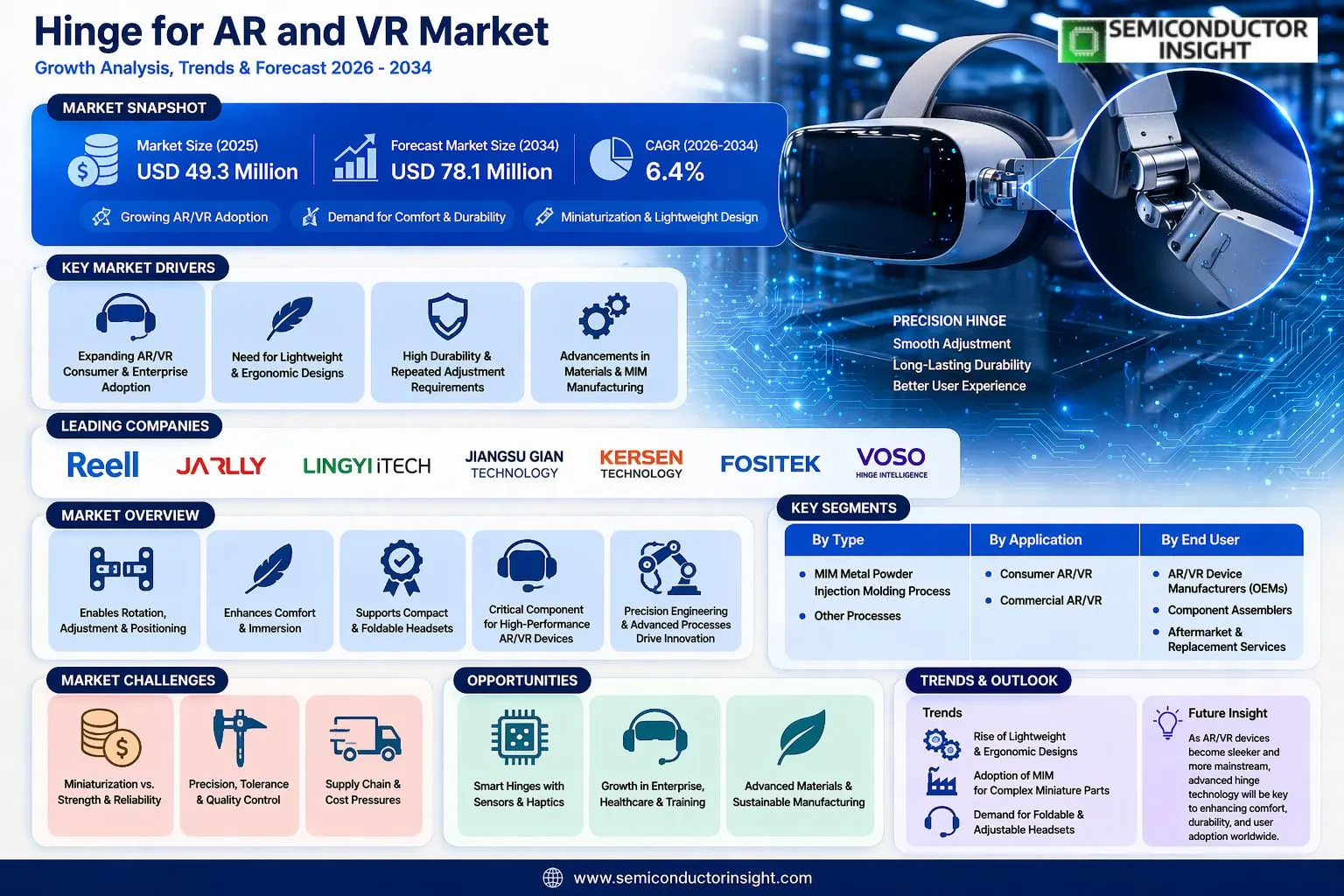
Global Hinge for AR and VR market size was valued at USD 49.3 million in 2025. The market is projected to grow from USD 52.4 million in 2026 to USD 78.1 million by 2034, exhibiting a CAGR of 6.4% during the forecast period.
A hinge for AR (Augmented Reality) and VR (Virtual Reality) is a critical mechanical component designed specifically for head-mounted displays and other wearable devices. These precision hinges facilitate essential functions such as rotation, adjustment, and secure positioning of the visor or display relative to the user’s head, enabling optimal fit, comfort, and immersion. They are engineered to withstand repeated use while maintaining precise torque control and durability.
The market growth is primarily driven by the expanding consumer adoption of AR/VR headsets for gaming and entertainment, alongside increasing commercial applications in training, design, and healthcare. However, the industry faces challenges related to the miniaturization and weight reduction required for next-generation devices. Key players like Reell Precision Manufacturing and Fositek Corporation are focusing on developing compact, high-reliability hinge solutions that meet stringent ergonomic demands. Furthermore, advancements in manufacturing processes such as Metal Injection Molding (MIM) are enabling more complex geometries at lower costs, supporting market expansion as device volumes increase.
MARKET DRIVERS
Proliferation of Consumer and Enterprise AR/VR Devices
The rapid expansion of AR and VR hardware, from standalone headsets to smart glasses, creates a foundational demand for enabling hardware components. As manufacturers strive for slimmer, more durable, and more interactive devices, the hinge for AR and VR market is directly propelled by its critical role in achieving user comfort and ergonomic design. This component is essential for adjusting headsets for different facial structures and enabling compact form factors for mobile use.
Advancement Towards Lightweight and Durable Materials
Innovations in materials science, including the use of high-strength polymers and advanced metal alloys, allow for the production of hinges that are both extremely lightweight and capable of withstanding tens of thousands of movement cycles. This durability is paramount for the hinge for AR and VR market, as consumer and industrial devices require reliable, long-lasting mechanical joints to maintain alignment and positioning of optical elements, directly impacting immersion and usability.
➤ The demand for sophisticated, multi-axis hinges is escalating with the rise of mixed reality devices that must seamlessly transition between AR and VR modes, requiring precise and stable mechanical articulation.
Furthermore, the trend towards foldable and travel-friendly headset designs is a significant catalyst. Hinges that allow devices to collapse into a compact form without damaging internal optics or displays are becoming a key differentiator for manufacturers, directly influencing purchase decisions in the competitive hinge for AR and VR market.
MARKET CHALLENGES
Engineering for Precision and Miniaturization
Designing a hinge for AR and VR applications presents unique engineering hurdles. The mechanism must provide smooth, incremental adjustability for precise fit while occupying minimal space and adding negligible weight. Achieving this level of miniaturized precision without compromising on strength or introducing cost-prohibitive manufacturing processes is a persistent technical challenge. The hinge must also maintain absolute stability to prevent image jitter, a critical factor for user comfort and immersion.
Other Challenges
Durability Under Constant Mechanical Stress
A hinge for a VR headset may be adjusted multiple times per use and over thousands of hours. Ensuring the mechanism resists wear, maintains friction settings, and does not develop looseness or “play” over time requires rigorous testing and high-quality materials, which increases unit cost and complexity.
Thermal and Environmental Management
Hinges in AR/VR devices are often located near heat-generating processors and displays. They must be engineered from materials that resist thermal expansion or deformation, which could misalign optics. Additionally, hinges must function reliably across various environmental conditions, including humidity, which can affect metallic components.
MARKET RESTRAINTS
High Cost of Advanced Hinge Mechanisms
The integration of high-precision, durable hinges using specialty alloys or custom polymer compounds significantly increases the bill of materials for AR/VR hardware. For mass-market adoption, especially in the consumer segment, there is intense pressure to reduce overall device costs. This creates a restraint on the hinge for AR and VR market, as manufacturers may opt for simpler, less expensive hinge designs that can compromise on user experience and long-term durability to meet price points.
Supply Chain and Standardization Issues
The lack of industry-wide standardization for hinge mechanisms in AR/VR headsets means most designs are proprietary and custom-built. This limits economies of scale for component suppliers and creates vulnerability in the supply chain. Sourcing specialized materials and manufacturing capabilities for these custom hinges can lead to production bottlenecks, restraining the ability to scale production rapidly in response to market demand.
MARKET OPPORTUNITIES
Integration with Haptic Feedback and Smart Hinges
The evolution of the hinge for AR and VR market lies in transforming it from a passive mechanical part into an active interface component. Significant opportunities exist in developing “smart hinges” with embedded sensors that detect position, adjust tension automatically, or even integrate basic haptic feedback to enhance realism. This added functionality could create new value propositions for high-end devices.
Expansion into Enterprise and Medical Applications
Beyond consumer gaming, the enterprise and medical sectors offer robust growth avenues for sophisticated hinge mechanisms. In these fields, devices are used for extended periods for training, remote assistance, or surgical planning. Hinges that offer superior comfort, precise adjustability for shared use, and ruggedized durability for industrial environments represent a high-value, specialized segment of the hinge for AR and VR market with greater tolerance for advanced, higher-cost components.
Material Innovation for Sustainability
Opportunity exists for companies to lead in developing sustainable hinge solutions. Utilizing recycled high-performance materials or designing for easier disassembly and recycling addresses growing environmental, social, and governance (ESG) concerns. Pioneering eco-friendly yet durable hinges could become a key competitive advantage as regulations tighten and corporate procurement policies evolve.
Hinge for AR and VR Market Trends
Increasing Demand for Ergonomic and Durable Designs
As AR and VR devices transition from niche applications to broader consumer and commercial adoption, the mechanical components enabling their functionality face heightened scrutiny. The hinge for AR and VR market is experiencing a primary trend towards designs that prioritize both long-term durability and user-centric ergonomics. Manufacturers are innovating hinge mechanisms that endure thousands of articulation cycles without failure while offering smooth, adjustable resistance. This focus is critical for maintaining device integrity and ensuring consistent user comfort, which directly influences product adoption and customer satisfaction in competitive markets.
Other Trends
Material and Process Innovation
A significant subtopic within the Hinge for AR and VR market is the shift towards advanced manufacturing processes like Metal Injection Molding (MIM). This process allows for the high-volume production of complex, miniature hinge components with excellent strength-to-weight ratios and consistent tolerances. The adoption of MIM and other sophisticated processes enables the creation of more compact and reliable hinge assemblies, which are essential for the sleek, lightweight form factors demanded by next-generation AR and VR headsets. Key industry suppliers are actively developing capabilities in this area to meet stringent technical requirements.
Supply Chain and Geographic Concentration
The landscape for hinge production is notably concentrated, with a significant share of Global market supplied by a group of specialized manufacturers primarily based in Asia, particularly China. Companies like Reell, Jarlly, LINGYI iTECH, and Jiangsu Gian Technology represent key players driving innovation and scale. This geographic concentration influences global supply dynamics, with OEMs seeking reliable partners who can deliver both precision engineering and volume manufacturing. The competitive landscape is defined by technological expertise, production capacity, and the ability to form strategic partnerships with major AR/VR device brands.
Differentiation by Application Segment
Trends within the Hinge for AR and VR market further diverge based on end-use application. Hinges designed for consumer-grade devices often emphasize cost-effective solutions and aesthetic integration, while those for commercial and industrial AR/VR applications prioritize robustness, precision, and the ability to withstand more frequent or rigorous use. This segmentation drives specialized product development, with manufacturers tailoring hinge characteristics,such as torque, size, and material,to the specific performance and durability needs of each market vertical, from gaming and entertainment to enterprise training and field service.
COMPETITIVE LANDSCAPE
Key Industry Players
A Concentrated Market with Key Suppliers Driving Component Innovation
Global hinge for AR and VR market features a competitive landscape dominated by specialized mechanical component manufacturers, primarily based in the Asia-Pacific region, which underscores the supply chain dynamics of the consumer electronics sector. The market structure is moderately concentrated, with the top five global players collectively commanding a significant revenue share. Reell, recognized as a leader in precision torque hinge solutions, holds a strong position, particularly in serving high-end commercial and consumer AR/VR headset manufacturers. The competitive intensity is fueled by the stringent technical requirements for hinges in AR/VR devices, including precise torque control for user comfort, durability for frequent adjustments, and miniaturization to save space and weight. Market leaders compete on R&D capabilities, manufacturing precision,especially in advanced processes like Metal Injection Molding (MIM),and the ability to form strategic partnerships with major OEMs.
Beyond the top-tier suppliers, a layer of significant niche players, such as Fositek and Kunshan Kersen Science and Technology, contributes to market dynamism by focusing on cost-effective solutions and rapid prototyping for emerging headset brands. The competitive environment is further shaped by the push for technological differentiation, with companies like Kunshan Voso Hinge Intelligence Technology incorporating “intelligent” features into hinge designs. As the AR/VR market segments into consumer and commercial applications, hinge manufacturers are increasingly tasked with developing application-specific designs, creating opportunities for specialized suppliers to capture market share. The continuous demand for more comfortable, adjustable, and reliable hardware ensures that competition remains centered on engineering excellence and supply chain reliability.
List of Key Hinge for AR and VR Companies Profiled
- Reell
- Jarlly
- LINGYI iTECH
- Jiangsu Gian Technology
- Kunshan Kersen Science and Technology
- Fositek
- Kunshan Voso Hinge Intelligence Technology
- Dongguan Socen
- Shenzhen Yuanzhao
- Suzhou Zhaoxinchi
- SHENZHEN PRECISE HINGE TECHNOLOGY
- Find Technology (SHENZHEN)
- ShenZhen Smooth Technology
Segment Analysis:
| Segment Category | Sub-Segments | Key Insights |
| By Type |
|
MIM Metal Powder Injection Molding Process is the dominant manufacturing technology due to its superior ability to produce high-precision, complex miniature hinge components with exceptional strength-to-weight ratios, a critical factor for comfortable and durable head-mounted devices. This process also delivers excellent surface finish and high-volume consistency, which is essential for the cost-effective mass production required by leading consumer electronics brands. The technology’s advantages in creating intricate geometries with tight tolerances support the development of more ergonomic and reliable hinge designs. |
| By Application |
|
Consumer AR/VR represents the primary application segment, driven by a high-volume demand for gaming, entertainment, and social interaction headsets where hinge durability, user comfort, and precise adjustability are paramount for widespread consumer adoption. The intense focus on product aesthetics and lightweight design in this segment pushes hinge innovation towards sleeker, more integrated solutions. Rapid iteration cycles in consumer electronics, fueled by competition among major technology firms, create continuous demand for advanced hinge mechanisms that enhance the overall user experience and device portability. |
| By End User |
|
Original Equipment Manufacturers (OEMs) are the leading end-users, as they integrate hinges directly into final headset products, establishing stringent quality and design specifications that drive the entire supply chain. Their demand is characterized by long-term strategic partnerships with hinge suppliers to ensure reliability, secure intellectual property, and co-develop customized solutions for next-generation devices. The competitive pressure among OEMs to differentiate their products often hinges on the performance and innovation of these critical mechanical components, making them a focal point for R&D collaboration. |
| By Device Form Factor |
|
Standalone/All-in-One Headsets are the most demanding segment for hinge technology, as these self-contained units require robust, high-cycle hinges to manage the frequent folding and adjustment of displays and headbands inherent to their portable design. Hinges in this category must balance structural integrity with minimal weight to avoid user fatigue during extended wear. The evolution towards slimmer, more consumer-friendly standalone devices is heavily reliant on advancements in compact and multi-axis hinge designs that enable sophisticated articulation without compromising device aesthetics or durability. |
| By Hinge Functionality |
|
Display Adjustment & Folding Hinges constitute the core functionality segment, directly impacting the user’s visual comfort and immersion by enabling precise control over the interpupillary distance and screen angle relative to the eyes. This segment is witnessing significant innovation towards friction-based and detent mechanisms that provide smooth, stable, and repeatable positioning without accidental movement. The integration of these hinges is critical for accommodating diverse user anatomies and is a key differentiator in high-end devices, where a seamless and intuitive adjustment experience is a major selling point. |
Regional Analysis: Hinge for AR and VR Market
North America
The region’s ecosystem excels in rapid prototyping and iterative design for the Hinge for AR and VR Market. Specialized engineering firms collaborate closely with headset OEMs to develop custom hinge solutions that balance complex mechanical requirements with strict industrial design guidelines, facilitating faster time-to-market for new devices.
A mature and integrated supply chain for precision components supports the Hinge for AR and VR Market. Local access to specialized machining, micro-stamping, and advanced surface treatment services ensures consistent quality and reduces lead times, which is critical for maintaining production schedules for high-volume consumer electronics.
Strong enterprise adoption of AR for training, remote assistance, and design visualization creates demand for ruggedized professional-grade headsets. This segment requires especially robust and reliable Hinge for AR and VR Market components that can withstand frequent use in industrial environments, pushing manufacturers towards higher durability standards.
Market leaders prioritize hinge mechanisms that contribute significantly to overall user experience. Innovations focus on creating smooth, silent, and intuitive articulation that allows for easy adjustment of headsets, enhancing comfort during extended use, which is a key purchasing factor in the competitive consumer Hinge for AR and VR Market.
Europe
Europe represents a significant and sophisticated market for Hinge for AR and VR components, characterized by a strong industrial base in Germany, the UK, and the Nordic countries. The regional demand is fueled by advanced automotive and industrial design sectors utilizing AR for engineering and manufacturing, necessitating highly precise and reliable mechanical interfaces. European manufacturers are renowned for their expertise in high-precision engineering and material science, leading to innovations in compact, low-friction hinge designs. Strict regulatory standards for product safety and durability also influence component design, encouraging the development of hinges that exceed basic performance requirements. Collaboration between academic institutes and industrial players fosters research into smart hinge mechanisms with integrated sensors for the evolving Hinge for AR and VR Market.
Asia-Pacific
The Asia-Pacific region is Global manufacturing hub and the fastest-growing market for the Hinge for AR and VR Market. Countries like China, South Korea, Japan, and Taiwan are central to mass production, offering significant cost advantages and scalable supply chains for component fabrication. Local demand is exploding due to the massive consumer electronics base, gaming culture, and increasing enterprise digitalization. This region excels in cost-optimized, high-volume production of hinge assemblies, with manufacturers continuously improving processes for efficiency. There is also a growing focus on in-house R&D to move up the value chain, developing more advanced proprietary hinge technologies tailored for next-generation lightweight and foldable AR/VR devices entering Global Hinge for AR and VR Market.
South America
The Hinge for AR and VR market in South America is in a developing phase, with growth primarily concentrated in industrial and niche commercial applications within Brazil and Argentina. Market expansion is currently moderated by economic volatility and a reliance on imports for high-tech components. However, burgeoning sectors such as mining, agriculture, and education are beginning to pilot AR solutions for training and operations, creating initial, specialized demand for durable hardware. Local assembly and servicing of AR/VR equipment may gradually stimulate a need for regional supply chains for replacement parts, including hinges. Partnerships with global technology providers are key to transferring knowledge and establishing foundational standards for the regional Hinge for AR and VR Market ecosystem.
Middle East & Africa
The Hinge for AR and VR Market across the Middle East & Africa is emerging, driven by strategic investments in smart city projects, tourism, and energy sector digitalization, particularly in Gulf Cooperation Council nations. The focus is predominantly on enterprise and governmental applications rather than mass consumer adoption. Demand hinges on imported high-specification hardware for these professional use cases, which necessitates robust mechanical components. While local manufacturing for such precision parts is limited, there is potential for growth in maintenance and localized customization services. The region’s interest in becoming a technology adoption hub could stimulate future market development for supporting components within the broader Hinge for AR and VR Market landscape.
Report Scope
This market research report provides a comprehensive analysis of the Hinge for AR and VR Market , covering the forecast period 2026–2034. It offers detailed insights into market dynamics, technological advancements, competitive landscape, and key trends shaping the industry.
Key focus areas of the report include:
- Market Overview: The report begins with an overview outlining its current market scenario, key growth indicators, and industry transformation drivers. It discusses macroeconomic factors, demand–supply balance, regulatory landscape, and the strategic role of semiconductors in powering advancements across industries such as automotive, telecommunications, consumer electronics, and industrial automation.
- Market Size & Forecast: Historical data and future projections for revenue, unit shipments, and market value across major regions and segments.
- Segmentation Analysis: Detailed breakdown by product type, technology, application, and end-user industry to identify high-growth segments and investment opportunities.
- Regional Insights: Insights into market performance across North America, Europe, Asia-Pacific, Latin America, and the Middle East & Africa, including country-level analysis where relevant.
- Competitive Landscape: Profiles of leading market participants, including their product offerings, R&D focus, manufacturing capacity, pricing strategies, and recent developments such as mergers, acquisitions, and partnerships.
- Technology Trends & Innovation: Assessment of emerging technologies, integration of AI/IoT, semiconductor design trends, fabrication techniques, and evolving industry standards.
- Market Drivers & Restraints: Evaluation of factors driving market growth along with challenges, supply chain constraints, regulatory issues, and market-entry barriers.
- Stakeholder Insights: Insights for component suppliers, OEMs, system integrators, investors, and policymakers regarding the evolving ecosystem and strategic opportunities.
Primary and secondary research methods are employed, including interviews with industry experts, data from verified sources, and real-time market intelligence to ensure the accuracy and reliability of the insights presented.
FREQUENTLY ASKED QUESTIONS:
What is the current market size of Hinge for AR and VR Market?
-> Global Hinge for AR and VR Market was valued at USD 49.3 million in 2025 and is projected to reach USD 78.1 million by 2034, at a CAGR of 6.4% during the forecast period.
Which key companies operate in Hinge for AR and VR Market?
-> Key players include Reell, Jarlly, LINGYI iTECH, Jiangsu Gian Technology, Kunshan Kersen Science and Technology, Fositek, and Kunshan Voso Hinge Intelligence Technology, among others. In 2025, Global top five players held a significant revenue share.
What is a Hinge for AR and VR?
-> AR (Augmented Reality) and VR (Virtual Reality) hinge is a mechanical structure designed specifically for AR and VR devices, typically used for adjustable parts of the device, such as the connection between the headset or display screen and the user. It is an important component used to achieve functions such as rotation, adjustment, and positioning of the equipment.
How is the market segmented by type and application?
-> The market is segmented by Type into MIM Metal Powder Injection Molding Process and Other Processes. By Application, it is segmented into Consumer AR/VR and Commercial AR/VR.
What are the key regional markets?
-> U.S. market size is estimated at USD million in 2025, while China is projected to reach USD million. Key markets also include regions such as Europe (Germany, France, U.K., etc.) and Asia (Japan, South Korea, Southeast Asia, etc.).

Get Sample Report PDF for Exclusive Insights
Report Sample Includes
- Table of Contents
- List of Tables & Figures
- Charts, Research Methodology, and more...
 Download Sample Report PDF