MARKET INSIGHTS
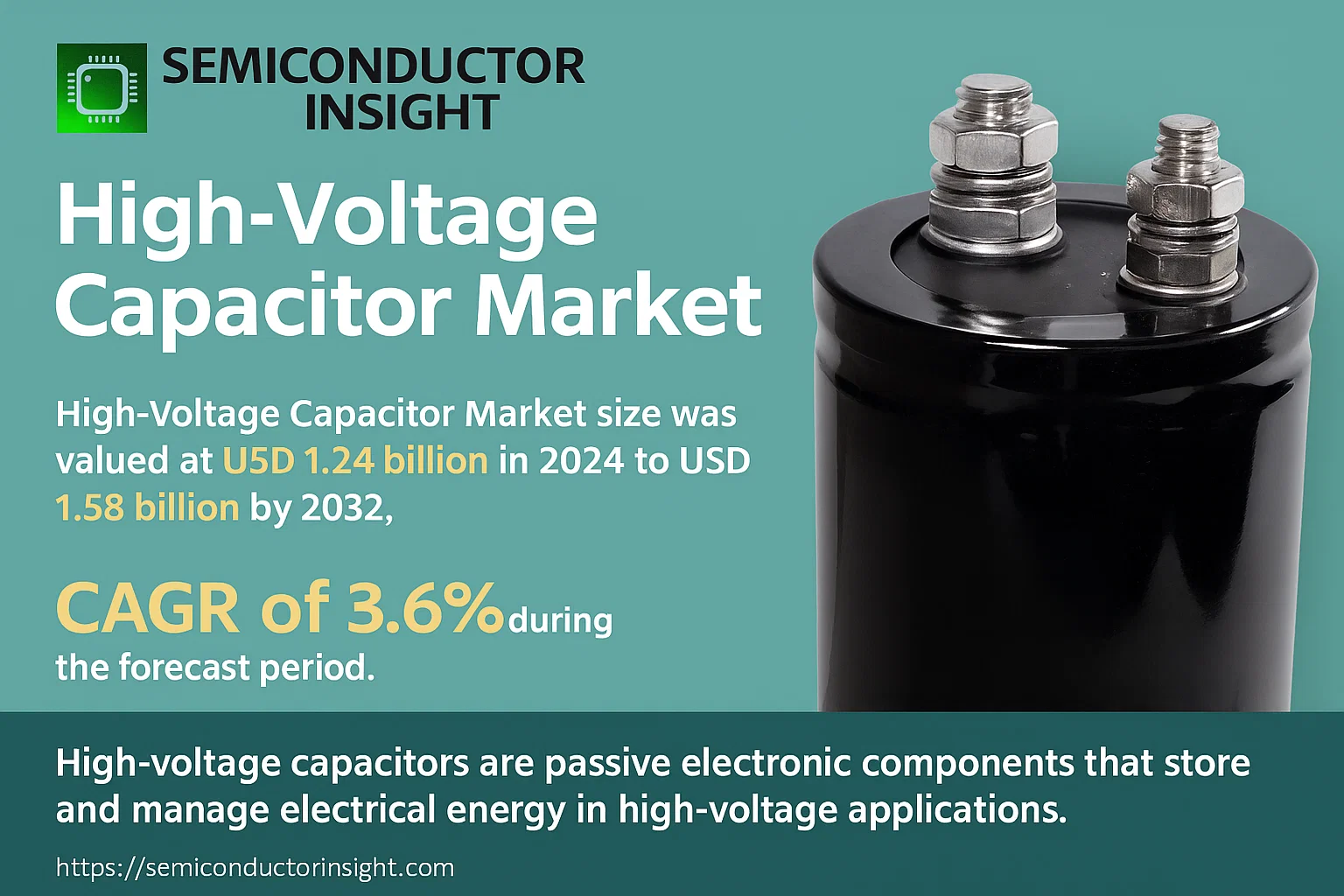
Global High-Voltage Capacitor Market size was valued at USD 1.24 billion in 2024 to USD 1.58 billion by 2032, exhibiting a CAGR of 3.6% during the forecast period.
High-voltage capacitors are passive electronic components that store and manage electrical energy in high-voltage applications. These devices are crucial for improving power quality, providing reactive power compensation, filtering harmonics, and enhancing the stability of electrical grids. Common types include ceramic, film, and electrolytic capacitors designed to operate at voltages typically above 1,000 volts.
The market is experiencing steady growth due to several factors, including the global expansion and modernization of power infrastructure, increasing integration of renewable energy sources such as wind and solar, and rising demand for efficient power transmission and distribution systems. Furthermore, stringent regulations regarding power quality and grid reliability are contributing to market expansion. Initiatives by key players in the market are also expected to fuel market growth. For instance, in recent years, companies have been focusing on developing capacitors with higher energy density and longer operational life to meet the demands of smart grids and HVDC transmission projects. Hitachi Energy Ltd., Siemens AG, Eaton Corporation plc, General Electric Company, and China XD Group are some of the key players that operate in the market with a wide range of portfolios.
MARKET DRIVERS
Global Expansion of Renewable Energy Infrastructure
The rapid global transition towards renewable energy sources is a primary driver for the High-Voltage Capacitor Market. These capacitors are essential components in wind and solar power generation systems, as well as in the associated high-voltage direct current (HVDC) transmission infrastructure required to transport electricity over long distances. The integration of large-scale renewable projects into national grids necessitates robust power conditioning and stability, which high-voltage capacitors provide. This demand is further intensified by government mandates and incentives aimed at achieving carbon neutrality.
Modernization of Aging Power Grids
Ongoing investments in upgrading and modernizing aging electrical grids, particularly in developed economies, are fueling market growth. High-voltage capacitors are critical for improving power factor correction, enhancing voltage stability, and increasing the overall efficiency and reliability of transmission and distribution networks. Utilities are deploying capacitor banks to reduce transmission losses and manage reactive power, which is crucial for maintaining grid integrity amidst fluctuating demand. This focus on grid resilience is a significant and sustained driver.
Additionally, the electrification of transportation, including the expansion of electric vehicle charging networks and railway electrification systems, creates substantial demand for high-voltage capacitors used in power conversion and filtering applications.
MARKET CHALLENGES
High Initial Costs and Complex Manufacturing
The production of high-voltage capacitors involves specialized materials, such as high-purity dielectric films and precise metallization processes, leading to significant manufacturing costs. The requirement for rigorous testing and certification to meet international safety and performance standards further adds to the overall expense. These high costs can be a barrier to entry for new market players and can pressure profit margins, especially when competing on price in certain segments.
Other Challenges
Supply Chain Vulnerabilities for Raw Materials
The market is susceptible to disruptions in the supply of key raw materials, including specific polymers and metals. Geopolitical tensions and trade restrictions can lead to price volatility and availability issues, impacting production schedules and cost structures for manufacturers.
Technical Limitations and Failure Modes
High-voltage capacitors operate under extreme electrical stress, making them prone to specific failure modes like dielectric breakdown or partial discharge. Ensuring long-term reliability and preventing catastrophic failures in critical applications like power grids requires advanced design and materials, presenting an ongoing engineering challenge.
MARKET RESTRAINTS
Cyclical Nature of End-Use Industries
High-Voltage Capacitor Market’s growth is closely tied to capital expenditure cycles in its primary end-use sectors, such as power transmission, industrial manufacturing, and heavy rail. During periods of economic downturn or reduced industrial activity, investment in large-scale infrastructure projects can be deferred or canceled. This cyclicality can lead to fluctuating demand, creating uncertainty for manufacturers and potentially restraining steady market expansion.
Stringent Environmental and Safety Regulations
The use of certain dielectric fluids, such as polychlorinated biphenyls (PCBs) in older capacitor designs, has led to stringent international regulations regarding their manufacture, use, and disposal. While modern capacitors use environmentally friendlier alternatives, the industry remains constrained by complex regulatory compliance requirements that govern hazardous substances, product safety, and end-of-life recycling, adding to operational complexity and cost.
MARKET OPPORTUNITIES
Advancements in Digital Substations and Smart Grids
Global push for smart grid deployment presents a significant growth avenue. Digital substations, which rely on advanced sensors and monitoring, require highly reliable capacitive components for applications like coupling capacitors for voltage transformers. The integration of Internet of Things (IoT) capabilities for predictive maintenance in grid assets opens opportunities for smart capacitors with embedded diagnostics, enabling condition-based monitoring and enhancing grid reliability.
Growth in High-Voltage Direct Current (HVDC) Transmission
The increasing adoption of HVDC transmission systems for long-distance and submarine power cables is a major opportunity. HVDC technology is more efficient for bulk power transmission over long distances compared to alternating current (AC) systems and is crucial for integrating offshore wind farms. HVDC converters require large banks of high-voltage capacitors for filtering and energy storage, creating a specialized and high-growth niche within the market.
Innovation in Capacitor Technologies
Research and development into new dielectric materials, such as advanced polymers and nanocomposites, offers opportunities to create capacitors with higher energy density, better thermal stability, and longer operational lifetimes. Innovations that lead to more compact, efficient, and cost-effective solutions can open new applications in areas like pulsed power, medical imaging equipment, and defense systems, expanding the market beyond traditional power sector applications.
High-Voltage Capacitor Market Trends
Sustained Market Expansion Driven by Grid Modernization
Global High-Voltage Capacitor Market is on a trajectory of steady growth, with its value projected to increase from 1240 million in 2024 to 1576 million by 2032, representing a compound annual growth rate of 3.6%. This expansion is fundamentally driven by the global imperative to modernize and stabilize electrical grids. Grid operators are increasingly reliant on high-voltage capacitors to minimize transmission losses, facilitate the integration of intermittent renewable energy sources like wind and solar, and provide critical voltage support during unplanned network events, ensuring the delivery of efficient and reliable power.
Other Trends
Dominance of Asia-Pacific and Single-Phase Capacitors
Regional and product segmentation reveals clear market concentrations. The Asia-Pacific region stands as the largest market, accounting for approximately 40% of the global share, followed by Europe (23%) and North America (16%). In terms of product type, single-phase capacitors are the dominant segment, holding a commanding 60% share of the market, underscoring their critical role in specific applications. Regarding end-use, the power generation sector is the largest application area for these components, followed closely by distribution networks, highlighting the capacitor’s essential function across the energy value chain.
Focus on Industrial Power Quality and Cost Efficiency
Beyond utility-scale grid support, high-voltage capacitors are vital for large industrial power consumers. These users face dual challenges of lowering operating costs and meeting strict contractual obligations concerning power factor correction and harmonic distortion mitigation. By deploying high-voltage capacitors, industrial facilities can enhance their power quality, avoid financial penalties from utilities, and improve overall energy efficiency, making them a key component for industrial competitiveness and operational reliability.
Consolidated Competitive Landscape
The market’s competitive environment is characterized by the presence of several established global players. The top five manufacturers, including industry leaders like Hitachi, Siemens, and Eaton, collectively hold about 25% of the market share. This moderate level of concentration indicates a competitive landscape where technological innovation, reliability, and global supply chain capabilities are key differentiators for companies seeking to capture a larger portion of the growing market demand driven by global energy infrastructure investments.
COMPETITIVE LANDSCAPE
Key Industry Players
A Fragmented Market Led by Global Industrial Giants
Global High-Voltage Capacitor Market is characterized by a significant number of established players, with the top five companies accounting for approximately 25% of the market share. This indicates a fragmented competitive environment. Leading multinational corporations such as Hitachi, Siemens, and Eaton are dominant forces, leveraging their extensive product portfolios, strong global distribution networks, and significant investments in research and development. Their strength lies in providing comprehensive solutions for complex grid and industrial power quality challenges, including power factor correction, harmonic filtering, and voltage stabilization, particularly for utilities and large industrial consumers.
Beyond the top-tier players, the market includes numerous other significant manufacturers that often specialize in specific regions, product types, or applications. Companies like China XD Group and Sieyuan Electric hold substantial influence in the Asia-Pacific region, which is the largest market. Niche players and specialized manufacturers, such as Electronicon Kondensatoren and ICAR, focus on high-reliability components for demanding applications. This diverse landscape includes providers of various capacitor technologies, including film, ceramic, and electrolytic types, serving segments from power generation and transmission to industrial manufacturing.
List of Key High-Voltage Capacitor Companies Profiled
- Hitachi, Ltd.
- Siemens AG
- Eaton Corporation
- General Electric (GE)
- Nissin Electric Co., Ltd.
- Iskra
- Sieyuan Electric Co., Ltd.
- China XD Group
- Herong Electric Group
- Samwha Capacitor Group
- Electronicon Kondensatoren GmbH
- ZEZ Silko, a.s.
- ICAR
- API Capacitors
- Kondas
Segment Analysis:
| Segment Category | Sub-Segments | Key Insights |
| By Type |
|
Single Phase capacitors are the dominant segment in the market, primarily due to their extensive use in a wide range of applications from industrial motor drives to compact power electronics. Their simpler design and lower cost compared to three-phase systems make them the preferred choice for many standard applications, driving broad adoption. The three-phase segment, while smaller, is crucial for heavy industrial and utility-scale applications requiring balanced power across multiple phases, indicating a specialized but critical niche within the broader market. |
| By Application |
|
Power Generation represents the most significant application area, driven by the critical need for power factor correction and voltage stabilization at the source, especially with the integration of intermittent renewable energy sources like wind and solar. The distribution segment also shows strong demand as utilities work to improve efficiency and power quality for end consumers. Transmission applications are essential for managing reactive power and ensuring grid stability over long distances, highlighting the capacitor’s role in resilient electrical infrastructure. The ‘Others’ category includes specialized industrial uses, demonstrating the component’s versatility. |
| By End User |
|
Electric Utilities & Grid Operators are the foremost end users, as high-voltage capacitors are fundamental assets for maintaining grid reliability, managing power flow, and integrating diverse generation sources. Large industrial consumers, such as manufacturing plants and data centers, rely on these capacitors to meet strict power quality contracts and reduce operational costs through improved power factor. The renewable energy sector is an increasingly important end user, utilizing capacitors for smoothing power output from solar farms and wind turbines, which is vital for the stability of modern energy systems. |
| By Dielectric Material |
|
Plastic Film capacitors, particularly those using polypropylene, are the leading segment due to their excellent reliability, self-healing properties, and suitability for high-power AC applications. They are the material of choice for most power correction and filtering duties. Ceramic capacitors are favored in high-frequency and high-voltage pulse applications where compact size and stability are critical. The ‘Others’ category, including older technologies like paper-in-oil or aluminum electrolytic types, finds use in specific legacy systems or applications with unique voltage and durability requirements, representing a more specialized segment of the market. |
| By Voltage Rating |
|
Medium Voltage capacitors constitute the largest segment, as this range is most commonly deployed in industrial power correction systems and utility distribution networks, balancing performance with cost-effectiveness. High Voltage ratings are essential for transmission-level applications and large industrial facilities, demanding robust design for long-term reliability under strenuous conditions. The Extra High Voltage segment, while representing a smaller portion of the market, is critical for the backbone of national and international power grids, where capacitors are used for series compensation to enhance power transfer capacity over very long distances, underscoring their strategic importance. |
Regional Analysis: High-Voltage Capacitor Market
The rapid modernization and expansion of power transmission networks across developing Asian economies fuel demand for high-voltage capacitors used in reactive power compensation, harmonic filtering, and voltage stabilization. This is critical for improving grid efficiency and reliability over vast distances.
As a global leader in solar and wind power installation, the region requires extensive high-voltage capacitor banks for power conditioning and smoothing the intermittent output from these sources before feeding it into the grid, a key growth driver.
The dense concentration of heavy industries, such as steel, chemicals, and automotive manufacturing, creates strong demand for high-voltage capacitors used in industrial motor drives, induction heating, and power quality correction systems within factories.
The region’s dominance in producing electronic goods, from consumer devices to specialized industrial equipment, supports a vibrant ecosystem for capacitor manufacturers, fostering innovation and cost-effective production of high-voltage variants for various applications.
North America
North America represents a mature yet technologically advanced market for high-voltage capacitors, characterized by a focus on grid modernization and reliability. The primary demand stems from the ongoing need to upgrade aging power infrastructure, particularly in the United States and Canada, to enhance resilience and incorporate smart grid technologies. There is significant investment in replacing old capacitor banks with more efficient and reliable units to manage reactive power and improve voltage stability. Furthermore, the growth of data centers, electric vehicle charging infrastructure, and renewable energy projects, especially large-scale solar farms and offshore wind initiatives, provides substantial opportunities. The market is also driven by stringent regulatory standards for energy efficiency and power quality, pushing utilities and industrial users to adopt advanced capacitor solutions.
Europe
The European market is driven by a strong regulatory push towards energy transition and decarbonization, creating a robust environment for high-voltage capacitor adoption. The European Union’s ambitious Green Deal and targets for renewable energy integration are key catalysts. There is significant demand for capacitors used in grid stabilization to support the fluctuating input from wind farms in the North Sea and solar installations across Southern Europe. Furthermore, the phase-out of conventional power plants necessitates enhanced grid management solutions where capacitors play a vital role. The presence of leading industrial automation and rail transportation sectors also contributes to steady demand for high-voltage capacitors in motor drives and traction systems. The market is characterized by a high emphasis on quality, reliability, and compliance with strict international standards.
South America
The South American market for high-voltage capacitors is emerging, with growth largely tied to investments in energy infrastructure and industrial development. Brazil is the dominant player in the region, driven by its large-scale investments in hydropower and the need to transmit electricity over long distances from generation sites to urban centers. This creates a consistent demand for capacitors for reactive power compensation in transmission networks. Other countries are focusing on modernizing their power grids and expanding access to electricity, which provides growth avenues. The mining industry, particularly in Chile and Peru, also utilizes high-voltage capacitors for heavy machinery and process control. However, market growth can be influenced by economic volatility and the pace of large-scale infrastructure projects.
Middle East & Africa
This region presents a diverse landscape for the High-Voltage Capacitor Market, with growth potential linked to economic diversification and infrastructure expansion. In the Middle East, Gulf Cooperation Council countries are investing heavily in power generation and water desalination plants, which require capacitors for power factor correction and voltage support. There is also growing interest in integrating renewable energy, particularly solar power, into the grid. In Africa, the market is nascent but promising, driven by efforts to expand electricity access and develop industrial bases. Projects aimed at building and interconnecting national grids create opportunities. However, the market growth is uneven and often depends on political stability and foreign investment in large-scale energy and industrial projects.
Report Scope
This market research report provides a comprehensive analysis of the High-Voltage Capacitor Market , covering the forecast period 2025–2032. It offers detailed insights into market dynamics, technological advancements, competitive landscape, and key trends shaping the industry.
Key focus areas of the report include:
- Market Overview: The report begins with an overview outlining its current market scenario, key growth indicators, and industry transformation drivers. It discusses macroeconomic factors, demand–supply balance, regulatory landscape, and the strategic role of high-voltage capacitors in supporting grid operators and large industrial power consumers by addressing challenges related to power quality, renewable integration, and operational efficiency.
- Market Size & Forecast: Historical data and future projections for revenue, unit shipments, and market value across major regions and segments.
- Segmentation Analysis: Detailed breakdown by product type, technology, application, and end-user industry to identify high-growth segments and investment opportunities.
- Regional Insights: Insights into market performance across North America, Europe, Asia-Pacific, Latin America, and the Middle East & Africa, including country-level analysis where relevant.
- Competitive Landscape: Profiles of leading market participants, including their product offerings, R&D focus, manufacturing capacity, pricing strategies, and recent developments such as mergers, acquisitions, and partnerships.
- Technology Trends & Innovation: Assessment of emerging technologies, integration of AI/IoT, design trends, fabrication techniques, and evolving industry standards.
- Market Drivers & Restraints: Evaluation of factors driving market growth along with challenges, supply chain constraints, regulatory issues, and market-entry barriers.
- Stakeholder Insights: Insights for component suppliers, OEMs, system integrators, investors, and policymakers regarding the evolving ecosystem and strategic opportunities.
Primary and secondary research methods are employed, including interviews with industry experts, data from verified sources, and real-time market intelligence to ensure the accuracy and reliability of the insights presented.
FREQUENTLY ASKED QUESTIONS:
What is the current market size of High-Voltage Capacitor Market?
-> High-Voltage Capacitor Market size was valued at USD 1.24 billion in 2024 to USD 1.58 billion by 2032, exhibiting a CAGR of 3.6% during the forecast period.
Which key companies operate in High-Voltage Capacitor Market?
-> Key players include Hitachi, Siemens, Eaton, GE, and Nissin, among others. The top five companies hold a share of about 25%.
What are the key growth drivers?
-> Key growth drivers include the need for power quality, integration of renewable energy sources like wind and solar into the grid, and the demand from large industrial power consumers to lower operating costs and meet contractual power factor conditions.
Which region dominates the market?
-> Asia-Pacific is the largest market, with a share of about 40%, followed by Europe and North America with shares of about 23% and 16%, respectively.
What are the emerging trends?
-> The largest application segment is power generation, and in terms of product, the single-phase segment holds the largest share of about 60%.

Get Sample Report PDF for Exclusive Insights
Report Sample Includes
- Table of Contents
- List of Tables & Figures
- Charts, Research Methodology, and more...
 Download Sample Report PDF