MARKET INSIGHTS
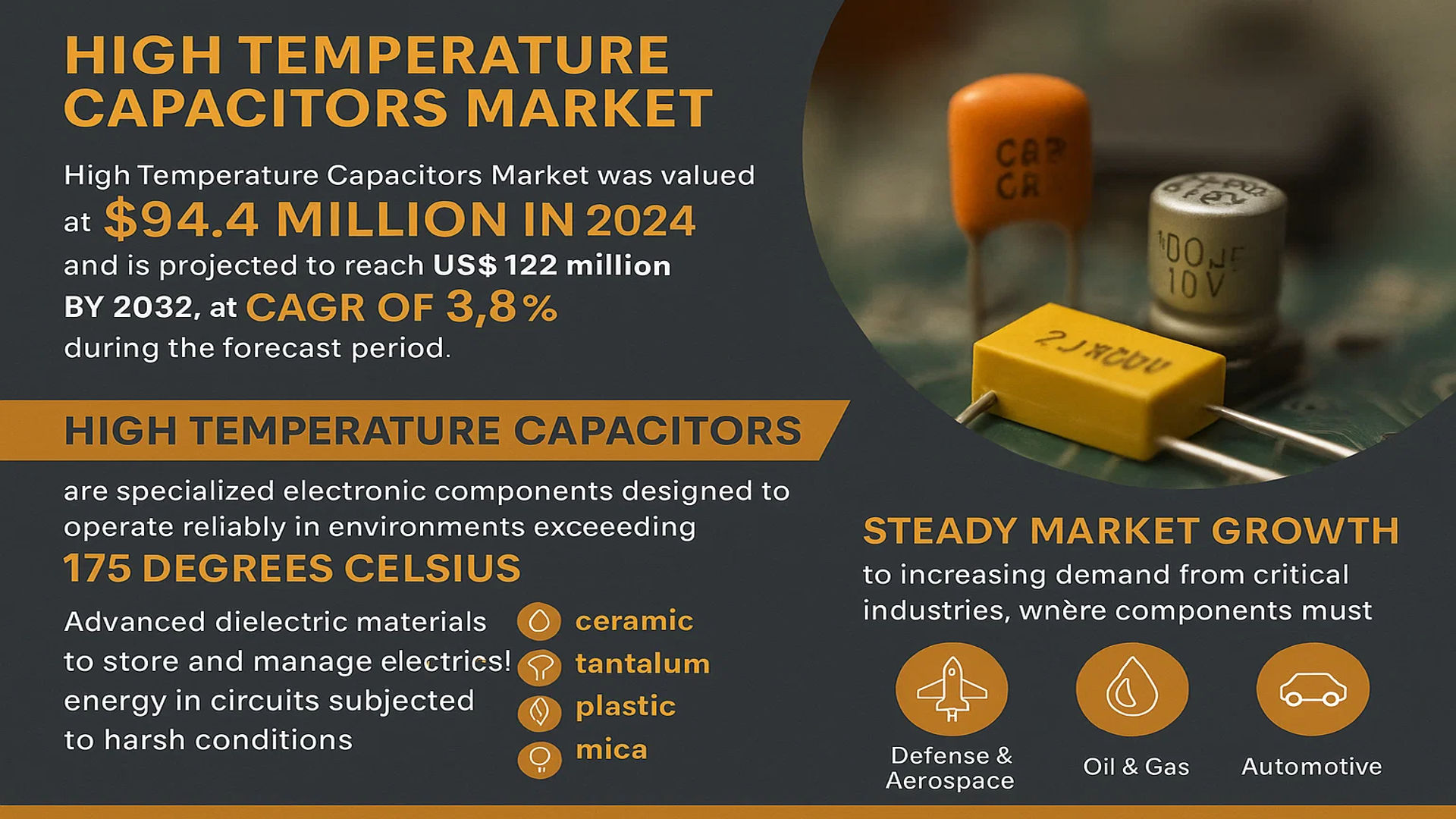
The global High Temperature Capacitors Market was valued at 94.4 million in 2024 and is projected to reach US$ 122 million by 2032, at a CAGR of 3.8% during the forecast period.
High Temperature Capacitors are specialized electronic components designed to operate reliably in environments exceeding 175 degrees Celsius. These capacitors utilize advanced dielectric materials, including ceramic, tantalum, plastic, mica, silicon, and glass, to maintain stable performance and capacitance under extreme thermal stress. Their primary function is to store and manage electrical energy in circuits subjected to harsh conditions.
The market is experiencing steady growth driven by increasing demand from critical industries such as defense & aerospace, oil & gas, and automotive, where components must endure extreme operational temperatures. Furthermore, technological advancements in material science are enabling higher temperature tolerances and improved reliability. The market is also characterized by a high degree of consolidation, with the top five players—KEMET, Vishay Intertechnology, Murata, AVX Corporation (KYOCERA), and Exxelia—collectively holding approximately 67% of the global market share, underscoring the competitive and technologically intensive nature of this sector.
MARKET DYNAMICS
MARKET DRIVERS
Expanding Aerospace and Defense Applications to Drive Market Growth
The aerospace and defense sector represents a primary growth driver for high temperature capacitors, demanding components capable of withstanding extreme thermal conditions exceeding 175°C. Modern aircraft systems, including avionics, radar systems, and engine control units, require capacitors that maintain stable performance under thermal stress. The global defense expenditure has reached approximately 2.2 trillion dollars annually, with significant portions allocated to advanced electronic systems. Furthermore, the increasing deployment of unmanned aerial vehicles (UAVs) and satellite communication systems necessitates reliable high-temperature electronic components. These applications require capacitors that can operate reliably in environments where temperatures fluctuate dramatically, driving innovation and adoption of advanced ceramic and tantalum-based solutions.
Rising Demand in Automotive Electrification to Accelerate Market Expansion
Automotive electrification represents a significant growth vector for high temperature capacitors, particularly in electric vehicle (EV) power systems and internal combustion engine management. The transition toward electric vehicles has accelerated globally, with EV sales projected to exceed 17 million units annually by 2024. Under-hood applications, including engine control units, transmission systems, and power inverters, operate in environments where temperatures regularly exceed 200°C. High temperature capacitors ensure reliable performance in these harsh conditions, preventing system failures and maintaining vehicle safety. The automotive industry’s shift toward 48-volt electrical systems and advanced driver assistance systems (ADAS) further increases the demand for robust capacitive components that can withstand thermal cycling and maintain electrical characteristics at elevated temperatures.
Oil and Gas Exploration Activities to Fuel Market Development
Down-hole drilling and exploration equipment in the oil and gas industry requires electronic components capable of operating at extreme temperatures and pressures. High temperature capacitors are essential for measurement-while-drilling (MWD) and logging-while-drilling (LWD) tools that operate in environments where temperatures can reach 200°C or higher. The global oil and gas exploration expenditure has maintained steady investment levels despite market fluctuations, with particular emphasis on deep-water and unconventional resource development. These applications demand capacitors that can withstand not only high temperatures but also extreme pressures and corrosive environments. The reliability of these components directly impacts operational efficiency and safety in exploration activities, making them critical investments for energy companies.
MARKET CHALLENGES
High Manufacturing Costs and Complex Production Processes to Challenge Market Growth
The production of high temperature capacitors involves specialized materials and manufacturing techniques that significantly increase costs compared to standard capacitors. Ceramic formulations capable of withstanding temperatures above 175°C require rare earth materials and precise sintering processes that drive up production expenses. Tantalum capacitors designed for high-temperature operation utilize premium-grade tantalum powder and specialized electrolytes that add to the manufacturing complexity. These cost factors become particularly challenging in price-sensitive applications such as automotive electronics, where manufacturers face intense pressure to reduce component costs while maintaining performance standards.
Other Challenges
Material Limitations and Performance Degradation
Even advanced dielectric materials face performance degradation at extreme temperatures, presenting significant engineering challenges. Ceramic capacitors may experience changes in capacitance value and increased leakage current at temperatures approaching 200°C, while polymer-based capacitors face limitations in thermal stability. The search for new dielectric materials that maintain stable electrical characteristics across wide temperature ranges remains an ongoing challenge for manufacturers and researchers alike.
Supply Chain Vulnerabilities
The reliance on specialized raw materials, particularly rare earth elements and high-purity tantalum, creates supply chain vulnerabilities that can impact production stability. Geopolitical factors and trade restrictions have occasionally disrupted the supply of critical materials, leading to production delays and cost increases. These supply chain challenges require manufacturers to maintain strategic inventories and develop alternative material sources, adding complexity to production planning and cost management.
MARKET RESTRAINTS
Technical Limitations in Extreme Temperature Ranges to Restrain Market Expansion
While high temperature capacitors demonstrate remarkable performance characteristics, they face inherent technical limitations when operating at the upper extremes of their temperature range. Capacitance drift, increased equivalent series resistance (ESR), and reduced lifespan become significant concerns as temperatures approach 200°C and beyond. These limitations restrict their application in certain extreme environments, particularly in aerospace and oil exploration where reliability is paramount. Manufacturers continue to invest in research and development to overcome these limitations, but fundamental material constraints present ongoing challenges to market expansion in the most demanding applications.
Competition from Alternative Technologies to Limit Market Penetration
Emerging alternative technologies, including advanced cooling systems and solid-state devices, present competitive challenges to high temperature capacitor adoption. In some applications, engineers opt to implement sophisticated thermal management systems that allow the use of standard capacitors rather than investing in premium high-temperature components. Additionally, developments in wide-bandgap semiconductors and other solid-state devices offer alternative solutions for power electronics in high-temperature environments. These competing technologies provide designers with options that may reduce the overall system cost, thereby limiting the market penetration of high temperature capacitors in certain applications.
MARKET OPPORTUNITIES
Advancements in Renewable Energy Systems to Create New Growth Opportunities
The rapid expansion of renewable energy infrastructure presents significant opportunities for high temperature capacitor manufacturers. Solar inverters, wind turbine power converters, and energy storage systems increasingly operate in demanding environmental conditions that require robust electronic components. The global renewable energy capacity addition has been growing at approximately 10% annually, creating substantial demand for reliable power electronics. High temperature capacitors play critical roles in these systems, particularly in power conversion and filtering applications where thermal management challenges exist. The transition toward higher efficiency and higher temperature operation in renewable energy systems drives innovation in capacitor technology and creates new market opportunities.
Emerging Industrial Automation and Robotics Applications to Drive Future Growth
Industrial automation and robotics represent growing application areas for high temperature capacitors, particularly in manufacturing environments where equipment operates continuously under thermal stress. Robotic systems in automotive manufacturing, food processing, and metalworking often encounter elevated temperatures that standard electronic components cannot withstand. The industrial robotics market has been expanding at approximately 12% annually, with increasing adoption in high-temperature manufacturing processes. These applications require capacitors that maintain performance reliability in harsh industrial environments, creating opportunities for manufacturers to develop specialized solutions tailored to industrial automation requirements.
Medical Electronics and Life Sciences Applications to Open New Market Frontiers
High temperature capacitors are finding new applications in medical sterilization equipment and life sciences instrumentation where components must withstand autoclave sterilization cycles reaching 135°C or higher. The medical device market continues to expand with increasing emphasis on sterilization and reliability in diagnostic and therapeutic equipment. Additionally, laboratory instrumentation for genetic analysis and pharmaceutical research often operates at elevated temperatures, creating demand for capacitors that can maintain stable performance in scientific applications. These emerging applications represent growth frontiers beyond traditional industrial and automotive markets, offering diversification opportunities for capacitor manufacturers.
HIGH TEMPERATURE CAPACITORS MARKET TRENDS
Electrification of Automotive and Aerospace Sectors to Emerge as a Key Trend
The global push towards vehicle electrification and more electric aircraft (MEA) is significantly driving demand for high-temperature capacitors capable of operating reliably under extreme thermal conditions. In the automotive sector, the transition to electric vehicles requires capacitors that can withstand under-hood temperatures exceeding 200°C, particularly for power electronics, battery management systems, and charging infrastructure. Similarly, aerospace applications demand components that maintain performance at elevated temperatures while minimizing weight and space requirements. This trend is further accelerated by regulatory mandates for reduced emissions and improved fuel efficiency, pushing manufacturers to develop advanced capacitor technologies that can operate in increasingly harsh environments without compromising reliability or performance.
Other Trends
Material Science Innovations
Recent breakthroughs in dielectric materials and electrode technologies are enabling capacitors to operate at higher temperatures with improved stability and longevity. The development of novel ceramic compositions, including modified barium titanate and other complex perovskite structures, has allowed operating temperatures to reach 250°C and beyond. Furthermore, advancements in tantalum capacitor technology, particularly the use of conductive polymer systems instead of manganese dioxide, have significantly enhanced performance at elevated temperatures while reducing equivalent series resistance (ESR). These material innovations are critical for applications in oil and gas exploration, where downhole electronics must function reliably at extreme depths where temperatures can exceed 200°C.
Defense Modernization and Harsh Environment Applications
Global defense spending increases and modernization programs are creating substantial demand for high-temperature capacitors that can withstand the rigorous conditions of military and aerospace systems. Modern defense platforms, including radar systems, electronic warfare equipment, and missile guidance systems, require components that maintain electrical characteristics across wide temperature ranges from -55°C to over 200°C. The growing complexity of these systems, coupled with the need for miniaturization and increased power density, is driving innovation in capacitor design and manufacturing. Additionally, the expansion of renewable energy infrastructure, particularly in solar and wind power applications, requires capacitors that can operate reliably in outdoor environments with significant temperature variations and harsh weather conditions.
COMPETITIVE LANDSCAPE
Key Industry Players
Leading Players Leverage Technological Innovation and Strategic Expansion to Secure Market Position
The global high temperature capacitors market exhibits a semi-consolidated structure, characterized by the dominance of a few major players alongside several specialized medium and small-sized companies. This competitive environment is driven by the critical need for components that can reliably operate in extreme environments exceeding 175°C, a niche that demands significant R&D investment and specialized manufacturing capabilities. The market’s growth is intrinsically linked to advancements in end-use industries such as aerospace, automotive electrification, and deep-well oil & gas exploration, where component failure is not an option.
KEMET, now a part of Yageo Corporation, stands as a definitive leader in this space. Its market leadership is anchored by a comprehensive and technologically advanced portfolio, particularly in high-temperature tantalum and ceramic capacitors. The company’s global manufacturing footprint and strong relationships with major OEMs in the defense and automotive sectors have solidified its top position, commanding a significant portion of the market’s revenue.
Similarly, Vishay Intertechnology and Murata Manufacturing Co., Ltd. are pivotal forces, each holding substantial market share. Vishay’s strength lies in its robust film and ceramic capacitor technologies, which are extensively specified in power electronics and industrial applications. Murata, a global electronics giant, leverages its immense R&D resources and economies of scale to innovate and produce high-reliability ceramic capacitors that meet stringent automotive and aerospace qualifications.
Furthermore, AVX Corporation (a subsidiary of KYOCERA) and the French specialist Exxelia are key competitors known for their engineering expertise in custom and high-performance solutions. AVX’s extensive range of ceramic capacitors is critical for down-hole tools and avionics, while Exxelia has carved out a strong reputation in the European defense and aerospace markets with its high-quality, custom-designed passive components.
These established players are continuously strengthening their positions through strategic initiatives. This includes significant investment in developing next-generation materials with higher temperature stability and energy density, as well as pursuing strategic acquisitions to broaden their technological base and customer reach. Meanwhile, specialized firms like Presidio Components and Johanson Dielectrics compete effectively by focusing on specific, high-value market segments, offering deep technical support and rapid prototyping services that larger companies may not provide. This dynamic ensures a competitive but collaborative landscape focused on pushing the boundaries of performance and reliability.
List of Key High Temperature Capacitor Companies Profiled
- KEMET (Yageo Corporation) (U.S.)
- Vishay Intertechnology, Inc. (U.S.)
- Murata Manufacturing Co., Ltd. (Japan)
- AVX Corporation (KYOCERA Group) (U.S.)
- Exxelia (France)
- Presidio Components, Inc. (U.S.)
- Johanson Dielectrics Inc. (U.S.)
- Wright Capacitors, Inc. (U.S.)
Segment Analysis:
By Type
High Temperature Ceramic Capacitors Segment Dominates the Market Due to Superior Thermal Stability and Reliability
The market is segmented based on type into:
- High Temperature Ceramic Capacitors
- High Temperature Tantalum Capacitors
- Others
- Subtypes: Silicon Capacitors, Film Capacitors, Mica Capacitors, Glass Capacitors
By Application
Defense & Aerospace Segment Leads Due to Critical Requirements for Extreme Environment Operation
The market is segmented based on application into:
- Defense & Aerospace
- Oil & Gas
- Automotive
- Others
- Subtypes: Industrial Equipment, Power Electronics, Renewable Energy Systems
By End User
OEMs Represent the Largest End-User Segment Due to Direct Integration in Harsh Environment Systems
The market is segmented based on end user into:
- Original Equipment Manufacturers (OEMs)
- Aftermarket
Regional Analysis: High Temperature Capacitors Market
North America
The North American market is a mature and technologically advanced region, characterized by stringent performance and reliability standards driven by its robust defense, aerospace, and oil & gas sectors. The United States, in particular, is a global leader, with significant R&D investments and a strong presence of key manufacturers like KEMET and Vishay Intertechnology. The region’s demand is heavily influenced by the need for components that can withstand extreme conditions in applications such as down-hole drilling equipment and next-generation military avionics. While growth is steady, it is moderated by the high level of market saturation and the cyclical nature of its core end-user industries. The focus remains on innovation, with a push towards capacitors offering higher energy density and even greater temperature resilience.
Europe
Europe represents a highly regulated and innovation-focused market, where environmental directives and a strong industrial base converge. The region’s well-established automotive industry, particularly in Germany, is a primary driver, demanding high-temperature capacitors for engine control units and electric vehicle power systems. Furthermore, the presence of major aerospace corporations and a growing focus on renewable energy infrastructure creates sustained demand. European manufacturers, including Exxelia, are often at the forefront of developing advanced ceramic and tantalum-based solutions that comply with strict EU regulations. The market’s growth is stable, underpinned by a commitment to quality and technological advancement, though it can be susceptible to broader economic fluctuations within the Eurozone.
Asia-Pacific
Asia-Pacific is the dominant and fastest-growing region in the global high-temperature capacitors market, accounting for the largest volume share. This leadership is propelled by massive industrialization, expansive manufacturing capabilities, and burgeoning automotive and electronics sectors, particularly in China, Japan, and South Korea. The region is a major hub for production, with giants like Murata and AVX Corporation (KYOCERA) having a significant operational footprint. Demand is further accelerated by infrastructure development, increasing defense budgets, and the rapid adoption of electric vehicles. While cost-competitive manufacturing is a key strength, there is a concurrent and growing emphasis on moving up the value chain by developing more sophisticated and reliable components for high-end applications.
South America
The South American market is in a developing phase, with growth opportunities primarily linked to the region’s natural resource extraction industries, especially oil & gas in countries like Brazil. The demand for high-temperature capacitors is nascent and directly tied to investments in exploration and production equipment that must operate in harsh down-hole environments. However, market expansion is often constrained by economic volatility, which can delay large-scale industrial projects, and a less mature local manufacturing ecosystem for advanced electronic components. Consequently, the region relies significantly on imports, and adoption rates for the latest technologies are generally slower compared to more developed markets.
Middle East & Africa
This region presents an emerging market with potential driven largely by the oil & gas sector, particularly in Gulf Cooperation Council (GCC) nations like Saudi Arabia and the UAE. The extreme ambient temperatures and demanding operational conditions of oil field equipment create a fundamental need for highly reliable electronic components, including high-temperature capacitors. While there is a clear application-driven demand, the local market is still developing, with limited domestic manufacturing capabilities. Growth is therefore closely linked to foreign investment in energy infrastructure and economic diversification efforts. Progress can be intermittent, influenced by global oil prices and regional geopolitical stability, but the underlying need for durable components ensures long-term potential.
Report Scope
This market research report provides a comprehensive analysis of the global High Temperature Capacitors market, covering the forecast period 2025–2032. It offers detailed insights into market dynamics, technological advancements, competitive landscape, and key trends shaping the industry.
Key focus areas of the report include:
- Market Size & Forecast: Historical data and future projections for revenue, unit shipments, and market value across major regions and segments.
- Segmentation Analysis: Detailed breakdown by product type, technology, application, and end-user industry to identify high-growth segments and investment opportunities.
- Regional Outlook: Insights into market performance across North America, Europe, Asia-Pacific, Latin America, and the Middle East & Africa, including country-level analysis where relevant.
- Competitive Landscape: Profiles of leading market participants, including their product offerings, R&D focus, manufacturing capacity, pricing strategies, and recent developments such as mergers, acquisitions, and partnerships.
- Technology Trends & Innovation: Assessment of emerging technologies, integration of AI/IoT, semiconductor design trends, fabrication techniques, and evolving industry standards.
- Market Drivers & Restraints: Evaluation of factors driving market growth along with challenges, supply chain constraints, regulatory issues, and market-entry barriers.
- Stakeholder Analysis: Insights for component suppliers, OEMs, system integrators, investors, and policymakers regarding the evolving ecosystem and strategic opportunities.
Primary and secondary research methods are employed, including interviews with industry experts, data from verified sources, and real-time market intelligence to ensure the accuracy and reliability of the insights presented.
FREQUENTLY ASKED QUESTIONS:
What is the current market size of Global High Temperature Capacitors Market?
-> High Temperature Capacitors Market was valued at 94.4 million in 2024 and is projected to reach US$ 122 million by 2032, at a CAGR of 3.8% during the forecast period.
Which key companies operate in Global High Temperature Capacitors Market?
-> Key players include KEMET, Vishay Intertechnology, Murata, AVX Corporation (KYOCERA), and Exxelia, among others.
What are the key growth drivers?
-> Key growth drivers include increasing demand from defense & aerospace, oil & gas exploration, and automotive electrification.
Which region dominates the market?
-> North America is a significant market, while Asia-Pacific is experiencing rapid growth due to expanding electronics manufacturing.
What are the emerging trends?
-> Emerging trends include development of higher temperature-rated components, miniaturization, and integration into next-generation electric vehicles and renewable energy systems.

Get Sample Report PDF for Exclusive Insights
Report Sample Includes
- Table of Contents
- List of Tables & Figures
- Charts, Research Methodology, and more...
 Download Sample Report PDF