MARKET INSIGHTS
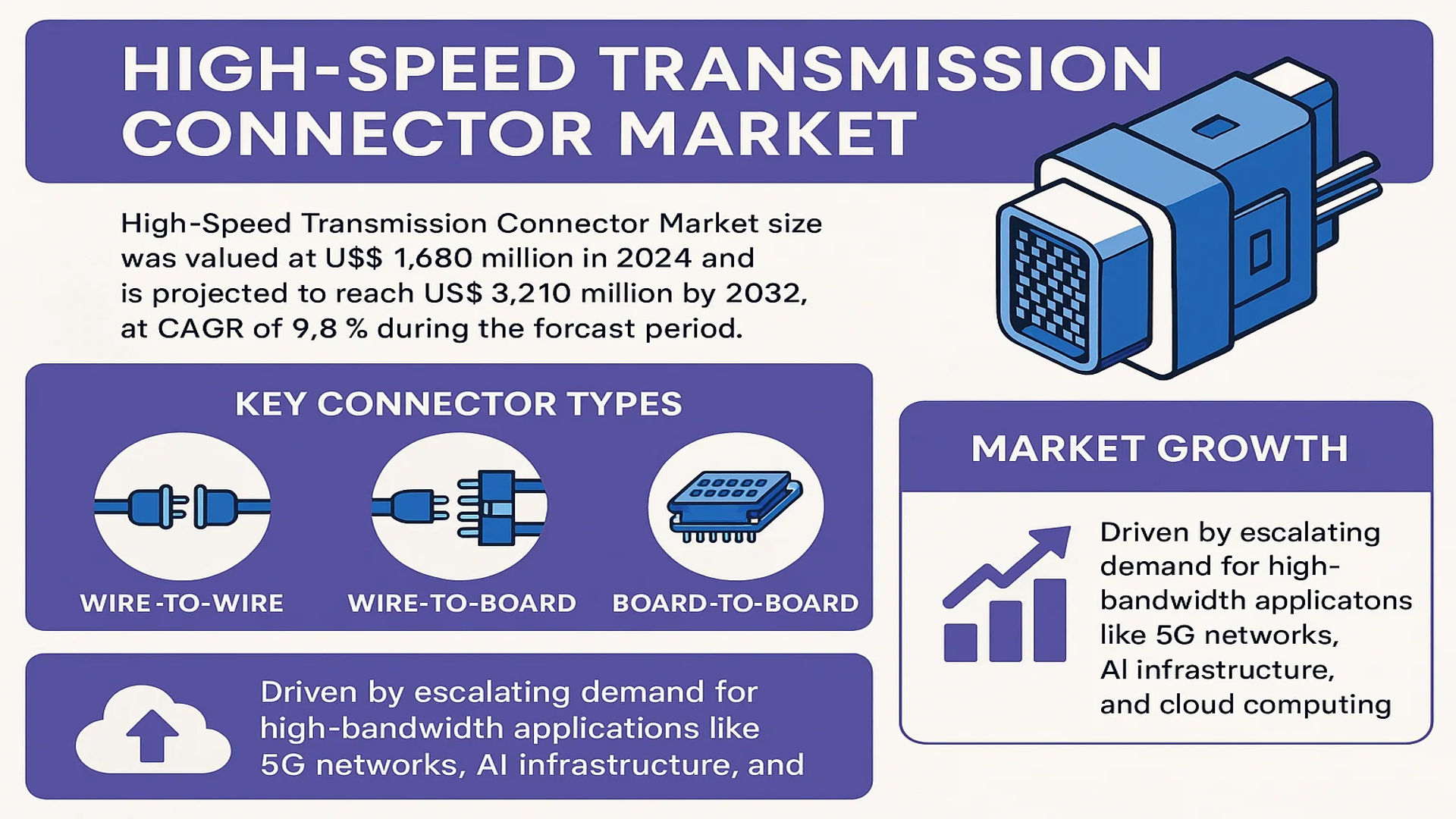
The global High-Speed Transmission Connector Market size was valued at US$ 1,680 million in 2024 and is projected to reach US$ 3,210 million by 2032, at a CAGR of 9.8% during the forecast period 2025-2032.
High-speed transmission connectors are specialized components designed to facilitate rapid data transfer in electronic systems. These connectors enable reliable signal transmission while minimizing interference, supporting applications ranging from consumer electronics to industrial automation. Key connector types include wire-to-wire, wire-to-board, and board-to-board configurations, each serving distinct integration needs in modern devices.
Market growth is driven by escalating demand for high-bandwidth applications like 5G networks, AI infrastructure, and cloud computing. The proliferation of IoT devices and automotive electronics further accelerates adoption, as compact connectors with robust performance become critical. Industry leaders such as TE Connectivity and Amphenol are expanding portfolios with advanced solutions, including miniaturized connectors for wearable tech and high-density interfaces for data centers. For instance, in March 2024, Molex launched its NovaRay® cable-to-board connector system, supporting 56 Gbps PAM4 signaling for hyperscale data centers—a testament to innovation fueling sector expansion.
MARKET DYNAMICS
MARKET DRIVERS
Proliferation of 5G and IoT Technologies Accelerating Market Demand
The global rollout of 5G networks is creating unprecedented demand for high-speed transmission connectors, with the technology requiring data transfer rates exceeding 10 Gbps in many implementations. This infrastructure upgrade cycle affects both mobile networks and the supporting data center ecosystems, where connector performance directly impacts latency and throughput. Simultaneously, the Internet of Things (IoT) ecosystem continues its rapid expansion, with projections indicating there will be over 25 billion connected devices worldwide within the next five years. Each endpoint device and network node requires reliable high-speed connectivity solutions, driving continuous innovation in connector technology to support higher frequency ranges and improved signal integrity.
Automotive Digital Transformation Creating New Demand Horizons
Modern vehicles are undergoing a technological revolution, with advanced driver assistance systems (ADAS), infotainment platforms, and autonomous driving technologies all requiring robust high-speed connectivity solutions. The average premium vehicle now contains over 100 connectors supporting data rates between 1-10 Gbps for sensor networks and onboard computing systems. This transformation extends beyond passenger vehicles into commercial transportation and logistics, where telematics and fleet management solutions similarly depend on high-performance connector systems. Recent developments in vehicle-to-everything (V2X) communication standards further underscore the critical role specialized connectors will play in next-generation automotive architectures.
Data Center Infrastructure Modernization Driving Premium Solutions
Hyperscale data centers represent one of the most demanding environments for high-speed connectors, with the transition to 400G and emerging 800G Ethernet standards pushing the boundaries of existing interconnect technologies. Major cloud providers are investing heavily in infrastructure upgrades to support artificial intelligence workloads and edge computing deployments, creating significant opportunities for advanced connector solutions. The need to balance performance with power efficiency in these installations has led to innovative connector designs featuring improved thermal management and reduced insertion loss, with some solutions now supporting data rates exceeding 56 Gbps per differential pair while maintaining signal integrity across backplane applications.
MARKET RESTRAINTS
Complex Certification Processes Slowing Time-to-Market
The high-speed connector industry faces growing regulatory complexity, with various international standards bodies establishing increasingly stringent requirements for electromagnetic compatibility, environmental resilience, and safety compliance. Obtaining certifications such as UL, IEC, and regional telecommunications approvals can extend product development cycles by 30-40% compared to conventional connectors. This regulatory burden disproportionately affects smaller manufacturers, potentially limiting market innovation as development costs escalate. Additionally, the lack of harmonization between regional standards creates further complications for global product strategies.
Signal Integrity Challenges at Higher Frequencies
As signal frequencies push beyond 50 GHz in next-generation applications, designers face mounting technical hurdles related to insertion loss, crosstalk, and impedance matching. These challenges require increasingly sophisticated simulation tools and measurement capabilities during development, dramatically increasing R&D expenditures. The physics of signal propagation at these frequencies often necessitates expensive materials and precision manufacturing techniques, with some high-end connectors requiring sub-micron tolerances that challenge conventional production methods. This technical complexity creates price-performance tradeoffs that can limit adoption in cost-sensitive applications.
Supply Chain Vulnerabilities Impacting Component Availability
High-speed connectors often incorporate specialized materials such as high-frequency dielectrics and precision-machined contacts that require complex manufacturing processes. Many of these components come from geographically concentrated supply sources, creating potential bottlenecks during periods of high demand. Recent disruptions have highlighted the fragility of these supply chains, with lead times for certain connector families extending to 40-50 weeks during peak shortages. This volatility complicates inventory management for OEMs and can delay product launches, particularly for applications requiring customized or application-specific connector variants.
MARKET OPPORTUNITIES
Emerging Photonic Integration Creating New Interconnect Paradigms
The convergence of optical and electrical interconnect technologies presents significant opportunities for connector innovators. Optical edge connectors that combine traditional electrical contacts with embedded fiber optic channels are gaining traction in data center and telecom applications where hybrid architectures are becoming prevalent. These solutions address the growing “bandwidth-distance” challenge in modern system designs, potentially enabling transmission speeds exceeding 100 Gbps per channel while reducing power consumption compared to all-electrical alternatives. Early adopters in high-performance computing and aerospace applications are already demonstrating the viability of these hybrid approaches.
Miniaturization Driving Innovation in Compact Solutions
The relentless push for smaller form factors across consumer electronics, medical devices, and industrial IoT applications creates sustained demand for space-efficient high-speed connectors. Recent advancements in micro-coaxial and board-to-board interconnect technologies now enable reliable multi-gigabit transmission in packages smaller than previous-generation solutions. Particularly promising are developments in embedded connector technologies that reduce board space requirements while improving signal integrity through optimized via structures and improved grounding techniques. These innovations open new design possibilities for portable medical diagnostic equipment, wearable technologies, and next-generation mobile devices.
Automated Manufacturing Technologies Enhancing Production Capabilities
Advances in precision manufacturing technologies such as micro-molding, laser welding, and automated optical inspection are transforming connector production economics. These innovations enable higher throughput while maintaining the tight tolerances required for high-frequency performance, potentially reducing unit costs for premium connector solutions. Automated alignment systems in particular are addressing one of the traditional challenges in high-speed connector assembly, ensuring consistent contact positioning across production volumes. Such manufacturing advancements allow suppliers to better balance performance requirements with cost considerations in competitive market segments.
MARKET CHALLENGES
Intellectual Property Protection in a Competitive Landscape
The high-speed connector market faces ongoing challenges related to intellectual property protection and technology differentiation. With major players investing heavily in proprietary connector designs and signaling technologies, disputes over patents and trade secrets have become increasingly common. These legal complexities can delay market entry for innovative solutions and increase operational costs associated with technology licensing and litigation. The situation is further complicated by differing intellectual property regimes across key global markets, requiring sophisticated legal strategies to protect innovations while maintaining freedom to operate.
Thermal Management in High-Density Applications
As connector densities increase to support higher bandwidth requirements, thermal dissipation becomes a critical design constraint. High-speed signals generate significant heat in closely packed connector arrays, potentially affecting both performance reliability and long-term material durability. This challenge is particularly acute in sealed applications or environments with limited airflow, where traditional cooling methods may be impractical. Addressing these thermal considerations often requires compromises in signal density or the incorporation of advanced thermal interface materials, both of which can impact overall system costs and design flexibility.
Workforce Development for High-Frequency Expertise
The specialized knowledge required for high-speed connector design and validation represents another market challenge. RF engineering principles, advanced materials science, and high-frequency measurement techniques constitute a skillset combination that remains relatively scarce in the labor market. Training programs and academic curricula have struggled to keep pace with industry needs, leading to intense competition for qualified engineers and technicians. This talent gap may constrain innovation cycles as companies balance the need for workforce development with aggressive product roadmap timelines in fast-moving technology segments.
HIGH-SPEED TRANSMISSION CONNECTOR MARKET TRENDS
Rising 5G and Data Center Expansion Driving Market Growth
The rapid global rollout of 5G networks and the expansion of hyperscale data centers have become primary drivers for high-speed transmission connector demand. With 5G networks requiring significantly improved bandwidth and lower latency, connectors capable of handling speeds exceeding 56 Gbps are witnessing increased adoption. Data centers, which formed over 35% of the high-speed connector market in 2024, continue to shift toward 400GbE and 800GbE infrastructure, necessitating connectors that maintain signal integrity at extreme frequencies. This transition is pushing connector manufacturers to develop advanced solutions with better electromagnetic interference shielding and reduced insertion loss.
Other Trends
Miniaturization and High-Density Connector Solutions
The relentless push for space optimization across industries has accelerated demand for compact, high-density connector designs. Modern automotive infotainment systems, IoT devices, and wearable technologies require connectors that offer maximum performance in minimal space. Board-to-board connectors with pitches below 0.5mm are gaining traction, particularly in smartphone applications where internal real estate remains constrained. While these miniature solutions provide space-saving benefits, they introduce challenges in thermal management and manufacturing precision that leading connector companies are actively addressing through innovative material science.
Automotive Connectivity Revolution Fueling Sector Growth
Advanced driver-assistance systems (ADAS) and vehicle electrification are transforming automotive connector requirements. The average modern vehicle now incorporates over 3,000 connectors, with high-speed variants becoming essential for camera modules, LiDAR systems, and in-vehicle networks. The shift toward autonomous driving is particularly noteworthy, as Level 4 autonomy demands data transmission rates above 25 Gbps between critical components. Automotive-grade connectors must simultaneously meet stringent vibration resistance standards while maintaining high-frequency performance, creating specialized market segments that several manufacturers are racing to dominate with ruggedized interconnect solutions.
COMPETITIVE LANDSCAPE
Key Industry Players
Strategic Innovations and Global Expansion Define Market Competition
The global high-speed transmission connector market demonstrates a competitive yet fragmented nature, with both established multinational corporations and emerging players striving for market dominance. TE Connectivity remains the market leader, commanding a significant share due to its extensive product portfolio and technological leadership in high-speed data transmission solutions. The company’s success stems from its ability to cater to diverse industries—ranging from telecommunications to aerospace—through innovations in signal integrity and miniaturization.
Close competitors such as Amphenol and Molex hold strong positions in the industry, leveraging their expertise in high-frequency connectors and investments in next-generation 5G and IoT applications. These companies reported robust revenue growth in 2024, driven by increasing demand for high-bandwidth connectors in data centers and next-gen automotive systems.
Japanese connector specialists Hirose Electric and Japan Aviation Electronics Industry (JAE) have strengthened their foothold in Asia-Pacific markets through compact, high-reliability connector solutions. Their focus on miniaturized board-to-board connectors has been particularly successful in mobile devices and wearable electronics segments.
Market dynamics show that mid-tier players like Samtec and Yamaichi Electronics are aggressively expanding their market presence through strategic acquisitions and new product development. These companies have successfully penetrated niche markets requiring specialized high-speed interconnect solutions, though they face increasing competition from larger players expanding into these segments.
List of Leading High-Speed Transmission Connector Manufacturers
- TE Connectivity Ltd. (Switzerland)
- Samtec Inc. (U.S.)
- Amphenol Corporation (U.S.)
- Molex LLC (U.S.)
- Hirose Electric Co., Ltd. (Japan)
- Japan Aviation Electronics Industry, Ltd. (Japan)
- Yamaichi Electronics Co., Ltd. (Germany)
- Kyocera Corporation (Japan)
- IMS Connector Systems GmbH (Germany)
Segment Analysis:
By Type
Board-to-Board Connectors Segment Leads Due to Rising Demand in Compact Electronics and High-Density Applications
The market is segmented based on type into:
- Wire-to-Wire Connector
- Subtypes: Terminal blocks, crimp connectors, and others
- Wire-to-Board Connector
- Subtypes: IDC connectors, FFC/FPC connectors, and others
- Board-to-Board Connector
- Subtypes: Mezzanine connectors, stacking connectors, and others
By Application
Communication Segment Dominates Owing to Proliferation of 5G Networks and High-Speed Data Transmission Needs
The market is segmented based on application into:
- Communication
- Subtypes: Data centers, telecom infrastructure, and others
- Aerospace
- Transportation
- Industrial
- Others
By Technology
Fiber Optic Connectors Gain Traction for Ultra-High-Speed Data Transfer in Next-Gen Networks
The market is segmented based on technology into:
- Copper-based Connectors
- Fiber Optic Connectors
- RF Connectors
By End-User
Enterprise Segment Expands Rapidly with Growing Data Center Infrastructure Investments
The market is segmented based on end-user into:
- Enterprise
- Consumer Electronics
- Automotive
- Healthcare
Regional Analysis: High-Speed Transmission Connector Market
Asia-Pacific
The Asia-Pacific region dominates the high-speed transmission connector market, accounting for over 40% of global demand, driven by China’s massive electronics manufacturing sector and Japan’s advanced automotive and industrial automation industries. China’s booming 5G infrastructure rollout, estimated to include 3 million base stations by 2025, along with India’s growing telecom sector, creates sustained demand for board-to-board and wire-to-board connectors. However, price pressure from local manufacturers and supply chain complexities present challenges for international suppliers. The region’s connector ecosystem benefits from Taiwan’s semiconductor dominance and South Korea’s leadership in consumer electronics, creating a vertically integrated supply chain.
North America
Characterized by innovation-centric demand, North America’s market prioritizes high-performance connectors for data centers (supporting up to 224 Gbps per channel), autonomous vehicles, and defense applications. The U.S. accounts for 78% of regional demand, with major hyperscalers investing billions annually in data center expansions. Government initiatives like the CHIPS Act indirectly boost connector demand by strengthening domestic semiconductor production. Key challenges include stringent compliance requirements and the need for miniaturized solutions in medical and aerospace applications, driving R&D investments from market leaders.
Europe
The European market emphasizes reliability and standardization, with Germany and France leading industrial automation adoption requiring ruggedized connectors. The EU’s focus on digital sovereignty and 6G research initiatives stimulates demand for advanced interconnect solutions. Automotive applications, particularly in electric vehicles and ADAS systems, account for 32% of regional connector usage. The market faces pressures from energy efficiency regulations and the need for sustainable manufacturing processes, prompting connector vendors to develop lead-free and recyclable products without compromising signal integrity.
Middle East & Africa
This emerging market shows promising growth in telecom and energy sectors, with smart city projects in UAE and Saudi Arabia driving demand for fiber optic and high-speed copper connectors. While currently representing less than 5% of global market share, the region benefits from increasing data center investments and digital transformation initiatives. Market expansion is constrained by reliance on imports and infrastructure limitations, though local assembly partnerships are gradually developing to address connectivity needs in harsh desert environments.
South America
Brazil anchors the regional market, with growing requirements for industrial and automotive connectors amidst economic recovery efforts. The push for 5G deployment across major cities creates opportunities, though adoption lags behind other regions. Market growth remains hampered by currency volatility and fragmented regulatory environments. Local manufacturing remains limited, with most connectors imported from Asia and North America, though regional trade agreements may stimulate future production capabilities.
Report Scope
This market research report provides a comprehensive analysis of the global High-Speed Transmission Connector market, covering the forecast period 2025–2032. It offers detailed insights into market dynamics, technological advancements, competitive landscape, and key trends shaping the industry.
Key focus areas of the report include:
- Market Size & Forecast: Historical data and future projections for revenue, unit shipments, and market value across major regions and segments. The global High-Speed Transmission Connector market was valued at US$ 1,680 million in 2024 and is projected to reach US$ 3,210 million by 2032, growing at a CAGR of 9.8%.
- Segmentation Analysis: Detailed breakdown by product type (Wire to Wire, Wire to Board, Board to Board), application (Communication, Aerospace, Transportation, Industrial, Others), and end-user industry to identify high-growth segments.
- Regional Outlook: Insights into market performance across North America, Europe, Asia-Pacific, Latin America, and the Middle East & Africa, with China expected to maintain the largest market share through 2032.
- Competitive Landscape: Profiles of 13 leading market participants, including TE Connectivity, Amphenol, and Molex, with analysis of their market share, R&D investments, and strategic partnerships.
- Technology Trends & Innovation: Assessment of emerging technologies including 5G infrastructure connectors, ultra-high-speed data transmission solutions, and miniaturization trends.
- Market Drivers & Restraints: Evaluation of factors such as 5G deployment (projected 1.2 billion 5G subscriptions by 2025) and data center expansion against challenges like raw material price volatility.
- Stakeholder Analysis: Strategic insights for component suppliers, OEMs, and investors regarding supply chain optimization and emerging opportunities in electric vehicle charging infrastructure.
The research employs both primary (industry expert interviews) and secondary (verified market data) research methodologies to ensure accuracy and reliability of all market projections and insights.
FREQUENTLY ASKED QUESTIONS:
What is the current market size of Global High-Speed Transmission Connector Market?
->High-Speed Transmission Connector Market size was valued at US$ 1,680 million in 2024 and is projected to reach US$ 3,210 million by 2032, at a CAGR of 9.8% during the forecast period 2025-2032.
Which key companies operate in Global High-Speed Transmission Connector Market?
-> Key players include TE Connectivity, Amphenol, Molex, Samtec, Hirose, Japan Aviation Electronics Industry, and Yamaichi Electronics, collectively holding over 45% market share.
What are the key growth drivers?
-> Primary growth drivers include 5G network expansion (projected USD 1.2 trillion investment by 2030), data center construction (expected to reach 1,200+ hyperscale facilities by 2026), and electric vehicle production (forecasted 26 million units annually by 2030).
Which region dominates the market?
-> Asia-Pacific accounts for 42% of global demand in 2024, led by China’s electronics manufacturing sector, while North America shows the highest growth potential with 7.3% CAGR through 2032.
What are the emerging trends?
-> Emerging trends include development of 112Gbps+ connectors, adoption of liquid cooling-compatible designs for data centers, and integration of AI-driven quality control in connector manufacturing.

Get Sample Report PDF for Exclusive Insights
Report Sample Includes
- Table of Contents
- List of Tables & Figures
- Charts, Research Methodology, and more...
 Download Sample Report PDF