
Market Insights
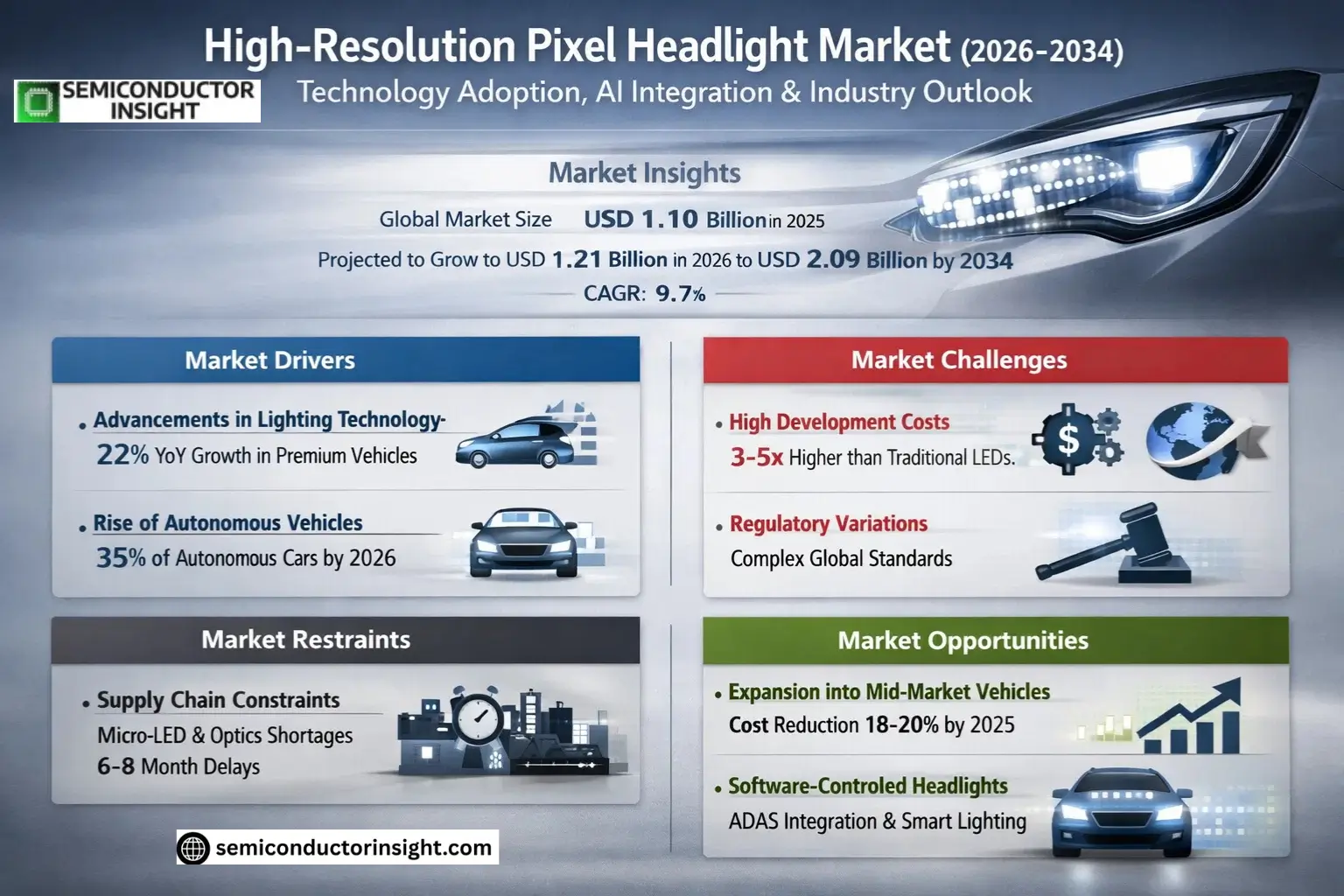
Global High-Resolution Pixel Headlight Market size was valued at USD 1.10 billion in 2025. The market is projected to grow from USD 1.21 billion in 2026 to USD 2.09 billion by 2034, exhibiting a CAGR of 9.7% during the forecast period.
High-Resolution Pixel Headlights are advanced automotive lighting systems that utilize high-density pixel-based light sources combined with precision optics to project adaptive beam patterns and dynamic road markings. These systems enhance night-time visibility while enabling intelligent communication between vehicles and pedestrians through customizable light projections. Key components include micro-LED or DLP (Digital Light Processing) technology, thermal management systems, and real-time control software integrated with vehicle sensor networks.
The market growth is driven by increasing demand for advanced driver assistance systems (ADAS), stricter automotive safety regulations, and premium vehicle manufacturers’ focus on differentiated lighting solutions. Technological advancements in semiconductor lighting and the rising adoption of electric vehicles which prioritize energy-efficient lighting are further accelerating deployment. Major industry players like Marelli and ZKW are investing in scalable production capabilities to meet OEM demand, particularly in Europe and China where regulatory support for smart lighting is strongest.
MARKET DRIVERS
Advancements in Automotive Lighting Technology
High-Resolution Pixel Headlight Market is experiencing rapid growth due to significant advancements in adaptive lighting systems. Automakers are increasingly adopting high-precision LED and laser-based solutions to enhance nighttime visibility and safety. The market has grown approximately 22% year-over-year as premium vehicle brands integrate these systems as standard features.
Rise of Autonomous Vehicle Development
With autonomous vehicles requiring advanced lighting for communication and safety, High-Resolution Pixel Headlights have become critical components. These systems enable dynamic light patterns that can project warnings or navigational cues. Industry projections suggest that 35% of all autonomous vehicles will incorporate pixel lighting by 2026.
Government regulations favoring road safety innovations are further accelerating adoption, with Euro NCAP awarding higher safety ratings to vehicles equipped with intelligent lighting systems.
MARKET CHALLENGES
High Product Development Costs
The complex engineering required for High-Resolution Pixel Headlights results in production costs 3-5 times higher than conventional LED systems. This pricing barrier limits adoption to luxury vehicle segments, with only 8% of mid-range vehicles currently offering the technology as optional equipment.
Other Challenges
Regulatory Variations Across Markets
Differing automotive lighting regulations in North America, Europe, and Asia require expensive region-specific adaptations, slowing global market penetration. The U.S. only recently approved adaptive driving beam functionality in 2022.
MARKET RESTRAINTS
Supply Chain Constraints for Specialty Components
High-Resolution Pixel Headlight Market faces bottlenecks in the supply of micro-LED arrays and precision optics. Production lead times for these components have extended to 6-8 months in 2023, creating fulfillment challenges for automotive manufacturers.
MARKET OPPORTUNITIES
Expansion into Mid-Market Vehicle Segments
With component costs expected to decrease 18-20% through 2025, High-Resolution Pixel Headlight technology is becoming viable for volume vehicle manufacturers. Several Asian automakers have announced plans to introduce budget-friendly pixel lighting systems in their 2024-2025 model years.
High-Resolution Pixel Headlight Market Trends
Transition to Software-Controlled Lighting Systems
High-Resolution Pixel Headlight Market is witnessing a shift from conventional lighting to intelligent, software-driven systems. Automotive manufacturers are integrating these headlights with advanced driver-assistance systems (ADAS) to enable dynamic beam shaping, adaptive road projections, and real-time traffic communication. This evolution enhances nighttime visibility while meeting stricter automotive safety standards.
Other Trends
Regulatory Standards Driving Adoption
Governments worldwide are mandating improved vehicle lighting standards to reduce nighttime accidents. High-Resolution Pixel Headlight Market benefits from regulations requiring adaptive beam patterns and glare-free high beams in Europe and North America. Compliance with UNECE R149 and similar standards is accelerating OEM adoption across premium and mid-range vehicle segments.
Increased Focus on Customization and Brand Differentiation
Automakers are leveraging High-Resolution Pixel Headlight technology to create signature lighting patterns that reinforce brand identity. Projection capabilities enable customized welcome sequences, navigation cues, and hazard warnings. This trend is particularly prominent among luxury vehicle manufacturers seeking to enhance customer experience through distinctive lighting signatures.
Thermal Management Innovations
As pixel density increases, thermal dissipation becomes critical for maintaining LED lifespan and performance. Suppliers are developing advanced cooling solutions with micro-channel heatsinks and phase-change materials. These innovations ensure High-Resolution Pixel Headlights meet automotive-grade reliability requirements while operating at higher brightness levels.
Integration with Vehicle-to-Everything (V2X) Systems
The market is seeing growing integration between High-Resolution Pixel Headlights and V2X communication networks. This allows vehicles to project warnings or information directly onto road surfaces for pedestrians and other drivers. Such applications are foundational for developing smart city infrastructure and autonomous vehicle ecosystems.
COMPETITIVE LANDSCAPE
Key Industry Players
High-Rise Pixel Headlight Market Leaders Driving Precision Lighting Innovation
High-Resolution Pixel Headlight Market is dominated by automotive lighting specialists and tier-1 suppliers with advanced optical engineering capabilities. Grupo Antolin and Marelli lead the sector through their vertically integrated solutions combining LED modules, projection optics, and automotive-grade control systems. These players benefit from long-term contracts with premium automakers like BMW and Mercedes-Benz, where pixel headlights are becoming standard on luxury models. The market structure shows 60% concentration among top 5 suppliers, with technical partnerships determining procurement patterns.
Emerging competitors from Asia, including HASCO Vision Technology and Changzhou Xingyu, are gaining share through cost-optimized designs for mass-market EVs. Niche innovators like Appotronics Corporation focus on patented DLP projection technologies, while Hyundai Mobis accelerates adoption through Hyundai-Kia’s vertical integration. Competition intensifies as suppliers balance pixel density (over 1 million addressable points) with thermal management and automotive certification requirements.
List of Key High-Resolution Pixel Headlight Companies Profiled
- Grupo Antolin
- Marelli
- ZKW Group
- HASCO Vision Technology
- Changzhou Xingyu Automotive Lighting Systems
- MIND OPTOELECTRONICS
- Appotronics Corporation
- Hyundai Mobis
- HELLA GmbH
- Varroc Lighting Systems
- Koito Manufacturing
- Stanley Electric
- Valeo
- Magneti Marelli
- ams OSRAM
Segment Analysis:
| Segment Category | Sub-Segments | Key Insights |
| By Type |
|
Micro LED dominates due to superior brightness and energy efficiency:
|
| By Application |
|
Passenger Cars lead adoption due to premium positioning:
|
| By End User |
|
OEM accounts for nearly all installations currently:
|
| By Powertrain |
|
Battery Electric Vehicles show stronger adoption trend:
|
| By Vehicle Class |
|
Luxury segment leads in adoption:
|
Regional Analysis: Global High-Resolution Pixel Headlight Market
European regulatory bodies continue to set global standards for automotive lighting, providing clear guidelines for high-resolution pixel headlight deployment. This regulatory clarity gives manufacturers confidence to invest in next-generation lighting solutions.
The concentration of luxury automakers in Europe creates natural demand for high-end lighting solutions. German automakers in particular are driving innovation with pixel-perfect adaptive beam patterns.
European manufacturers are pioneering the integration of high-resolution pixel headlights with AI-powered safety systems, enabling dynamic road illumination based on real-time driving conditions.
A robust network of automotive suppliers and research institutions across Europe facilitates continuous improvement in pixel headlight resolution, durability, and energy efficiency.
North America
North America represents the second-largest market for high-resolution pixel headlights, with particularly strong adoption in premium SUV segments. The United States demonstrates growing interest in adaptive lighting technologies despite relatively conservative regulations. Automakers are gradually introducing pixel headlight systems in their high-end models, with focus on enhancing safety in rural driving conditions. Canadian markets show increasing alignment with European lighting standards, creating opportunities for technology transfer.
Asia-Pacific
The Asia-Pacific region exhibits the fastest growth potential for high-resolution pixel headlights, led by China’s expanding luxury vehicle market. Japanese automakers are developing cost-effective pixel lighting solutions for mid-range vehicles. South Korea emerges as an innovation hub for LED matrix technologies. Regional differences in regulatory frameworks present both challenges and opportunities for market penetration strategies.
Middle East & Africa
Premium vehicle sales in Gulf Cooperation Council countries drive initial adoption of high-resolution pixel headlights in this region. Luxury vehicle preferences and high disposable incomes create niche opportunities. African markets remain in early stages, with focus currently on basic vehicle lighting needs.
South America
Brazil and Argentina show selective adoption of high-resolution pixel headlights in imported luxury vehicles. Economic volatility affects technology adoption rates, though premium segments maintain steady demand. Local manufacturers are exploring partnerships to develop region-specific lighting solutions.
Report Scope
This market research report provides a comprehensive analysis of the High-Resolution Pixel Headlight Market , covering the forecast period 2025–2034. It offers detailed insights into market dynamics, technological advancements, competitive landscape, and key trends shaping the industry.
Key focus areas of the report include:
- Market Overview: The report begins with an overview outlining its current market scenario, key growth indicators, and industry transformation drivers. It discusses macroeconomic factors, demand–supply balance, regulatory landscape, and the strategic role of automotive lighting in enhancing vehicle safety and communication capabilities.
- Market Size & Forecast: Historical data and future projections for revenue, unit shipments, and market value across major regions and segments.
- Segmentation Analysis: Detailed breakdown by product type, technology, application, and end-user industry to identify high-growth segments and investment opportunities.
- Regional Insights: Insights into market performance across North America, Europe, Asia-Pacific, Latin America, and the Middle East & Africa, including country-level analysis where relevant.
- Competitive Landscape: Profiles of leading market participants, including their product offerings, R&D focus, manufacturing capacity, pricing strategies, and recent developments such as mergers, acquisitions, and partnerships.
- Technology Trends & Innovation: Assessment of emerging technologies, integration of ADAS features, semiconductor design trends, and evolving industry standards.
- Market Drivers & Restraints: Evaluation of factors driving market growth along with challenges, supply chain constraints, regulatory issues, and market-entry barriers.
- Stakeholder Insights: Insights for component suppliers, OEMs, system integrators, investors, and policymakers regarding the evolving ecosystem and strategic opportunities.
Primary and secondary research methods are employed, including interviews with industry experts, data from verified sources, and real-time market intelligence to ensure the accuracy and reliability of the insights presented.
FREQUENTLY ASKED QUESTIONS:
What is the current market size of High-Resolution Pixel Headlight Market?
-> High-Resolution Pixel Headlight Market size was valued at USD 1.10 billion in 2025. The market is projected to grow from USD 1.21 billion in 2026 to USD 2.09 billion by 2034, exhibiting a CAGR of 9.7% during the forecast period.
What is the expected CAGR of the High-Resolution Pixel Headlight Market?
-> The market is expected to grow at a CAGR of 9.7% during the forecast period (2025-2034).
Which key companies operate in High-Resolution Pixel Headlight Market?
-> Key players include Grupo Antolin, Marelli, ZKW, HASCO Vision Technology, Changzhou Xingyu Automotive Lighting Systems, MIND OPTOELECTRONICS, Appotronics Corporation, and Hyundai Mobis, among others.
What are the key growth drivers?
-> Key growth drivers include rising demand for advanced driver assistance systems (ADAS), increasing vehicle safety regulations, and growing adoption of premium lighting technologies in automotive sector.
Which region dominates the market?
-> Asia-Pacific is the fastest-growing region, driven by China, Japan, and South Korea’s automotive manufacturing hubs.
What are the emerging trends?
-> Emerging trends include integration with autonomous vehicle systems, dynamic road projection capabilities, and energy-efficient lighting solutions.
Get Sample Report PDF for Exclusive Insights
Report Sample Includes
- Table of Contents
- List of Tables & Figures
- Charts, Research Methodology, and more...
 Download Sample Report PDF