MARKET INSIGHTS
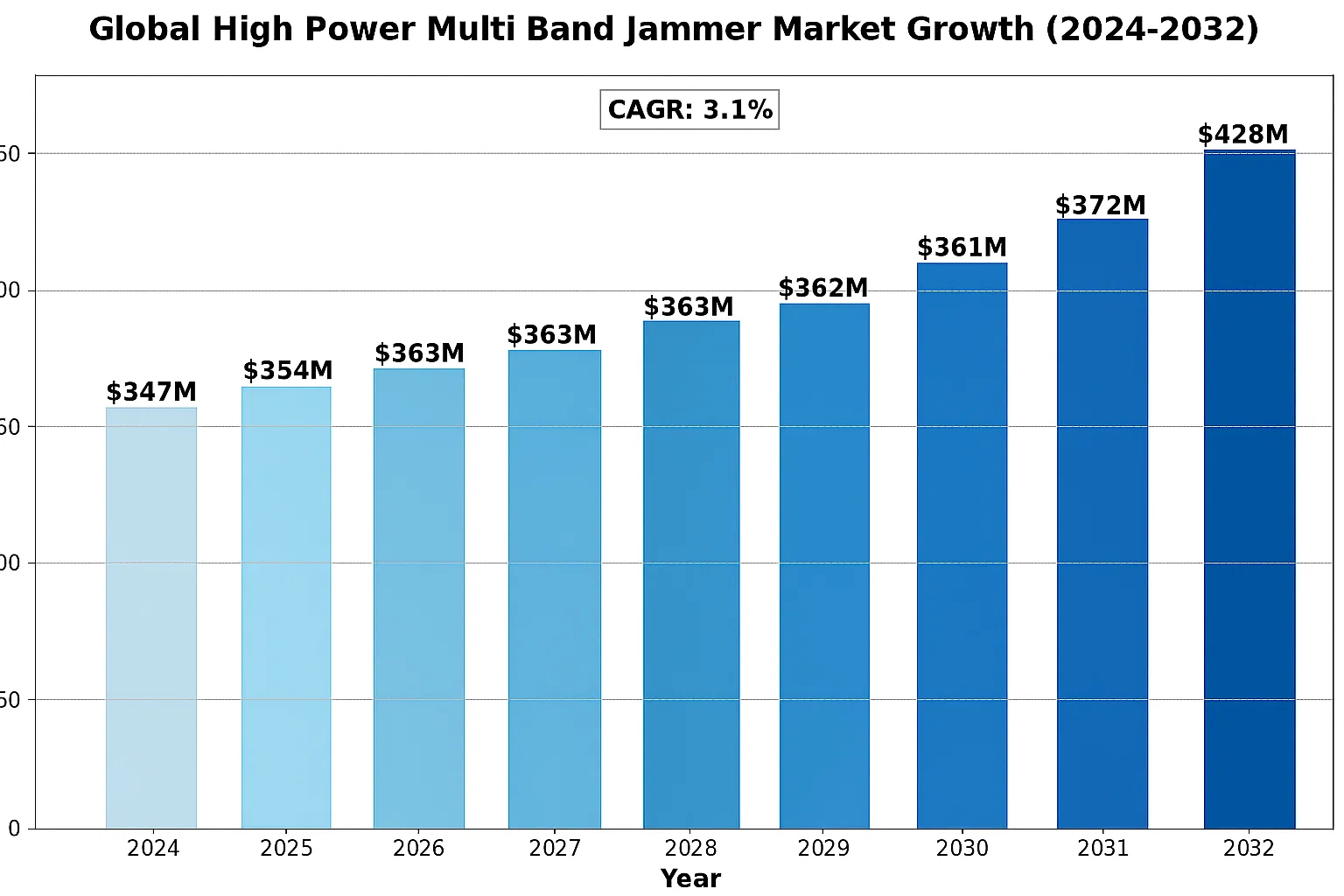
The global High Power Multi Band Jammer Market was valued at 347 million in 2024 and is projected to reach US$ 428 million by 2032, at a CAGR of 3.1% during the forecast period.
High Power Multi Band Jammers are advanced electronic countermeasure devices designed to block multiple wireless communication signals simultaneously. These jammers operate across diverse frequency bands, including cellular (2G, 3G, 4G, 5G), Wi-Fi (2.4GHz/5GHz), GPS, Bluetooth, VHF/UHF, and other RF signals. Their primary function is to create intentional interference that disrupts communication within specified areas, serving critical security and operational needs.
The market growth is primarily driven by increasing security concerns across military, defense, and law enforcement sectors, where signal control is paramount. Furthermore, the rapid proliferation of wireless technologies and the need for counter-surveillance measures in sensitive locations contribute to market expansion. Recent technological advancements have enabled these jammers to cover broader frequency ranges with higher power output, making them more effective against modern communication systems. Key players such as Raytheon, L3Harris Technologies, and BAE Systems continue to innovate, developing more sophisticated jamming solutions to meet evolving security requirements.
MARKET DYNAMICS
MARKET DRIVERS
Increasing Security Concerns and Military Modernization Programs Driving Market Growth
The global security landscape has witnessed rising threats from unauthorized communication and drone activities, creating substantial demand for signal jamming solutions. High Power Multi Band Jammers play a critical role in military operations, counter-terrorism efforts, and high-security facilities by effectively blocking all communication channels simultaneously. Modern military forces are prioritizing electronic warfare capabilities as part of their modernization initiatives, with defense budgets allocating approximately 15-20% of total expenditures to electronic warfare systems including jammers. For instance, recent conflicts have demonstrated the strategic importance of neutralizing enemy communications, surveillance systems, and drone swarms through electromagnetic spectrum dominance.
Proliferation of Wireless Devices and Smart Technologies Boosts Jammer Adoption
The exponential growth in wireless technologies across civilian and military applications has created new vulnerabilities that require sophisticated countermeasures. With over 17 billion connected devices expected globally by 2024 and the rapid deployment of 5G networks, the potential attack surface for malicious actors has expanded dramatically. High Power Multi Band Jammers provide critical protection against IED detonations, corporate espionage, and privacy breaches by completely isolating sensitive areas from all wireless communication. Prisons, government facilities, and corporate research centers are increasingly deploying these systems to prevent unauthorized data leaks and maintain operational security.
Furthermore, the emergence of advanced drone technologies has necessitated robust counter-drone solutions, with jammers being the preferred non-kinetic option for disabling unmanned aerial systems effectively.
Regulatory Support for Controlled Signal Management Fuels Market Expansion
Governments worldwide are implementing stricter regulations regarding electromagnetic spectrum management, particularly in sensitive environments. Recent policy developments have authorized law enforcement and defense agencies to use signal jamming technologies under specific operational circumstances. This regulatory framework has created a favorable environment for high power jammer adoption while maintaining necessary safeguards against misuse. As cyber-physical security threats continue evolving, these policies are expected to expand coverage to include new wireless protocols and emerging communication standards.
MARKET RESTRAINTS
Stringent Regulatory Compliance and Spectrum Licensing Challenges
The deployment and operation of High Power Multi Band Jammers face significant regulatory hurdles due to strict spectrum usage policies. Most countries require special licenses for operating such equipment, with civilian use typically restricted to authorized security agencies. The certification process involves extensive testing to ensure the jammers meet precise technical specifications and don’t interfere with critical communication services. These regulatory barriers can delay product commercialization by 12-18 months in some markets while requiring substantial compliance investments from manufacturers.
Additionally, international agreements governing electromagnetic spectrum usage impose geographic restrictions on jammer operations, particularly near borders and in civilian areas, limiting market expansion potential in certain regions.
Technical Limitations in Multi-Band Synchronization Pose Implementation Challenges
While High Power Multi Band Jammers offer comprehensive coverage, they face inherent technical constraints in simultaneously jamming multiple frequency bands with optimal efficiency. The rapidly evolving wireless communication standards require constant hardware and software updates to maintain effectiveness, with 5G networks presenting particular technical hurdles due to their beamforming capabilities and millimeter wave spectrum usage. Engineering teams must overcome significant challenges in power distribution, thermal management, and adaptive jamming algorithms to ensure consistent performance across all targeted bands without excessive power consumption or equipment overheating.
MARKET OPPORTUNITIES
Emerging Counter-Drone Applications Creating New Market Segments
The rapid proliferation of commercial and military drones has spawned significant demand for advanced jamming solutions capable of disrupting UAV communications and navigation systems. Modern High Power Multi Band Jammers with specialized anti-drone capabilities represent a high-growth segment expected to expand at approximately 25% CAGR through 2030. These systems are increasingly deployed for critical infrastructure protection, VIP security details, and large public event security, with particular emphasis on neutralizing swarming drone threats through sophisticated signal disruption techniques.
Integration with AI and Machine Learning for Adaptive Jamming Presents Growth Potential
The incorporation of artificial intelligence into jamming systems enables real-time spectrum analysis and adaptive response capabilities, significantly enhancing operational effectiveness. Next-generation jammers with cognitive radio features can automatically detect and prioritize emerging threats while optimizing power allocation across frequency bands. This technological evolution is driving development of smarter, more efficient jamming solutions that appeal to both military and high-security civilian customers seeking advanced spectrum dominance capabilities.
MARKET CHALLENGES
High Development Costs and Complex Manufacturing Processes
Developing and producing High Power Multi Band Jammers involves significant technical and financial investments, with advanced systems costing upwards of $500,000 per unit for military-grade configurations. The complex RF engineering required to maintain jamming effectiveness across multiple bands while meeting strict size, weight, and power constraints makes these systems substantially more expensive than single-band jammers. Additionally, the specialized components and testing requirements contribute to lengthy manufacturing cycles and high production costs that challenge market scalability.
Other Challenges
Spectrum Management Complexity
The dynamic nature of wireless communication standards requires constant system updates to address new protocols and modulation techniques, creating ongoing R&D burdens for manufacturers attempting to maintain market relevance.
Energy Efficiency Constraints
Thermal dissipation and power consumption issues in high-power operation limit operational durations and increase total cost of ownership, particularly for mobile and portable jammer applications.
HIGH POWER MULTI BAND JAMMER MARKET TRENDS
Military and Defense Applications Drive Market Expansion
The increasing adoption of High Power Multi Band Jammers in military and defense operations is projected to account for over 42% of market revenue by 2032. Modern warfare scenarios require advanced counter-drone and communication disruption capabilities where these jammers excel by simultaneously disabling signals across cellular (2G-5G), Wi-Fi (2.4GHz/5GHz), GPS, and VHF/UHF bands. Recent geopolitical tensions have accelerated procurement, with global defense budgets for electronic warfare systems growing at 5.3% CAGR since 2020. Military-grade jammers now feature adaptive frequency hopping and AI-powered signal identification to counter evolving threats in contested electromagnetic environments.
Other Trends
Regulatory Evolution for Security Applications
Governments worldwide are implementing revised spectrum management policies permitting controlled jammer deployment in high-security zones. Over 18 countries have established legal frameworks since 2022 for using multi-band jammers in prisons, government facilities, and critical infrastructure protection. This regulatory shift is enabling growth in the law enforcement segment, projected to reach $87 million in annual sales by 2026. However, strict emission control requirements continue to challenge manufacturers in balancing interference precision with operational effectiveness.
Technological Integration in Civilian Sectors
While military applications dominate the market, civilian sector adoption is growing at 8.1% annually, driven by exam hall security, corporate confidentiality needs, and anti-espionage measures. New compact models with directional antennas allow targeted jamming without affecting adjacent areas—a critical feature for urban deployments. The emergence of software-defined radio (SDR) architectures enables field-upgradable systems that can adapt to emerging frequency bands without hardware modifications. However, concerns about potential misuse continue to spark debates regarding civilian access, particularly after several incidents of GPS jamming affecting commercial aviation navigation systems.
Counter-Drone Technology Integration
The global drone detection and mitigation market’s 25% growth rate is creating symbiotic opportunities for multi-band jammer manufacturers. Modern systems combine radar detection with selective jamming protocols that neutralize rogue drones while minimizing collateral interference. Recent tests show advanced systems can identify and disrupt over 92% of commercial drone models at ranges exceeding 1.5km. This capability is becoming standard in airport security systems, with major hubs investing $2-4 million per site in integrated counter-UAS solutions featuring multi-band jamming modules.
COMPETITIVE LANDSCAPE
Key Industry Players
Market Leaders Focus on Technological Advancements to Maintain Dominance
The global high power multi-band jammer market exhibits a moderately consolidated structure, with defense contractors and specialized RF technology firms commanding significant shares. Raytheon Technologies and L3Harris Technologies collectively account for over 35% of the market revenue in 2024, owing to their comprehensive defense solutions portfolios and government contracts across multiple regions.
While military applications dominate current demand, the entry of specialized providers like Avnon HLS Group (SKYLOCK) reflects growing commercial adoption. Their innovative portable jamming solutions have gained traction in corporate security applications, demonstrating 18% year-over-year growth in 2023.
BAE Systems maintains technological leadership through continuous R&D investments, recently unveiling next-gen adaptable jamming systems capable of real-time spectrum analysis. This positions the company strongly for emerging 5G jamming requirements, a segment projected to grow at 4.2% CAGR through 2032.
The competitive landscape also features nimble innovators such as Phantom Technologies and Mctech Technology, who are expanding their presence through strategic collaborations with regional distributors. These partnerships enable them to penetrate markets where localized frequency regulations create specialized demand patterns.
List of Key High Power Multi Band Jammer Companies Profiled
- Raytheon Technologies (U.S.)
- L3Harris Technologies (U.S.)
- Northrop Grumman (U.S.)
- BAE Systems (U.K.)
- Avnon HLS Group (SKYLOCK) (Israel)
- Phantom Technologies (U.S.)
- Mctech Technology (China)
- Stratign (India)
- RF-Technologies (Germany)
- Digital RF (U.S.)
- HSS Development (France)
- Endoacustica Europe S.R.L (Italy)
Segment Analysis:
By Type
Mobile Phone Jammer Segment Leads Due to Rising Security Concerns and Illegal Communication Prevention
The market is segmented based on type into:
- Mobile Phone Jammer
- GPS Device Jammer
- Radio and Wi-Fi Jammer
- Microphone and Micro-Recorder Jammer
- Others
By Application
Military and Defense Segment Dominates Owing to Critical Signal Blocking Requirements
The market is segmented based on application into:
- Military and Defense
- Government and Law Enforcement Agencies
- Educational Institutions
- Others
Regional Analysis: High Power Multi Band Jammer Market
North America
The North American market for high power multi-band jammers is driven by robust defense spending and stringent security protocols. With the U.S. Department of Defense allocating over $842 billion for national security in 2024, the demand for advanced counter-drone and signal-jamming technologies remains high. Major manufacturers like Raytheon and L3Harris Technologies dominate this space, supplying jammers for military bases, federal facilities, and law enforcement. Regulatory approval processes here are among the most rigorous globally, ensuring compliance with FCC spectrum management rules. Recent investments in 5G infrastructure have also spurred innovation in multi-band jamming solutions capable of countering emerging frequency threats.
Europe
Europe’s market growth is propelled by increased counter-terrorism measures and the need to secure critical infrastructure. The EU’s Electronic Communications Code (ECC) governs signal jamming applications, limiting usage to authorized entities like law enforcement and military units. Countries such as Germany and France lead in adopting portable high-power jammers for border security and anti-surveillance operations. However, strict privacy laws, including GDPR, create hurdles for commercial deployment. Collaborative R&D initiatives—such as the European Defence Fund’s €8 billion allocation—are accelerating the development of next-gen jammers with AI-powered frequency agility.
Asia-Pacific
APAC is the fastest-growing market, fueled by geopolitical tensions and rapid military modernization. China’s defense budget, which increased to $230 billion in 2024, prioritizes electronic warfare capabilities, including multi-band jammers for disputed territorial regions. India and Japan are also expanding their arsenals with indigenous systems, like India’s “Shakti” electronic warfare suite. Meanwhile, Southeast Asian nations face challenges balancing cost constraints with the need for spectrum-monitoring solutions against illegal espionage. The region’s dense urban areas further drive demand for localized jamming in prisons and government complexes.
South America
The market here is constrained by economic instability but sees niche demand from narcotics enforcement and VIP protection units. Brazil’s federal police recently deployed jammers to counter drone-based drug smuggling along its borders, signaling incremental growth. However, the lack of standardized regulations and reliance on imported systems from North America or Israel limit scalability. Chile and Colombia exhibit moderate potential due to rising investments in defense, albeit at slower adoption rates compared to global counterparts.
Middle East & Africa
This region presents a high-growth yet uneven landscape. Gulf states like Saudi Arabia and the UAE invest heavily in electronic countermeasures, driven by threats from asymmetric warfare and drone attacks. The UAE’s EDGE Group has emerged as a key developer of multi-band jammers for desert operations. Conversely, Africa’s market is fragmented; while South Africa and Nigeria procure jammers for presidential security, broader adoption is hampered by budget limitations and intermittent conflicts. The lack of regional frequency coordination further complicates deployment.
Report Scope
This market research report provides a comprehensive analysis of the global and regional High Power Multi Band Jammer markets, covering the forecast period 2024–2032. It offers detailed insights into market dynamics, technological advancements, competitive landscape, and key trends shaping the industry.
Key focus areas of the report include:
- Market Size & Forecast: Historical data and future projections for revenue, unit shipments, and market value across major regions and segments. The global market was valued at USD 347 million in 2024 and is projected to reach USD 428 million by 2032 at a CAGR of 3.1%.
- Segmentation Analysis: Detailed breakdown by product type (Mobile Phone Jammer, GPS Device Jammer, etc.), application (Military & Defense, Government Agencies, etc.), and end-user industry to identify high-growth segments.
- Regional Outlook: Insights into market performance across North America, Europe, Asia-Pacific, Latin America, and Middle East & Africa, including country-level analysis of major markets.
- Competitive Landscape: Profiles of leading market participants including Raytheon, L3Harris Technologies, and BAE Systems, covering their product portfolios, market share, and strategic initiatives.
- Technology Trends: Analysis of multi-band jamming capabilities, integration with electronic warfare systems, and advancements in signal processing technologies.
- Market Drivers & Restraints: Evaluation of security concerns, military modernization programs, regulatory constraints, and technological challenges impacting market growth.
- Stakeholder Analysis: Strategic insights for defense contractors, security agencies, technology providers, and investors regarding market opportunities.
The research methodology combines primary interviews with industry experts and analysis of verified market data from authoritative sources to ensure accuracy and reliability.
FREQUENTLY ASKED QUESTIONS:
What is the current market size of Global High Power Multi Band Jammer Market?
-> High Power Multi Band Jammer Market was valued at 347 million in 2024 and is projected to reach US$ 428 million by 2032, at a CAGR of 3.1% during the forecast period.
Which key companies operate in this market?
-> Major players include Raytheon, L3Harris Technologies, Northrop Grumman, BAE Systems, and Avnon HLS Group.
What are the key growth drivers?
-> Growth is driven by rising security concerns, military modernization programs, and increasing demand for signal jamming in critical infrastructure protection.
Which region dominates the market?
-> North America currently leads the market, while Asia-Pacific is expected to witness the highest growth during the forecast period.
What are the emerging technology trends?
-> Emerging trends include AI-powered jamming systems, multi-spectral jamming capabilities, and compact portable jammer designs.

Get Sample Report PDF for Exclusive Insights
Report Sample Includes
- Table of Contents
- List of Tables & Figures
- Charts, Research Methodology, and more...