Market Insights
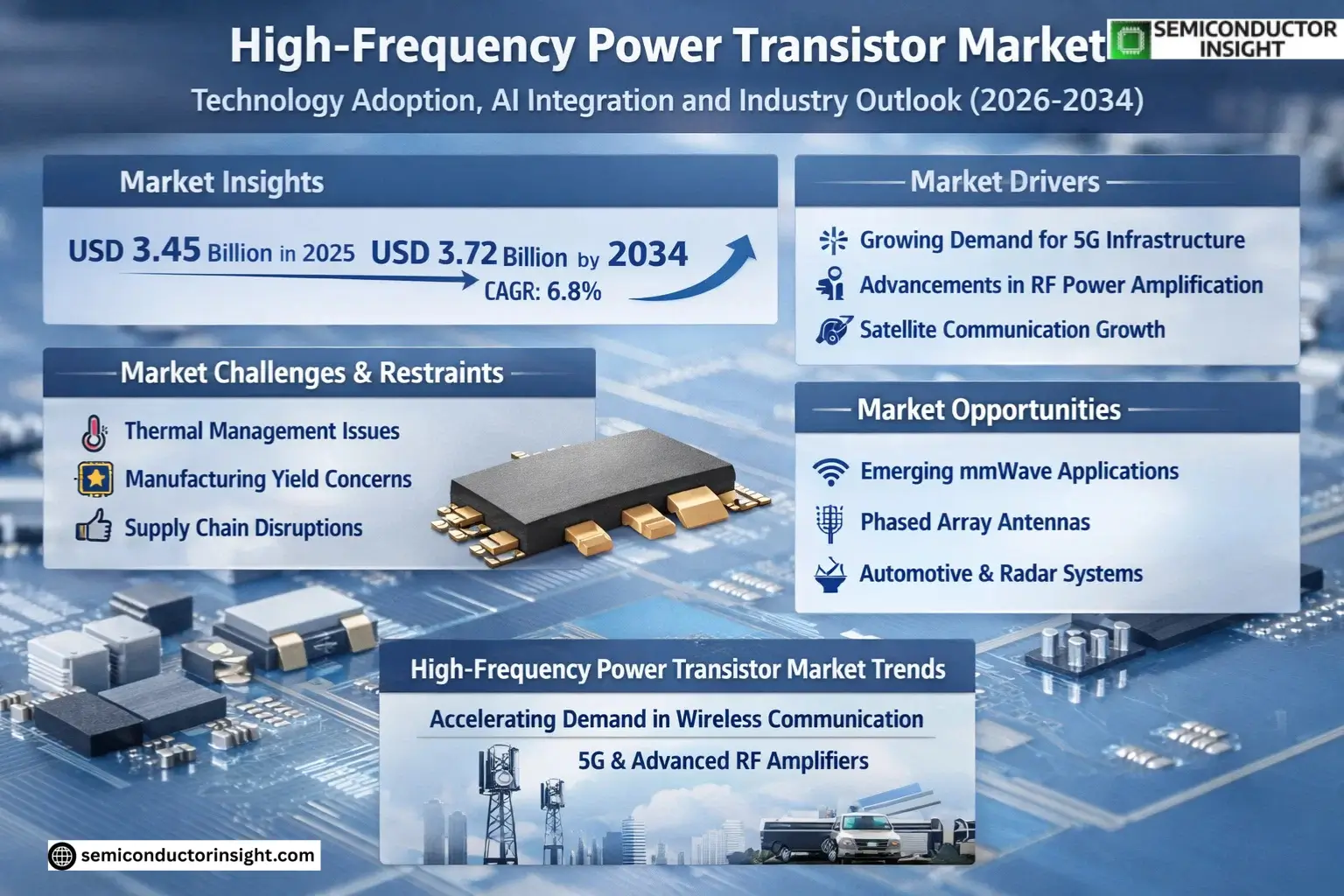
Global High-Frequency Power Transistor Market size was valued at USD 3.45 billion in 2025. The market is projected to grow from USD 3.72 billion in 2026 to USD 5.89 billion by 2034, exhibiting a CAGR of 6.8% during the forecast period.
High-frequency power transistors are semiconductor devices designed to amplify or switch electronic signals at high frequencies, typically above 1 MHz. These components are critical for applications requiring efficient power management and signal processing, such as wireless communication systems, radar technology, and RF amplifiers. Key types include gallium nitride (GaN), silicon carbide (SiC), and LDMOS transistors, each offering distinct advantages in terms of power efficiency, thermal stability, and frequency range.
The market growth is driven by increasing demand for high-speed data transmission, advancements in 5G infrastructure deployment, and the rising adoption of IoT devices. Additionally, the shift toward energy-efficient electronics and the expansion of defense and aerospace applications contribute to sector expansion. Leading players such as Infineon Technologies, ON Semiconductor, and STMicroelectronics are investing in R&D to enhance transistor performance while reducing production costs.
MARKET DRIVERS
Growing Demand for 5G Infrastructure
The rapid global deployment of 5G networks is significantly driving the High-Frequency Power Transistor Market. These components are critical for base stations and small cell installations, with an estimated 70% of 5G infrastructure relying on high-frequency transistor technology.
Advancements in RF Power Amplification
Modern gallium nitride (GaN) and silicon carbide (SiC) transistors are enabling higher frequency operation with better thermal performance. High-Frequency Power Transistor Market is benefiting from these material innovations, with GaN-based devices projected to grow at 22% CAGR through 2028.
Increasing satellite communication deployments are creating sustained demand for reliable high-frequency solutions, particularly in the 6-18 GHz range.
MARKET CHALLENGES
Thermal Management Complexities
High-Frequency Power Transistors face inherent challenges with heat dissipation at elevated frequencies, requiring expensive thermal interface materials and cooling solutions that can add 15-20% to system costs.
Other Challenges
Manufacturing Yield Optimization
Achieving consistent yields above 85% remains difficult for GaN-based high-frequency transistors, particularly for frequencies exceeding 6 GHz.
Supply Chain Vulnerabilities
High-Frequency Power Transistor Market experienced 8-12 week lead time extensions in 2023 due to specialized substrate material shortages.
MARKET RESTRAINTS
High R&D Investment Requirements
Developing next-generation High-Frequency Power Transistors requires annual R&D expenditures exceeding USD 2 million per design, creating significant barriers to entry for smaller manufacturers. The average design cycle has extended to 18-24 months for frequencies above 10 GHz.
MARKET OPPORTUNITIES
Emerging mmWave Applications
High-Frequency Power Transistor Market is poised for growth in the 24-40 GHz range, particularly for automotive radar and point-to-point backhaul systems. Projections indicate a USD 1.2 billion addressable market for mmWave transistors by 2027.
Phased Array Antenna Systems
Massive MIMO deployments and satellite communication terminals are creating new demand vectors for high-frequency transistor arrays, with each phased array unit requiring 64-256 individual power transistors.
High-Frequency Power Transistor Market Trends
Accelerating Demand in Wireless Communication
High-Frequency Power Transistor Market is witnessing significant growth driven by expanding wireless communication infrastructure. With 5G network deployments accelerating globally, these components are critical for base stations and RF power amplifiers. The transition from 4G to 5G requires transistors capable of operating at higher frequencies with improved efficiency.
Other Trends
Technological Advancements in Semiconductor Materials
Manufacturers are increasingly adopting gallium nitride (GaN) and silicon carbide (SiC) materials for High-Frequency Power Transistors, offering superior thermal conductivity and higher breakdown voltages compared to traditional silicon-based components. This shift enables more compact designs with better power handling capabilities.
Asia-Pacific as Manufacturing Hub
China and Japan account for over 40% of global High-Frequency Power Transistor production, benefiting from established semiconductor ecosystems and government support for electronics manufacturing. Major fabs in these regions are expanding capacity to meet growing demand from both domestic and international markets.
Increased Focus on Energy Efficiency
The market is seeing development of next-generation High-Frequency Power Transistors with lower power consumption, responding to global energy efficiency standards. Manufacturers are optimizing designs to reduce switching losses while maintaining high-frequency performance, particularly important for power amplifiers in communication systems.
Automotive Radar Applications Emerging
Advanced driver-assistance systems (ADAS) are creating new opportunities for High-Frequency Power Transistors in automotive radar modules operating at 24GHz and 77GHz frequencies. This segment is projected to show accelerated growth as vehicle autonomy levels increase.
COMPETITIVE LANDSCAPE
Key Industry Players
Global High-Frequency Power Transistor Market Concentration Among Top Electronic Component Manufacturers
High-Frequency Power Transistor Market is dominated by established semiconductor giants, with Infineon Technologies leading the sector with approximately 18% global revenue share in 2025. The market exhibits an oligopolistic structure where the top five players Infineon, ON Semiconductor, STMicroelectronics, Mitsubishi Electric, and Fuji Electric collectively control nearly 55% of market share. These companies maintain dominance through extensive R&D investments in gallium nitride (GaN) and silicon carbide (SiC) transistor technologies.
Several specialized players occupy important niches, with Renesas Electronics and ROHM Semiconductor focusing on RF amplifier applications, while Vishay and Toshiba maintain strong positions in radar systems. Emerging manufacturers like Anshi Semiconductor are gaining traction in Asia-Pacific markets through competitive pricing strategies, though they account for less than 5% of global sales collectively. The industry is witnessing increased M&A activity as companies seek to consolidate technological expertise in 5G and defense applications.
List of Key High-Frequency Power Transistor Companies Profiled
- Infineon Technologies
- ON Semiconductor
- STMicroelectronics
- Mitsubishi Electric
- Fuji Electric
- Toshiba Electronic Devices & Storage
- Anshi Semiconductor
- Renesas Electronics
- ROHM Semiconductor
- Vishay Intertechnology
- NXP Semiconductors
- Microchip Technology
- Wolfspeed
- Qorvo
- MACOM Technology Solutions
Segment Analysis:
| Segment Category | Sub-Segments | Key Insights |
| By Type |
|
Fully Controllable Type dominates due to superior performance characteristics:
|
| By Application |
|
Wireless Communication maintains industry leadership through:
|
| By End User |
|
Aerospace & Defense represents the premium segment due to:
|
| By Material |
|
Gallium Nitride (GaN) emerging as material of choice because:
|
| By Power Rating |
|
Medium Power (10-100W) segment shows strongest adoption due to:
|
Regional Analysis: Asia-Pacific High-Frequency Power Transistor Market
China’s nationwide 5G rollout drives unprecedented demand for high-frequency power transistors, particularly in base station power amplifiers. The technology adoption rate exceeds regional peers due to concentrated infrastructure investments.
Domestic semiconductor fabs are achieving remarkable progress in GaN-on-SiC production, reducing reliance on imports. Chinese firms now supply 40% of local high-frequency power transistor demand through indigenous manufacturing capabilities.
Chinese research institutes are applying machine learning algorithms to enhance high-frequency transistor performance. AI models predict optimal device geometries for specific frequency bands and power requirements.
Defense modernization programs create specialized demand for ruggedized high-frequency power transistors. Domestic manufacturers are developing radiation-hardened versions for satellite communication systems.
South Korea
South Korea emerges as Asia-Pacific’s innovation hub for high-frequency power transistors, led by semiconductor giants developing cutting-edge GaN technologies. The country’s advanced foundries achieve industry-leading yields in RF power device production. Strategic collaborations between device manufacturers and telecom operators accelerate technology adoption in 5G mmWave infrastructure. Korean research centers pioneer AI-based thermal management solutions for high-power RF transistors. The automotive sector generates growing demand for high-frequency components in vehicle radar systems, with local suppliers developing automotive-grade transistors.
Japan
Japan maintains technological leadership in high-frequency LDMOS transistors while transitioning to GaN solutions. The country’s unique ecosystem combines established semiconductor expertise with advanced materials science capabilities. Japanese manufacturers focus on reliability enhancement for industrial and medical RF applications. Government-supported consortia develop next-generation packaging technologies for high-power RF devices. The market benefits from strong domestic demand in broadcasting equipment and industrial heating systems requiring robust high-frequency components.
India
India’s High-Frequency Power Transistor Market grows rapidly alongside digital infrastructure expansion. Local design houses collaborate with global semiconductor firms to customize solutions for tropical operating conditions. Government PLI schemes incentivize domestic assembly of RF power modules for telecommunications. The space program drives specialized requirements for radiation-tolerant high-frequency transistors. Indian startups are innovating cost-effective manufacturing techniques for emerging 5G network deployments across rural areas.
Southeast Asia
Southeast Asia emerges as strategic production base for high-frequency power transistors, leveraging established electronics manufacturing ecosystems. Countries like Malaysia and Vietnam attract investments in backend semiconductor processes for RF devices. The region benefits from geographical proximity to both Chinese and Western markets. Local universities collaborate with multinationals on workforce development for compound semiconductor fabrication. Growing demand stems from data center infrastructure and industrial automation applications across the ASEAN economic bloc.
Report Scope
This market research report provides a comprehensive analysis of the High-Frequency Power Transistor Market, covering the forecast period 2025–2034. It offers detailed insights into market dynamics, technological advancements, competitive landscape, and key trends shaping the industry.
Key focus areas of the report include:
- Market Overview: The report begins with an overview outlining its current market scenario, key growth indicators, and industry transformation drivers. It discusses macroeconomic factors, demand–supply balance, regulatory landscape, and the strategic role of semiconductors in powering advancements across industries such as wireless communication, radar systems, and RF amplifiers.
- Market Size & Forecast: Historical data and future projections for revenue, unit shipments, and market value across major regions and segments.
- Segmentation Analysis: Detailed breakdown by product type (Uncontrollable Type, Semi Controllable Type, Fully Controllable Type), application (Wireless Communication, Radar System, RF Amplifier), and end-user industry.
- Regional Insights: Insights into market performance across North America, Europe, Asia, South America, and Middle East & Africa, including country-level analysis where relevant.
- Competitive Landscape: Profiles of leading market participants, including their product offerings, R&D focus, manufacturing capacity, pricing strategies, and recent developments.
- Technology Trends & Innovation: Assessment of emerging technologies in high-frequency power transistors, semiconductor design trends, and evolving industry standards.
- Market Drivers & Restraints: Evaluation of factors driving market growth along with challenges, supply chain constraints, regulatory issues, and market-entry barriers.
- Stakeholder Insights: Insights for component suppliers, OEMs, system integrators, investors, and policymakers regarding the evolving ecosystem and strategic opportunities.
Primary and secondary research methods are employed, including interviews with industry experts, data from verified sources, and real-time market intelligence to ensure the accuracy and reliability of the insights presented.
FREQUENTLY ASKED QUESTIONS:
What is the current market size of High-Frequency Power Transistor Market?
-> High-Frequency Power Transistor Market size was valued at USD 3.45 billion in 2025. The market is projected to grow from USD 3.72 billion in 2026 to USD 5.89 billion by 2034, exhibiting a CAGR of 6.8% during the forecast period.
Which key companies operate in High-Frequency Power Transistor Market?
-> Key players include Infineon, ON Semiconductor, STMicroelectronics, Mitsubishi, Fuji, Toshiba, Anshi Semiconductor, Renesas Electronics, ROHM, and Vishay, among others.
What are the key growth drivers?
-> Key growth drivers include increasing demand for wireless communication technologies, advancements in radar systems, and growth in RF amplifier applications.
Which region dominates the market?
-> Asia is a key growth region, with China expected to reach USD million by 2034, while North America (particularly the U.S.) remains a significant market.
What are the emerging trends?
-> Emerging trends include development of advanced controllable type transistors, increasing integration in communication systems, and technological innovations in semiconductor materials.
Get Sample Report PDF for Exclusive Insights
Report Sample Includes
- Table of Contents
- List of Tables & Figures
- Charts, Research Methodology, and more...
 Download Sample Report PDF