Market Insights
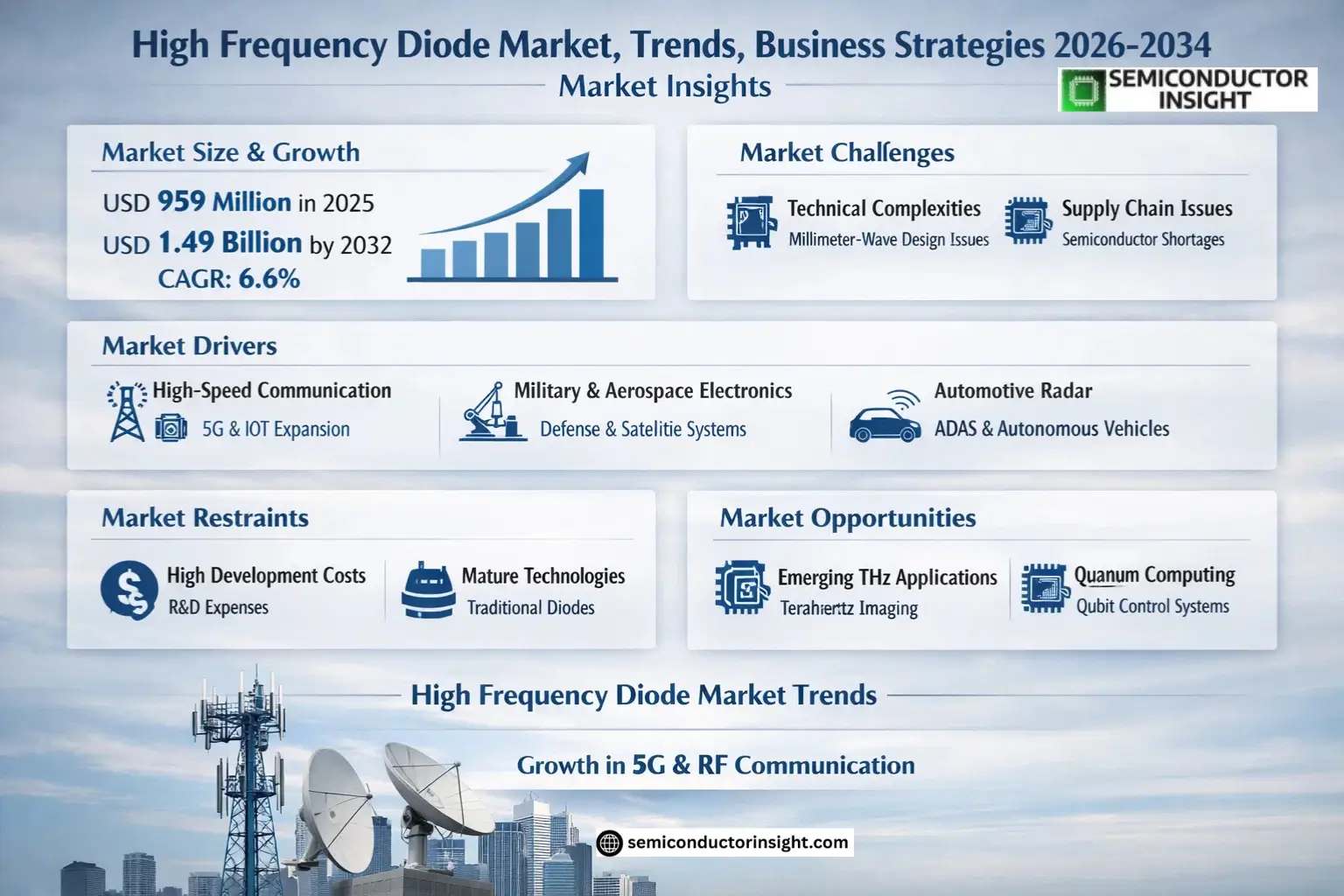
Global High Frequency Diode Market size was valued at USD 959 million in 2025. The market is projected to grow from USD 1.02 billion in 2026 to USD 1.49 billion by 2032, exhibiting a CAGR of 6.6% during the forecast period.
High Frequency Diode Market are semiconductor devices optimized for signal rectification, detection, and switching in high-frequency circuits. These components feature low junction capacitance and fast switching speeds, enabling stable performance across radio-frequency (RF), microwave, and millimeter-wave applications. Key product categories include RF diodes, microwave diodes, and millimeter-wave diodes, with packaging variations such as discrete, surface-mount, and module-based configurations.
The market growth is driven by expanding 5G infrastructure deployments and increasing demand for high-speed data transmission systems across telecommunications and consumer electronics sectors. While silicon-based diodes dominate mainstream applications due to cost advantages, manufacturers are focusing on process optimizations to reduce parasitic parameters and improve consistency. The industry maintains healthy capacity utilization rates of approximately 75% (1.2 billion units produced against 1.6 billion units capacity in 2025), reflecting balanced supply-demand dynamics.
MARKET DRIVERS
Increasing Demand for High-Speed Communication
The growing adoption of 5G networks and IoT applications is driving demand for high frequency diodes in communication infrastructure. These components enable efficient signal processing in RF circuits, with global shipments expected to grow at 8.2% CAGR through 2028.
Advancements in Military & Aerospace Electronics
High Frequency Diode Market are critical for radar systems, satellite communications, and electronic warfare equipment. Rising defense budgets worldwide, particularly in North America and Asia-Pacific, are fueling market growth in this segment.
Automotive radar systems for ADAS applications are emerging as another significant growth area, with projections indicating a 12% annual increase in diode requirements through 2027.
MARKET CHALLENGES
Technical Design Complexities
Developing high frequency diodes that maintain performance at millimeter-wave frequencies presents significant engineering challenges. The trade-off between switching speed and power handling capacity continues to limit some applications.
Other Challenges
Material Limitations
Silicon-based diodes face performance constraints above 100GHz, pushing manufacturers toward more expensive GaAs and GaN technologies that increase production costs by 30-40%.
Supply Chain Vulnerabilities
Recent semiconductor shortages have particularly impacted the availability of specialty diodes, with lead times extending to 40+ weeks for some high frequency variants in 2023.
MARKET RESTRAINTS
High Development Costs
The specialized fabrication processes and testing requirements for high performance diodes result in R&D expenditures that can exceed USD 2 million per new product design, limiting market entry for smaller players.
Mature Technology Substitution
In some low-frequency applications, traditional diodes continue to dominate due to their established reliability and lower cost, restraining full market penetration of high-frequency alternatives.
MARKET OPPORTUNITIES
Emerging THz Applications
The development of terahertz imaging and spectroscopy systems is creating demand for diodes capable of operating in the 0.1-10THz range, with prototype devices already showing commercial potential.
Quantum Computing Interfaces
Next-generation quantum computers require ultra-high frequency components for qubit control, opening a niche market segment projected to reach USD 150 million annually by 2026.
High Frequency Diode Market Trends
Accelerated Demand in RF Communication Applications
High Frequency Diode Market is experiencing significant growth driven by expanding RF communication infrastructure, particularly with global 5G deployment. Manufacturers are optimizing diode designs to meet stringent requirements for low junction capacitance and fast switching speeds in base stations and small cell networks. Silicon-based diodes remain preferred for cost-efficient solutions, while emerging applications in millimeter-wave frequencies are creating niche opportunities.
Other Trends
Product Innovation in Packaging Technologies
Surface-mount and module-based packaging solutions are gaining traction in the High Frequency Diode Market, addressing space constraints in modern electronic designs. Manufacturers are investing in advanced packaging techniques to improve thermal management and reduce parasitic effects, particularly for high-density circuit applications in consumer electronics and automotive systems.
Regional Manufacturing Capacity Expansion
Asia-Pacific continues to dominate High Frequency Diode production, with China, Taiwan and Japan accounting for approximately 65% of global capacity. Recent investments in wafer fabrication facilities and testing infrastructure are improving yield rates for high-performance diodes. European and North American manufacturers are focusing on specialized military and aerospace applications where reliability standards are critical.
Supply Chain Optimization Strategies
Leading High Frequency Diode suppliers are vertically integrating material sourcing to mitigate semiconductor shortages. Partnerships with epitaxial wafer providers and packaging material specialists are helping manufacturers maintain consistent quality while reducing lead times for high-volume orders in the consumer electronics segment.
Technical Benchmarking in Performance Parameters
The industry is seeing increased emphasis on standardized testing protocols for key High Frequency Diode specifications including reverse recovery time and thermal stability. Major vendors are differentiating products through advanced doping techniques that enhance frequency response while maintaining competitive pricing in the commercial wireless market.
COMPETITIVE LANDSCAPE
Key Industry Players
Strategic Positioning in the High-Frequency Diode Market
NXP Semiconductors and Infineon Technologies dominate the high-frequency diode market with combined revenue shares exceeding 25% in 2025. Their technological leadership in RF semiconductor solutions and vertical integration from silicon wafers to packaged devices create significant competitive advantages. Both companies maintain R&D investment ratios above 15% of revenues for frequency optimization and parasitic parameter reduction in diode designs. The market exhibits an oligopolistic structure where the top 5 players control 42% of global supply, with specialization across microwave (MACOM, Qorvo) and millimeter-wave (Skyworks Solutions) frequency bands.
Second-tier competitors including Vishay Intertechnology and ROHM Semiconductor compete through application-specific diode portfolios, particularly in automotive and industrial segments. Emerging Chinese manufacturers like Yangjie Technology and Silan Microelectronics are gaining traction in cost-sensitive consumer electronics applications, offering 20-30% price advantages over Western counterparts. Specialty manufacturers such as Analog Devices and STMicroelectronics focus on high-reliability diodes for defense and aerospace applications, commanding premium pricing with 40-50% gross margins.
List of Key High-Frequency Diode Companies Profiled
- NXP Semiconductors
- Infineon Technologies
- Onsemi
- STMicroelectronics
- Vishay Intertechnology
- ROHM Semiconductor
- MACOM
- Skyworks Solutions
- Qorvo
- Analog Devices
- JCET
- Yangjie Technology
- Silan Microelectronics
- CR Micro
Segment Analysis:
| Segment Category | Sub-Segments | Key Insights |
| By Type |
|
RF Diodes dominate market adoption due to their balance of performance and cost efficiency:
|
| By Application |
|
Radio Frequency Communication Equipment drives market growth with expanding deployment scenarios:
|
| By End User |
|
Telecommunication Providers represent the most demanding user segment:
|
| By Packaging Type |
|
Surface-Mount Devices are becoming the packaging standard:
|
| By Performance Class |
|
High Performance diodes demonstrate growing market traction:
|
Regional Analysis: High Frequency Diode Market
China’s strategic investments in domestic semiconductor production have significantly increased high frequency diode manufacturing capacity. The Made in China 2025 initiative prioritizes RF component development, driving innovation and competitive pricing in the regional market.
Japan maintains technological leadership in precision high frequency diodes, with companies specializing in high-reliability components for automotive and industrial applications. The country’s strong R&D focus ensures continuous performance improvements in diode technology.
South Korea’s advanced consumer electronics sector creates substantial demand for high frequency diodes in smartphones, displays, and IoT devices. The country’s vertically integrated electronics giants drive innovations in diode miniaturization and energy efficiency.
Growing electronics manufacturing in Malaysia, Vietnam, and Thailand expands the High Frequency Diode Market through increased assembly operations. The region benefits from shifting global supply chains and offers new growth opportunities for diode suppliers.
North America
North America remains a key innovation center for high frequency diode technology, particularly in defense and aerospace applications. The region’s strong research institutions and tech giants drive advancements in high-frequency communications systems. Growing investments in 5G infrastructure and autonomous vehicle technologies are creating new demand for specialized diode solutions. The U.S. maintains a competitive edge in high-performance diode design, benefiting from close collaborations between semiconductor firms and end-users in critical industries.
Europe
Europe’s High Frequency Diode Market is characterized by strong automotive and industrial applications, especially in Germany and France. Stringent quality standards and environmental regulations shape diode development toward higher reliability and eco-friendly solutions. The region’s emphasis on renewable energy systems and electric vehicles presents growing opportunities for high efficiency diodes. European research programs support innovation in semiconductor materials that could redefine future diode performance characteristics.
South America
The South American High Frequency Diode Market shows steady growth, primarily driven by telecommunications infrastructure upgrades and increasing electronics consumption. Brazil leads regional demand, with gradual expansion of domestic electronic manufacturing capabilities. While still dependent on imports for advanced diode technologies, the region benefits from growing investments in digital infrastructure that necessitate high frequency components for signal processing and transmission applications.
Middle East & Africa
This emerging market for high frequency diodes benefits from urban infrastructure developments and expanding telecommunications networks. Gulf nations are investing heavily in smart city technologies that incorporate high frequency components. Africa’s growing mobile penetration creates downstream demand for electronics containing high frequency diodes, though the region remains largely an import market currently developing local assembly capabilities.
Report Scope
This market research report provides a comprehensive analysis of the High Frequency Diode Market , covering the forecast period 2025–2032. It offers detailed insights into market dynamics, technological advancements, competitive landscape, and key trends shaping the industry.
Key focus areas of the report include:
- Market Overview: The report begins with an overview outlining its current market scenario, key growth indicators, and industry transformation drivers. It discusses macroeconomic factors, demand–supply balance, regulatory landscape, and the strategic role of semiconductors in powering advancements across industries such as automotive, telecommunications, consumer electronics, and industrial automation.
- Market Size & Forecast: Historical data and future projections for revenue, unit shipments, and market value across major regions and segments.
- Segmentation Analysis: Detailed breakdown by product type, technology, application, and end-user industry to identify high-growth segments and investment opportunities.
- Regional Insights: Insights into market performance across North America, Europe, Asia-Pacific, Latin America, and the Middle East & Africa, including country-level analysis where relevant.
- Competitive Landscape: Profiles of leading market participants, including their product offerings, R&D focus, manufacturing capacity, pricing strategies, and recent developments such as mergers, acquisitions, and partnerships.
- Technology Trends & Innovation: Assessment of emerging technologies, integration of AI/IoT, semiconductor design trends, fabrication techniques, and evolving industry standards.
- Market Drivers & Restraints: Evaluation of factors driving market growth along with challenges, supply chain constraints, regulatory issues, and market-entry barriers.
- Stakeholder Insights: Insights for component suppliers, OEMs, system integrators, investors, and policymakers regarding the evolving ecosystem and strategic opportunities.
Primary and secondary research methods are employed, including interviews with industry experts, data from verified sources, and real-time market intelligence to ensure the accuracy and reliability of the insights presented.
FREQUENTLY ASKED QUESTIONS:
What is the current market size of High Frequency Diode Market?
-> High Frequency Diode Market size was valued at USD 959 million in 2025. The market is projected to grow from USD 1.02 billion in 2026 to USD 1.49 billion by 2032, exhibiting a CAGR of 6.6% during the forecast period.
What is the forecasted growth rate for the High Frequency Diode Market?
-> The market is expected to grow at a CAGR of 6.6% during the forecast period (2025-2032).
Which key companies operate in High Frequency Diode Market?
-> Key players include NXP Semiconductors, Infineon Technologies, Onsemi, STMicroelectronics, Vishay Intertechnology, ROHM Semiconductor, MACOM, Skyworks Solutions, Qorvo, Analog Devices, JCET, Yangjie Technology, Silan Microelectronics, and CR Micro.
What are the key growth drivers?
-> Key growth drivers include 5G infrastructure deployment, expansion of wireless communication and consumer electronics, and demand from automotive electronics and radar systems.
Which region dominates the market?
-> Asia dominates the market, with major production bases in China, Taiwan, Japan, and Southeast Asia.
What are the emerging trends?
-> Emerging trends include process optimization for parasitic parameter reduction, increased frequency performance, and silicon-based diode dominance in cost-sensitive markets.

Get Sample Report PDF for Exclusive Insights
Report Sample Includes
- Table of Contents
- List of Tables & Figures
- Charts, Research Methodology, and more...
 Download Sample Report PDF