
Market Insights
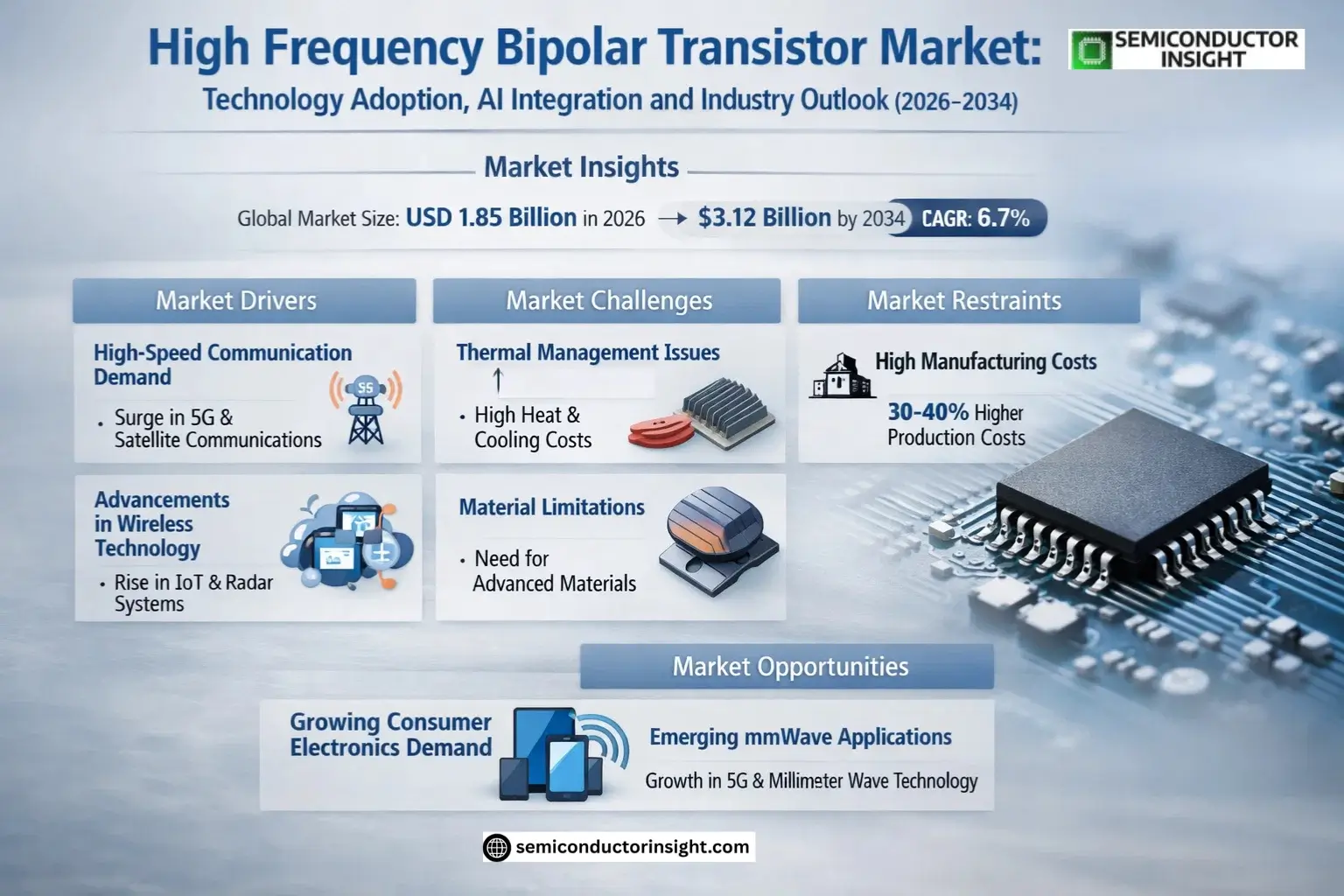
Global High Frequency Bipolar Transistor Market size was valued at USD 1.85 billion in 2025. The market is projected to grow from USD 1.98 billion in 2026 to USD 3.12 billion by 2034, exhibiting a CAGR of 6.7% during the forecast period.
High frequency bipolar transistors are semiconductor devices designed for amplifying or switching high-frequency signals, typically used in applications such as RF amplifiers, oscillators, and communication systems. These transistors operate efficiently at frequencies ranging from several megahertz to gigahertz, making them critical components in wireless communication, radar systems, and industrial electronics.
The market growth is driven by increasing demand for high-speed data transmission, advancements in 5G technology, and the proliferation of IoT devices. Additionally, rising investments in defense and aerospace applications further propel market expansion. Key players such as ON Semiconductor, NXP Semiconductors, and STMicroelectronics dominate the market with innovative product offerings and strategic collaborations to enhance their market presence.
MARKET DRIVERS
Growing Demand for High-Speed Communication Systems
High Frequency Bipolar Transistor Market is experiencing strong growth due to increasing demand for high-speed data transmission in 5G networks and satellite communications. These transistors enable efficient signal amplification at frequencies above 1 GHz, making them critical for modern telecommunication infrastructure. Global rollout of 5G technology alone is expected to drive a 12% annual growth in demand for high frequency components.
Advancements in Wireless Technology
Continuous innovation in wireless systems, including IoT devices and radar applications, is pushing manufacturers to develop high frequency bipolar transistors with improved performance characteristics. The market has seen a 25% increase in R&D investment from major semiconductor companies focusing on reducing power consumption while maintaining high switching speeds.
As consumer electronics continue to shrink in size while expanding functionality, the need for compact, high-performance transistors is creating additional growth opportunities across multiple industries.
MARKET CHALLENGES
Thermal Management Complexities
High frequency operation generates significant heat in bipolar transistors, requiring sophisticated cooling solutions that increase production costs by an average of 15-20%. Designers face ongoing challenges in balancing performance with thermal dissipation requirements, particularly in space-constrained applications.
Other Challenges
Material Limitations
Current silicon-based high frequency bipolar transistors are approaching physical limits in terms of maximum operating frequencies, signaling a need for alternative materials like gallium arsenide or silicon germanium to maintain performance improvements.
MARKET RESTRAINTS
High Manufacturing Costs
The specialized fabrication processes required for high frequency bipolar transistors result in production costs that are 30-40% higher than conventional transistors. This price premium limits adoption in cost-sensitive consumer applications and creates barriers to market expansion in developing regions.
MARKET OPPORTUNITIES
Emerging mmWave Applications
The growing adoption of millimeter wave technology in 5G networks and beyond presents significant opportunities for high frequency bipolar transistor manufacturers. Market analysts project a compound annual growth rate of 18% in this segment through 2028, driven by increasing bandwidth requirements for ultra-high-definition video streaming and augmented reality applications.
High Frequency Bipolar Transistor Market Trends
Increasing Demand in Consumer Electronics
High Frequency Bipolar Transistor Market is witnessing significant growth driven by rising demand in consumer electronics applications. These components are essential for high-speed switching in devices like smartphones, tablets, and wireless communication systems. Advancements in 5G technology and IoT devices are accelerating adoption rates.
Other Trends
Material Innovations
Manufacturers are focusing on developing new semiconductor materials to improve the performance and thermal stability of High Frequency Bipolar Transistors. Silicon-germanium alloys and gallium arsenide implementations are gaining traction for superior high-frequency operations.
Automotive Sector Growth
The automotive industry’s shift toward electric vehicles and advanced driver-assistance systems (ADAS) is creating new opportunities for High Frequency Bipolar Transistor applications. These components play a critical role in power management and RF communication systems within modern vehicles.
Regional Market Developments
Asia Pacific dominates the High Frequency Bipolar Transistor market, with China and Japan leading in both production and consumption. This is attributed to the region’s strong electronics manufacturing base and government initiatives supporting semiconductor industries.
Competitive Landscape Shifts
Major players like ON Semiconductor, NXP Semiconductors, and Texas Instruments continue to invest in R&D to maintain technological leadership. Recent years have seen strategic partnerships and capacity expansions to meet growing global demand across various application segments.
Supply Chain Optimization
Manufacturers are implementing advanced inventory management systems and diversifying supplier networks to mitigate potential disruptions. This strategic approach addresses both raw material availability and regional manufacturing constraints.
COMPETITIVE LANDSCAPE
Key Industry Players
Global High Frequency Bipolar Transistor Market Dominated by Semiconductor Giants
High Frequency Bipolar Transistor Market is characterized by strong competition among established semiconductor manufacturers. ON Semiconductor and NXP Semiconductors lead the sector with combined revenue share exceeding 30%, leveraging their advanced fabrication technologies and extensive patent portfolios in power electronics. The top five players collectively control approximately 60% of global market revenue, with strategic positioning in both high-power and low-power transistor segments.
Niche specialists like Changjing Technology and CSMSC are gaining traction in regional markets through specialized product offerings. Emerging players are focusing on developing efficient transistors for 5G infrastructure and electric vehicle applications, though they face significant barriers due to the capital-intensive nature of semiconductor manufacturing and stringent quality requirements in industrial applications.
List of Key High Frequency Bipolar Transistor Companies Profiled
- ON Semiconductor
- NXP Semiconductors
- Renesas Electronics Corporation
- STMicroelectronics
- Texas Instruments
- Fairchild Semiconductor International
- Vishay Intertechnology
- Toshiba Electronic Devices & Storage Corporation
- Changjing Technology
- CSMSC
- Infineon Technologies
- Micro Commercial Components
- Diodes Incorporated
- Central Semiconductor
- ROHM Semiconductor
Segment Analysis:
| Segment Category | Sub-Segments | Key Insights |
| By Type |
|
High Power Segment dominates due to its critical role in energy-intensive applications:
|
| By Application |
|
Consumer Electronics Segment shows strongest growth potential:
|
| By End User |
|
Telecommunication Providers demonstrate highest adoption rate:
|
| By Technology |
|
Silicon-Germanium-Based Technology emerges as innovation leader:
|
| By Sales Channel |
|
OEM Direct Channel remains primary procurement method:
|
Regional Analysis: High Frequency Bipolar Transistor Market
Asia-Pacific
China’s semiconductor foundries have mastered mass production of High Frequency Bipolar Transistors, particularly for 5G base stations and smartphone power amplifiers. The country benefits from vertically integrated supply chains and increasing domestic demand.
Japanese companies lead in high-frequency material science and precision manufacturing, producing ultra-low noise transistors for critical communication systems. Their focus on quality and reliability maintains strong export demand.
Major Korean conglomerates invest heavily in next-generation High Frequency Bipolar Transistor technologies, particularly for mmWave applications. Their close collaboration with global telecom equipment providers drives continuous product innovation.
Taiwan’s semiconductor foundries provide cutting-edge fabrication services for High Frequency Bipolar Transistors, offering advanced packaging solutions that enhance performance for RF power applications across multiple industries.
North America
The North American High Frequency Bipolar Transistor market benefits from strong defense and aerospace sector demand, particularly for ruggedized components in military communication systems. U.S. manufacturers focus on high-reliability designs for critical infrastructure applications, with significant R&D investments in GaN-on-SiC transistor technologies. The region’s regulatory landscape favors domestic production for defense applications, creating a stable demand base. Emerging applications in autonomous vehicle sensor systems and satellite constellations present new growth avenues for specialized High Frequency Bipolar Transistor solutions.
Europe
Europe maintains a strong position in automotive-grade High Frequency Bipolar Transistors, with German and French manufacturers leading development for advanced driver assistance systems. The region’s focus on energy efficiency drives innovation in low-power RF transistor designs. Collaborative research programs between universities and semiconductor firms accelerate technology transfer, particularly for industrial radar and medical imaging applications. Strict environmental regulations influence material choices and production processes for European High Frequency Bipolar Transistor manufacturers.
Middle East & Africa
The Middle East demonstrates growing demand for High Frequency Bipolar Transistors in telecommunication infrastructure projects, particularly for 5G network rollouts in urban centers. Africa shows potential for market growth as mobile network operators upgrade existing infrastructure, though adoption remains limited by economic constraints. Regional defense modernization programs create specialized demand for robust transistor solutions in harsh environmental conditions.
South America
Brazil and Argentina represent developing markets for High Frequency Bipolar Transistors, primarily serving the broadcast equipment and industrial automation sectors. Local production remains limited, with most components imported from Asia. Emerging smart city initiatives and digital television transitions drive gradual market growth, though economic volatility impacts long-term investment in semiconductor infrastructure.
Report Scope
This market research report provides a comprehensive analysis of the High Frequency Bipolar Transistor Market, covering the forecast period 2025–2034. It offers detailed insights into market dynamics, technological advancements, competitive landscape, and key trends shaping the industry.
Key focus areas of the report include:
- Market Overview: The report begins with an overview outlining its current market scenario, key growth indicators, and industry transformation drivers. It discusses macroeconomic factors, demand–supply balance, regulatory landscape, and the strategic role of semiconductors in powering advancements across industries such as automotive, telecommunications, consumer electronics, and industrial automation.
- Market Size & Forecast: Historical data and future projections for revenue, unit shipments, and market value across major regions and segments.
- Segmentation Analysis: Detailed breakdown by product type, application, and end-user industry to identify high-growth segments and investment opportunities.
- Regional Insights: Insights into market performance across North America, Europe, Asia, South America, and the Middle East & Africa, including country-level analysis where relevant.
- Competitive Landscape: Profiles of leading market participants, including their product offerings, R&D focus, manufacturing capacity, pricing strategies, and recent developments such as mergers, acquisitions, and partnerships.
- Technology Trends & Innovation: Assessment of emerging technologies, semiconductor design trends, and evolving industry standards.
- Market Drivers & Restraints: Evaluation of factors driving market growth along with challenges, supply chain constraints, regulatory issues, and market-entry barriers.
- Stakeholder Insights: Insights for component suppliers, OEMs, system integrators, investors, and policymakers regarding the evolving ecosystem and strategic opportunities.
Primary and secondary research methods are employed, including interviews with industry experts, data from verified sources, and real-time market intelligence to ensure the accuracy and reliability of the insights presented.
FREQUENTLY ASKED QUESTIONS:
What is the current market size of High Frequency Bipolar Transistor Market?
-> High Frequency Bipolar Transistor Market size was valued at USD 1.85 billion in 2025. The market is projected to grow from USD 1.98 billion in 2026 to USD 3.12 billion by 2034, exhibiting a CAGR of 6.7% during the forecast period.
Which key companies operate in High Frequency Bipolar Transistor Market?
-> Key players include ON Semiconductor, NXP Semiconductors, Renesas Electronics Corporation, STMicroelectronics, Texas Instruments, Fairchild Semiconductor International, Vishay Intertechnology, Toshiba, Changjing Technology, and CSMSC, among others. In 2025, the global top five players held approximately % share in terms of revenue.
What are the key growth drivers?
-> Key growth drivers include increasing demand for consumer electronics, advancements in automotive technologies, and industrial automation trends.
Which region dominates the market?
-> Asia is a key growth region, with China projected to reach USD million by 2034, while the U.S. market was estimated at USD million in 2025.
What are the emerging trends?
-> Emerging trends include high-power bipolar junction transistors and increasing adoption in energy and power applications.
Get Sample Report PDF for Exclusive Insights
Report Sample Includes
- Table of Contents
- List of Tables & Figures
- Charts, Research Methodology, and more...
 Download Sample Report PDF