
MARKET INSIGHTS
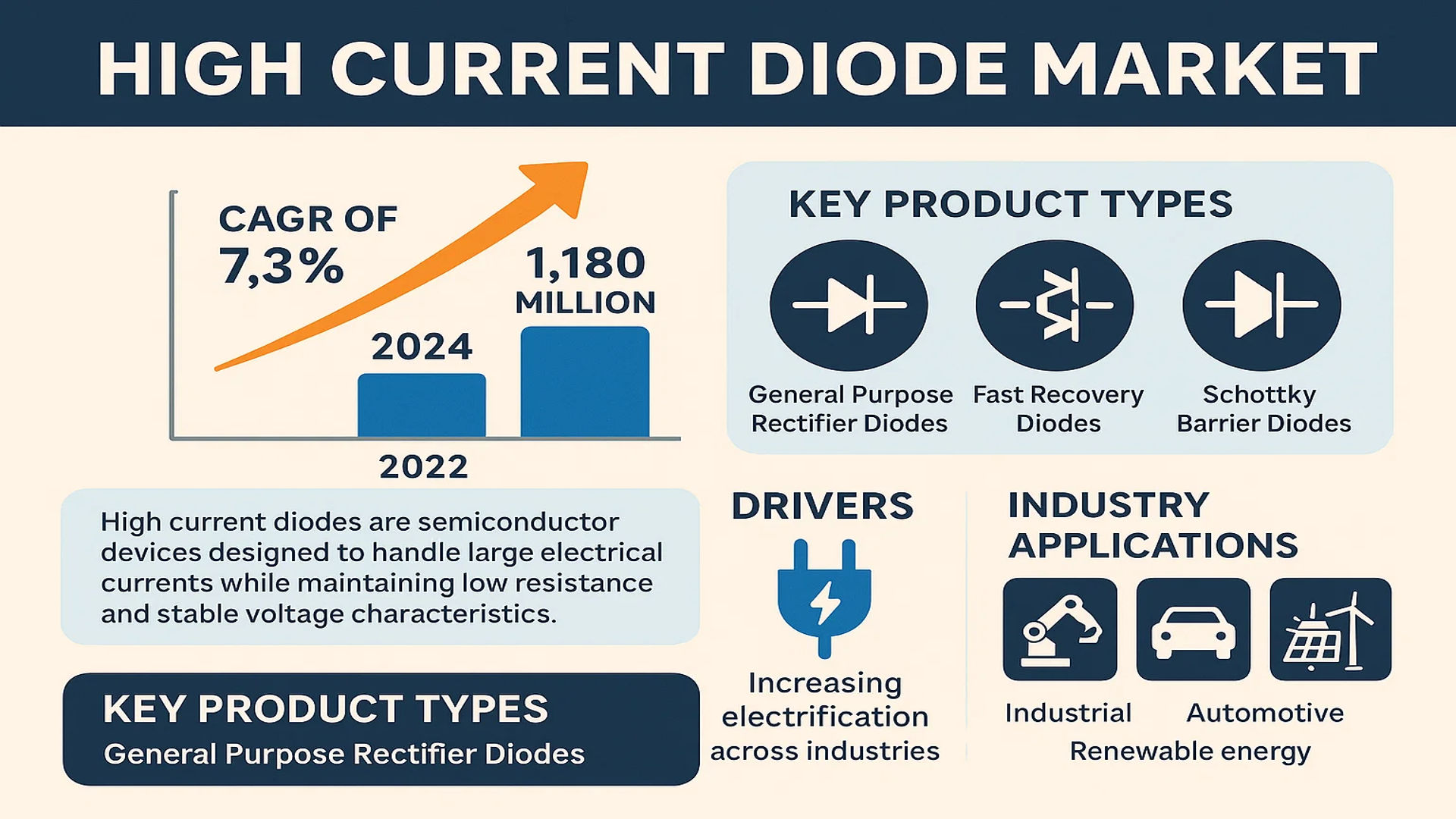
The global High Current Diode Market size was valued at US$ 720 million in 2024 and is projected to reach US$ 1,180 million by 2032, at a CAGR of 7.3% during the forecast period 2025-2032.
High current diodes are semiconductor devices designed to handle large electrical currents while maintaining low resistance and stable voltage characteristics. These components are critical in power management applications where circuit overflow prevention is essential, particularly in high-power systems like industrial machinery, automotive electronics, and power supply units. Key product types include General Purpose Rectifier Diodes, Fast Recovery Diodes, and Schottky Barrier Diodes, each serving distinct applications based on switching speed and efficiency requirements.
The market growth is driven by increasing electrification across industries, particularly in automotive and renewable energy sectors. The rising adoption of electric vehicles, which require efficient power conversion systems, has significantly boosted demand. However, supply chain disruptions in semiconductor materials pose challenges. Leading manufacturers like Infineon Technologies and Analog Devices are investing in silicon carbide (SiC) diode technology to improve efficiency, which could further accelerate market expansion in coming years.
MARKET DYNAMICS
MARKET DRIVERS
Expansion of Power Electronics in Automotive and Industrial Sectors Boosts Demand
The global transition toward electric vehicles and renewable energy systems has significantly increased the adoption of high current diodes. These components are essential for power conversion, voltage regulation, and energy efficiency in electric vehicle charging stations, industrial motor drives, and renewable energy inverters. As EV production surges with an estimated 40% annual growth rate, the need for robust power management solutions using high-current diodes intensifies. Furthermore, industrial automation advancements requiring precise current control are propelling market expansion, particularly in regions with strong manufacturing ecosystems.
5G Infrastructure Deployment Accelerates High-Current Diode Applications
With 5G network installations expanding globally, telecom infrastructure demands high-efficiency power components that can handle substantial current loads in base stations and transmission equipment. High-current diodes play a critical role in power supply units for 5G systems, where they ensure stable operation under varying load conditions. The telecommunications sector’s rapid transformation is creating substantial opportunities, particularly for fast recovery and Schottky barrier diodes that minimize power losses in high-frequency applications. This technological shift aligns with the broader digitalization trends affecting multiple industries.
MARKET RESTRAINTS
Thermal Management Challenges in High-Power Applications Constrain Market Growth
While high-current diodes offer superior performance, their operation generates substantial heat that requires sophisticated thermal solutions. In applications exceeding 1000V and 100A, thermal runaway risks and efficiency losses become significant barriers. Many end-users face added costs for heat sinks, cooling systems, and circuit redesigns to accommodate these thermal limitations. These technical constraints particularly affect compact applications like electric vehicle power modules where space is at a premium, potentially slowing adoption rates in certain market segments.
Supply Chain Disruptions Impact Material Availability and Pricing
The high-current diode market remains vulnerable to semiconductor material shortages, particularly for silicon carbide (SiC) and gallium nitride (GaN) based components. Recent industry data indicates lead times extending beyond 52 weeks for some specialized diode products, causing project delays across multiple sectors. Furthermore, volatile pricing for raw materials like tungsten and molybdenum – crucial for heat-resistant packaging – has increased manufacturing costs by over 20% in some cases, forcing manufacturers to either absorb margins or pass costs to customers.
MARKET OPPORTUNITIES
Emerging Wide Bandgap Semiconductor Technologies Create New Growth Frontiers
Advancements in SiC and GaN diode technology present substantial opportunities for market expansion. These materials enable higher switching frequencies, greater temperature tolerance, and improved efficiency compared to conventional silicon diodes. The power electronics industry is witnessing a gradual shift toward these superior alternatives, especially in electric vehicle fast-charging systems and industrial power supplies where energy efficiency gains translate directly into cost savings. Major manufacturers are investing heavily in next-generation production facilities to capitalize on this transition.
Integration of Smart Features Opens New Application Possibilities
The development of intelligent diodes with embedded sensors and diagnostic capabilities represents a significant market opportunity. These components can monitor temperature, current flow, and degradation in real-time, enabling predictive maintenance and system optimization. Such features are particularly valuable in mission-critical applications like data center power distribution and aerospace systems. The integration of these smart technologies with Industry 4.0 infrastructure creates additional synergies, allowing for more sophisticated power management across connected industrial ecosystems.
MARKET CHALLENGES
Technology Standardization Issues Complicate Market Development
The high-current diode industry faces fragmentation in technical specifications and performance metrics, making component selection and system integration challenging for end-users. Different manufacturers often use proprietary designs and testing protocols, requiring customers to customize their applications for specific diode models. This lack of standardization increases development costs and limits component interchangeability, particularly in global supply chain environments where multiple vendor solutions may be employed.
Intense Price Competition Pressures Manufacturer Profitability
While demand for high-performance diodes grows, the market remains highly competitive with price sensitivity affecting all segments. Asian manufacturers have intensified competition by offering cost-competitive alternatives, forcing established players to streamline operations while maintaining quality standards. This pricing pressure is particularly acute in the general-purpose rectifier segment, where differentiation becomes challenging. Many companies now focus on specialized applications and value-added services to maintain margins in this competitive landscape.
HIGH CURRENT DIODE MARKET TRENDS
Rising Demand for Power Electronics to Fuel Market Growth
The global high current diode market, valued at several million dollars in 2024, is projected to witness steady expansion due to the escalating need for power electronics across industries. High current diodes play a critical role in applications such as power supplies, motor drives, and renewable energy systems, where high current-carrying capacity and voltage stability are essential. With the increasing adoption of electric vehicles (EVs) and renewable energy technologies, the demand for efficient power management solutions is growing significantly. The market is expected to maintain a healthy CAGR through 2032, driven by advancements in semiconductor materials and design innovations.
Other Trends
Automotive Electrification and Energy Efficiency
The shift toward automotive electrification is a major growth driver for the high current diode market, particularly in EVs and hybrid vehicles. Manufacturers are investing in diodes with low forward voltage drops and high thermal stability to enhance battery management and power conversion efficiency. Additionally, stringent energy efficiency regulations in North America and Europe are pushing the adoption of advanced rectifiers in industrial and consumer electronics, further accelerating market growth.
Expansion of Renewable Energy Infrastructure
High current diodes are integral to solar inverters and wind power systems, where they facilitate efficient DC-AC conversion. The rapid development of solar and wind energy projects worldwide, particularly in China and India, is fueling market demand for robust diode solutions. Innovations in silicon carbide (SiC) and gallium nitride (GaN) diodes are improving performance in high-temperature and high-frequency applications, making them ideal for renewable energy systems. This trend is expected to remain strong, supported by global investments in green energy initiatives.
COMPETITIVE LANDSCAPE
Key Industry Players
Leading Manufacturers Focus on Technological Advancements to Gain Market Share
The global High Current Diode market features a highly competitive environment with both established multinational corporations and emerging regional players. Among these, Infineon Technologies stands as a market leader, leveraging its extensive R&D capabilities and broad product portfolio in power semiconductors. The company’s dominance is reinforced by its strong presence in the automotive and industrial sectors, where high current diodes are critical components. Recent innovations in Schottky barrier diodes and fast recovery solutions have further solidified its position.
Analog Devices (ADI) and Littelfuse also maintain substantial market shares, attributed to their strategic acquisitions and focus on high-reliability diodes for harsh environments. Both companies have invested heavily in expanding their production capacities to meet the growing demand from the electronics and energy sectors. Meanwhile, Renesas Electronics and Murata have carved niches in compact, high-efficiency diode solutions, particularly for applications in portable electronics and IoT devices.
The market is witnessing intensified competition as mid-sized players like Diodes Inc. and Microsemi ramp up their production capabilities. These companies are differentiating themselves through cost-effective, application-specific diode solutions. Furthermore, regional manufacturers such as Dongguan Tongke Electronic Co., Ltd. and Wuhan Shengshi Optical Technology Co., Ltd. are gaining traction in Asia-Pacific due to competitive pricing and localized supply chains.
List of Key High Current Diode Manufacturers Profiled
- Infineon Technologies (Germany)
- Analog Devices (ADI) (U.S.)
- Littelfuse (U.S.)
- Murata (Japan)
- Renesas Electronics (Japan)
- Electronic Devices, Inc. (U.S.)
- C&H Technology, Inc. (U.S.)
- Dongguan Tongke Electronic Co., Ltd. (China)
- Wuhan Shengshi Optical Technology Co., Ltd. (China)
- Diodes Inc. (U.S.)
High Current Diode Market: Segment Analysis
By Type
General Purpose Rectifier High Power Diodes Lead the Market Due to Their Wide Application in Power Supplies
The High Current Diode market is segmented based on type into:
- General Purpose Rectifier High Power Diodes
- Fast Recovery High Power Diodes
- Schottky Barrier High Power Diodes
By Application
Industrial Applications Dominate the Market Owing to High Demand for Power Electronics
The High Current Diode market is segmented based on application into:
- Industry
- Manufacturing
- Electronics Industry
- Automotive
- Others
By Technology
Silicon-based Diodes Maintain Strong Market Position Due to Established Manufacturing Processes
The market is segmented based on technology into:
- Silicon-based High Current Diodes
- Silicon Carbide (SiC) High Current Diodes
- Gallium Nitride (GaN) High Current Diodes
By Voltage Rating
Medium Voltage Segment Shows Significant Growth Potential
The market is segmented based on voltage rating into:
- Low Voltage
- Medium Voltage
- High Voltage
Regional Analysis: High Current Diode Market
Asia-Pacific
The Asia-Pacific region dominates the global high current diode market, driven by rapid industrialization and expanding electronics manufacturing in China, Japan, and South Korea. China, in particular, accounts for the largest market share due to its massive semiconductor industry and government initiatives like “Made in China 2025.” The proliferation of electric vehicles and renewable energy projects further accelerates demand for high current diodes in power conversion systems. While Japan leads in technological advancements with companies like Renesas Electronics and Murata, India is emerging as a key growth market due to increased focus on domestic electronics production under the PLI scheme. However, supply chain bottlenecks and competition from local manufacturers pose challenges to global players.
North America
North America’s market is characterized by high-value applications in aerospace, defense, and premium automotive sectors, with the U.S. contributing over 80% of regional demand. Stringent quality standards and the presence of industry leaders like Analog Devices and Diodes Incorporated drive innovation in high-efficiency diode solutions. The region shows strong adoption of Schottky barrier diodes for 5G infrastructure and data centers. Recent CHIPS Act investments in semiconductor fabrication are expected to boost domestic diode production. However, higher costs compared to Asian alternatives and supply chain dependencies limit market expansion in price-sensitive segments.
Europe
Europe maintains a strong position in the high current diode market, led by Germany’s automotive industry and renewable energy sector. Infineon Technologies dominates regional supply, particularly for automotive-grade diodes used in EV powertrains. EU regulations on energy efficiency and the push for CO2 reduction drive demand for advanced diode solutions in industrial motor drives and solar inverters. While Western Europe shows mature adoption, Eastern European countries are witnessing growth due to expanding electronics manufacturing. The market faces pressure from Asian imports, though premium applications continue to favor local suppliers for quality and compliance reasons.
Middle East & Africa
This region represents an emerging market where growth is primarily driven by infrastructure development and renewable energy projects in GCC countries. The UAE and Saudi Arabia lead in adopting high current diodes for oil/gas applications and solar power plants. While market penetration remains low compared to other regions, increasing investments in industrial automation and smart grids present long-term opportunities. The lack of local manufacturing and dependence on imports from Asia constrain market growth, though several countries are initiating electronics manufacturing zones to address this gap.
South America
South America’s market is developing gradually, with Brazil accounting for nearly half of regional demand across industrial and consumer electronics applications. Economic volatility and currency fluctuations have historically hindered market growth, though stabilization in key economies is renewing investment in power infrastructure. The automotive sector shows promising adoption of high current diodes, particularly in Argentina and Colombia. Local production remains limited, with most supply imported from North America and Asia, creating opportunities for distributors and value-added resellers in the region.
Report Scope
This market research report provides a comprehensive analysis of the global High Current Diode market, covering the forecast period 2025–2032. It offers detailed insights into market dynamics, technological advancements, competitive landscape, and key trends shaping the industry.
Key focus areas of the report include:
- Market Size & Forecast: Historical data and future projections for revenue, unit shipments, and market value across major regions and segments. The global High Current Diode market was valued at US$ 720 million in 2024 and is projected to reach US$ 1,180 million by 2032.
- Segmentation Analysis: Detailed breakdown by product type (General Purpose Rectifier, Fast Recovery, Schottky Barrier), application (Industry, Manufacturing, Electronics, Automotive), and end-user sectors to identify high-growth segments.
- Regional Outlook: Insights into market performance across North America, Europe, Asia-Pacific, Latin America, and Middle East & Africa. The U.S. market is estimated at USD million in 2024, while China is projected to reach USD million.
- Competitive Landscape: Profiles of leading market participants including Infineon Technologies, Analog Devices, Littelfuse, Murata, and Renesas Electronics, covering their market share, product portfolios, and strategic developments.
- Technology Trends: Assessment of emerging semiconductor technologies, power efficiency improvements, and integration with modern electronic systems.
- Market Drivers & Restraints: Evaluation of factors driving market growth such as increasing power electronics demand, along with challenges like supply chain constraints and raw material price volatility.
- Stakeholder Analysis: Strategic insights for component manufacturers, OEMs, system integrators, and investors regarding market opportunities and competitive positioning.
The report employs primary and secondary research methodologies, including industry expert interviews, manufacturer data analysis, and market intelligence from verified sources to ensure accuracy and reliability.
FREQUENTLY ASKED QUESTIONS:
What is the current market size of Global High Current Diode Market?
-> High Current Diode Market size was valued at US$ 720 million in 2024 and is projected to reach US$ 1,180 million by 2032, at a CAGR of 7.3% during the forecast period 2025-2032..
Which key companies operate in Global High Current Diode Market?
-> Key players include Infineon Technologies, Analog Devices (ADI), Littelfuse, Murata, Renesas Electronics, and Diodes Inc, among others.
What are the key growth drivers?
-> Key growth drivers include rising demand for power electronics, expansion of renewable energy infrastructure, and increasing automotive electrification.
Which region dominates the market?
-> Asia-Pacific leads the market, driven by strong electronics manufacturing in China and Japan, while North America shows significant growth potential.
What are the emerging trends?
-> Emerging trends include development of wide-bandgap semiconductor diodes, miniaturization of components, and integration with IoT-enabled power systems.

Get Sample Report PDF for Exclusive Insights
Report Sample Includes
- Table of Contents
- List of Tables & Figures
- Charts, Research Methodology, and more...
 Download Sample Report PDF



