MARKET INSIGHTS
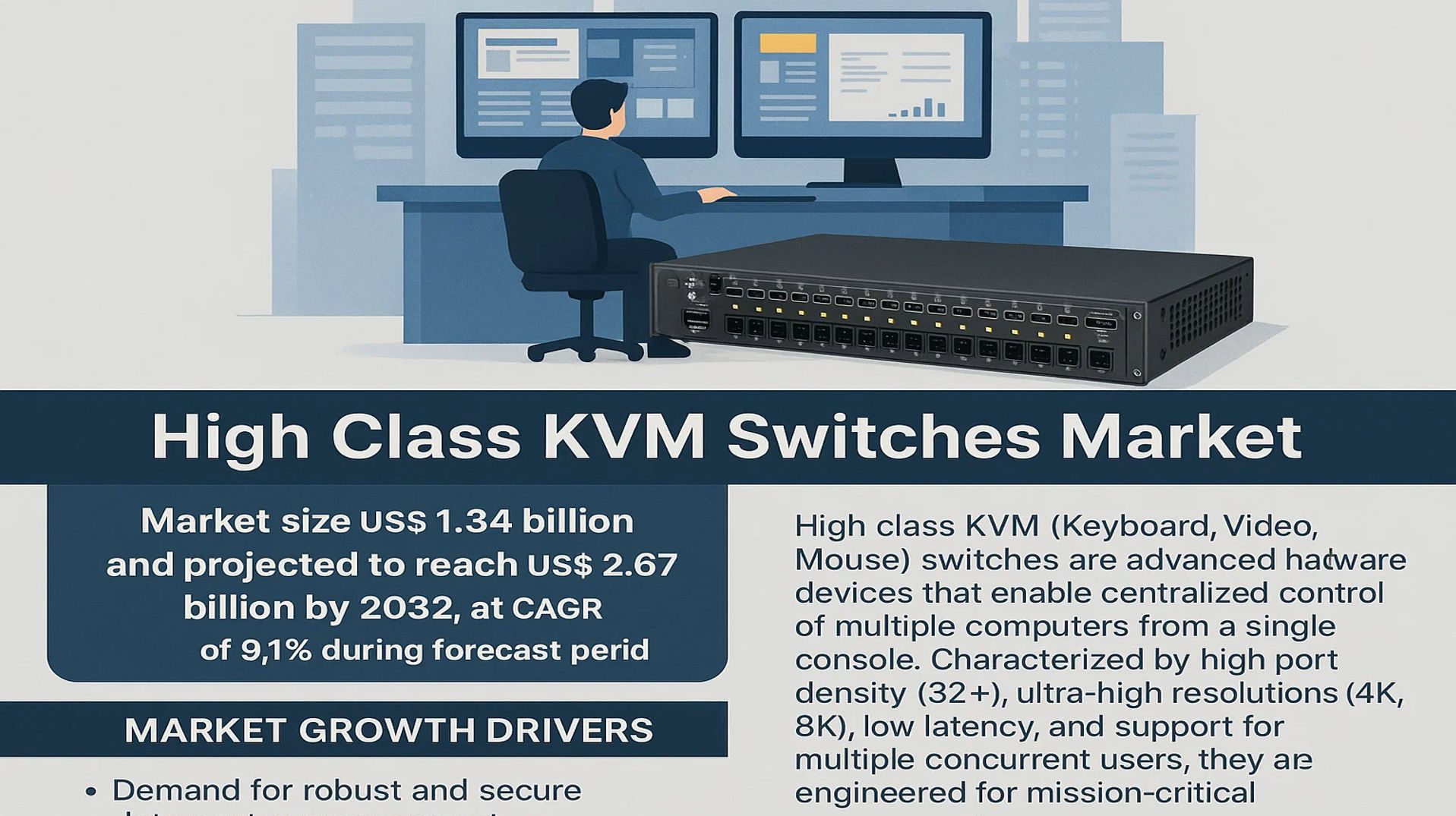
The global High Class KVM Switches Market size was valued at US$ 1.34 billion in 2024 and is projected to reach US$ 2.67 billion by 2032, at a CAGR of 9.1% during the forecast period 2025-2032.
High Class KVM (Keyboard, Video, Mouse) switches are advanced hardware devices that enable centralized control of multiple computers from a single console. These are not standard switches; they are characterized by high port density (often 32 ports and above), support for ultra-high resolutions (including 4K and 8K), extremely low latency, and the ability to support multiple concurrent users. They are engineered for mission-critical environments where reliability, security, and performance are non-negotiable.
The market growth is primarily driven by the escalating demand for robust and secure data center management solutions and the expansion of broadcast and media production infrastructure globally. Furthermore, sectors such as aviation control, financial trading floors, and industrial automation are increasingly adopting these high-end solutions to ensure operational continuity and security. Key industry players, including Avocent (Emerson), Raritan (Legrand), and IHSE GmbH, continue to innovate, focusing on integrating advanced features like fiber optic connectivity and enhanced cybersecurity protocols to meet the evolving needs of these demanding applications.
MARKET DYNAMICS
MARKET DRIVERS
Increasing Demand for Advanced Data Center Management to Drive Market Expansion
The global surge in data center construction and modernization projects is significantly propelling the high class KVM switches market. With digital transformation accelerating across industries, data centers require sophisticated infrastructure management solutions that offer centralized control, enhanced security, and operational efficiency. High class KVM switches enable IT administrators to manage multiple servers and workstations from a single console, reducing physical space requirements and improving response times during critical situations. The ongoing expansion of cloud computing services, which witnessed a growth rate of approximately 20% annually, further amplifies the need for reliable KVM solutions that can handle complex server environments with minimal latency and maximum reliability.
Rising Adoption in Broadcast and Media Industries to Boost Market Growth
The broadcast and media industry’s transition to high-definition and ultra-high-definition content creation has created substantial demand for high class KVM switches. These specialized switches provide the necessary video throughput, resolution support, and zero latency required for professional broadcast environments where real-time editing and switching between multiple sources are critical. The global broadcast equipment market, valued at over $5 billion, continues to invest in KVM technology that supports 4K and 8K video formats without compression artifacts. Major broadcasting corporations and post-production facilities are implementing high class KVM solutions to streamline their operations, reduce setup complexity, and maintain the integrity of high-value content throughout the production chain.
Enhanced Security Requirements in Critical Infrastructure to Fuel Market Development
Growing cybersecurity concerns and regulatory compliance requirements are driving adoption of high class KVM switches in sensitive environments such as financial institutions, government facilities, and industrial control systems. These advanced switches provide secure access to critical systems while maintaining physical separation between networks, preventing unauthorized access and potential cyber threats. The financial sector alone invests approximately $150 billion annually in cybersecurity infrastructure, with a significant portion allocated to secure hardware solutions like KVM switches that offer encryption, authentication protocols, and audit trail capabilities. The ability to maintain operational security while providing centralized control makes high class KVM switches indispensable for organizations handling sensitive data and critical operations.
MARKET RESTRAINTS
High Initial Investment Costs to Limit Market Penetration
The substantial capital expenditure required for high class KVM switch implementation presents a significant barrier to market growth, particularly for small and medium-sized enterprises. These advanced systems typically cost between $5,000 and $50,000 per unit depending on port density and features, making them considerably more expensive than standard KVM solutions. The total cost of ownership extends beyond the hardware itself, including installation, configuration, and ongoing maintenance expenses that can account for an additional 20-30% of the initial investment. This financial barrier becomes particularly challenging in price-sensitive markets and organizations with limited IT budgets, causing them to opt for less sophisticated alternatives despite the operational advantages offered by high class solutions.
Technical Complexity and Integration Challenges to Hinder Adoption
The sophisticated nature of high class KVM switches creates implementation challenges that can deter potential users. These systems often require specialized knowledge for proper configuration and integration with existing infrastructure, particularly in heterogeneous environments with mixed server types and operating systems. The complexity increases when deploying large-scale systems with hundreds of ports and multiple user access levels, necessitating thorough planning and expert installation. Many organizations face difficulties in ensuring compatibility with legacy systems and meeting specific performance requirements, leading to extended deployment timelines and additional consulting expenses that can delay adoption decisions.
Limited Awareness and Perception Issues to Restrict Market Growth
A significant portion of potential users remains unaware of the advanced capabilities and benefits offered by high class KVM switches, often perceiving them as luxury items rather than essential infrastructure components. This awareness gap is particularly evident in emerging markets and smaller organizations where IT decision-makers may not fully understand the operational efficiencies and security advantages these systems provide. The market also faces perception challenges regarding the necessity of high-end features, with many users believing that standard KVM solutions adequately meet their needs. This misconception prevents organizations from recognizing the long-term value proposition and return on investment that high class KVM switches can deliver through improved management efficiency and reduced downtime.
MARKET OPPORTUNITIES
Emerging Technologies and Digital Transformation Initiatives to Create Growth Prospects
The rapid adoption of emerging technologies such as artificial intelligence, machine learning, and Internet of Things applications presents substantial opportunities for high class KVM switch manufacturers. These technologies require robust infrastructure management solutions that can handle increased computational demands while maintaining security and reliability. The global AI infrastructure market, projected to exceed $50 billion by 2025, represents a significant addressable market for high performance KVM solutions that can manage GPU clusters and high-density computing environments. Additionally, the ongoing digital transformation across various industry verticals creates demand for advanced KVM systems that support hybrid cloud environments and remote management capabilities.
Expansion in Healthcare and Industrial Automation Sectors to Offer New Revenue Streams
The healthcare industry’s increasing reliance on digital systems and medical imaging technologies creates new opportunities for high class KVM switch deployment. Hospitals and medical research facilities require secure, reliable access to critical systems handling patient data and medical imaging equipment that often demands high-resolution video support. Similarly, the industrial automation sector’s growth, particularly in smart manufacturing and process control applications, necessitates robust KVM solutions that can operate in harsh environments while providing centralized control of distributed systems. These vertical markets represent untapped potential for manufacturers who can develop specialized solutions meeting industry-specific requirements and compliance standards.
Geographical Expansion and Emerging Markets to Provide Growth Potential
While developed markets continue to show strong demand, emerging economies present significant growth opportunities for high class KVM switch providers. Regions experiencing rapid digital infrastructure development, particularly in Asia-Pacific and Latin America, are investing heavily in data center construction and modernization projects. These markets often leapfrog older technologies and directly implement advanced solutions, creating demand for high performance KVM systems that support their digital transformation goals. The increasing adoption of remote work models and distributed computing infrastructure in these regions further drives need for sophisticated management solutions that can support geographically dispersed operations while maintaining security and performance standards.
MARKET CHALLENGES
Rapid Technological Obsolescence and Upgrade Pressures to Challenge Market Stability
The high class KVM switch market faces continuous pressure from rapidly evolving technology standards and interface requirements. As display technologies advance toward higher resolutions and refresh rates, KVM manufacturers must constantly update their products to support new video standards such as DisplayPort 2.0 and HDMI 2.1. This technological evolution creates challenges in product lifecycle management and inventory control, as systems may become obsolete within relatively short timeframes. The need for backward compatibility with existing infrastructure while supporting new standards adds complexity to product development and increases research and development costs, which ultimately affects pricing and market competitiveness.
Other Challenges
Supply Chain Constraints and Component Availability
The global electronics supply chain issues continue to impact high class KVM switch manufacturing, particularly for specialized components required for high-performance video processing and signal integrity. These challenges affect production timelines, product availability, and manufacturing costs, creating uncertainty in delivery schedules and pricing stability. The specialized nature of many components used in high class KVM switches makes alternative sourcing difficult, leading to potential production bottlenecks during periods of high demand or supply chain disruptions.
Intense Competition and Price Pressure
The market faces increasing competition from both established players and new entrants offering alternative solutions, including software-based KVM alternatives and integrated management platforms. This competitive landscape creates price pressure and margin compression, particularly in standardized product categories. Customers increasingly expect feature-rich solutions at competitive price points, challenging manufacturers to balance performance, reliability, and cost considerations while maintaining profitability and market share.
HIGH CLASS KVM SWITCHES MARKET TRENDS
Rising Demand for High-Density and Multi-User Operation Capabilities
The global High Class KVM Switches market is experiencing significant growth, primarily driven by the escalating demand for high-density and multi-user operation capabilities across various mission-critical sectors. These advanced switches, which support a large number of ports—often exceeding 32—and allow multiple users to operate simultaneously, are becoming indispensable in environments requiring robust, reliable, and centralized control. Industries such as broadcasting, financial services, and air traffic control are increasingly adopting these solutions to enhance operational efficiency and security. The market’s expansion is further fueled by the global trend towards digital transformation, where centralized IT management reduces physical infrastructure, lowers operational costs, and minimizes potential points of failure. This trend is particularly pronounced in large multinational corporations and government organizations that manage vast, distributed server farms and data centers.
Other Trends
Integration with Advanced Video and Audio Technologies
A prominent trend shaping the High Class KVM Switches market is the seamless integration with cutting-edge video and audio technologies. In sectors like broadcast and post-production, the demand for switches capable of handling ultra-high resolutions—such as 4K and 8K—with zero latency is paramount. These switches must also support advanced audio formats and provide pristine signal quality to ensure uninterrupted workflows. The proliferation of high-definition content creation and real-time data visualization in control rooms is accelerating the adoption of digital KVM switches over their analog counterparts. This shift is because digital switches offer superior signal integrity over longer distances, a critical requirement for modern, geographically dispersed operations.
Enhanced Security and Remote Access Features
Enhanced security features and the capability for secure remote access are becoming critical purchasing factors, especially in the wake of increased cybersecurity threats and the rise of hybrid work models. High Class KVM switches now incorporate advanced encryption protocols, multi-factor authentication, and detailed user activity logging to protect sensitive data and infrastructure from unauthorized access. This is particularly vital in sectors like banking, healthcare, and government, where data breaches can have severe consequences. Furthermore, the ability to manage and troubleshoot systems remotely without compromising on security or performance is a significant driver. This allows organizations to maintain continuous operations and provide technical support across global locations, reducing downtime and improving overall resilience.
COMPETITIVE LANDSCAPE
Key Industry Players
Companies Strive to Strengthen their Product Portfolio to Sustain Competition
The global High Class KVM Switches market exhibits a semi-consolidated competitive structure, characterized by the presence of established multinational corporations alongside specialized niche players. Market leadership is largely determined by technological innovation, product reliability, and the ability to serve mission-critical applications across diverse sectors such as broadcasting, aviation, and industrial automation. While the market is global, regional players also maintain strong positions in their respective territories due to deep industry relationships and tailored solutions.
Avocent (Emerson) and Raritan (Legrand) are dominant forces in the market, collectively holding a significant revenue share. Their leadership is underpinned by extensive product portfolios that include both analog and digital high-class KVM switches, catering to high-density and ultra-low latency requirements. These companies benefit from longstanding relationships with major clients in government, finance, and broadcast sectors, where equipment failure is not an option. Furthermore, their global service and support networks provide a competitive edge in multi-national deployments.
Meanwhile, IHSE GmbH and G&D (Guntermann & Drunck GmbH) have carved out strong positions, particularly in the European market, by focusing on cutting-edge technology for real-time video and data transmission. Their growth is driven by innovations in fiber optic KVM systems, which are essential for applications requiring long-distance connectivity and electromagnetic interference immunity. These companies are increasingly targeting the growing demand in control rooms and air traffic management systems, where performance and reliability are paramount.
Additionally, Rose Electronics maintains a notable presence, especially in North America, by offering scalable solutions that balance high performance with cost-effectiveness. The company’s strategy includes continuous investment in R&D to enhance user experience and compatibility with emerging video standards. Their recent developments focus on IP-based KVM over IP solutions, addressing the trend towards remote and distributed work environments.
Competition is intensifying as these key players pursue growth through strategic initiatives such as product launches, partnerships, and occasional acquisitions. For instance, the push towards 4K and 8K video support in broadcast and post-production applications is driving R&D investments across the industry. Because high-class KVM switches are often part of larger infrastructure projects, companies are also strengthening their system integration capabilities and forming alliances with other technology providers to offer comprehensive solutions.
List of Key High Class KVM Switches Companies Profiled
- Avocent (Emerson) (U.S.)
- Raritan (Legrand) (U.S.)
- Rose Electronics (U.S.)
- IHSE GmbH (Germany)
- G&D (Guntermann & Drunck GmbH) (Germany)
Segment Analysis:
By Type
Digital High Class KVM Switches Segment Dominates the Market Due to Superior Performance and IP-Based Remote Access Capabilities
The market is segmented based on type into:
- Analog High Class KVM Switches
- Digital High Class KVM Switches
By Application
Broadcast Stations Segment Leads Due to Critical Demand for Zero Latency and Ultra-High Video Resolution
The market is segmented based on application into:
- Broadcast Stations
- Aviation Controls Industry
- Automation Industrial Application Process Control
- Control Room
By End User
Government and Defense Sector Represents a Major End User Due to Stringent Security and Reliability Requirements
The market is segmented based on end user into:
- Government and Defense
- Broadcasting and Media
- Banking, Financial Services, and Insurance (BFSI)
- Healthcare
- Industrial Automation
By Port Density
High-Port Density Systems (64 Ports and Above) are Critical for Large-Scale Data Center and Enterprise Operations
The market is segmented based on port density into:
- Up to 16 Ports
- 17 to 32 Ports
- 33 to 64 Ports
- 64 Ports and Above
Regional Analysis: High Class KVM Switches Market
North America
North America represents the most mature and technologically advanced market for High Class KVM Switches, driven by the presence of major financial institutions, government data centers, and leading broadcast and media companies. The United States, in particular, accounts for a dominant share of the regional market. Stringent cybersecurity requirements, especially within defense and federal agencies, mandate the use of highly secure and reliable KVM solutions that offer advanced encryption and user access controls. The region’s focus on data center consolidation and remote management capabilities, accelerated by the post-pandemic shift to hybrid work models, continues to fuel demand for digital KVM over IP switches that provide seamless access over long distances. Major players like Avocent (Emerson) and Raritan (Legrand) have a strong foothold here, constantly innovating to meet the demands for 4K and 8K video support with zero latency for critical applications in broadcasting and air traffic control.
Europe
Europe is a significant market characterized by a strong emphasis on data privacy regulations, such as the General Data Protection Regulation (GDPR), which influences the procurement of secure IT infrastructure. This has propelled the adoption of high-class KVM switches that ensure secure, isolated access to sensitive servers and workstations. The region boasts a robust manufacturing and industrial automation sector, particularly in Germany, which utilizes these switches for process control and monitoring in highly automated environments. Furthermore, Europe’s thriving media and broadcast industry, with major hubs in the UK, Germany, and France, demands high-performance KVM matrices that support ultra-high-definition video and audio with no compression or lag. European manufacturers like IHSE GmbH and Guntermann & Drunck (G&D) are key innovators, often setting the benchmark for quality and performance in the global high-end segment.
Asia-Pacific
The Asia-Pacific region is the fastest-growing market for High Class KVM Switches, fueled by massive investments in IT infrastructure, data center construction, and rapid digitalization across industries. China and Japan are the primary drivers, with Japan being a hub for technological innovation and manufacturing excellence. The burgeoning financial technology (fintech) sector, expanding broadcasting networks, and government initiatives for smart city development are creating substantial demand. While cost sensitivity can be a factor, there is a clear and growing trend toward investing in premium, reliable solutions for mission-critical operations in banking, healthcare, and telecommunications to ensure business continuity and security. The presence of local manufacturing and a strong supply chain supports this growth, making it a highly competitive and dynamic market.
South America
The market in South America is in a developing phase, with growth primarily concentrated in the financial and natural resource sectors in countries like Brazil and Argentina. The adoption of High Class KVM Switches is often driven by large enterprises and multinational corporations that require centralized control and high security for their server rooms and control centers. However, market expansion is tempered by economic volatility and budgetary constraints, which can delay large-scale IT infrastructure upgrades. Consequently, while there is a recognized need for the reliability and advanced features offered by high-class solutions, price competition is fiercer, and sales cycles can be longer compared to more developed regions.
Middle East & Africa
This region presents an emerging but promising market, with growth centered around major urban and economic centers like the UAE, Saudi Arabia, and Israel. Significant government-led investments in diversifying economies away from oil, such as Saudi Arabia’s Vision 2030 and the UAE’s focus on becoming a global tech hub, are driving the development of large-scale data centers and smart infrastructure projects. These initiatives create a direct need for high-class KVM solutions in control rooms for security, transportation, and energy management. While the market is currently smaller in volume, the projects undertaken are often large in scale and require top-tier, reliable technology, indicating strong long-term potential for premium KVM switch providers as digital transformation accelerates across the region.
Report Scope
This market research report provides a comprehensive analysis of the global High Class KVM Switches market, covering the forecast period 2025–2032. It offers detailed insights into market dynamics, technological advancements, competitive landscape, and key trends shaping the industry.
Key focus areas of the report include:
- Market Size & Forecast: Historical data and future projections for revenue, unit shipments, and market value across major regions and segments.
- Segmentation Analysis: Detailed breakdown by product type, technology, application, and end-user industry to identify high-growth segments and investment opportunities.
- Regional Outlook: Insights into market performance across North America, Europe, Asia-Pacific, Latin America, and the Middle East & Africa, including country-level analysis where relevant.
- Competitive Landscape: Profiles of leading market participants, including their product offerings, R&D focus, manufacturing capacity, pricing strategies, and recent developments such as mergers, acquisitions, and partnerships.
- Technology Trends & Innovation: Assessment of emerging technologies, integration of advanced connectivity protocols, evolving industry standards, and cybersecurity enhancements.
- Market Drivers & Restraints: Evaluation of factors driving market growth along with challenges, supply chain constraints, regulatory issues, and market-entry barriers.
- Stakeholder Analysis: Insights for component suppliers, OEMs, system integrators, investors, and policymakers regarding the evolving ecosystem and strategic opportunities.
Primary and secondary research methods are employed, including interviews with industry experts, data from verified sources, and real-time market intelligence to ensure the accuracy and reliability of the insights presented.
FREQUENTLY ASKED QUESTIONS:
What is the current market size of Global High Class KVM Switches Market?
-> High Class KVM Switches Market size was valued at US$ 1.34 billion in 2024 and is projected to reach US$ 2.67 billion by 2032, at a CAGR of 9.1% during the forecast period 2025-2032.
Which key companies operate in Global High Class KVM Switches Market?
-> Key players include Avocent (Emerson), Raritan (Legrand), Rose Electronics, IHSE GmbH, and G&D, among others.
What are the key growth drivers?
-> Key growth drivers include increasing demand for data center efficiency, rising adoption in broadcast and control room applications, and the need for enhanced cybersecurity in multi-computer environments.
Which region dominates the market?
-> North America holds the largest market share, while Asia-Pacific is expected to witness the highest growth rate during the forecast period.
What are the emerging trends?
-> Emerging trends include integration of IP-based KVM solutions, adoption of 4K and 8K video support, and the development of software-defined KVM infrastructure.

Get Sample Report PDF for Exclusive Insights
Report Sample Includes
- Table of Contents
- List of Tables & Figures
- Charts, Research Methodology, and more...
 Download Sample Report PDF