MARKET INSIGHTS
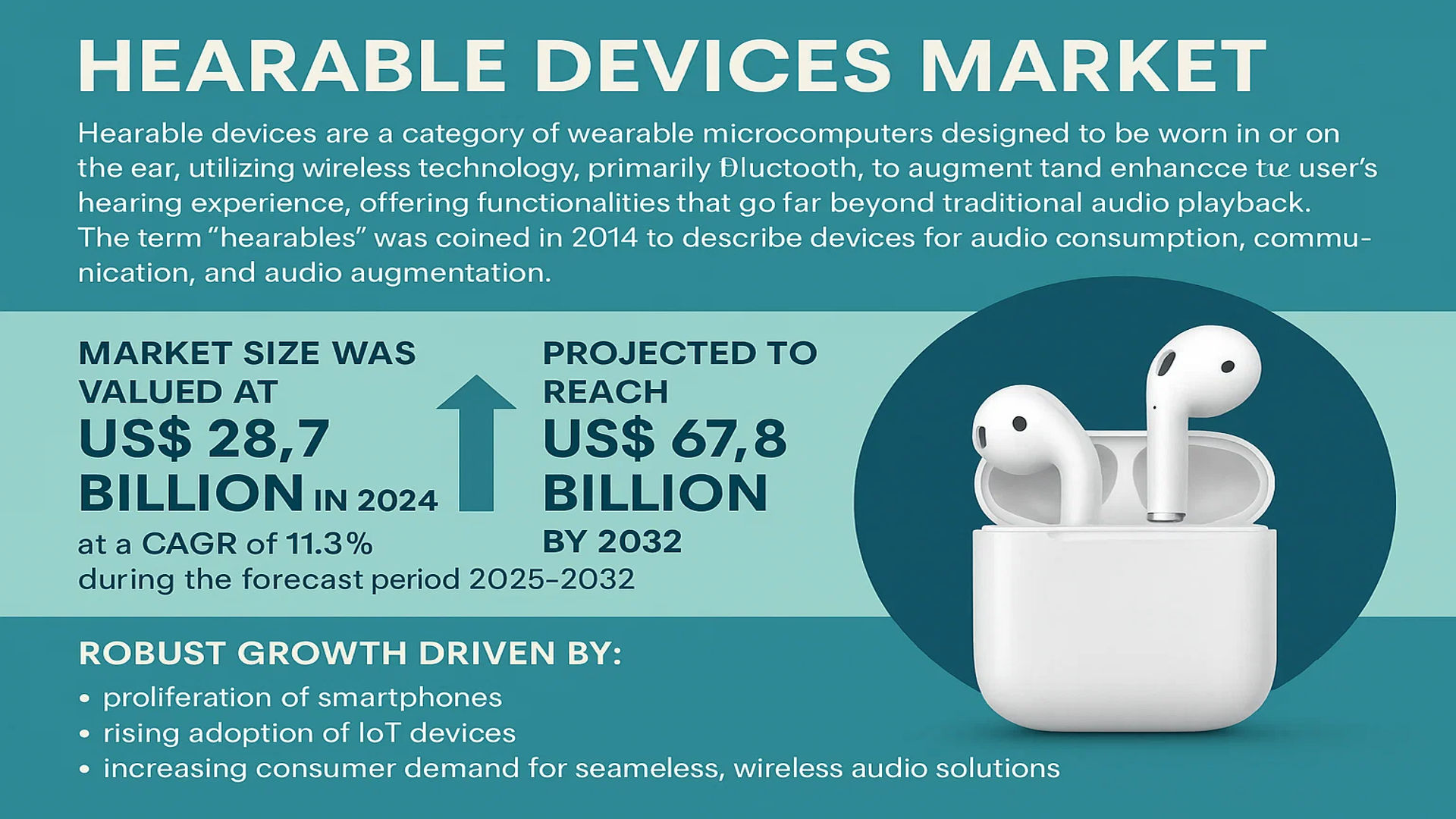
The global Hearable Devices Market size was valued at US$ 28.7 billion in 2024 and is projected to reach US$ 67.8 billion by 2032, at a CAGR of 11.3% during the forecast period 2025-2032.
Hearable devices are a category of wearable microcomputers designed to be worn in or on the ear. These sophisticated devices utilize wireless technology, primarily Bluetooth, to augment and enhance the user’s hearing experience, offering functionalities that go far beyond traditional audio playback. The term “hearables” was coined in 2014 to describe this emerging product category, which includes devices for audio consumption, communication, and audio augmentation.
This market is experiencing robust growth driven by several key factors, including the proliferation of smartphones, the rising adoption of IoT devices, and increasing consumer demand for seamless, wireless audio solutions. Furthermore, the integration of advanced features such as active noise cancellation, real-time language translation, and biometric health monitoring is significantly expanding their appeal. The growing awareness and adoption of these devices in the healthcare sector for hearing augmentation and diagnostic purposes also present a substantial growth opportunity. Key players such as Apple, Samsung, Sennheiser, Sony, and GN (Jabra) dominate the market with continuous innovation and strategic product launches.
MARKET DYNAMICS
MARKET DRIVERS
Rising Adoption of Wireless Audio Technologies to Drive Market Expansion
The global hearable devices market is experiencing significant growth due to the widespread adoption of wireless audio technologies. The transition from wired to wireless earbuds and headphones has accelerated, driven by advancements in Bluetooth connectivity and the removal of traditional audio jacks in smartphones. Over 70% of smartphone users now prefer wireless audio solutions, creating sustained demand for hearables. The integration of advanced features such as active noise cancellation, spatial audio, and voice assistant compatibility further enhances user experience, positioning these devices as essential consumer electronics. Additionally, the increasing penetration of smartphones globally, which exceeded 6.8 billion users in 2024, provides a substantial user base for hearable device adoption.
Growing Health and Wellness Applications to Boost Market Growth
Health and wellness applications represent a major growth driver for the hearable devices market. Modern hearables are equipped with sensors that monitor vital signs such as heart rate, body temperature, and physical activity levels, transforming them into wearable health devices. The global wearable health technology market is projected to exceed $100 billion by 2027, with hearables capturing a significant share. These devices enable continuous health monitoring, which is particularly valuable for fitness enthusiasts and individuals managing chronic conditions. The integration of biometric tracking with audio functionality creates multifunctional devices that appeal to health-conscious consumers, driving both adoption rates and premium pricing.
Increasing Demand for Smart Assistants and IoT Integration to Fuel Market Development
The proliferation of smart assistants and Internet of Things (IoT) integration is significantly fueling the hearable devices market. Voice-activated assistants like Siri, Google Assistant, and Alexa have become standard features in hearables, enabling hands-free operation and seamless connectivity with other smart devices. The number of IoT-connected devices worldwide is expected to reach 30 billion by 2025, creating an ecosystem where hearables serve as primary interface points. This integration allows users to control smart home devices, receive notifications, and access information without interrupting their activities. The convenience and functionality offered by these connected devices are driving consumer preference toward advanced hearable solutions.
MARKET CHALLENGES
High Production Costs and Premium Pricing to Challenge Market Penetration
The hearable devices market faces significant challenges related to high production costs and resulting premium pricing. Advanced features such as active noise cancellation, biometric sensors, and high-quality audio components require sophisticated manufacturing processes and expensive materials. The average manufacturing cost for premium wireless earbuds ranges between $80-$120 per unit, leading to retail prices that can exceed $250. This pricing structure creates barriers to adoption in price-sensitive markets and among budget-conscious consumers. While the market is experiencing rapid growth, these cost factors limit mass-market penetration and may slow adoption rates in developing economies where disposable incomes are lower.
Other Challenges
Battery Life Limitations
Battery life remains a significant challenge for hearable devices. Despite technological advancements, most wireless earbuds offer only 4-8 hours of continuous use, requiring frequent charging through carrying cases. This limitation affects user experience, particularly for those who use hearables for extended periods during travel, work, or exercise. The need for compact form factors conflicts with battery capacity requirements, creating an engineering challenge that manufacturers continue to address through improved power management and energy-efficient components.
Interoperability Issues
Interoperability between different devices and platforms presents ongoing challenges. While major manufacturers optimize their hearables for their own ecosystems, cross-platform compatibility often suffers. Users frequently experience connectivity issues when pairing devices from different brands or operating systems. These technical limitations can frustrate consumers and may influence purchasing decisions toward sticking with single-brand ecosystems, potentially limiting market competition and innovation.
MARKET RESTRAINTS
Technical Limitations and Performance Consistency to Deter Market Growth
Technical limitations and performance consistency issues serve as significant restraints for the hearable devices market. Audio latency, particularly in wireless models, remains a concern for users engaged in activities requiring real-time audio synchronization, such as gaming or video conferencing. The average latency in Bluetooth audio transmission ranges between 100-200 milliseconds, which can create noticeable delays. Additionally, connection stability problems, including intermittent dropouts and interference in crowded wireless environments, affect user experience. These technical challenges are particularly problematic in professional applications where reliability is crucial, potentially limiting adoption in certain market segments.
Regulatory Compliance and Certification Requirements to Impede Market Expansion
Regulatory compliance and certification requirements present substantial restraints for hearable device manufacturers. Different regions have varying regulations regarding wireless transmission power, electromagnetic emissions, and product safety standards. Navigating these complex regulatory landscapes requires significant time and financial investment, particularly for companies seeking global market presence. The certification process for wireless devices can take several months and cost upwards of $50,000 per product variant. These regulatory hurdles delay product launches and increase development costs, particularly affecting smaller manufacturers with limited resources.
MARKET OPPORTUNITIES
Advancements in Artificial Intelligence and Machine Learning to Create New Growth Opportunities
Advancements in artificial intelligence and machine learning present substantial growth opportunities for the hearable devices market. AI-powered features such as real-time language translation, personalized sound optimization, and advanced noise cancellation are transforming hearables into intelligent personal assistants. The integration of machine learning algorithms enables devices to adapt to individual hearing profiles and environmental conditions, providing customized audio experiences. These technological advancements are creating new application areas in education, travel, and professional communication, expanding the market beyond traditional audio consumption.
Expansion into Healthcare and Medical Applications to Offer Lucrative Opportunities
The expansion into healthcare and medical applications offers lucrative opportunities for market growth. Hearable devices are increasingly being developed for hearing augmentation, tinnitus management, and early detection of health conditions. The global hearing aids market is projected to reach $10 billion by 2027, with hearables capturing a growing segment of this market. Medical-grade hearables can provide continuous health monitoring while being less obtrusive than traditional medical devices. This convergence of consumer electronics and healthcare technology creates new revenue streams and addresses the needs of aging populations worldwide.
Emerging Markets and Demographic Shifts to Provide Substantial Growth Potential
Emerging markets and demographic shifts present substantial growth potential for the hearable devices market. Increasing urbanization, rising disposable incomes, and growing tech adoption in developing regions create new customer bases. The Asia-Pacific region, particularly countries like India and China, shows remarkable growth potential with smartphone penetration rates increasing by 15% annually. Additionally, aging populations in developed markets are creating demand for hearing enhancement technologies. These demographic trends, combined with improving economic conditions in emerging economies, provide long-term growth opportunities for hearable device manufacturers.
HEARABLE DEVICES MARKET TRENDS
Integration of Advanced Health Monitoring Features to Emerge as a Dominant Trend
The integration of sophisticated health and wellness monitoring capabilities is fundamentally reshaping the hearables landscape, transforming these devices from simple audio accessories into comprehensive personal health hubs. This evolution is driven by consumer demand for proactive health management and the growing prevalence of chronic conditions requiring continuous monitoring. Advanced sensors now enable the tracking of a wide array of biometric data directly from the ear, including heart rate variability, blood oxygen saturation levels, body temperature, and even electrodermal activity for stress monitoring. The strategic positioning within the ear canal provides a unique anatomical advantage for capturing precise physiological signals, as it offers stable contact points and proximity to major blood vessels. This trend is further accelerated by the development of more power-efficient processing chips and miniaturized sensor technology, allowing for extended battery life despite the increased computational demands of real-time health data analysis. The convergence of audio technology and digital health represents a significant market expansion opportunity, with healthcare applications becoming a primary growth driver rather than just an ancillary feature.
Other Trends
Artificial Intelligence and Machine Learning Integration
The incorporation of artificial intelligence and machine learning algorithms is revolutionizing how hearable devices process and interpret both audio and biometric data. These technologies enable advanced features such as real-time language translation, adaptive noise cancellation that responds to environmental changes, and personalized sound amplification based on individual hearing profiles. Machine learning models can analyze listening habits to optimize battery usage and audio preferences automatically, creating a truly customized user experience. Furthermore, AI-powered health analytics can detect patterns in physiological data that might indicate emerging health issues, providing users with early warnings and actionable insights. The processing capabilities required for these functions have driven innovation in edge computing, allowing complex computations to occur directly on the device rather than relying solely on cloud connectivity. This not only enhances privacy and security for health data but also reduces latency for critical functions like hearing enhancement and real-time feedback.
Expansion into Professional and Enterprise Applications
While consumer applications continue to dominate the market, there is significant growth occurring in professional and enterprise segments where hearable devices are being adopted for specialized use cases. In corporate environments, advanced hearables with superior voice pickup technology and AI-enhanced noise suppression are becoming essential tools for remote workers, enabling crystal-clear communication during video conferences even in noisy environments. The healthcare sector represents another substantial growth area, with medical-grade hearing aids evolving into connected health devices that can remotely adjust settings based on audiologist recommendations and monitor patient compliance. Industrial applications are also emerging, where hearables equipped with situational awareness features protect workers by allowing important environmental sounds to pass through while dampening harmful noise levels. The enterprise segment typically commands higher price points due to specialized requirements for security, durability, and integration with business communication systems, creating valuable revenue opportunities for manufacturers who can meet these demanding specifications.
COMPETITIVE LANDSCAPE
Key Industry Players
Companies Strive to Strengthen their Product Portfolio to Sustain Competition
The global hearable devices market exhibits a dynamic and semi-consolidated competitive structure, featuring a mix of established technology giants, specialized audio companies, and innovative healthcare-focused firms. Apple Inc. has maintained its dominant position, largely because of its iconic AirPods product line and seamless integration within its broader ecosystem. The company’s significant market share is further bolstered by its extensive global retail and online presence, along with continuous investments in enhancing features like active noise cancellation and spatial audio.
Samsung Electronics and Sony Corporation are also major contenders, holding substantial shares of the market. Their growth is driven by a combination of high-quality audio engineering, strong brand loyalty, and a diverse portfolio that ranges from premium wireless earbuds to feature-rich headphones. These companies consistently leverage their technological expertise in consumer electronics to introduce innovative hearables that appeal to a broad audience.
Meanwhile, the healthcare segment of the market is led by companies such as GN Group (Jabra) and WS Audiology, which have carved out significant niches. Their growth is attributed to deep expertise in audiology, strategic acquisitions to expand their hearing aid portfolios, and a focus on developing clinically validated devices that meet stringent regulatory standards. These players are increasingly blurring the lines between consumer electronics and medical devices by introducing hearables that offer both enhanced listening and hearing assistance features.
Furthermore, the competitive intensity is heightened by the strategies of other key players. Companies like Sennheiser and Starkey Hearing Technologies are strengthening their market positions through significant research and development initiatives, strategic partnerships with audio technology firms, and geographic expansions into emerging markets. This ensures a continuous pipeline of advanced products and secures their growth in an increasingly crowded and innovative landscape.
List of Key Hearable Devices Companies Profiled
- Apple Inc. (U.S.)
- Samsung Electronics Co., Ltd. (South Korea)
- Sennheiser Electronic GmbH & Co. KG (Germany)
- Sony Corporation (Japan)
- GN Group (Jabra) (Denmark)
- WS Audiology (Denmark)
- Starkey Hearing Technologies (U.S.)
- Bragi GmbH (Germany)
- Miracle-Ear, Inc. (U.S.)
Segment Analysis:
By Type
Earbuds Segment Dominates the Market Fueled by Wireless Audio Adoption and Smart Features
The market is segmented based on type into:
- Earbuds
- Subtypes: True Wireless Stereo (TWS), Neckband, and others
- Hearing Aids
- Subtypes: Behind-the-Ear (BTE), In-the-Ear (ITE), Receiver-in-Canal (RIC), and others
- Headsets
- Subtypes: On-ear, Over-ear, and others
- Hearable Augmentation Devices
- Subtypes: Language translation devices, augmented reality audio devices, and others
By Application
Consumer Segment Leads Due to Mass Adoption for Music, Communication, and Entertainment
The market is segmented based on application into:
- Consumer
- Healthcare
- Subtypes: Hearing assistance, tinnitus management, and others
- Enterprise & Industrial
- Subtypes: Call centers, industrial safety communication, and others
- Sports & Fitness
- Subtypes: Activity tracking, biometric monitoring, and others
By Technology
Bluetooth Technology Segment is Pivotal for Wireless Connectivity and Device Interoperability
The market is segmented based on technology into:
- Bluetooth
- Subtypes: Bluetooth Classic, Bluetooth Low Energy (BLE)
- Wi-Fi
- Hearing Aid Compatible (HAC)
- Artificial Intelligence (AI) Enabled
By Distribution Channel
Online Retail Segment is Expanding Rapidly with the Growth of E-commerce Platforms
The market is segmented based on distribution channel into:
- Online Retail
- Subtypes: E-commerce websites, brand-owned online stores
- Offline Retail
- Subtypes: Electronics stores, specialty stores, hypermarkets
- Hearing Care Professionals (HCPs)
- Direct-to-Consumer (DTC)
Regional Analysis: Hearable Devices Market
Asia-Pacific
The Asia-Pacific region is the dominant force in the global hearable devices market, accounting for the largest share of both volume and revenue. This leadership is propelled by massive manufacturing capabilities, particularly in China, and a vast, tech-savvy consumer base. Countries like China, Japan, and South Korea are not just major consumers but also global innovation hubs, home to key players like Samsung, Sony, and a multitude of component manufacturers. The market is characterized by intense competition, rapid adoption of new technologies like True Wireless Stereo (TWS) earbuds, and a growing demand for health and fitness tracking features integrated into audio devices. Furthermore, increasing disposable incomes and the rapid expansion of e-commerce platforms are making advanced hearables more accessible to a broader population, fueling consistent market growth.
North America
North America represents a mature and high-value market for hearable devices, driven by high consumer purchasing power and early adoption of cutting-edge technology. The United States is the central market, with major brands like Apple, Bose, and Starkey Holding a significant presence. Consumer demand is heavily skewed towards premium, feature-rich products such as noise-cancelling headphones and advanced hearing aids with AI-driven sound augmentation. The healthcare segment is particularly robust, supported by favorable reimbursement policies and a growing aging population seeking sophisticated hearing solutions. While growth rates may be more modest compared to Asia-Pacific, the region’s focus on premiumization and technological innovation ensures it remains a critical and highly profitable market.
Europe
Europe is another key market characterized by stringent regulatory standards and a strong emphasis on product quality, safety, and data privacy, governed by frameworks like the Medical Device Regulation (MDR) for hearing aids and GDPR for consumer data. The region has a well-established and growing hearing healthcare sector, with leading companies like Sennheiser, GN Group (Jabra), and WS Audiology based there. Consumer demand is similar to North America, with a preference for high-fidelity audio products and advanced features. However, market growth is also supported by strong environmental consciousness, driving demand for sustainable products with longer lifecycles and recyclable materials, aligning with the EU’s circular economy action plan.
South America
The hearable devices market in South America is in a growth phase, presenting significant opportunities amidst economic challenges. Brazil and Argentina are the largest markets, with growth primarily fueled by the expanding young population’s adoption of affordable TWS earbuds and headphones for entertainment and communication. However, economic volatility and currency fluctuations often constrain consumer spending on premium devices. The hearing aid segment is developing but faces hurdles due to limited healthcare coverage and high out-of-pocket costs. Despite these challenges, increasing mobile phone penetration and internet accessibility are creating a solid foundation for future market expansion in the consumer segment.
Middle East & Africa
The Middle East and Africa region is an emerging market with potential concentrated in more economically developed nations like the UAE, Saudi Arabia, Israel, and South Africa. Demand is primarily driven by the consumer segment, with a growing affinity for luxury and branded audio products among the affluent urban population. The healthcare segment is still nascent, with awareness and access to advanced hearing aids gradually increasing. Overall market development is uneven, hindered by economic disparities and political instability in certain areas. Nevertheless, the region’s young demographic profile and increasing urbanization are positive indicators for long-term, steady growth in hearable device adoption.
Report Scope
This market research report provides a comprehensive analysis of the global and regional Hearable Devices markets, covering the forecast period 2025–2032. It offers detailed insights into market dynamics, technological advancements, competitive landscape, and key trends shaping the industry.
Key focus areas of the report include:
- Market Size & Forecast: Historical data and future projections for revenue, unit shipments, and market value across major regions and segments.
- Segmentation Analysis: Detailed breakdown by product type, technology, application, and end-user industry to identify high-growth segments and investment opportunities.
- Regional Outlook: Insights into market performance across North America, Europe, Asia-Pacific, Latin America, and the Middle East & Africa, including country-level analysis where relevant.
- Competitive Landscape: Profiles of leading market participants, including their product offerings, R&D focus, manufacturing capacity, pricing strategies, and recent developments such as mergers, acquisitions, and partnerships.
- Technology Trends & Innovation: Assessment of emerging technologies, integration of AI/IoT, semiconductor design trends, fabrication techniques, and evolving industry standards.
- Market Drivers & Restraints: Evaluation of factors driving market growth along with challenges, supply chain constraints, regulatory issues, and market-entry barriers.
- Stakeholder Analysis: Insights for component suppliers, OEMs, system integrators, investors, and policymakers regarding the evolving ecosystem and strategic opportunities.
Primary and secondary research methods are employed, including interviews with industry experts, data from verified sources, and real-time market intelligence to ensure the accuracy and reliability of the insights presented.
FREQUENTLY ASKED QUESTIONS:
What is the current market size of Global Hearable Devices Market?
-> Hearable Devices Market size was valued at US$ 28.7 billion in 2024 and is projected to reach US$ 67.8 billion by 2032, at a CAGR of 11.3% during the forecast period 2025-2032.
Which key companies operate in Global Hearable Devices Market?
-> Key players include Apple, Samsung, Sennheiser, Sony, GN (Jabra), WS Audiology, and Starkey Hearing, among others.
What are the key growth drivers?
-> Key growth drivers include rising adoption of wireless audio technology, increasing health and fitness consciousness, growing demand for hearing augmentation devices, and integration of AI-powered features.
Which region dominates the market?
-> Asia-Pacific is the fastest-growing region, while North America remains a dominant market.
What are the emerging trends?
-> Emerging trends include advanced biometric monitoring, real-time language translation features, AI-powered noise cancellation, and integration with health and wellness ecosystems.

Get Sample Report PDF for Exclusive Insights
Report Sample Includes
- Table of Contents
- List of Tables & Figures
- Charts, Research Methodology, and more...
 Download Sample Report PDF