MARKET INSIGHTS
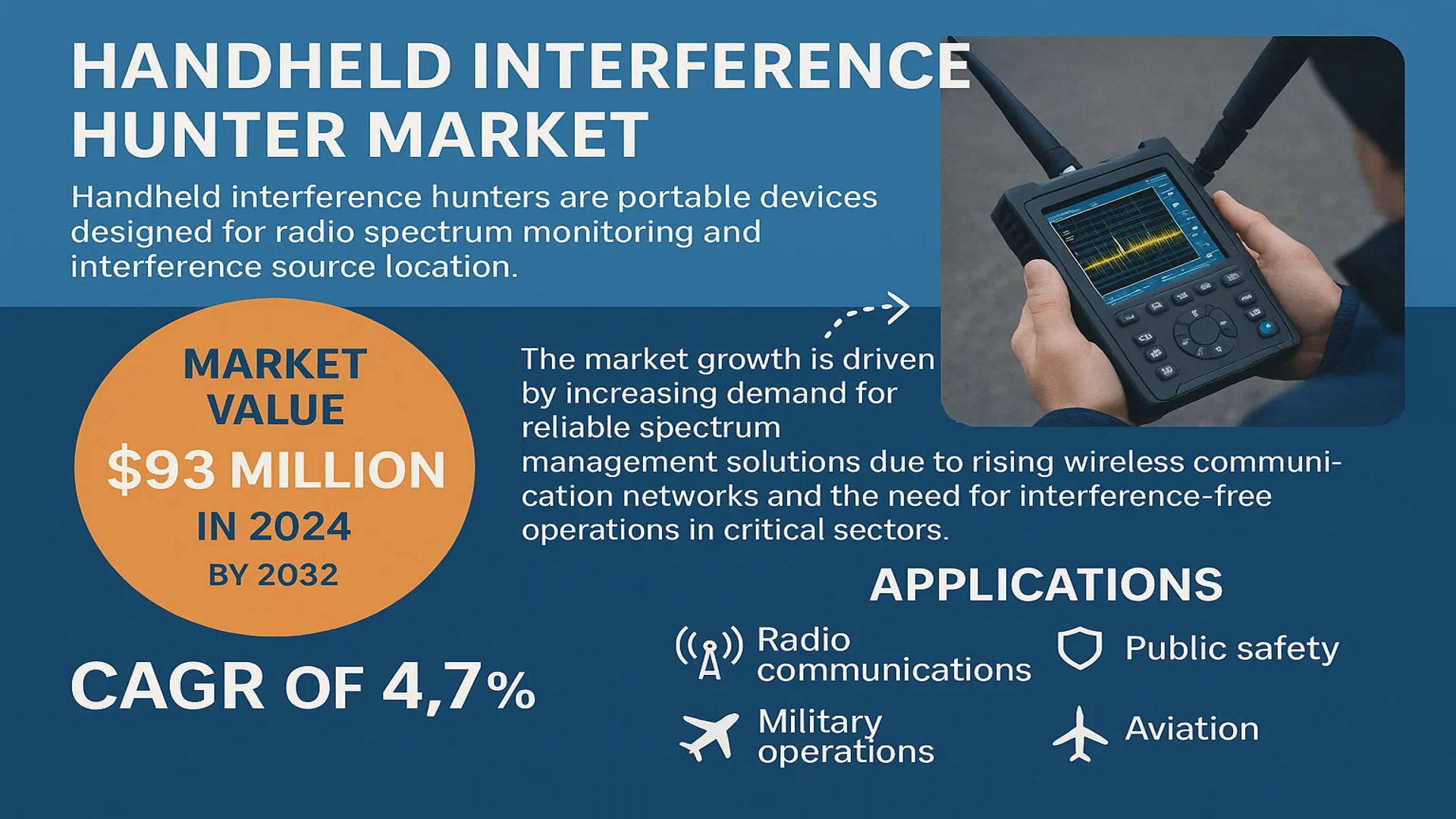
The global Handheld Interference Hunter Market was valued at 93 million in 2024 and is projected to reach US$ 128 million by 2032, at a CAGR of 4.7% during the forecast period.
Handheld interference hunters are portable devices designed for radio spectrum monitoring and interference source location. These devices integrate advanced RF detection technology with signal processing algorithms and user-friendly interfaces to help users identify, analyze, and locate radio frequency interference sources efficiently. They find applications across radio communications, public safety, military operations, aviation, and broadcasting sectors.
The market growth is driven by increasing demand for reliable spectrum management solutions due to rising wireless communication networks and the need for interference-free operations in critical sectors. Additionally, technological advancements in RF detection and the development of compact, high-performance handheld devices are propelling market expansion. Key players such as Rohde & Schwarz, Anritsu, and Keysight dominate the market with innovative product offerings and strategic collaborations to enhance their market presence.
MARKET DYNAMICS
MARKET DRIVERS
Growing Demand for Spectrum Monitoring in Military and Public Safety to Accelerate Market Growth
The increasing need for radio frequency spectrum monitoring in military and public safety applications is a key driver for the handheld interference hunter market. With expanding wireless communication networks and growing electronic warfare capabilities, defense forces worldwide are investing heavily in portable spectrum analysis tools. These devices enable rapid detection and localization of signal interference that could compromise critical communications or indicate hostile surveillance activities. Military modernization programs across regions are allocating substantial budgets for electronic warfare equipment, with spectrum monitoring devices being a crucial component.
Rising Deployments of 5G Networks to Boost Market Demand
The global rollout of 5G networks presents significant opportunities for handheld interference hunters. As 5G operates across multiple frequency bands with complex modulation schemes, network operators require sophisticated tools to identify and troubleshoot interference sources that degrade service quality. The increasing carrier aggregation and densification of 5G networks result in more complex RF environments that demand real-time spectrum analysis capabilities. Telecom regulators and service providers are investing in portable interference hunting solutions to maintain optimal network performance and compliance with spectrum regulations.
Furthermore, the proliferation of IoT devices and wireless technologies in industrial settings is creating additional demand for spectrum monitoring tools. Smart factories, automated warehouses, and critical infrastructure facilities require reliable wireless communications that can be compromised by unintentional interference sources.
MARKET RESTRAINTS
High Equipment Costs and Budget Limitations to Constrain Market Expansion
While demand for handheld interference hunters is growing, the relatively high cost of advanced spectrum analysis equipment remains a significant market restraint. Professional-grade handheld units with comprehensive features can cost thousands of dollars, making them prohibitive for some potential users, especially in price-sensitive markets. This financial barrier limits adoption among smaller organizations and municipal agencies that could benefit from spectrum monitoring capabilities but lack sufficient equipment budgets.
Public safety organizations in developing regions often face budget constraints that delay the acquisition of modern spectrum monitoring tools. While the need for interference detection exists, competing budget priorities for essential equipment and personnel often result in deferred purchases of specialized RF analysis devices.
The requirement for additional accessories and software licenses to enable full functionality can further increase the total cost of ownership, creating additional financial challenges for potential buyers.
MARKET CHALLENGES
Complexity of Modern RF Environments to Increase Technical Challenges
The growing complexity of modern RF environments presents significant technical challenges for interference detection and analysis. Today’s wireless ecosystems combine legacy analog systems with advanced digital communications across multiple frequency bands, creating dense and dynamic signal environments. Handheld interference hunters must distinguish between legitimate signals and actual interference sources in these congested spectral conditions, requiring increasingly sophisticated signal processing algorithms and advanced filtering capabilities.
Other Challenges
Detection of Short-Duration Signals
The emergence of low-probability-of-intercept signals and transient interference sources requires high-speed signal capture and analysis capabilities that challenge current handheld instrument designs. Modern electronic warfare and surveillance systems increasingly employ frequency hopping and spread spectrum techniques that are difficult to detect with conventional scanning methods.
Operator Skill Requirements
Effective use of handheld interference hunters requires specialized technical knowledge of RF theory and spectrum analysis techniques. The shortage of qualified RF engineers and technicians in some regions creates workforce challenges for organizations seeking to implement comprehensive spectrum monitoring programs.
MARKET OPPORTUNITIES
Advancements in AI-Powered Spectrum Analysis to Create New Market Opportunities
The integration of artificial intelligence and machine learning technologies into handheld interference hunters presents significant market opportunities. AI-powered spectrum analysis can automate the detection and classification of interference patterns, reducing operator workload and improving detection accuracy. Intelligent systems can learn normal spectrum usage patterns for specific environments and automatically flag anomalies, enabling faster response to emerging interference issues.
Predictive maintenance applications represent another promising opportunity, where continuous spectrum monitoring can identify deteriorating RF components before they cause significant interference problems. This capability could prove valuable for infrastructure operators who must maintain reliable wireless communications for critical services.
The development of cost-effective handheld solutions with cloud connectivity could enable smaller organizations to implement spectrum monitoring programs through subscription-based services, potentially expanding the market reach beyond traditional defense and telecom customers.
Advancements in RF Detection Technology Driving Market Growth
The handheld interference hunter market is experiencing significant growth due to continuous improvements in radio frequency (RF) detection and signal processing technologies. Modern devices now incorporate high-sensitivity receivers capable of detecting interference signals as low as -120 dBm, with frequency ranges extending beyond 6 GHz in premium models. Artificial intelligence-powered spectral analysis allows real-time pattern recognition of interference sources, reducing identification time by up to 40% compared to traditional methods. Furthermore, integration with GPS and mapping software enables precise geo-location of interference sources with accuracy within 3 meters, particularly valuable for critical applications in aviation and public safety sectors.
Other Trends
Increasing Spectrum Congestion and Regulation
The proliferation of wireless devices and IoT networks has created unprecedented spectrum congestion, with the number of connected devices projected to exceed 30 billion globally by 2025. This density has intensified the need for effective interference hunting solutions, particularly in urban environments where signal overlap is most problematic. Regulatory bodies worldwide are imposing stricter spectrum management requirements, with penalties for unauthorized transmissions increasing by an average of 25% across major markets since 2023. These factors are compelling telecom operators, broadcasters, and government agencies to invest in portable interference detection equipment that ensures compliance and maintains service quality.
Military and Public Safety Applications Accelerating Demand
Defense sectors account for approximately 32% of handheld interference hunter sales, driven by increasing electronic warfare threats and the need to detect unauthorized surveillance devices. Modern military-grade units now feature ruggedized designs with IP67 protection, extended battery life exceeding 12 hours, and specialized detection algorithms for identifying IED signals. In public safety, the transition to broadband emergency communication networks has created new interference challenges, with first responder agencies allocating 15-20% of their communications budgets to spectrum monitoring solutions. Recent product innovations include integrated drone detection capabilities, responding to the 300% increase in rogue drone incidents near critical infrastructure since 2020.
Miniaturization and Multi-functionality Shaping Product Development
Manufacturers are prioritizing device compactness without compromising performance, with new generation models being 40% lighter than predecessors while maintaining equivalent detection capabilities. The integration of spectrum analysis, signal decoding, and direction finding into single devices has reduced equipment costs by approximately 18% for end-users. Growing adoption of software-defined radio (SDR) architecture allows firmware updates that extend device lifespan, with some units supporting over-the-air calibration that decreases maintenance downtime by 65%. These improvements are particularly impactful for field technicians in telecommunications, where reduced equipment weight correlates with a 28% increase in daily site inspections.
COMPETITIVE LANDSCAPE
Key Industry Players
Technological Innovation and Strategic Partnerships Drive Market Competition
The global Handheld Interference Hunter market features a competitive landscape dominated by established RF measurement equipment manufacturers as well as specialized spectrum analysis solution providers. With the market projected to grow at a 4.7% CAGR through 2032, leading players are aggressively expanding their product portfolios with advanced features like real-time spectrum analysis and geolocation capabilities.
Rohde & Schwarz and Keysight Technologies currently lead the market share, collectively accounting for approximately 28% of global revenues in 2024. Their dominance stems from comprehensive RF measurement solutions tailored for defense, telecom, and aviation applications. Both companies have recently introduced AI-powered interference detection algorithms that significantly improve source identification accuracy.
Meanwhile, Anritsu Corporation has been gaining traction in the Asia-Pacific region through strategic collaborations with telecom operators. The company’s recent launch of ultra-compact interference hunters with 5G NR measurement capabilities has been particularly well-received in emerging markets.
Smaller but technologically advanced players like Aaronia AG and Signal Hound are carving out niches in specific verticals. Aaronia’s real-time spectrum surveillance systems are increasingly adopted for military applications, while Signal Hound’s cost-effective solutions appeal to small telecom operators.
List of Key Handheld Interference Hunter Manufacturers
- Rohde & Schwarz (Germany)
- Anritsu Corporation (Japan)
- Keysight Technologies (U.S.)
- Aaronia AG (Germany)
- Tektronix (U.S.)
- Signal Hound (U.S.)
- Narda Safety Test Solutions (Germany)
- Berkeley Varitronics Systems (U.S.)
- ThinkRF (Canada)
- RF Explorer (Spain)
Segment Analysis:
By Type
Spectrum Analysis Segment Dominates Due to Advanced RF Detection Capabilities
The market is segmented based on type into:
- Spectrum Analysis
- Subtypes: Real-time spectrum analyzers, swept analyzers, and others
- Directional Antenna
- Others
By Application
Public Safety Leads Due to Critical Interference Detection Needs
The market is segmented based on application into:
- Radio Communications
- Public Safety
- Military
- Aviation
- Other
By End-User Industry
Telecommunications Sector Shows Strong Adoption of Interference Detection Solutions
The market is segmented based on end-user industry into:
- Telecommunications
- Government & Defense
- Aerospace
- Broadcasting
- Others
By Technology
Real-time Spectrum Analysis Gains Traction for Immediate Interference Detection
The market is segmented based on technology into:
- FFT-based Analysis
- Real-time Spectrum Analysis
- Direction Finding
- Others
Regional Analysis: Handheld Interference Hunter Market
North America
The North American market for Handheld Interference Hunters is driven by stringent spectrum regulations and the increasing need for secure radio communications across defense, public safety, and aviation sectors. The U.S. Federal Communications Commission (FCC) mandates strict compliance with spectrum efficiency, pushing organizations to adopt advanced interference detection tools. The region benefits from strong R&D investments by key players like Keysight and Tektronix. With increasing 5G deployment and congested RF environments, demand for portable spectrum analyzers is projected to grow steadily. Cybersecurity concerns in military communications further accelerate adoption, particularly for real-time signal analysis in critical operations.
Europe
Europe’s market thrives on regulatory frameworks like the European Telecommunications Standards Institute (ETSI) and spectrum harmonization efforts under the Radio Equipment Directive. Countries like Germany and the U.K. lead in deployments due to dense urban networks and widespread LTE/5G infrastructure. The presence of Rohde & Schwarz and Aaronia AG strengthens the regional supply chain. Applications in aviation navigation (e.g., interference mitigation near airports) and emergency services drive demand. However, high product costs and competition from North American manufacturers pose challenges for local suppliers aiming to expand market share.
Asia-Pacific
As the fastest-growing market, Asia-Pacific is fueled by rapid telecommunications expansion, particularly in China and India. China’s centralized spectrum management policies and large-scale 5G rollout create substantial demand for interference hunting tools. India’s growing defense modernization programs also contribute to market growth. While cost sensitivity favors mid-range solutions, urbanization and spectrum congestion issues are pushing adoption in Tier-1 cities. Local manufacturers are emerging, but global brands dominate high-end applications in aviation and military sectors. Japan and South Korea exhibit steady demand due to advanced RF infrastructure and stringent compliance requirements.
South America
The market in South America remains nascent but shows potential, especially in Brazil and Argentina, where telecom operators and defense agencies are modernizing legacy systems. Economic constraints limit large-scale deployments, but selective investments in public safety (e.g., interference detection for emergency responder networks) are driving incremental growth. The lack of localized manufacturing means dependence on imported solutions, often from North American or European suppliers. Regulatory frameworks are evolving, though enforcement remains uneven, slowing wider adoption.
Middle East & Africa
This region presents a mixed landscape, with Gulf Cooperation Council (GCC) countries like Saudi Arabia and the UAE leading in adoption due to smart city initiatives and military modernization. Demand primarily stems from aviation (e.g., airport RF monitoring) and oil & gas sectors requiring secure communication networks. Sub-Saharan Africa’s growth is hampered by limited infrastructure, though mobile network expansions in countries like South Africa and Nigeria are creating opportunities. Budgetary constraints push customers toward competitively priced solutions, often sourced from regional distributors of global brands.
Report Scope
This market research report provides a comprehensive analysis of the global Handheld Interference Hunter market, covering the forecast period 2024–2032. It offers detailed insights into market dynamics, technological advancements, competitive landscape, and key trends shaping the industry.
Key focus areas of the report include:
- Market Size & Forecast: Historical data and future projections for revenue, unit shipments, and market value across major regions and segments. The global Handheld Interference Hunter market was valued at USD 93 million in 2024 and is projected to reach USD 128 million by 2032, growing at a CAGR of 4.7%.
- Segmentation Analysis: Detailed breakdown by product type (Spectrum Analysis, Directional Antenna) and application (Radio Communications, Public Safety, Military, Aviation, Others) to identify high-growth segments.
- Regional Outlook: Insights into market performance across North America, Europe, Asia-Pacific, Latin America, and Middle East & Africa, with the U.S. and China being key markets.
- Competitive Landscape: Profiles of leading market participants including Rohde & Schwarz, Anritsu, Keysight, Aaronia AG, Tektronix, and others, with their market shares and strategic developments.
- Technology Trends & Innovation: Assessment of emerging RF detection technologies, signal processing algorithms, and integration with AI for improved interference detection.
- Market Drivers & Restraints: Evaluation of factors such as increasing spectrum congestion, growing security concerns, and regulatory requirements driving market growth, along with technical challenges.
- Stakeholder Analysis: Insights for telecom operators, defense agencies, regulatory bodies, and equipment manufacturers regarding market opportunities and challenges.
Primary and secondary research methods were employed, including interviews with industry experts and analysis of verified market data, to ensure accuracy and reliability of the insights presented.
FREQUENTLY ASKED QUESTIONS:
What is the current market size of Global Handheld Interference Hunter Market?
-> Handheld Interference Hunter Market was valued at 93 million in 2024 and is projected to reach US$ 128 million by 2032, at a CAGR of 4.7% during the forecast period.
Which key companies operate in Global Handheld Interference Hunter Market?
-> Key players include Rohde & Schwarz, Anritsu, Keysight, Aaronia AG, Tektronix, Signal Hound, Narda Safety Test Solutions, Berkeley Varitronics Systems, among others.
What are the key growth drivers?
-> Key growth drivers include increasing spectrum congestion, growing security concerns in defense and public safety sectors, and stricter regulatory requirements for spectrum management.
Which region dominates the market?
-> North America currently leads the market due to strong defense and telecom sectors, while Asia-Pacific is expected to show the highest growth rate.
What are the emerging trends?
-> Emerging trends include integration of AI for automated interference detection, development of more compact devices, and increasing use in 5G network management.

Get Sample Report PDF for Exclusive Insights
Report Sample Includes
- Table of Contents
- List of Tables & Figures
- Charts, Research Methodology, and more...
 Download Sample Report PDF