
Half-Bridge Drivers Market Insights
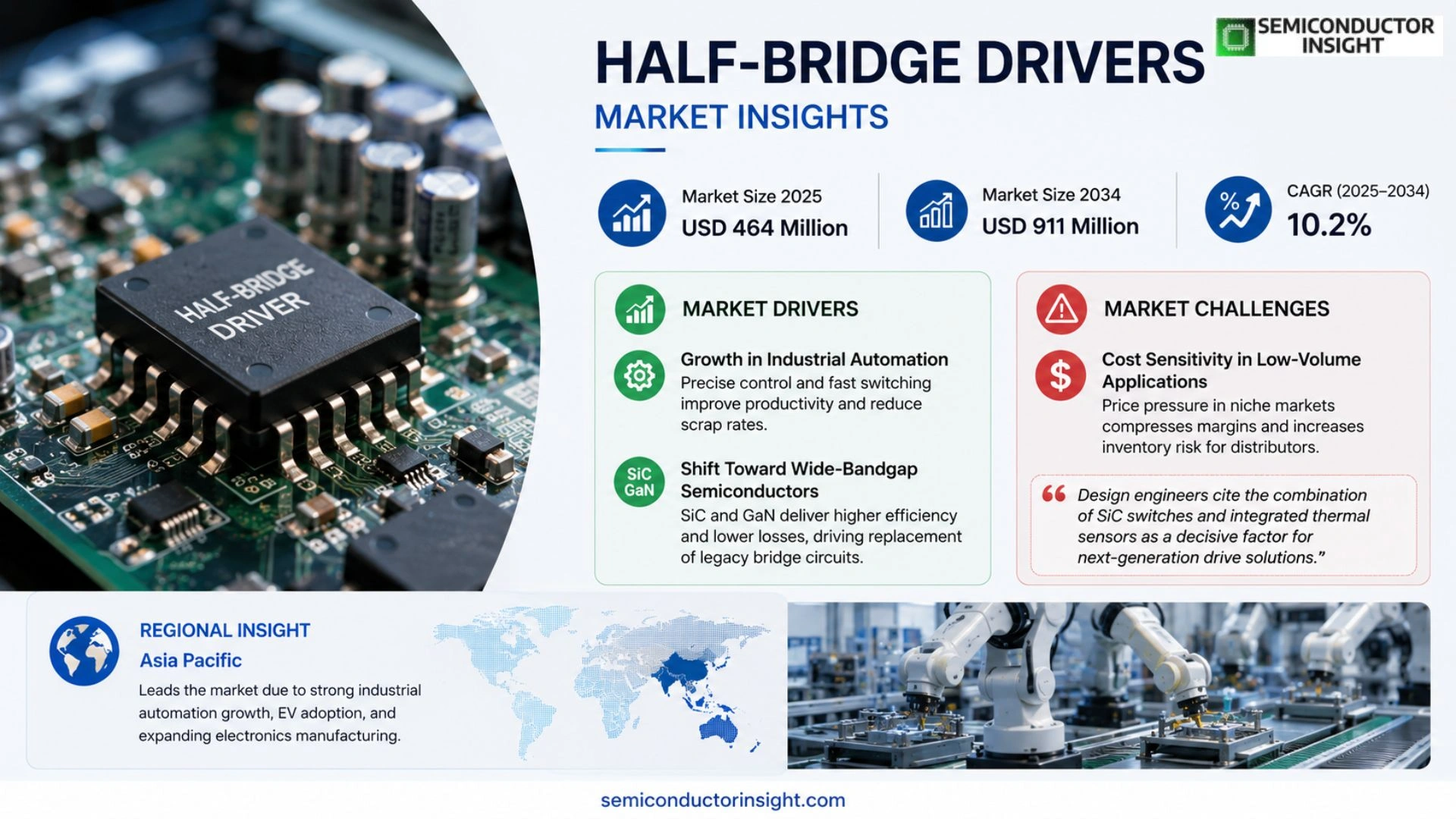
Global Half-Bridge Drivers market was valued at USD 464 million in 2025 and is projected to reach USD 911 million by 2034, exhibiting a CAGR of 10.2% during the forecast period.
Half‑bridge drivers are driver ICs positioned between a controller and power‑switching devices such as high‑side and low‑side MOSFETs, IGBTs or emerging GaN/SiC devices. They manage turn‑on/turn‑off events while providing level shifting, shoot‑through protection, dead‑time control and high dv/dt immunity. Typical implementations integrate bootstrap supplies, undervoltage lockout, short‑circuit and over‑current protection, fault reporting and programmable drive strength. Product families range from non‑isolated single‑channel gate drivers to fully isolated dual‑channel or multi‑half‑bridge solutions that may embed MOSFETs or GaN FETs. Core applications include synchronous buck converters, DC–DC modules, motor drives, industrial inverters, PFC/LLC converters, solar & energy‑storage systems and automotive actuators; customers span industrial power suppliers, automotive electronics vendors, appliance manufacturers and new‑energy equipment makers.
MARKET DRIVERS
Growth in Industrial Automation
Half-Bridge Drivers Market is gaining traction as manufacturers modernize production lines. Precise current regulation and fast switching capabilities enable servo‑driven robotics to achieve tighter tolerances, which in turn reduces scrap rates. End users value the ability to integrate these drivers with standard PLC platforms, shortening deployment cycles and boosting overall equipment effectiveness.
Shift Toward Wide‑Bandgap Semiconductors
Adoption of silicon‑carbide (SiC) and gallium‑nitride (GaN) devices is reshaping driver architecture. Compared with traditional silicon, wide‑bandgap components handle higher voltages with lower losses, directly translating into energy‑efficient motor controllers. This technical advantage encourages OEMs to replace legacy bridge circuits, creating a clear upward pressure on demand for half‑bridge modules.
➤ “Design engineers cite the combination of SiC switches and integrated thermal sensors as a decisive factor for next‑generation drive solutions.”
When these two forces converge,automation’s push for tighter control and the efficiency gains of modern semiconductors,investment budgets are reallocated toward half‑bridge driver portfolios, reinforcing the market’s momentum.
MARKET CHALLENGES
Cost Sensitivity in Low‑Volume Applications
Smaller system integrators often face price pressure when sourcing half‑bridge drivers. The economies of scale that benefit high‑volume automotive programs do not translate to niche machinery, leading to margin compression for distributors who must balance inventory risk with competitive quoting.
Other Challenges
Supply Chain Constraints
The transition to SiC and GaN has strained the upstream semiconductor supply chain. Limited wafer throughput and longer qualification cycles extend lead times, compelling buyers to maintain higher safety stocks, which inflates working capital requirements.
MARKET RESTRAINTS
Thermal Management Complexity
Half‑bridge drivers operating at elevated switching frequencies generate concentrated heat pockets. Designing adequate heat‑sink solutions without compromising board real‑estate becomes a technical bottleneck, especially in compact electric‑vehicle inverters where space is at a premium. Failure to address this can erode reliability metrics and deter adoption.
MARKET OPPORTUNITIES
Emerging EV Powertrain Architectures
The rise of modular electric‑vehicle platforms creates a fresh demand envelope for half‑bridge drivers that can be re‑used across multiple power‑train segments. Engineers appreciate the flexibility of a single driver family that supports both traction inverters and auxiliary converters, opening pathways for volume‑driven cost reductions and cross‑segmentation sales.
Half-Bridge Drivers Market Trends
Higher Voltage Capability and Isolation Adoption
Designers of power‑conversion systems are increasingly demanding drivers that can tolerate bus voltages above 600 V while preserving tight control over switching transients. The shift stems from the migration of industrial inverters, automotive traction inverters, and renewable‑energy converters toward higher‑voltage architectures that reduce current stress and improve overall efficiency. Vendors such as Analog Devices and Chipanalog have accelerated the rollout of isolated half‑bridge families, positioning them as enablers for applications that must meet stringent safety standards and survive harsh electromagnetic environments. This technical direction elevates the strategic relevance of half‑bridge drivers, turning them from peripheral switch‑control blocks into differentiating components that determine whether a converter can achieve the target power density.
Other Trends
Wide‑Bandgap Compatibility
GaN and SiC power devices are no longer confined to niche markets; their faster switching speeds are prompting system architects to pair them with drivers that can handle rapid dv/dt transients without compromising reliability. Companies like Infineon and onsemi have integrated high‑dv/dt immunity and low propagation delay into their driver portfolios, allowing manufacturers of server power supplies and high‑performance motor drives to push switching frequencies well beyond traditional silicon limits. The resulting efficiency gains translate into lower thermal budgets and smaller heat‑sink footprints, a compelling value proposition for data‑center and aerospace segments.
Geographic Competitive Shifts
While North‑American and European firms retain leadership in high‑voltage, automotive‑qualified driver designs, Chinese manufacturers are rapidly closing the gap in isolated solutions for emerging new‑energy applications. This regional diversification mitigates supply‑chain risks for global OEMs, who can source comparable functionality from multiple continents. Moreover, the convergence of automotive electrification, industrial automation, and grid‑scale storage in China, Europe, and the United States creates a balanced demand base that supports steady volume growth across all major driver categories.
COMPETITIVE LANDSCAPE
Key Industry Players
Half‑Bridge Drivers: Competitive Dynamics and Market Structure
Texas Instruments anchors the upper tier of the market, leveraging a deep portfolio that couples mature non‑isolated drivers with a rapidly expanding isolated‑dual‑channel line. Its breadth of reference designs and robust ecosystem of evaluation boards give it a decisive edge in industrial power‑supply and automotive actuator segments, where customers prioritize proven reliability and quick time‑to‑market. Infineon Technologies follows closely, differentiating through high‑voltage silicon‑carbide compatible devices and AEC‑Q100 qualified automotive parts. The firm’s strategic emphasis on integrated driver‑MOSFET modules sustains its share in the automotive body‑actuator niche, while also feeding demand from solar‑inverter and motor‑drive applications. Together, these two firms shape a duopolistic core that dictates pricing trends, component qualification standards, and the pace of feature adoption across the broader ecosystem.
Beyond the duopoly, a diverse set of specialist firms injects competitive pressure on niche fronts. Analog Devices and Chipanalog have accelerated isolated‑driver offerings that target high‑voltage renewable‑energy converters, capitalising on their analog‑signal heritage to embed sophisticated fault‑diagnostics. Allegro MicroSystems and ROHM focus on multi‑half‑bridge architectures for electric‑vehicle power‑train modules, embedding ASIL‑compatible safety features that appeal to OEMs. Meanwhile, companies such as On Semiconductor, Renesas Electronics, and Monolithic Power Systems (MPS) concentrate on GaN‑ready drivers and compact automotive solutions, using aggressive silicon‑process scaling to improve dv/dt immunity. The cumulative effect of these players is a fragmented mid‑tier where product differentiation hinges on isolation topology, wide‑bandgap compatibility, and application‑specific protective functions.
List of Key Half‑Bridge Drivers Companies Profiled
- Texas Instruments
- Infineon Technologies
- STMicroelectronics
- Analog Devices
- Allegro MicroSystems
- ON Semiconductor
- Renesas Electronics
- ROHM Semiconductor
- Microchip Technology
- Monolithic Power Systems (MPS)
- Nexperia
- Toshiba Electronic Devices & Storage Corporation
- Novosense Microelectronics
- Chipanalog Microelectronics Co., Ltd.
- Richtek Technology Corporation
Segment Analysis:
| Segment Category | Sub-Segments | Key Insights |
| By Type |
|
Non‑Isolated Drivers remain the foundational segment because they offer a simple architecture and broad voltage coverage.
|
| By Application |
|
Motor Control drives the segment narrative because of the relentless push for higher efficiency and power density in industrial and automotive motors.
|
| By End User |
|
Industrial Power Suppliers dominate due to their broad portfolio of converters, inverters and motor drives that rely on robust driver ICs.
|
| By Technology |
|
Wide‑Bandgap Compatibility is emerging as the leading technology focus because designers target ultra‑fast switching and superior efficiency.
|
| By Qualification |
|
Automotive Functional Safety leads this segment as vehicle electrification demands higher safety grades.
|
Regional Analysis: Half-Bridge Drivers Market
Manufacturers are accelerating migration from discrete transistors to integrated half‑bridge drivers, exploiting their reduced parasitic inductance and improved switching speed. This shift is especially pronounced in electric‑vehicle inverters where tighter control loops demand higher precision, prompting designers to favor monolithic solutions that simplify board layout and enhance reliability.
The automotive power‑train sector consumes the bulk of half‑bridge drivers, followed by renewable‑energy converters and high‑performance industrial drives. Each segment values the architecture’s ability to handle high currents while maintaining low conduction loss, a decisive factor for efficiency‑centric applications.
A handful of legacy silicon vendors dominate, yet start‑ups leveraging silicon‑carbide and gallium‑nitride technologies are gaining traction. The competitive dynamic is shaped by patents around gate‑drive sequencing and thermal management, forcing incumbents to invest heavily in IP protection and portfolio diversification.
Energy‑efficiency directives across federal and state levels compel OEMs to select drivers that meet stringent loss thresholds. Standards such as ISO 26262 for functional safety also dictate fault‑tolerant designs, making half‑bridge topologies attractive for their inherent redundancy options.
Europe
European manufacturers regard Half-Bridge Drivers Market as a fulcrum for achieving the EU’s ambitious carbon‑reduction targets. Automotive groups are integrating these drivers into hybrid and full‑electric platforms to satisfy the European Union’s fleet‑average emissions mandates. Meanwhile, industrial sectors, particularly in precision tooling, are drawn to the compactness of half‑bridge modules to meet space constraints on high‑speed equipment. The region’s strong emphasis on functional safety, reinforced by rigorous certification processes, pushes suppliers to embed advanced diagnostic features within the driver circuitry. Collaborative research programs funded by the EU further accelerate the transition toward wide‑bandgap implementations, positioning Europe as a hub for next‑generation power‑electronics standards.
Asia‑Pacific
Asia‑Pacific’s rapid electrification of transport and expansive manufacturing base fuels demand for efficient power conversion, making half‑bridge drivers a critical component. Countries such as China, Japan, and South Korea are scaling production of electric‑vehicle power modules, where half‑bridge architectures offer a balance of performance and cost. In parallel, the region’s burgeoning renewable‑energy projects, especially offshore wind farms, rely on robust converters that benefit from the driver’s high current capability. Competitive pressure from a dense supplier ecosystem drives continuous price compression, prompting firms to differentiate through integration of smart control algorithms and tighter thermal management solutions.
South America
South America’s market activity centers on incremental adoption within automotive assemblers seeking to meet regional fuel‑efficiency legislation. While the overall volume remains modest compared to larger continents, localized production of half‑bridge drivers is emerging in Brazil, leveraging government incentives for domestic semiconductor fabrication. Industrial users, particularly in mining equipment, appreciate the driver’s ability to handle rigorous duty cycles, reducing downtime in remote operations. The region’s regulatory environment, though less prescriptive than in Europe or North America, is beginning to align with global efficiency standards, nudging manufacturers toward more advanced driver topologies.
Middle East & Africa
In the Middle East & Africa, Half-Bridge Drivers Market is still nascent, yet growth prospects are linked to aggressive renewable‑energy deployment and the adoption of electric‑vehicle fleets in affluent Gulf states. Solar‑farm developers favor half‑bridge drivers for their resilience under high‑temperature conditions, a vital attribute given the climate. Automotive imports are increasingly equipped with power‑train technologies that depend on these drivers, prompting local distributors to expand inventory. Although the talent pool for power‑electronics design is limited, partnerships with established European and Asian firms are facilitating technology transfer, laying groundwork for a more mature market over the next decade.
Report Scope
This market research report provides a comprehensive analysis of the Half-Bridge Drivers Market , covering the forecast period 2026–2034. It offers detailed insights into market dynamics, technological advancements, competitive landscape, and key trends shaping the industry.
Key focus areas of the report include:
- Market Overview: The report begins with an overview outlining its current market scenario, key growth indicators, and industry transformation drivers. It discusses macroeconomic factors, demand–supply balance, regulatory landscape, and the strategic role of semiconductors in powering advancements across industries such as automotive, telecommunications, consumer electronics, and industrial automation.
- Market Size & Forecast: Historical data and future projections for revenue, unit shipments, and market value across major regions and segments.
- Segmentation Analysis: Detailed breakdown by product type, technology, application, and end-user industry to identify high-growth segments and investment opportunities.
- Regional Insights: Insights into market performance across North America, Europe, Asia-Pacific, Latin America, and the Middle East & Africa, including country-level analysis where relevant.
- Competitive Landscape: Profiles of leading market participants, including their product offerings, R&D focus, manufacturing capacity, pricing strategies, and recent developments such as mergers, acquisitions, and partnerships.
- Technology Trends & Innovation: Assessment of emerging technologies, integration of AI/IoT, semiconductor design trends, fabrication techniques, and evolving industry standards.
- Market Drivers & Restraints: Evaluation of factors driving market growth along with challenges, supply chain constraints, regulatory issues, and market-entry barriers.
- Stakeholder Insights: Insights for component suppliers, OEMs, system integrators, investors, and policymakers regarding the evolving ecosystem and strategic opportunities.
Primary and secondary research methods are employed, including interviews with industry experts, data from verified sources, and real-time market intelligence to ensure the accuracy and reliability of the insights presented.
FREQUENTLY ASKED QUESTIONS:
What is the current market size of Half-Bridge Drivers Market?
-> Half-Bridge Drivers market was valued at USD 464 million in 2025 and is projected to reach USD 911 million by 2034, exhibiting a CAGR of 10.2%
Which key companies operate in Half-Bridge Drivers Market?
-> Key players include Texas Instruments, Infineon Technologies, STMicroelectronics, Allegro MicroSystems, Diodes Inc., Analog Devices, Melexis, Microchip Technology, Monolithic Power Systems (MPS), ON Semiconductor, Renesas Electronics, ROHM Semiconductor, Nexperia, Toshiba Electronic Devices & Storage Corporation, Mitsubishi Electric, Nisshinbo Micro Devices, Novosense Microelectronics, Shanghai Chipanalog Microelectronics Co., Ltd., Hangzhou Silan Microelectronics Co., Ltd., RP Semiconductor, Richtek Technology Corporation, Iron Device Corporation.
What are the key growth drivers?
-> Key growth drivers include rising demand for efficient power conversion in EVs, renewable energy systems, industrial automation, and data‑center power supplies; accelerated adoption of wide‑bandgap (GaN/SiC) technologies; and increasing need for high‑voltage, highly isolated drivers in automotive and energy‑storage applications.
Which region dominates the market?
-> Asia-Pacific is the largest consumption region, driven primarily by China’s rapid EV expansion, Europe’s industrial energy‑efficiency upgrades, and North America’s data‑center growth, making it the dominant market for half‑bridge drivers.
What are the emerging trends?
-> Emerging trends include integration of isolation and protection features, higher voltage and current capability, expanded support for GaN/SiC devices, automotive‑grade functional safety (ASIL, AEC‑Q100), and the convergence of driver functionality with power stages to create compact, high‑performance modules.

Get Sample Report PDF for Exclusive Insights
Report Sample Includes
- Table of Contents
- List of Tables & Figures
- Charts, Research Methodology, and more...



