Graphics Cards for AI Market Insights
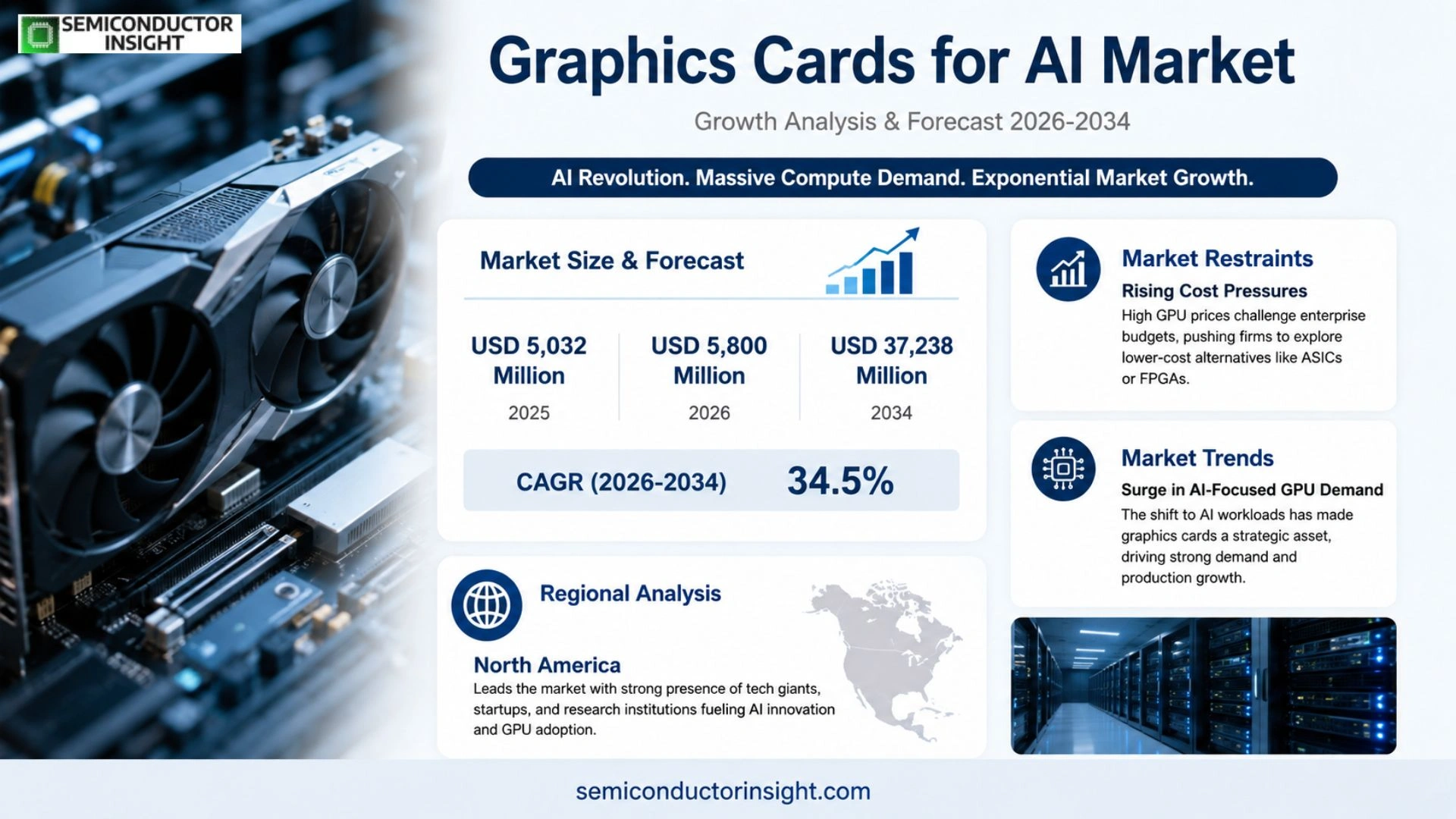
Graphics Cards for AI market size was valued at USD 5,032 million in 2025. The market is forecasted to rise from USD 5,800 million in 2026 to USD 37,238 million by 2034, exhibiting a CAGR of roughly 34.5% during the forecast horizon.
Graphics Cards for AI, often called AI accelerators or GPUs for AI, are specialized hardware designed to execute the intensive mathematical operations required by machine‑learning models. Their parallel‑processing architecture enables simultaneous handling of massive data sets and iterative computations typical of deep‑learning training and inference workloads.
The sector’s expansion is fueled by growing investment in cloud‑based AI services, rising demand for large language models, and intensified competition among hyperscale providers. At the same time, constraints in advanced‑node semiconductor capacity and high‑bandwidth memory supply create pricing pressure and limit production scalability.
MARKET DRIVERS
Escalating Compute Requirements for Generative AI
Enterprises adopting large language models are confronting a surge in tensor operations, which forces a reevaluation of their hardware stack. Graphics Cards for AI Market have become the de‑facto solution because they deliver the parallelism necessary for billions of matrix multiplications per second. This shift is less about cost and more about meeting service‑level agreements for latency‑sensitive applications.
Convergence of Cloud and Edge Workloads
Cloud providers are extending AI inference to edge locations to reduce round‑trip times for vision‑based services. The same GPU architectures that power data‑center training are now being miniaturized for edge appliances, creating a unified procurement strategy. Companies that can source a single family of GPUs for both environments benefit from streamlined firmware management and economies of scale.
➤ “The ability to re‑use the same silicon across training and inference dramatically shortens the product development cycle,” a senior architect noted during a recent industry forum.
Regulatory pressure on data sovereignty is nudging firms to retain processing locally rather than rely on distant clusters. This regulatory nuance accelerates the adoption of high‑performance graphics solutions at regional data hubs, reinforcing the upward trajectory of Graphics Cards for AI market.
MARKET CHALLENGES
Supply‑Chain Volatility
Semiconductor fabs operate near full capacity, and any shift in wafer allocation can ripple through the GPU ecosystem. Manufacturers face longer lead times, which forces AI start‑ups to either over‑stock inventory or redesign workloads for alternative accelerators, both of which erode margins.
Other Challenges
Power‑Density Constraints
Data‑center operators are encountering limits on power distribution and cooling. Deploying additional GPUs without upgrading facility infrastructure can lead to throttling, forcing firms to balance performance gains against operational expenditures.
MARKET RESTRAINTS
Rising Cost Pressures
While GPUs deliver unmatched flexibility, their price points have outpaced many enterprise budgets, especially for midsize firms seeking to scale AI initiatives. The premium attached to cutting‑edge silicon discourages incremental upgrades and encourages the exploration of lower‑cost alternatives such as ASICs or FPGAs.
In addition, the accelerated depreciation schedules required for high‑value hardware increase the total cost of ownership, prompting finance teams to scrutinize ROI calculations more rigorously.
These fiscal considerations create a cautionary environment where purchasing decisions are deferred until clear performance‑to‑cost metrics are demonstrated.
MARKET OPPORTUNITIES
Specialized AI‑Optimized GPU Variants
Vendors are beginning to segment their product lines, offering GPUs tuned for specific AI workloads such as transformer inference or high‑resolution video analytics. This granularity enables customers to match hardware capabilities to algorithmic demands, unlocking efficiency gains that were previously unattainable with generic graphics solutions.
Furthermore, the emergence of unified software stacks that abstract hardware differences encourages broader adoption across industries that have traditionally lagged in AI integration, widening the addressable market for Graphics Cards for AI Market providers.
Graphics Cards for AI Market Trends
Surge in AI‑Focused GPU Demand Fuels Production Upswing
The shift from general‑purpose compute to dedicated AI workloads has turned graphics cards into a strategic asset for data‑center operators. In 2024, manufacturers shipped roughly 571 000 units, each commanding an average price near US$ 7,110. This pricing power reflects the cost‑intensive silicon, high‑bandwidth memory, and advanced 2.5D/3D packaging that differentiate AI‑grade GPUs from consumer products. The revenue jump from US$ 5.0 billion in 2025 to an estimated US$ 37.2 billion by 2032 underscores how tightly coupled AI model training and inference have become with specialized hardware.
Other Trends
Upstream Constraints Shape Supply Dynamics
Foundry capacity at leading nodes and the limited availability of HBM modules are the principal bottlenecks that temper shipment growth. Suppliers of advanced substrates and interposers are also heavily consolidated, meaning that any disruption in the ecosystem reverberates through pricing and lead times. As a result, vendors negotiate long‑term contracts with memory makers and secure priority fab slots, a practice that cushions margins but raises entry barriers for new entrants.
Downstream Adoption Extends Beyond Cloud Training
While hyperscale cloud platforms remain the largest buyers, enterprises are accelerating AI‑driven services such as recommendation engines and generative content creation. This diversification pushes demand for inference‑optimized cards, which, although lower‑priced per unit, generate volume growth across data‑center and edge deployments. System integrators and OEM server builders act as pivotal intermediaries, bundling GPUs with optimized software stacks that lock customers into specific ecosystems. The combined effect is a market where revenue per unit stays robust while overall unit shipments expand across a broader set of applications.
COMPETITIVE LANDSCAPE
Key Industry Players
Competitive snapshot of AI GPU ecosystem, 2024
Nvidia continues to dominate the AI‑accelerated graphics segment, a position reinforced by its cutting‑edge Ampere and Hopper architectures that combine high‑density HBM2E memory with proprietary software stacks such as CUDA and cuDNN. The company’s control over both silicon and developer ecosystems yields pricing leverage and strong gross margins, especially in the training‑card tier where unit values exceed $10,000. OEM server builders and hyperscale cloud operators gravitate toward Nvidia’s solutions because of the breadth of validated frameworks and the relative predictability of supply from its second‑source fabs.
Beyond the market leader, a diverse set of competitors is reshaping the value chain. AMD leverages its CDNA lineage to challenge Nvidia on price‑performance, while Intel’s Xe‑HPC portfolio targets data‑center customers seeking tighter integration with its broader processor portfolio. Chinese entrants such as Moore Threads and Biren Intelligent Technology are expanding capacity through domestic fabs, offering HBM‑based offerings that appeal to regional cloud providers. European and U.S. specialists, including Graphcore, Cerebras Systems, and Samsung Electronics, focus on novel packaging or wafer‑scale designs that address niche workloads like inference at the edge or ultra‑large model training. These players collectively increase choice for system integrators and mitigate concentration risk in the upstream supply network.
List of Key Graphics Cards for AI Companies Profiled
- Nvidia Corporation
- Advanced Micro Devices (AMD)
- Intel Corporation
- Samsung Electronics
- Qualcomm Technologies
- Moore Threads Technology Co., Ltd.
- Biren Intelligent Technology
- Graphcore Ltd.
- Cerebras Systems
- Advanced Micro Devices (Xilinx)
- Huawei Technologies
- Broadcom Inc.
Segment Analysis:
| Segment Category | Sub-Segments | Key Insights |
| By Type |
|
AI Training Graphics Cards dominate the high‑performance segment because they deliver massive parallelism required for deep‑learning model development. – Their architecture emphasizes large memory bandwidth and tensor cores, enabling rapid convergence of complex neural networks. – Vendors focus on scalability and software stack integration, fostering ecosystem lock‑in for researchers and large‑scale cloud operators. |
| By Application |
|
Data Center remains the primary demand engine, driven by massive model training and inference at hyperscale. – Cloud providers prioritize the most efficient GPUs to reduce time‑to‑insight and operational expenditure. – Emerging enterprise AI initiatives seek on‑premise acceleration for proprietary workloads, reinforcing the need for flexible integration pathways. |
| By End User |
|
Hyperscale Cloud Providers shape product roadmaps through volume commitments and performance feedback loops. – Their scale drives aggressive adoption of the latest GPU generations, creating a virtuous cycle of innovation. – Academic and government labs focus on cutting‑edge research, valuing flexibility and access to specialized software ecosystems. |
| By Form Factor |
|
SXM / OAM Modules are favored in high‑density data‑center racks for superior power delivery and thermal management. – PCIe cards retain broad compatibility, serving both enterprise servers and workstation markets. – Embedded form factors enable AI acceleration at the edge, allowing latency‑critical inference in industrial IoT deployments. |
| By Memory Configuration |
|
HBM‑based AI Graphics Cards provide the bandwidth essential for large‑scale model training, becoming the preferred choice for top‑tier data‑center deployments. – GDDR solutions balance cost and performance, attracting mid‑range enterprise and edge users. – The ongoing tension between memory cost and performance drives continuous innovation in packaging and tiered memory hierarchies. |
Regional Analysis: Graphics Cards for AI Market
North America
Large‑scale adopters are moving beyond proof‑of‑concepts, embedding AI‑ready graphics cards into core analytics pipelines. This shift demands tighter integration with existing IT governance, prompting vendors to offer enterprise‑grade security features and lifecycle support that align with corporate risk frameworks.
The North American ecosystem benefits from proximity between silicon fabs, board‑level designers, and cloud operators. This geographic clustering reduces friction in co‑design initiatives, allowing faster iteration on cooling solutions and power‑efficiency tweaks tailored for AI workloads.
A high concentration of PhD‑level talent in AI research fuels demand for ever‑more capable cards. Companies capture this talent through university collaborations, ensuring that next‑generation architectures address both academic benchmarks and commercial use cases.
Aggressive R&D budgets support multi‑year roadmaps that prioritize tensor‑core density and inter‑GPU communication bandwidth, reflecting a strategic focus on scaling deep‑learning model complexity without proportionate cost escalation.
Europe
European nations exhibit a nuanced approach, balancing strong academic research with a growing emphasis on data sovereignty. Nations such as Germany and France are channeling public funds into AI‑centric hardware projects that prioritize energy efficiency, a response to regional sustainability mandates. While adoption rates lag slightly behind North America, the market benefits from a dense cluster of specialized integrators that tailor graphics cards for sector‑specific applications, notably in automotive safety systems and medical imaging. Vendors looking to capture European share must align product roadmaps with EU regulatory expectations and demonstrate transparent supply‑chain provenance to satisfy both corporate buyers and public‑sector procurement guidelines.
Asia‑Pacific
The Asia‑Pacific region presents a paradox of scale and fragmentation. China’s expansive manufacturing base accelerates hardware availability, yet geopolitical considerations drive local firms to develop indigenous alternatives to circumvent export controls. Meanwhile, Japan and South Korea leverage advanced semiconductor expertise to produce high‑performance graphics solutions optimized for mobile AI inference. The region’s rapid digital transformation, especially in smart‑city initiatives, creates pockets of intense demand that reward vendors capable of delivering localized support and flexible financing models. Strategic focus on partnership with regional cloud platforms can unlock significant upside as enterprises scale AI workloads across heterogeneous environments.
South America
South America’s market is in an early growth phase, characterized by cautious capital allocation and a reliance on imported technology. Countries such as Brazil and Chile are beginning to recognize the competitive advantage conferred by AI‑enhanced graphics cards in agriculture analytics and resource exploration. However, infrastructural constraints, including limited high‑speed connectivity, temper the speed of adoption. Companies that can provide turnkey solutions, combining hardware, optimized software stacks, and managed services, stand to gain early footholds as regional players transition from pilot projects to production‑grade deployments.
Middle East & Africa
In the Middle East & Africa, the narrative revolves around strategic diversification away from traditional oil‑centric economies. Nations like the United Arab Emirates and South Africa are investing in AI research hubs that prioritize high‑performance computing capabilities. Although overall market size remains modest, the willingness to fund flagship projects, such as AI‑driven oil‑field analytics and healthcare diagnostics, creates niche opportunities for graphics card providers offering bespoke acceleration solutions. Success hinges on building local expertise through training programs and ensuring after‑sales support that can navigate varied regulatory landscapes across the region.
Report Scope
This market research report provides a comprehensive analysis of the Graphics Cards for AI Market , covering the forecast period 2026–2034. It offers detailed insights into market dynamics, technological advancements, competitive landscape, and key trends shaping the industry.
Key focus areas of the report include:
- Market Overview: The report begins with an overview outlining its current market scenario, key growth indicators, and industry transformation drivers. It discusses macroeconomic factors, demand–supply balance, regulatory landscape, and the strategic role of semiconductors in powering advancements across industries such as automotive, telecommunications, consumer electronics, and industrial automation.
- Market Size & Forecast: Historical data and future projections for revenue, unit shipments, and market value across major regions and segments.
- Segmentation Analysis: Detailed breakdown by product type, technology, application, and end-user industry to identify high-growth segments and investment opportunities.
- Regional Insights: Insights into market performance across North America, Europe, Asia-Pacific, Latin America, and the Middle East & Africa, including country-level analysis where relevant.
- Competitive Landscape: Profiles of leading market participants, including their product offerings, R&D focus, manufacturing capacity, pricing strategies, and recent developments such as mergers, acquisitions, and partnerships.
- Technology Trends & Innovation: Assessment of emerging technologies, integration of AI/IoT, semiconductor design trends, fabrication techniques, and evolving industry standards.
- Market Drivers & Restraints: Evaluation of factors driving market growth along with challenges, supply chain constraints, regulatory issues, and market-entry barriers.
- Stakeholder Insights: Insights for component suppliers, OEMs, system integrators, investors, and policymakers regarding the evolving ecosystem and strategic opportunities.
Primary and secondary research methods are employed, including interviews with industry experts, data from verified sources, and real-time market intelligence to ensure the accuracy and reliability of the insights presented.
FREQUENTLY ASKED QUESTIONS:
What is the current market size of Graphics Cards for AI Market?
-> Graphics Cards for AI market is forecasted to rise from USD 5,800 million in 2026 to USD 37,238 million by 2034, exhibiting a CAGR of roughly 34.5%
Which key companies operate in Graphics Cards for AI Market?
-> Key players include Nvidia, AMD, Intel, Moore Threads, Biren Intelligent Technology, among others.
What are the key growth drivers?
-> Key growth drivers include rapid expansion of AI training workloads, surge in large language model development, growing hyperscale cloud AI services, and increased enterprise AI infrastructure investments.
Which region dominates the market?
-> North America holds the largest market share, while Asia‑Pacific shows the fastest growth.
What are the emerging trends?
-> Emerging trends include integration of high‑bandwidth memory (HBM), advanced 2.5D/3D packaging (CoWoS), development of unified training‑inference GPUs, and edge‑AI accelerator deployments.

Get Sample Report PDF for Exclusive Insights
Report Sample Includes
- Table of Contents
- List of Tables & Figures
- Charts, Research Methodology, and more...
 Download Sample Report PDF