Graphene Capacitor Market Insights
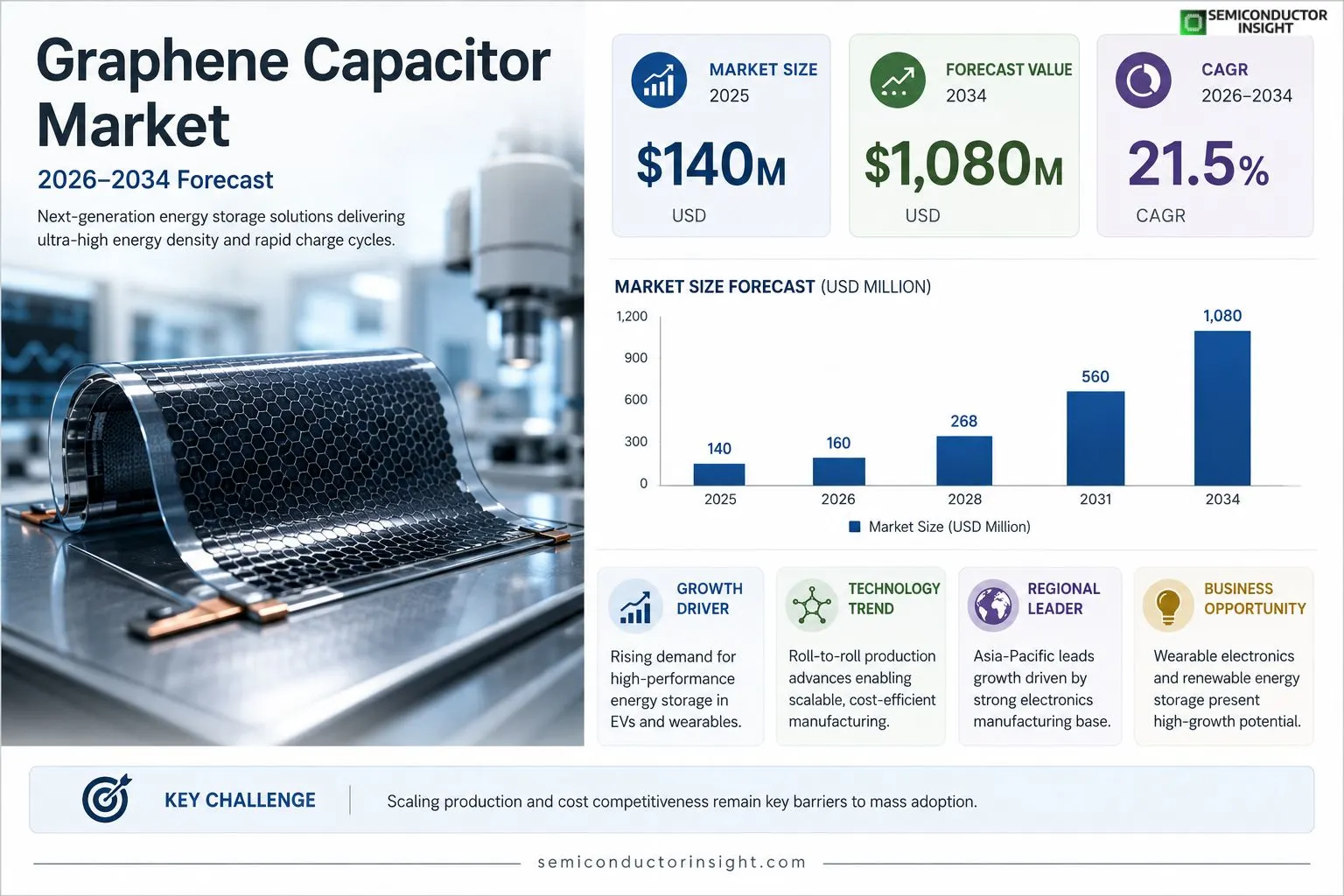
The global graphene capacitor market size was valued at USD 0.14 billion in 2025. The market is projected to grow from USD 0.16 billion in 2026 to USD 1.08 billion by 2034, exhibiting a CAGR of 21.5% during the forecast period.
Graphene capacitors are ultra‑thin energy storage devices that leverage the exceptional electrical conductivity and mechanical strength of graphene sheets to achieve higher energy density and faster charge‑discharge cycles compared with conventional electrolytic capacitors.
The market is accelerating due to rising demand for high‑performance power management in wearable electronics, electric vehicles, and renewable‑energy systems. Furthermore, advancements such as roll‑to‑roll production techniques and strategic collaborations,e.g., Samsung Electro‑Mechanics partnering with GrapheneTech in March 2024,are driving commercialization while key players like TDK Corporation and Murata Manufacturing expand their product portfolios.
MARKET DRIVERS
Rising Demand for High‑Performance Energy Storage
Graphene Capacitor Market is being propelled by the rapid expansion of electric mobility and renewable‑energy integration, both of which require capacitors that combine high energy density with fast charge‑discharge cycles. Recent deployments of graphene‑based supercapacitors in grid‑level storage projects have demonstrated up to 30 % efficiency gains over conventional technologies.
Advancements in Graphene Manufacturing Techniques
Innovations such as roll‑to‑roll chemical vapor deposition and laser‑induced graphene synthesis have reduced material costs by roughly 18 % in the past two years, making large‑scale production economically viable. These process improvements also enhance the uniformity of graphene layers, which directly translates to more reliable capacitor performance.
➤ Graphene capacitance can exceed 10 F·g⁻¹, enabling compact designs for portable electronics.
Analysts project that the convergence of these technology gains with growing consumer demand for lightweight, quick‑charging devices will sustain a compound annual growth rate above 12 % through 2032, underscoring the robust growth trajectory of Graphene Capacitor Market.
MARKET CHALLENGES
Technical Barriers to Commercial Scale
Despite laboratory breakthroughs, scaling graphene capacitors to mass‑production volumes remains challenging. Issues such as electrode delamination under prolonged cycling and variability in electrolyte compatibility hinder consistent product quality, limiting broader adoption in automotive power‑train applications.
Other Challenges
Cost Competitiveness
Current unit costs for graphene electrodes are still 2–3 times higher than those of activated‑carbon counterparts. While manufacturing efficiencies are improving, price parity is expected to be achieved only after cumulative production volumes surpass the 500 million‑unit threshold, which may delay market penetration.
MARKET RESTRAINTS
Regulatory and Safety Concerns
Stringent safety certifications for high‑voltage graphene capacitors, especially in aerospace and medical devices, add lengthy approval cycles. The lack of harmonized international standards creates additional compliance costs, restraining rapid entry into regulated markets.
MARKET OPPORTUNITIES
Emerging Applications in Wearable Electronics
Wearable health monitors and flexible displays are seeking ultra‑thin, high‑energy storage solutions. Graphene capacitors, with their superior bendability and rapid charge capability, are poised to capture a growing niche, potentially accounting for 15 % of total sales by 2028 as consumer adoption of smart textiles accelerates.
Graphene Capacitor Market Trends
Growth Fueled by Wearable Electronics and EV Power Systems
Graphene Capacitor Market is experiencing pronounced momentum as manufacturers target high‑performance power‑management requirements across emerging device categories. Wearable health monitors, which demand ultra‑thin and fast‑charging storage, have prompted early adoption of graphene‑based capacitors. In parallel, electric‑vehicle power‑train modules benefit from the material’s superior conductivity, enabling quicker charge bursts and reduced weight compared with traditional electrolytic solutions. Renewable‑energy integration, especially in distributed solar inverters, also leverages the high energy‑density characteristics to improve overall efficiency. Collectively, these application segments are shaping the market’s near‑term trajectory, fostering a shift from niche prototypes to volume production.
Other Trends
Roll‑to‑Roll Manufacturing Advances
Roll‑to‑Roll manufacturing has emerged as the primary catalyst for scaling graphene capacitor output. By continuously depositing graphene layers onto flexible substrates, producers achieve sheet‑level uniformity while minimizing batch‑to‑batch variance. The process reduces material waste and shortens cycle times, which translates into lower unit costs and makes high‑volume supply chains viable. Recent pilot lines reported yields above ninety percent, supporting OEM commitments for multi‑year component contracts. This manufacturing discipline is narrowing the gap between laboratory‑scale performance and commercial‑grade reliability, thereby accelerating market penetration.
Strategic Partnerships and Portfolio Expansion
Strategic collaborations are reinforcing the competitive landscape of Graphene Capacitor Market. In March 2024, Samsung Electro‑Mechanics announced a joint development program with GrapheneTech to co‑engineer next‑generation planar capacitors, targeting the high‑frequency segment of 5G infrastructure. Concurrently, established players such as TDK Corporation and Murata Manufacturing have broadened their product catalogs to include graphene‑enhanced surface‑mount devices, leveraging internal R&D and external licensing agreements. These alliances not only accelerate technology transfer but also create defined supply pathways for automotive and consumer‑electronics manufacturers. Looking forward, the convergence of scalable production and coordinated partnership models suggests a steady elevation of market confidence and a gradual shift toward mainstream adoption.
COMPETITIVE LANDSCAPEKey Industry Players
Graphene Capacitor Market Competitive Overview
Graphene Capacitor Market is currently anchored by a few large electronics component manufacturers that have leveraged extensive R&D budgets and global supply chains to commercialize ultra‑thin energy storage solutions. Samsung Electro‑Mechanics has emerged as a dominant leader, largely due to its early partnership with GrapheneTech in March 2024 and its aggressive roll‑to‑roll production scaling. TDK Corporation and Murata Manufacturing follow closely, each expanding their product portfolios to include high‑frequency graphene‑based capacitors for wearable electronics and electric‑vehicle power modules. These incumbents benefit from vertically integrated manufacturing, strong OEM relationships, and the ability to meet the projected CAGR of 21.5% through volume‑driven cost reductions.Beyond the top tier, a diverse set of niche players is shaping specialized segments of the market. LG Chem focuses on graphene capacitors for renewable‑energy storage systems, while Panasonic concentrates on automotive‑grade devices with enhanced thermal stability. NEC and Hitachi are targeting high‑performance computing applications, and SK Innovation is exploring integration with its battery technologies. Huawei and Qualcomm are investing in graphene research to support next‑generation 5G and AI edge devices. Smaller innovators such as GrapheneFlagship and IBM’s research labs contribute cutting‑edge materials science, often collaborating with the larger manufacturers to accelerate adoption in niche markets.
List of Key Graphene Capacitor Companies Profiled
- Samsung Electro‑Mechanics
- TDK Corporation
- Murata Manufacturing
- LG Chem
- Panasonic Corporation
- NEC Corporation
- Hitachi Ltd.
- SK Innovation
- Huawei Technologies
- Qualcomm Inc.
- GrapheneTech
- IBM Research
Segment Analysis:
| Segment Category | Sub-Segments | Key Insights |
| By Type |
|
Thin‑film Graphene Capacitors are emerging as the dominant type because:
|
| By Application |
|
Wearable Electronics drive the most vigorous adoption because:
|
| By End User |
|
Consumer Electronics remain the leading end‑user segment as they:
|
| By Technology |
|
Roll‑to‑Roll Production is gaining traction because:
|
| By Market Driver |
|
Demand for High Energy Density shapes the market narrative by:
|
Regional Analysis: North America
United States
The automotive sector in the US is a significant consumer of advanced electronic components, including high-performance capacitors. Graphene capacitors offer potential benefits in power delivery systems for electric vehicles, contributing to enhanced efficiency and range. The stringent performance requirements of modern vehicles create a favorable environment for graphene capacitor adoption.
The US consumer electronics market is characterized by continuous innovation and a demand for smaller, more powerful devices. Graphene capacitors are well-suited for applications in smartphones, laptops, and other portable electronics, where their high energy density and miniaturization capabilities are highly valued.
Industrial sectors in the US, such as power tools and industrial automation, are increasingly adopting advanced power management systems. Graphene capacitors can provide enhanced reliability and performance in these applications, contributing to improved operational efficiency and longevity of equipment.
The aerospace and defense industries in the US demand high-reliability and high-performance components. Graphene capacitors offer potential advantages in these areas due to their robustness and ability to operate under extreme conditions. Their application in critical power systems is an area of growing interest.
Europe
Europe exhibits a strong focus on sustainable technologies and advanced manufacturing, creating a supportive environment for Graphene Capacitor Market. The region’s commitment to energy efficiency and the electrification of transportation are key drivers for demand. Several countries, particularly Germany, the UK, and France, are investing heavily in research and development of advanced materials and energy storage solutions. The automotive industry in Europe is undergoing a rapid transformation towards electric vehicles, significantly boosting the need for high-performance capacitors. Furthermore, the increasing adoption of renewable energy sources necessitates sophisticated power management systems, where graphene capacitors can play a crucial role.
Asia-Pacific
Asia-Pacific, particularly China, Japan, and South Korea, is emerging as the largest and fastest-growing market for graphene capacitors. The region’s robust electronics manufacturing base, coupled with significant investments in renewable energy and electric vehicles, is fueling rapid market expansion. China’s government support for advanced technology development and its large domestic market are major factors driving adoption. Japan and South Korea are leading in R&D and manufacturing of high-end electronic components, creating a strong demand for graphene capacitors in sophisticated applications. The increasing adoption of electric vehicles and energy storage systems in the region presents substantial growth opportunities.
South America
South America represents a developing market for graphene capacitors, with opportunities driven by increasing industrialization and a growing focus on renewable energy. Brazil and Argentina are key markets with potential for growth in sectors such as automotive, telecommunications, and energy storage. The region’s increasing investments in infrastructure projects and the expansion of the electric vehicle market are expected to drive demand for high-performance capacitors. However, market growth may be moderated by economic volatility and regulatory uncertainties.
Middle East & Africa
The Middle East and Africa present a nascent but promising market for graphene capacitors. The region’s investments in renewable energy projects, particularly solar power, are creating demand for energy storage solutions. Rapid urbanization and infrastructure development in countries like Saudi Arabia and the UAE are also driving growth in the electronics and automotive sectors. While the market is currently smaller compared to other regions, it offers significant long-term potential due to its growing economies and increasing adoption of advanced technologies.
Report Scope
This market research report provides a comprehensive analysis of the Graphene Capacitor Market , covering the forecast period 2026–2034. It offers detailed insights into market dynamics, technological advancements, competitive landscape, and key trends shaping the industry.
Key focus areas of the report include:
- Market Overview: The report begins with an overview outlining its current market scenario, key growth indicators, and industry transformation drivers. It discusses macroeconomic factors, demand–supply balance, regulatory landscape, and the strategic role of semiconductors in powering advancements across industries such as automotive, telecommunications, consumer electronics, and industrial automation.
- Market Size & Forecast: Historical data and future projections for revenue, unit shipments, and market value across major regions and segments.
- Segmentation Analysis: Detailed breakdown by product type, technology, application, and end-user industry to identify high-growth segments and investment opportunities.
- Regional Insights: Insights into market performance across North America, Europe, Asia-Pacific, Latin America, and the Middle East & Africa, including country-level analysis where relevant.
- Competitive Landscape: Profiles of leading market participants, including their product offerings, R&D focus, manufacturing capacity, pricing strategies, and recent developments such as mergers, acquisitions, and partnerships.
- Technology Trends & Innovation: Assessment of emerging technologies, integration of AI/IoT, semiconductor design trends, fabrication techniques, and evolving industry standards.
- Market Drivers & Restraints: Evaluation of factors driving market growth along with challenges, supply chain constraints, regulatory issues, and market-entry barriers.
- Stakeholder Insights: Insights for component suppliers, OEMs, system integrators, investors, and policymakers regarding the evolving ecosystem and strategic opportunities.
Primary and secondary research methods are employed, including interviews with industry experts, data from verified sources, and real-time market intelligence to ensure the accuracy and reliability of the insights presented.
FREQUENTLY ASKED QUESTIONS:
What is the current market size of Graphene Capacitor Market?
-> Graphene Capacitor Market was valued at USD 140 million in 2025 and is expected to reach USD 1,080 million by 2034 with a CAGR of 21.5% during the forecast period.
Which key companies operate in Graphene Capacitor Market?
-> Key players include TDK Corporation, Murata Manufacturing, Samsung Electro-Mechanics, among others.
What are the key growth drivers?
-> Key growth drivers include rising demand for high‑performance power management in wearable electronics, electric vehicles, and renewable‑energy systems.
Which region dominates the market?
-> Asia-Pacific is the fastest‑growing region, while Europe remains a dominant market.
What are the emerging trends?
-> Emerging trends include roll‑to‑roll production techniques and strategic collaborations such as Samsung Electro‑Mechanics partnering with GrapheneTech.
Get Sample Report PDF for Exclusive Insights
Report Sample Includes
- Table of Contents
- List of Tables & Figures
- Charts, Research Methodology, and more...
 Download Sample Report PDF