MARKET INSIGHTS
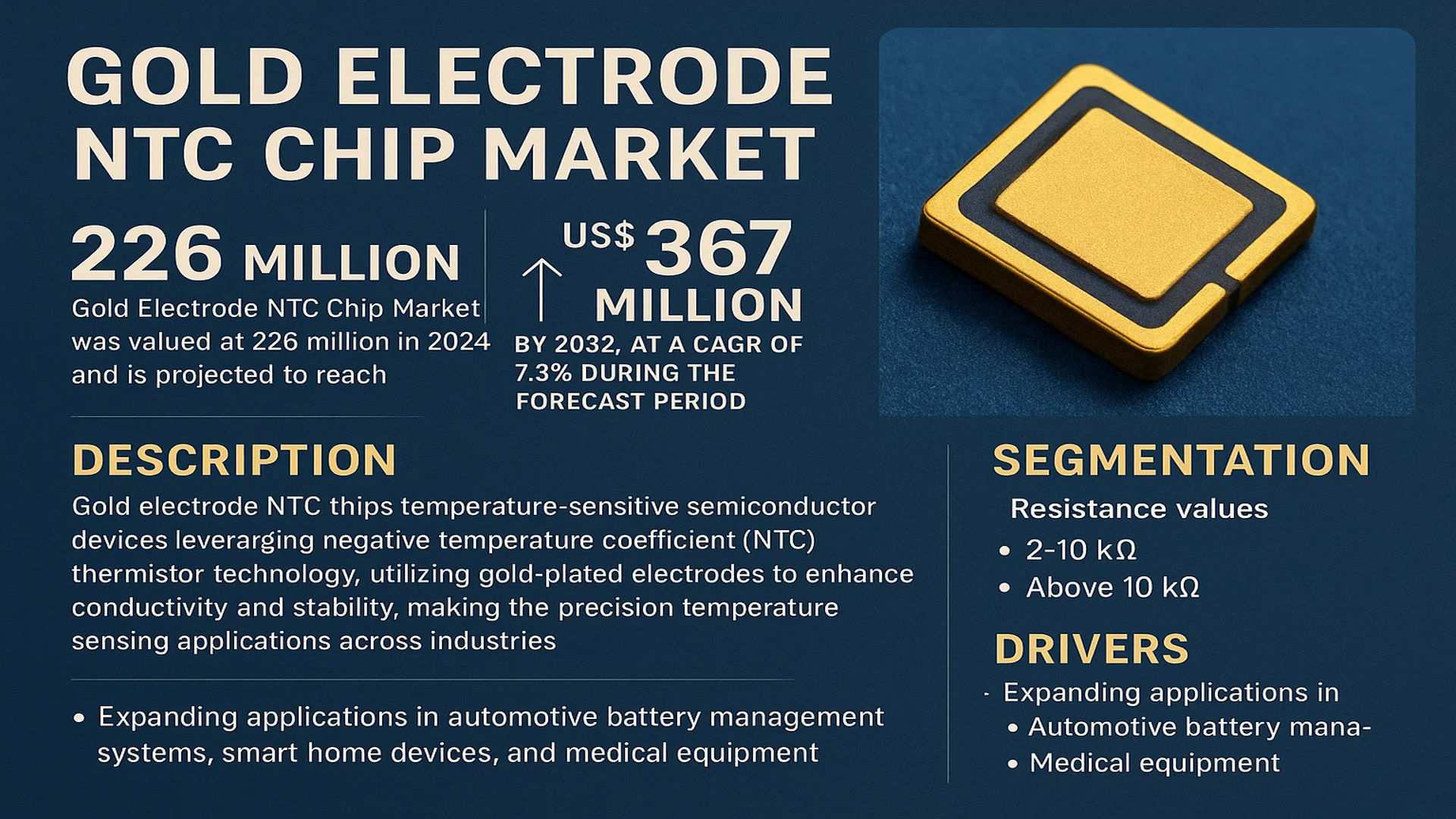
The global Gold Electrode NTC Chip Market was valued at 226 million in 2024 and is projected to reach US$ 367 million by 2032, at a CAGR of 7.3% during the forecast period.
Gold electrode NTC chips are temperature-sensitive semiconductor devices leveraging negative temperature coefficient (NTC) thermistor technology. These components utilize gold-plated electrodes to enhance conductivity and stability, making them ideal for precision temperature sensing applications across industries. The market includes segments based on resistance values, primarily categorized as 2-10 KΩ and above 10 KΩ variants.
Growth is driven by expanding applications in automotive battery management systems, smart home devices, and medical equipment where reliable temperature monitoring is critical. While Asia Pacific leads in production and consumption due to its electronics manufacturing hubs, North America shows strong demand from advanced medical and automotive sectors. Key players like Murata, TDK, and Panasonic dominate the competitive landscape, collectively holding over 60% market share as of 2024.
MARKET DYNAMICS
MARKET DRIVERS
Expanding Adoption in Automotive and Consumer Electronics Fuels Market Growth
The global gold electrode NTC chip market is experiencing significant growth due to increasing integration across automotive and consumer electronics applications. With over 85 million vehicles produced annually worldwide, the demand for reliable temperature sensors in battery management systems has created robust opportunities for NTC chip manufacturers. The transition to electric vehicles, where battery temperature monitoring is critical for safety and performance, has further accelerated adoption. In consumer electronics, the widespread use of smartphones and wearable devices, exceeding 1.5 billion units shipped annually, continues to drive demand for compact, high-precision temperature sensing solutions.
Technological Advancements Enhance Performance Characteristics
Recent developments in manufacturing techniques have significantly improved the stability and accuracy of gold electrode NTC chips, making them more desirable for mission-critical applications. Advanced thin-film deposition technologies now enable the production of chips with ±0.1°C accuracy while maintaining long-term stability. The gold electrode’s superior conductivity and corrosion resistance have become particularly valuable in harsh environments, leading to increased adoption in industrial automation and medical equipment. The medical device segment, growing at over 6% annually, represents one of the fastest-growing application areas for these precision components.
Infrastructure Development and 5G Deployment Create New Opportunities
The global rollout of 5G networks and IoT infrastructure is generating substantial demand for reliable temperature monitoring solutions in communication equipment. Base stations and network infrastructure require precise thermal management to maintain optimal performance, with each 5G small cell typically incorporating multiple temperature sensors. The anticipated installation of over 5 million 5G base stations by 2030 presents a significant growth avenue for gold electrode NTC chip manufacturers. Furthermore, the expansion of smart city initiatives worldwide is driving demand for these components in environmental monitoring and building automation systems.
MARKET RESTRAINTS
Volatile Gold Prices Impact Production Costs and Profit Margins
The gold electrode NTC chip market faces significant pressure from fluctuating raw material costs, with gold prices experiencing 20-30% annual volatility in recent years. As a critical component comprising up to 15-20% of the total chip cost, gold price instability creates challenges in maintaining consistent pricing and profitability. Manufacturers must implement sophisticated hedging strategies, which adds complexity to supply chain management. The situation is particularly challenging for small and medium-sized producers who lack the financial resources to absorb sudden price fluctuations in the precious metals market.
Competition from Alternative Technologies Challenges Market Expansion
While gold electrode NTC chips offer superior performance characteristics, they face increasing competition from emerging technologies. Silicon-based temperature sensors and MEMS devices are gaining traction in certain applications due to their lower cost and digital output capabilities. The development of platinum-based temperature sensors with enhanced stability profiles is also creating competitive pressure in high-end applications. These alternatives threaten to cannibalize market share, particularly in price-sensitive segments where the premium performance of gold electrodes may not justify the additional cost.
MARKET CHALLENGES
Maintaining Performance Consistency Across Production Batches
The manufacturing of gold electrode NTC chips presents significant technical challenges in maintaining consistent performance characteristics across production batches. Variations in resistive material composition and electrode deposition can lead to performance deviations that impact product reliability. The industry reports that achieving batch-to-batch consistency of better than ±1% in resistance values requires sophisticated process controls and quality assurance measures. These manufacturing complexities result in higher scrap rates and production costs, particularly when dealing with miniaturized components for wearable and medical applications.
Regulatory Compliance and Certification Hurdles
The medical and automotive applications driving much of the market growth come with stringent regulatory requirements. Obtaining certifications such as AEC-Q200 for automotive components or ISO 13485 for medical devices requires extensive testing and documentation, often taking 6-12 months to complete. These processes add significant time and cost to product development cycles, particularly for companies expanding into new geographic markets with different regulatory frameworks.
MARKET OPPORTUNITIES
Emerging Applications in Energy Storage Systems Present Growth Potential
The rapid growth of renewable energy systems and grid-scale storage solutions is creating new opportunities for gold electrode NTC chips. Large-scale battery installations require hundreds of temperature sensors per installation to ensure safe operation and optimize performance. With global energy storage capacity projected to grow at a 25% CAGR through 2030, this represents a significant untapped market for sensor manufacturers. The superior reliability and long-term stability of gold electrode components make them particularly suitable for these demanding applications where maintenance access may be limited.
Miniaturization Trends Enable New Product Developments
Advancements in microfabrication technologies are enabling the production of gold electrode NTC chips with dimensions below 0.5mm × 0.5mm, opening doors to applications in miniaturized medical devices and ultra-compact electronics. The development of chip-scale packaging solutions further enhances integration possibilities with other sensor components. These technological breakthroughs are creating opportunities in emerging fields such as implantable medical devices and microscopic IoT sensors, where space constraints previously limited the use of conventional temperature sensing solutions.
Regional Manufacturing Expansion to Meet Local Demand
The growing emphasis on supply chain resilience and regional manufacturing is prompting many sensor companies to establish local production facilities. In markets like Southeast Asia, where electronics manufacturing has grown by 15-20% annually, localization strategies can provide significant competitive advantages. Several major players are investing in production capacity within key growth regions to reduce lead times, lower logistics costs, and better serve local customer requirements while complying with increasing regional content regulations.
GOLD ELECTRODE NTC CHIP MARKET TRENDS
Expanding Applications in Automotive and Consumer Electronics Driving Market Growth
The demand for gold electrode NTC chips is experiencing strong growth, primarily driven by their increasing adoption in automotive battery management systems and consumer electronics. In the automotive sector, these chips play a critical role in temperature monitoring for EV battery packs, where precise thermal management is essential for safety and performance. With global EV sales projected to reach 16.7 million units by 2024, the need for reliable temperature sensors continues to escalate. Meanwhile, in consumer electronics, the chips are extensively used in smartphones, wearables, and IoT devices, benefiting from the 6.9% annual growth rate in global wearable shipments.
Other Trends
Miniaturization and Performance Enhancements
Manufacturers are increasingly focusing on miniaturization while maintaining or improving thermal response times and accuracy. Recent advancements have led to chips with sub-millimeter dimensions and response times under 3 seconds, making them ideal for compact devices. The 2-10 KΩ segment, currently dominating 58.7% of the market, is seeing particular innovation in stability at high temperatures up to 150°C. These improvements are critical for applications in medical devices where reliable temperature sensing is non-negotiable.
Supply Chain Diversification and Regional Market Shifts
While China currently accounts for over 42% of global production, there’s a noticeable trend towards supply chain diversification following recent global disruptions. Southeast Asian nations are emerging as alternative manufacturing hubs, with Vietnam and Malaysia increasing their production capacity by 28% since 2022. This geographical shift coincides with tightening quality standards in North America and Europe, where automotive-grade chips now require 0.5% resistance tolerance compared to the previous 1% standard. These changes are prompting manufacturers to invest in advanced thin-film deposition and laser trimming technologies to meet evolving requirements.
The industry is also witnessing growing R&D investment in novel composite materials for electrodes, with some manufacturers achieving 15% improvement in thermal stability through gold-palladium alloys. As smart home adoption reaches 32.4% penetration in developed markets, these enhanced chips are finding new applications in HVAC systems and smart appliances, further diversifying market opportunities beyond traditional sectors.
COMPETITIVE LANDSCAPE
Key Industry Players
Key Manufacturers Focus on Innovation to Maintain Market Position
The global Gold Electrode NTC Chip market exhibits a semi-consolidated competitive landscape, with established electronics manufacturers competing alongside specialized sensor producers. Murata, a Japanese multinational, currently leads the market with its advanced thermistor technology, which is widely adopted in automotive and consumer electronics applications. The company’s strong R&D capabilities and global distribution network have solidified its dominant position.
Panasonic and TDK follow closely behind, leveraging their extensive experience in electronic components to develop highly reliable NTC chips. Both companies have recently expanded their portfolios to include specialized variants for medical applications, opening new growth opportunities. Meanwhile, TE Connectivity has gained significant traction in industrial applications through its ruggedized temperature sensors with gold electrodes.
Emerging Chinese manufacturers such as Shenzhen Kemin Sensor and Huagong Tech are rapidly gaining market share through competitive pricing and improved product quality. These companies are particularly strong in Asia’s growing smart home and mobile power supply sectors. Their growth reflects the broader industry trend of regional players expanding beyond domestic markets.
List of Key Gold Electrode NTC Chip Manufacturers
- Murata Manufacturing Co., Ltd. (Japan)
- Panasonic Corporation (Japan)
- TDK Corporation (Japan)
- Semitec Corporation (Japan)
- TE Connectivity (Switzerland)
- Vishay Intertechnology, Inc. (U.S.)
- Shenzhen Kemin Sensor Co., Ltd. (China)
- Huagong Tech Co., Ltd. (China)
- Shenzhen KEPENGDA Electronics Co., Ltd. (China)
- TOPOS Technology (China)
Segment Analysis:
By Type
R25 Resistance Value: 2-10 KΩ Segment Leads Due to High Demand in Temperature-Sensitive Applications
The market is segmented based on type into:
- R25 Resistance Value: 2-10 KΩ
- Subtypes: Precision NTC chips, General-purpose NTC chips
- R25 Resistance Value: More Than 10 KΩ
- Subtypes: High-resistance thermistors, Specialized NTC chips
By Application
Automotive Batteries Segment Dominates Owing to Increased EV Adoption and Battery Management Needs
The market is segmented based on application into:
- Automotive Batteries
- Communication
- Smart Home
- Mobile Power Supplies
- Medical
- Others
By End-User Industry
Electronics Manufacturing Sector Holds Largest Share Due to Widespread Component Integration
The market is segmented based on end-user industry into:
- Consumer Electronics
- Automotive
- Healthcare
- Telecommunications
- Industrial Automation
Regional Analysis: Gold Electrode NTC Chip Market
Asia-Pacific
The Asia-Pacific region is the dominant market for Gold Electrode NTC Chips, accounting for over 45% of global demand, driven by China’s robust electronics manufacturing sector and India’s expanding telecommunications infrastructure. Major manufacturers like Murata and Panasonic have established production facilities in the region to serve local automotive battery and smart home industries. With China’s semiconductor self-sufficiency initiatives and Japan’s precision electronics sector, APAC maintains technological leadership in chip production, though rising material costs present ongoing challenges for mid-tier suppliers. The proliferation of IoT devices across Southeast Asia continues to fuel demand for miniature, high-reliability temperature sensors.
North America
North America shows strong adoption of gold electrode NTC chips in medical devices and electric vehicle battery management systems, where measurement accuracy impacts safety compliance. The U.S. accounts for nearly 30% of regional market value, with TE Connectivity and Vishay supplying chips meeting stringent FDA and UL certification requirements. While labor costs limit local production, R&D investments in Boston and Silicon Valley drive innovations in chip miniaturization. Recent supply chain reconfigurations have prompted some manufacturers to establish secondary sourcing channels beyond traditional Asian suppliers.
Europe
European demand focuses on industrial and automotive applications, where German engineering firms specify gold electrode NTCs for precision temperature monitoring in manufacturing equipment. The region’s emphasis on material traceability under REACH regulations gives established brands like TDK and Semitec a competitive edge. France and Italy show growing adoption in smart HVAC systems, though the market faces pricing pressures from Asian imports. EU-funded research projects aim to develop lead-free chip variants to meet upcoming environmental directives.
South America
Brazil represents the largest South American market, where gold electrode NTC chips are increasingly used in renewable energy systems and consumer electronics assembly. However, import dependency exceeds 85% due to limited local semiconductor fabrication capacity. Currency fluctuations and complex import procedures continue to challenge distributors, though regional trade agreements are gradually improving component accessibility. The medical device sector shows promise for growth as hospitals modernize equipment.
Middle East & Africa
This emerging market demonstrates patchy adoption, with Israel and UAE leading in medical technology applications while other nations lag due to infrastructure limitations. The lack of local standards for temperature-sensitive electronics slows market maturation. Some growth emerges from data center cooling systems in Gulf states, where operators prioritize precise thermal management, but overall penetration remains below 5% of global demand. Joint ventures between Asian suppliers and regional distributors are beginning to establish stronger supply channels.
Report Scope
This market research report provides a comprehensive analysis of the global and regional Gold Electrode NTC Chip markets, covering the forecast period 2024–2032. It offers detailed insights into market dynamics, technological advancements, competitive landscape, and key trends shaping the industry.
Key focus areas of the report include:
- Market Size & Forecast: Historical data and future projections for revenue, unit shipments, and market value across major regions and segments. The global Gold Electrode NTC Chip market was valued at USD 226 million in 2024 and is projected to reach USD 367 million by 2032, growing at a CAGR of 7.3%.
- Segmentation Analysis: Detailed breakdown by product type (R25 Resistance Value: 2-10 KΩ and More Than 10 KΩ) and application (Automotive Batteries, Communication, Smart Home, Mobile Power Supplies, Medical, Others) to identify high-growth segments.
- Regional Outlook: Insights into market performance across North America, Europe, Asia-Pacific, Latin America, and the Middle East & Africa, with country-level analysis. The U.S. market is estimated at USD XX million in 2024, while China is projected to reach USD XX million.
- Competitive Landscape: Profiles of leading market participants including Murata, Panasonic, TDK, Semitec, TE Connectivity, Vishay, and others, covering their market share, product portfolios, and strategic developments.
- Technology Trends & Innovation: Assessment of emerging semiconductor technologies, material advancements, and fabrication techniques in NTC thermistor production.
- Market Drivers & Restraints: Evaluation of factors driving market growth (increasing demand for temperature sensing in electronics) along with challenges (supply chain constraints, raw material price volatility).
- Stakeholder Analysis: Insights for component manufacturers, OEMs, distributors, and investors regarding market opportunities and strategic positioning.
Primary and secondary research methods are employed, including manufacturer surveys, industry expert interviews, and verified market data to ensure accuracy and reliability.
FREQUENTLY ASKED QUESTIONS:
What is the current market size of Global Gold Electrode NTC Chip Market?
-> Gold Electrode NTC Chip Market was valued at 226 million in 2024 and is projected to reach US$ 367 million by 2032, at a CAGR of 7.3% during the forecast period.
Which key companies operate in Global Gold Electrode NTC Chip Market?
-> Key players include Murata, Panasonic, TDK, Semitec, TE Connectivity, Vishay, Shenzhen Kemin Sensor, Huagong Tech, among others.
What are the key growth drivers?
-> Key growth drivers include rising demand for temperature sensors in automotive electronics, expansion of IoT devices, and increasing adoption in medical equipment.
Which region dominates the market?
-> Asia-Pacific dominates the market due to strong electronics manufacturing, while North America shows significant growth in medical applications.
What are the emerging trends?
-> Emerging trends include miniaturization of NTC chips, development of high-temperature resistant variants, and integration with smart sensor networks.

Get Sample Report PDF for Exclusive Insights
Report Sample Includes
- Table of Contents
- List of Tables & Figures
- Charts, Research Methodology, and more...