MARKET INSIGHTS
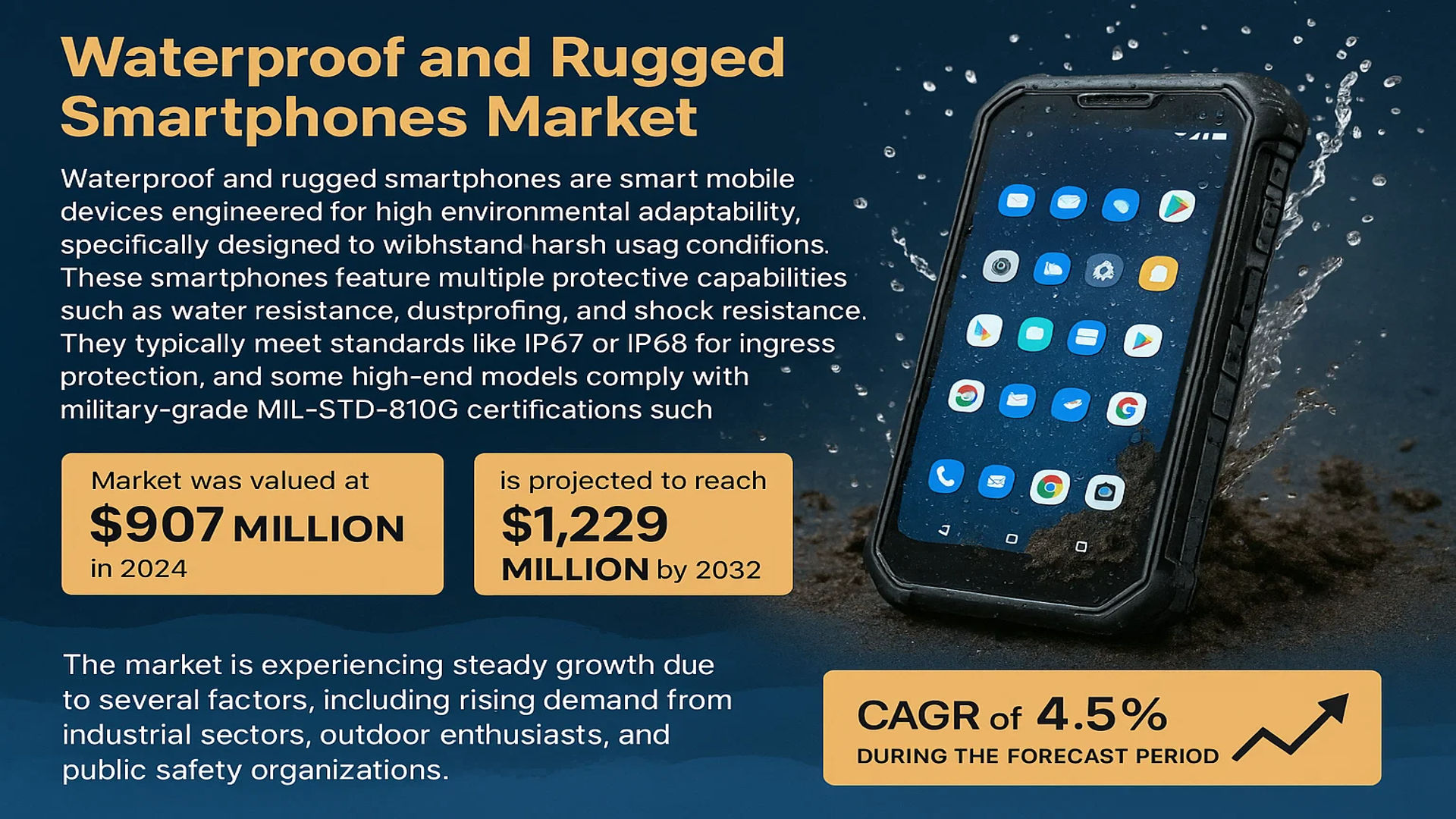
The global Waterproof and Rugged Smartphones Market was valued at 907 million in 2024 and is projected to reach US$ 1229 million by 2032, at a CAGR of 4.5% during the forecast period.
Waterproof and rugged smartphones are smart mobile devices engineered for high environmental adaptability, specifically designed to withstand harsh usage conditions. These smartphones feature multiple protective capabilities such as water resistance, dustproofing, and shock resistance. They typically meet standards like IP67 or IP68 for ingress protection, and some high-end models comply with military-grade certifications such as MIL-STD-810G, enabling stable performance under extreme conditions including high/low temperatures, humidity, and vibration.
The market is experiencing steady growth due to several factors, including rising demand from industrial sectors, outdoor enthusiasts, and public safety organizations. The integration of advanced technologies like 5G and IoT is further expanding their utility beyond basic durability, transforming them into intelligent tools for data collection and remote operations. However, the market faces challenges such as high production costs and intense competition. Key players like Samsung, Caterpillar, and Sonim Technologies lead the market with robust product portfolios designed for both professional and consumer applications.
MARKET DYNAMICS
MARKET DRIVERS
Rising Demand from Industrial and Outdoor Sectors to Accelerate Market Growth
The global waterproof and rugged smartphones market is experiencing robust growth driven by increasing adoption across industrial, construction, and outdoor recreational sectors. These devices are becoming essential tools for workers in harsh environments where standard smartphones fail. The construction industry alone employs over 7 million workers in the United States and 40 million across Europe, with a significant portion requiring durable communication devices. Field service technicians, utility workers, and first responders represent additional substantial user groups demanding reliable equipment. The integration of specialized applications for inventory management, safety compliance, and real-time data collection further enhances their utility in professional settings. As enterprises continue digital transformation initiatives, the need for ruggedized mobile solutions that can withstand extreme conditions while maintaining connectivity continues to expand substantially.
Advancements in 5G and IoT Integration to Fuel Market Expansion
The rollout of 5G networks and expansion of Internet of Things (IoT) applications are creating significant growth opportunities for waterproof and rugged smartphones. These devices are evolving beyond basic communication tools to become integral components of connected industrial ecosystems. The global IoT market is projected to grow substantially, with industrial IoT applications representing a major segment. Rugged smartphones equipped with 5G capabilities enable real-time data transmission, remote monitoring, and enhanced field operations across various industries. The manufacturing sector’s increasing adoption of smart factory concepts requires devices that can operate reliably in challenging environments while maintaining high-speed connectivity. Furthermore, the integration of specialized sensors and scanning capabilities transforms these smartphones into multifunctional tools for logistics, warehouse management, and quality control applications.
Additionally, regulatory requirements and industry standards are pushing organizations toward more durable communication solutions.
➤ For instance, occupational safety regulations in multiple countries mandate that equipment used in certain environments must meet specific durability standards, driving institutional adoption of certified rugged devices.
Furthermore, the growing emphasis on worker safety and operational efficiency in extreme conditions is prompting enterprises to invest in reliable communication infrastructure, thereby sustaining market growth throughout the forecast period.
MARKET CHALLENGES
High Production Costs and Premium Pricing to Constrain Market Penetration
The waterproof and rugged smartphones market faces significant challenges related to manufacturing complexity and resulting high consumer prices. These devices require specialized materials, enhanced sealing technologies, and rigorous testing procedures that substantially increase production costs compared to conventional smartphones. The average price point for rugged smartphones remains approximately 40-60% higher than comparable non-rugged devices, creating adoption barriers particularly in price-sensitive markets and consumer segments. The extensive research and development required to achieve military-grade certifications (MIL-STD-810) and high ingress protection (IP68/IP69) ratings further contributes to the elevated cost structure. Additionally, the relatively low production volumes compared to mainstream smartphones limit economies of scale, maintaining higher per-unit costs throughout the supply chain.
Other Challenges
Design and Aesthetic Limitations
The functional requirements of rugged smartphones often result in bulkier designs and heavier form factors that appeal primarily to professional users rather than general consumers. While durability is paramount, the aesthetic compromise presents challenges in expanding beyond industrial applications into broader consumer markets. The average rugged smartphone weighs approximately 250-300 grams compared to 170-200 grams for conventional flagships, creating usability concerns for everyday carry scenarios.
Technical Performance Trade-offs
Achieving maximum durability sometimes requires compromises in other aspects such as display quality, camera performance, and processing power. The additional protective layers can affect touch sensitivity, while sealed ports may limit connectivity options. These technical trade-offs become particularly noticeable when comparing rugged devices to mainstream smartphones that prioritize thinness and cutting-edge features over extreme durability.
MARKET RESTRAINTS
Limited Consumer Awareness and Niche Market Perception to Hinder Growth
Despite technological advancements, the waterproof and rugged smartphones market remains constrained by limited consumer awareness and perception as a niche product category. Many potential users in industrial and outdoor sectors continue to use conventional smartphones with protective cases rather than investing in purpose-built rugged devices. The market penetration rate remains below 5% of total smartphone sales globally, indicating significant growth barriers. Consumer education regarding the actual capabilities and cost-benefit analysis of rugged devices presents an ongoing challenge. Additionally, the rapid improvement in water and dust resistance in mainstream smartphones further blurs the differentiation, with many flagship models now offering IP67 or IP68 ratings that meet basic environmental protection requirements for average users.
Furthermore, the distribution channels for rugged smartphones remain relatively limited compared to conventional devices, with stronger presence in specialized industrial equipment suppliers rather than mainstream consumer electronics retailers. This channel limitation reduces visibility and accessibility for potential users who might benefit from rugged devices but are not actively seeking them through traditional procurement channels.
MARKET OPPORTUNITIES
Expansion into Emerging Applications and Geographic Markets to Unlock New Growth Potential
The waterproof and rugged smartphones market presents substantial growth opportunities through expansion into emerging application areas and untapped geographic markets. The rising popularity of extreme sports and outdoor recreational activities creates new consumer segments beyond traditional industrial users. The global outdoor recreation economy generates substantial economic activity, with participants increasingly seeking durable devices that can accompany them in challenging environments. Additionally, emerging markets in Asia-Pacific and Latin America show growing potential due to increasing industrial investment and infrastructure development projects that require reliable communication equipment in difficult environmental conditions.
Technological convergence with other durable devices presents another significant opportunity. The integration of specialized features such as thermal imaging, gas detection, and enhanced GPS capabilities transforms rugged smartphones into multifunctional tools for various professional applications. The development of modular designs that allow customization based on specific industry requirements further enhances their value proposition. Moreover, partnerships with enterprise software providers and industry-specific application developers create ecosystems that lock in professional users and drive recurring revenue through software and service offerings.
Additionally, the growing emphasis on sustainable manufacturing and longer product lifecycles aligns perfectly with the durable nature of rugged smartphones, potentially attracting environmentally conscious consumers and organizations seeking to reduce electronic waste through longer-lasting devices.
WATERPROOF AND RUGGED SMARTPHONES MARKET TRENDS
Integration of 5G and IoT Technologies to Emerge as a Dominant Trend
The global waterproof and rugged smartphones market is undergoing a significant transformation, driven by the widespread adoption of 5G connectivity and the Internet of Things (IoT). These devices are evolving from basic durable communication tools into sophisticated, connected nodes within larger industrial and enterprise ecosystems. In sectors such as logistics, manufacturing, and public safety, the ability to transmit high-bandwidth data reliably from harsh environments is paramount. For instance, a field technician can now use a rugged smartphone to stream live video for remote expert assistance or upload large sensor data sets in real-time, a capability that was previously constrained by network limitations. This technological integration is not merely an added feature but is becoming a core purchasing criterion, with an estimated over 60% of new enterprise-grade rugged devices shipped in 2024 featuring 5G compatibility. This trend is fundamentally expanding the value proposition of these smartphones beyond mere durability, positioning them as critical tools for the digital transformation of field operations and outdoor industries.
Other Trends
Expansion into Consumer and Outdoor Recreation Markets
While the industrial sector remains a cornerstone, there is a pronounced and growing trend of waterproof and rugged smartphones penetrating the consumer market, particularly within outdoor recreation and adventure sports. This shift is fueled by a rising consumer desire for devices that can withstand active lifestyles without sacrificing the advanced features found in mainstream flagships. Manufacturers are responding by designing models that blend military-grade durability, often meeting MIL-STD-810H standards, with high-resolution cameras, powerful processors, and vibrant displays. The market for consumer-focused rugged devices is experiencing a notable uptick, with sales in this segment projected to grow at a CAGR exceeding that of the industrial segment over the next five years. This is because consumers engaged in activities like hiking, skiing, and water sports are increasingly viewing these phones not as specialized tools but as essential, reliable companions for both adventure and daily use, effectively creating a new blue ocean within the broader smartphone industry.
Advancements in Material Science and Battery Technology
Concurrent with connectivity upgrades, relentless innovation in material science and power management is a critical trend shaping the future of rugged smartphones. To enhance durability without increasing bulk, manufacturers are increasingly utilizing advanced composites, reinforced polymers, and shock-absorbent structural designs that offer superior protection against drops, vibrations, and extreme temperatures. Furthermore, battery technology has become a major focal point. The demand for extended operational life in remote areas where charging is impractical has led to the integration of high-capacity, often user-replaceable, batteries exceeding 8000mAh in many professional models. Some devices now also incorporate power-saving software optimizations and support for rapid charging technologies, ensuring that the device remains operational through prolonged shifts or multi-day excursions. These advancements directly address the core needs of professional users, reducing downtime and increasing productivity, which in turn strengthens the market’s value proposition and drives adoption across its key verticals.
COMPETITIVE LANDSCAPE
Key Industry Players
Companies Strive to Strengthen their Product Portfolio to Sustain Competition
The global waterproof and rugged smartphones market exhibits a fragmented competitive structure, characterized by a mix of established electronics giants, specialized niche manufacturers, and emerging regional players. While consumer electronics brands leverage their mainstream reputation, dedicated rugged phone companies compete through superior durability certifications and industry-specific features. This creates a dynamic environment where brand recognition, technical specifications, and distribution networks are critical differentiators.
Samsung Electronics Co., Ltd. holds a notable position in this segment, primarily through its Galaxy XCover series. Their strength derives from integrating rugged features into devices that maintain the aesthetic and performance of mainstream smartphones, appealing to both enterprise and consumer markets. Similarly, SONY Corporation has carved out a significant share with its Xperia series, which often boasts high IP68 ratings and is favored by users in media and outdoor sectors due to its advanced camera systems housed in durable bodies.
Meanwhile, specialized manufacturers like Caterpillar Inc. (CAT phones) and Sonim Technologies dominate the high-end professional segment. These companies focus on extreme durability, often exceeding military-grade (MIL-STD-810H) certifications, and offer features like push-to-talk (PTT) and extended battery life crucial for construction, logistics, and public safety applications. Their growth is heavily driven by B2B contracts and a reputation for reliability in harsh environments.
The market also sees strong competition from value-focused brands such as Blackview, Ulefone, and Doogee. These companies have gained traction by offering aggressively priced devices with robust specifications, including high-capacity batteries and thermal cameras, primarily through online channels. Their strategy revolves around capturing price-sensitive consumers and professionals in emerging economies.
Furthermore, companies like Kyocera Corporation and Motorola Solutions, Inc. strengthen their market presence through deep vertical integration and strategic partnerships with telecom providers and enterprise software firms. Their initiatives in developing 5G-ready rugged devices for IoT and field force automation are expected to be key growth drivers, ensuring their continued relevance in an increasingly connected industrial landscape.
List of Key Waterproof and Rugged Smartphone Companies Profiled
- Samsung Electronics Co., Ltd. (South Korea)
- Caterpillar Inc. (CAT phones) (U.S.)
- Sonim Technologies Inc. (U.S.)
- Kyocera Corporation (Japan)
- SONY Corporation (Japan)
- Motorola Solutions, Inc. (U.S.)
- Blackview (China)
- Ulefone (China)
- Doogee (China)
- RugGear (Germany)
- CROSSCALL (France)
- THURAYA (UAE)
Segment Analysis:
By Type
Professional Smartphone Segment Dominates Due to Superior Durability and Advanced Features for Industrial Use
The market is segmented based on type into:
- Ordinary Smartphone
- Subtypes: Consumer-grade rugged phones with basic IP67/IP68 ratings
- Professional Smartphone
- Subtypes: MIL-STD-810H certified devices with specialized industrial features
By Application
Outdoor Work Segment Leads Due to High Demand from Construction, Manufacturing and Public Safety Sectors
The market is segmented based on application into:
- Outdoor Work
- Subtypes: Construction, energy utilities, public safety, and field services
- Outdoor Sport
- Subtypes: Adventure tourism, extreme sports, and recreational activities
- Industrial Operations
- Military and Defense
- Others
By Protection Level
IP68 Certified Devices Lead the Market Due to Comprehensive Environmental Protection Standards
The market is segmented based on protection level into:
- IP67 Rated
- IP68 Rated
- MIL-STD-810G Certified
- MIL-STD-810H Certified
- Others
By Distribution Channel
B2B Direct Sales Segment Dominates Through Enterprise Contracts and Customized Solutions
The market is segmented based on distribution channel into:
- Online Retail
- Offline Retail
- B2B Direct Sales
- Specialty Stores
- Others
Regional Analysis: Waterproof and Rugged Smartphones Market
Asia-Pacific
The Asia-Pacific region dominates the global Waterproof and Rugged Smartphones market, accounting for over 40% of total volume consumption as of 2024. This leadership is driven by massive manufacturing bases in China and India, coupled with extensive industrial and infrastructure development projects. Countries like China, Japan, and South Korea are hubs for both production and consumption, with brands like Doogee, Blackview, and Ulefone originating from this region. The demand is heavily fueled by the growing outdoor recreation sector and the need for durable communication devices in construction, logistics, and public safety sectors. While cost sensitivity keeps demand high for mid-range models, there is a noticeable shift towards more advanced, 5G-enabled rugged smartphones, particularly in developed markets like Japan and South Korea, where technological adoption is rapid.
North America
North America represents a significant and high-value market for Waterproof and Rugged Smartphones, characterized by stringent requirements for device durability and advanced features. The region’s strong outdoor culture, particularly in the United States and Canada, drives substantial demand from consumers engaged in activities like hiking, camping, and extreme sports. Furthermore, sectors such as oil and gas, construction, and public safety are major adopters, often requiring devices that meet military-grade standards (MIL-STD-810) and offer robust data security. Leading players like Motorola and Kyocera have a strong presence here, with innovations focused on integrating enterprise-level software and 5G connectivity. The market is also influenced by corporate policies emphasizing employee safety and productivity in field operations, supporting steady B2B growth.
Europe
Europe is a mature market for Waterproof and Rugged Smartphones, with demand driven by a combination of industrial applications and a growing consumer interest in outdoor adventures. Countries like Germany, the UK, and France are key contributors, where regulations around workplace safety and equipment durability encourage adoption in manufacturing, utilities, and transport sectors. European consumers also show a high preference for environmentally sustainable and feature-rich devices, supporting brands like Crosscall and RugGear that emphasize both durability and aesthetic design. The market is further bolstered by the region’s well-developed telecommunications infrastructure, facilitating the integration of IoT and 5G capabilities into rugged devices. However, competition from mainstream smartphone brands offering ruggedized models poses a challenge for specialized manufacturers.
South America
The South American market for Waterproof and Rugged Smartphones is emerging, with growth primarily driven by industrial and natural resource sectors in countries like Brazil and Argentina. Mining, agriculture, and oil extraction industries create demand for devices that can withstand harsh environmental conditions. However, economic volatility and fluctuating currency values often limit purchasing power, leading to a higher reliance on cost-effective and entry-level rugged smartphones. While adoption is increasing, the market remains constrained by limited awareness and weaker distribution networks compared to more developed regions. Nonetheless, as digital transformation initiatives gain traction, there is potential for gradual market expansion, particularly in urban centers and industrial zones.
Middle East & Africa
The Middle East & Africa region shows nascent but promising growth for Waterproof and Rugged Smartphones, driven largely by construction, defense, and oil & gas activities. Countries like Saudi Arabia, the UAE, and South Africa are key markets where extreme climates and challenging work environments necessitate durable mobile solutions. The demand is further supported by infrastructure development projects and increasing investment in industrial automation. However, the market faces challenges such as limited local manufacturing, reliance on imports, and fragmented regulatory standards. Despite these hurdles, the long-term outlook remains positive, with growing recognition of the need for reliable communication tools in remote and demanding settings.
Report Scope
This market research report provides a comprehensive analysis of the global and regional Waterproof and Rugged Smartphones markets, covering the forecast period 2025–2032. It offers detailed insights into market dynamics, technological advancements, competitive landscape, and key trends shaping the industry.
Key focus areas of the report include:
- Market Size & Forecast: Historical data and future projections for revenue, unit shipments, and market value across major regions and segments.
- Segmentation Analysis: Detailed breakdown by product type, technology, application, and end-user industry to identify high-growth segments and investment opportunities.
- Regional Outlook: Insights into market performance across North America, Europe, Asia-Pacific, Latin America, and the Middle East & Africa, including country-level analysis where relevant.
- Competitive Landscape: Profiles of leading market participants, including their product offerings, R&D focus, manufacturing capacity, pricing strategies, and recent developments such as mergers, acquisitions, and partnerships.
- Technology Trends & Innovation: Assessment of emerging technologies, integration of AI/IoT, semiconductor design trends, fabrication techniques, and evolving industry standards.
- Market Drivers & Restraints: Evaluation of factors driving market growth along with challenges, supply chain constraints, regulatory issues, and market-entry barriers.
- Stakeholder Analysis: Insights for component suppliers, OEMs, system integrators, investors, and policymakers regarding the evolving ecosystem and strategic opportunities.
Primary and secondary research methods are employed, including interviews with industry experts, data from verified sources, and real-time market intelligence to ensure the accuracy and reliability of the insights presented.
FREQUENTLY ASKED QUESTIONS:
What is the current market size of Global Waterproof and Rugged Smartphones Market?
-> Waterproof and Rugged Smartphones Market was valued at 907 million in 2024 and is projected to reach US$ 1229 million by 2032, at a CAGR of 4.5% during the forecast period.
Which key companies operate in Global Waterproof and Rugged Smartphones Market?
-> Key players include Samsung, Caterpillar, Kyocera, Motorola, Sonim Technologies, Blackview, and Doogee, among others.
What are the key growth drivers?
-> Key growth drivers include increasing demand from industrial sectors, growth in outdoor recreational activities, enterprise digital transformation initiatives, and advancements in 5G and IoT technologies.
Which region dominates the market?
-> Asia-Pacific is the fastest-growing region, while North America remains a dominant market due to strong industrial and enterprise adoption.
What are the emerging trends?
-> Emerging trends include integration of military-grade certifications (MIL-STD-810H), enhanced battery technologies, specialized enterprise features, and the development of 5G-enabled rugged devices for industrial IoT applications.

Get Sample Report PDF for Exclusive Insights
Report Sample Includes
- Table of Contents
- List of Tables & Figures
- Charts, Research Methodology, and more...
 Download Sample Report PDF