MARKET INSIGHTS
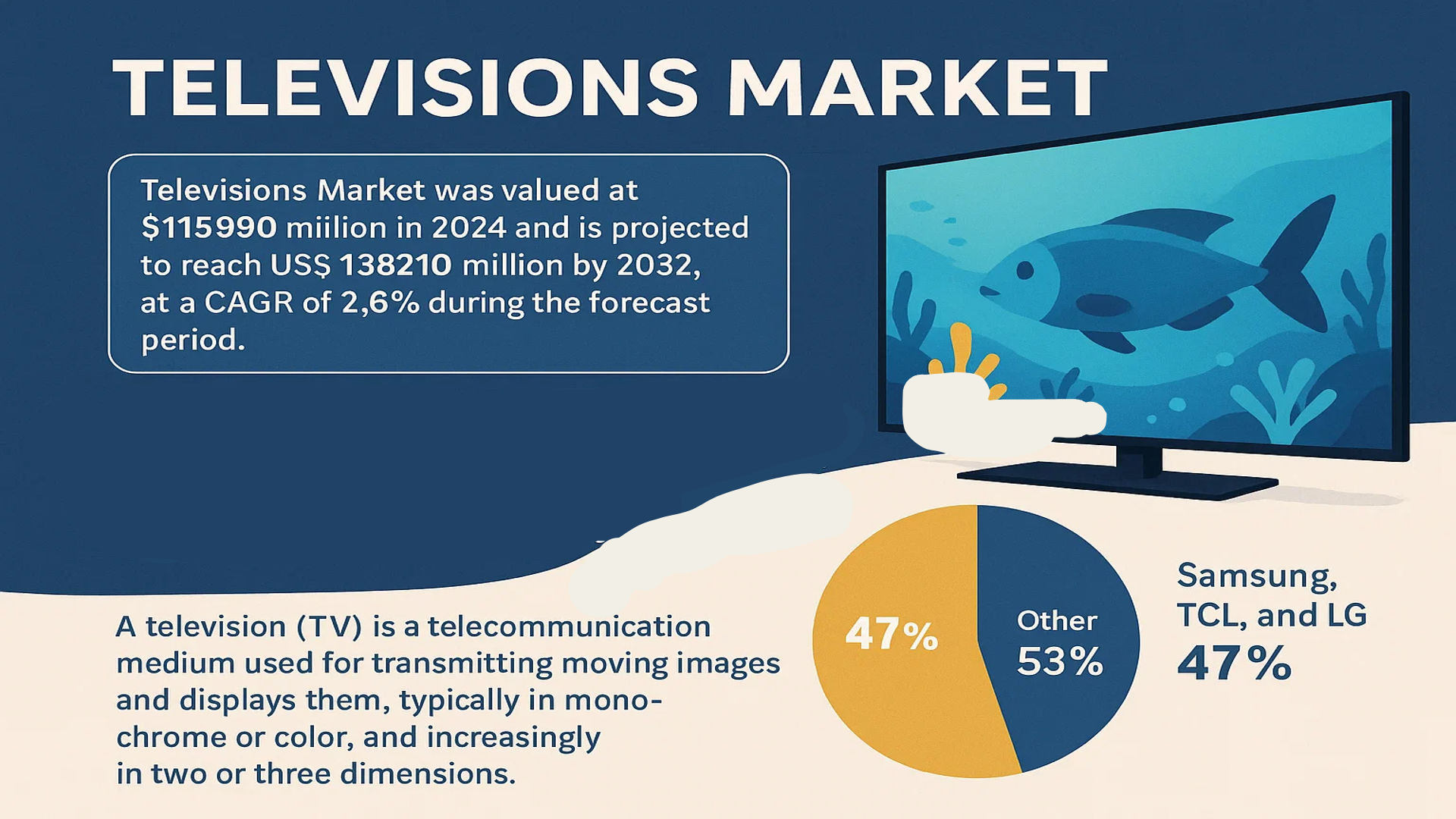
The global Televisions Market was valued at 115990 million in 2024 and is projected to reach US$ 138210 million by 2032, at a CAGR of 2.6% during the forecast period.
A television (TV) is a telecommunication medium used for transmitting moving images and sound. The term refers to the television set, a device that receives broadcast signals and displays them, typically in monochrome or color, and increasingly in two or three dimensions. The market is dominated by a few key players, with Samsung, TCL, and LG collectively holding approximately 47% of the global market share.
The market is experiencing steady growth driven primarily by technological advancements and evolving consumer preferences. The continuous innovation in display technologies, such as OLED, QD-OLED, Mini LED, and quantum dots, has significantly enhanced picture quality, offering features like ultra-high-definition resolution, HDR, and high refresh rates. This progression meets the rising consumer demand for a more immersive and realistic viewing experience. Furthermore, the market is bolstered by the increasing integration of smart functionalities and the shift towards larger screen sizes, particularly in the 55-inch and above segments.
MARKET DYNAMICS
MARKET DRIVERS
Advancements in Display Technologies to Propel Market Growth
The global televisions market is significantly driven by continuous innovations in display technologies, which enhance picture quality, color accuracy, and overall viewing experience. Technologies such as OLED, QD-OLED, Mini-LED, and quantum dots have revolutionized the industry by offering deeper blacks, higher contrast ratios, and more vibrant colors. OLED televisions, for instance, have seen a surge in adoption due to their self-emissive pixels, which eliminate the need for backlighting and allow for perfect black levels. The market for OLED TVs is projected to grow substantially, with shipments expected to exceed 6 million units annually by 2025. Additionally, the integration of high dynamic range (HDR) and refresh rates up to 120Hz provides a more immersive experience, catering to the demands of both entertainment enthusiasts and gamers. These technological advancements not only attract consumers seeking premium viewing experiences but also encourage upgrades from older models, thereby fueling market expansion.
Rising Consumer Demand for Smart and Connected Televisions
Consumer preferences have shifted towards smart and connected televisions that offer seamless integration with streaming services, voice assistants, and other smart home devices. The proliferation of over-the-top (OTT) platforms such as Netflix, Amazon Prime Video, and Disney+ has increased the demand for televisions with built-in smart capabilities. It is estimated that over 70% of televisions sold globally are now smart TVs, with this figure expected to rise as internet penetration and digital content consumption grow. Features such as 4K and 8K resolution support, along with user-friendly interfaces and AI-driven recommendations, enhance the appeal of these devices. Furthermore, the integration of voice control through assistants like Google Assistant and Amazon Alexa provides added convenience, making smart TVs a central hub for home entertainment. This trend is particularly prominent in developed regions, where consumers are willing to invest in advanced televisions to access a wide array of digital content.
Increasing Disposable Income and Urbanization in Emerging Markets
Economic growth and rising disposable incomes in emerging markets are key drivers for the televisions market. As urbanization accelerates, consumers in regions such as Asia-Pacific and Latin America are increasingly purchasing televisions as essential household appliances. The middle-class expansion in countries like India and China has led to higher spending on consumer electronics, including televisions. For example, the television penetration rate in urban Indian households has reached over 95%, with a growing preference for larger screen sizes and advanced features. Additionally, government initiatives promoting digitalization and the transition to high-definition broadcasting have further stimulated demand. The affordability of televisions has also improved due to competitive pricing and financing options, making them accessible to a broader audience. These factors collectively contribute to sustained market growth, particularly in regions with previously low adoption rates.
MARKET RESTRAINTS
High Production Costs and Price Sensitivity to Limit Market Penetration
Despite technological advancements, the high production costs associated with premium televisions, such as those featuring OLED and 8K resolution, pose a significant restraint. These costs are often passed on to consumers, resulting in higher retail prices that can deter price-sensitive segments. For instance, OLED TVs are typically priced 50-100% higher than comparable LED-LCD models, limiting their adoption to affluent consumers. In emerging markets, where budgets are constrained, consumers may opt for more affordable alternatives or delay upgrades. Additionally, fluctuations in the prices of key components, such as display panels and semiconductors, can impact manufacturing expenses and profit margins for brands. This price sensitivity is exacerbated by intense competition, which forces companies to balance innovation with affordability, sometimes at the expense of feature-rich models.
Market Saturation in Developed Regions to Slow Growth
Market saturation in developed regions, such as North America and Europe, presents a considerable challenge to growth. Television penetration in these areas is already high, with most households owning at least one TV, and replacement cycles are lengthening as consumers hold onto devices longer. The average replacement cycle for televisions has extended to 7-8 years, compared to 5-6 years a decade ago, due to the durability and satisfactory performance of existing models. This trend is compounded by the shift in consumer spending towards other electronics, such as smartphones and tablets, which offer portable entertainment options. As a result, growth in these regions relies heavily on technological upgrades and the adoption of new features, which may not be sufficient to drive significant volume increases. Manufacturers must therefore focus on emerging markets and niche segments to maintain momentum.
Regulatory and Environmental Compliance to Increase Operational Costs
Stringent regulatory requirements and environmental standards add complexity and cost to television manufacturing and distribution. Regulations governing energy efficiency, such as the Energy Star program in the United States and the Ecodesign Directive in the European Union, mandate stricter power consumption limits for televisions. Compliance often necessitates investments in research and development to produce energy-efficient models, which can increase production expenses. Additionally, regulations related to the use of hazardous substances, such as lead and mercury, and e-waste management require manufacturers to adopt environmentally friendly practices and materials. These compliance costs are ultimately reflected in product prices, potentially reducing competitiveness. Furthermore, trade policies and tariffs can disrupt supply chains and increase costs, particularly for companies operating across multiple regions.
MARKET CHALLENGES
Intense Competition and Price Wars to Squeeze Profit Margins
The televisions market is characterized by intense competition among established brands and new entrants, leading to price wars that erode profit margins. Major players like Samsung, LG, and TCL dominate the market, but they face pressure from low-cost manufacturers, particularly from China, who offer feature-rich televisions at competitive prices. This competition forces companies to continuously innovate while managing costs, which can be challenging given the high expenses associated with research and development. Price aggression is especially prevalent during seasonal sales and promotional events, where discounts of 20-30% are common, further compressing margins. Additionally, the rise of private-label brands and online-only models has intensified competition, making it difficult for companies to maintain pricing power and profitability.
Other Challenges
Supply Chain Disruptions
Global supply chain vulnerabilities, exacerbated by events such as the COVID-19 pandemic and geopolitical tensions, pose significant challenges. Disruptions in the availability of critical components, including display panels and semiconductors, can lead to production delays and increased costs. For example, semiconductor shortages have affected television manufacturing schedules, causing inventory shortages and longer lead times. These issues are compounded by logistical challenges and rising freight costs, which impact the timely delivery of products to markets.
Rapid Technological Obsolescence
The fast pace of technological innovation means that televisions can become obsolete quickly, challenging manufacturers to keep up with consumer expectations. New features and standards, such as 8K resolution and advanced HDR formats, are introduced frequently, rendering older models less desirable. This rapid obsolescence requires continuous investment in new technologies and product development, which can strain resources. Additionally, consumers may delay purchases in anticipation of newer models, creating fluctuations in demand and sales cycles.
MARKET OPPORTUNITIES
Expansion in Emerging Markets to Offer Significant Growth Potential
Emerging markets present substantial opportunities for growth, driven by increasing disposable incomes, urbanization, and rising demand for advanced televisions. Regions such as Asia-Pacific, Latin America, and Africa have lower television penetration rates compared to developed markets, indicating significant untapped potential. For example, in Southeast Asia, television ownership is growing at a rate of 5-7% annually, with a strong preference for large-screen and smart TVs. Companies can leverage this demand by offering products tailored to local preferences, such as affordable smart TVs with regional content partnerships. Additionally, government initiatives to improve digital infrastructure and broadcast quality are expected to boost adoption. By focusing on these markets, manufacturers can diversify their revenue streams and reduce dependence on saturated regions.
Integration of Advanced Features to Create New Revenue Streams
The integration of advanced features, such as artificial intelligence, gaming capabilities, and health-related applications, opens new revenue opportunities. AI-powered televisions can offer personalized content recommendations, voice control, and energy efficiency, enhancing user experience and differentiation. Gaming-oriented TVs with high refresh rates, low input lag, and compatibility with next-generation consoles are gaining popularity among gamers, a demographic with growing purchasing power. Furthermore, the incorporation of health and wellness features, such as built-in fitness apps and blue light reduction, appeals to health-conscious consumers. These innovations allow manufacturers to command premium prices and tap into niche segments, driving growth beyond traditional television functionality.
Sustainability Initiatives to Enhance Brand Value and Market Position
Sustainability and eco-friendly practices are increasingly important to consumers, presenting opportunities for brands to differentiate themselves. Developing energy-efficient televisions, using recyclable materials, and implementing responsible e-waste management programs can enhance brand reputation and appeal to environmentally conscious buyers. For instance, televisions with energy-saving modes can reduce power consumption by up to 30%, aligning with global sustainability goals. Companies that prioritize sustainability may also benefit from regulatory incentives and partnerships with green organizations. By adopting these practices, manufacturers can not only reduce their environmental impact but also attract a growing segment of consumers who value corporate responsibility, thereby strengthening their market position.
TELEVISIONS MARKET TRENDS
Advancements in Display Technology to Emerge as a Trend in the Market
Advancements in display technology, particularly the maturation of OLED (Organic Light-Emitting Diode) and the rapid adoption of Mini-LED backlighting, are fundamentally reshaping the television market and driving consumer upgrade cycles. These technologies deliver superior picture quality through perfect blacks, infinite contrast ratios, and enhanced brightness uniformity, creating a more immersive viewing experience. The market for OLED TVs is projected to grow significantly, with shipments expected to surpass 10 million units annually, as manufacturing yields improve and costs become more competitive. Furthermore, the emergence of QD-OLED, which combines quantum dots with OLED technology, offers even wider color gamuts and higher peak brightness, presenting a compelling high-end alternative. This relentless pursuit of visual fidelity is a primary catalyst for the premium segment of the market.
Other Trends
Smart TV Ecosystem Integration
The evolution of televisions into central hubs for home entertainment and smart home control is a dominant trend accelerating market expansion. Modern Smart TV platforms are no longer just for streaming; they integrate voice assistants, gaming services, and IoT device management, creating a seamless connected experience. Consumer demand for these integrated ecosystems is robust, with over 80% of TVs shipped now being smart-enabled. This shift is compelling manufacturers to invest heavily in proprietary operating systems and partnerships with content providers to offer exclusive features, thereby increasing the average selling price and creating new revenue streams through advertising and subscription services within the platform.
Rising Demand for Larger Screen Sizes
The consumer preference for larger screen sizes continues to be a powerful driver of market value, as viewers seek a more cinematic experience at home. While sets under 40 inches still hold volume share in price-sensitive markets, the revenue growth is overwhelmingly concentrated in sizes above 55 inches. The segment for televisions 70 inches and larger is the fastest-growing category, with annual growth rates exceeding 15%, as the price per inch for these large panels continues to fall. This trend is supported by the increasing availability of 4K and 8K content, which is best appreciated on a larger canvas, and the declining average selling prices of larger panels due to improved manufacturing efficiencies and scale.
Gaming-Centric Features as a Key Differentiator
The convergence of the television and gaming markets has emerged as a critical trend, with leading manufacturers now designing sets specifically to cater to the needs of console and PC gamers. Features such as 4K resolution at 120Hz refresh rates, Variable Refresh Rate (VRR), and Auto Low Latency Mode (ALLM) have become significant selling points. The next-generation gaming consoles released in recent years have amplified the demand for TVs that can fully utilize their graphical capabilities. Consequently, manufacturers are segmenting their product lines to include dedicated gaming models, a strategic move to capture a valuable and growing demographic of consumers who prioritize performance and are willing to pay a premium for it.
COMPETITIVE LANDSCAPE
Key Industry Players
Companies Leverage Technological Innovation and Strategic Positioning to Maintain Market Leadership
The global televisions market exhibits a semi-consolidated structure, characterized by intense competition among a mix of established multinational giants, ambitious regional champions, and niche-focused brands. This dynamic environment is primarily driven by rapid technological evolution, shifting consumer preferences towards smart and connected home ecosystems, and the relentless pursuit of superior picture quality. Market leadership is no longer solely defined by volume sales but increasingly by brand perception, technological prowess, and the ability to integrate seamlessly into the broader digital lifestyle.
Samsung Electronics consistently secures its position as the dominant force, commanding a significant portion of global revenue. Its leadership is anchored in a multi-pronged strategy: heavy investment in QLED and Neo QLED display technologies, a robust portfolio of 8K resolution models, and the deeply integrated Tizen OS smart platform. Furthermore, Samsung’s vast marketing reach and strong retail partnerships across North America, Europe, and Asia solidify its top-tier status. Close behind, LG Electronics maintains a formidable presence, primarily through its pioneering and widely acclaimed OLED TV technology, which is synonymous with superior contrast and image quality. LG’s webOS platform is also a key differentiator, praised for its user-friendly interface and content aggregation capabilities.
The competitive landscape has been notably reshaped by the rise of TCL and Hisense. These companies have successfully disrupted the market by offering feature-rich products, including QLED and Mini-LED models, at highly aggressive price points. Their growth strategy heavily relies on vertical integration, controlling key components like panels, which allows for greater cost efficiency and faster time-to-market. Their expansive presence in the Asia-Pacific region and growing footprint in North American and European markets make them formidable competitors, continually pressuring the margins of established players.
Meanwhile, Sony continues to leverage its heritage in imaging and processing to carve out a premium segment. The brand is revered for its Cognitive Processor XR, which delivers what many experts consider benchmark-setting picture and sound processing. While its market share by volume is smaller, its strength in the high-end market ensures strong profitability and brand prestige. Other players, including Xiaomi, are strengthening their positions by focusing on the smart home ecosystem integration, offering competitively priced TVs that act as a hub for controlling other IoT devices, thus appealing to a younger, tech-savvy demographic.
List of Key Television Manufacturers Profiled
- Samsung Electronics (South Korea)
- TCL Electronics (China)
- LG Electronics (South Korea)
- Hisense (China)
- Sony Corporation (Japan)
- Skyworth (China)
- TPV Technology (Philips+AOC) (Netherlands/Taiwan)
- Xiaomi (China)
- Sharp Corporation (Japan)
- Panasonic Corporation (Japan)
- Changhong (China)
- Haier (China)
- Vizio (United States)
- Konka (China)
- Funai (Japan)
Segment Analysis:
By Display Technology
OLED Segment Leads Due to Superior Picture Quality and Consumer Demand for Premium Viewing Experiences
The market is segmented based on display technology into:
- OLED (Organic Light Emitting Diode)
- QLED (Quantum Dot Light Emitting Diode)
- LED/LCD (Light Emitting Diode/Liquid Crystal Display)
- MicroLED
- Others (including Plasma and Projection)
By Screen Size
40-50 Inches Segment Dominates as it Offers the Optimal Balance Between Viewing Immersion and Space Constraints
The market is segmented based on screen size into:
- Under 40 Inches
- 40-50 Inches
- 51-60 Inches
- 61-70 Inches
- Above 70 Inches
By Resolution
4K Ultra HD Segment Holds Major Share Driven by Content Availability and Declining Price Points
The market is segmented based on resolution into:
- HD (720p/1080p)
- Full HD (1080p)
- 4K Ultra HD (2160p)
- 8K Ultra HD (4320p)
By Application
Residential Segment Commands the Largest Market Share Fueled by Global Household Penetration and Replacement Cycles
The market is segmented based on application into:
- Residential
- Commercial
- Subtypes: Hospitality, Retail, Corporate, and others
Regional Analysis: Televisions Market
Asia-Pacific
The Asia-Pacific region dominates the global televisions market, accounting for the largest volume share due to massive manufacturing hubs and high domestic consumption. Led by China, which produces over 70% of the world’s television sets, and supported by strong demand in India, Japan, and South Korea, the region benefits from extensive supply chain integration and cost-effective production. While budget-friendly LED TVs remain popular in price-sensitive markets, there is a significant and growing shift toward premium technologies like OLED, QLED, and 8K resolution, particularly in urban centers. Rising disposable incomes, rapid urbanization, and the expansion of streaming services are key growth drivers. However, market saturation in developed areas and intense price competition among local and global brands present ongoing challenges.
North America
North America represents a mature but high-value market characterized by strong demand for advanced, large-screen televisions. The United States is the largest contributor, with consumers showing a clear preference for screens above 50 inches and features such as 4K/8K resolution, smart TV capabilities, and integration with home automation systems. Replacement cycles are shortening due to rapid technological innovation, with brands like Samsung, LG, and Vizio competing fiercely on both quality and price. Sustainability concerns are also becoming more influential, leading to increased interest in energy-efficient models. While market growth is slower than in emerging regions, steady demand is sustained by high household penetration rates and a culture that values home entertainment.
Europe
Europe is a technologically advanced and highly competitive television market, with Western European nations like Germany, the UK, and France leading in adoption of premium products. Consumer preferences strongly favor high-quality displays, including OLED and QLED technologies, with a notable trend toward larger screen sizes and enhanced sound systems. The market is heavily influenced by stringent EU energy efficiency regulations and environmental standards, which drive innovation in eco-design and power consumption. While replacement sales form the core of demand, growth is also supported by the rising popularity of gaming-oriented TVs with high refresh rates. Economic volatility in some Southern and Eastern European countries, however, tempers overall growth and maintains a segment for value-oriented models.
South America
The South American television market is gradually expanding, driven primarily by economic recovery and increasing digitalization in countries like Brazil and Argentina. Consumer demand is largely focused on entry-level and mid-range LED TVs, as economic constraints limit widespread adoption of premium technologies. The region shows potential for growth due to rising disposable incomes and the ongoing transition from analog to digital broadcasting. However, market development is hindered by currency fluctuations, import dependencies, and inconsistent regulatory environments. Local assembly is growing in some countries to avoid import tariffs, but international brands still dominate the landscape, competing closely on affordability and basic smart features.
Middle East & Africa
The Middle East & Africa region is an emerging market with varied growth patterns. Gulf Cooperation Council (GCC) countries, such as the UAE and Saudi Arabia, exhibit strong demand for luxury and large-screen televisions, driven by high per capita income and a preference for premium home electronics. In contrast, African markets are more price-sensitive, with demand centered on smaller, affordable LED models. Infrastructure development, urbanization, and the growing availability of streaming services are creating new opportunities. However, the market faces challenges such as limited purchasing power in many areas, logistical complexities, and political instability in certain regions. Despite these hurdles, long-term growth prospects remain positive as digital connectivity improves.
Report Scope
This market research report provides a comprehensive analysis of the global and regional Televisions markets, covering the forecast period 2025–2032. It offers detailed insights into market dynamics, technological advancements, competitive landscape, and key trends shaping the industry.
Key focus areas of the report include:
- Market Size & Forecast: Historical data and future projections for revenue, unit shipments, and market value across major regions and segments.
- Segmentation Analysis: Detailed breakdown by screen size, technology, application, and end-user industry to identify high-growth segments and investment opportunities.
- Regional Outlook: Insights into market performance across North America, Europe, Asia-Pacific, Latin America, and the Middle East & Africa, including country-level analysis where relevant.
- Competitive Landscape: Profiles of leading market participants, including their product offerings, R&D focus, manufacturing capacity, pricing strategies, and recent developments such as mergers, acquisitions, and partnerships.
- Technology Trends & Innovation: Assessment of emerging technologies, integration of AI/IoT, display technology trends, fabrication techniques, and evolving industry standards.
- Market Drivers & Restraints: Evaluation of factors driving market growth along with challenges, supply chain constraints, regulatory issues, and market-entry barriers.
- Stakeholder Analysis: Insights for component suppliers, OEMs, system integrators, investors, and policymakers regarding the evolving ecosystem and strategic opportunities.
Primary and secondary research methods are employed, including interviews with industry experts, data from verified sources, and real-time market intelligence to ensure the accuracy and reliability of the insights presented.
FREQUENTLY ASKED QUESTIONS:
What is the current market size of Global Televisions Market?
-> Televisions Market was valued at 115990 million in 2024 and is projected to reach US$ 138210 million by 2032, at a CAGR of 2.6% during the forecast period.
Which key companies operate in Global Televisions Market?
-> Key players include Samsung, TCL, LG, Hisense, Sony, Xiaomi, Panasonic, Sharp, Skyworth, and Vizio, among others.
What are the key growth drivers?
-> Key growth drivers include technological advancements in display technologies, rising consumer demand for larger screens and smart features, urbanization, and increasing disposable incomes.
Which region dominates the market?
-> Asia-Pacific dominates the global televisions market, driven by strong manufacturing presence and high consumer demand in countries like China, India, and South Korea.
What are the emerging trends?
-> Emerging trends include integration of AI and IoT capabilities, adoption of 8K resolution, growth of OLED and QLED technologies, and development of eco-friendly and energy-efficient television models.

Get Sample Report PDF for Exclusive Insights
Report Sample Includes
- Table of Contents
- List of Tables & Figures
- Charts, Research Methodology, and more...
 Download Sample Report PDF