The Global SMD Potentiometer Market size was estimated at USD 446.30 million in 2023 and is projected to reach USD 651.91 million by 2032, exhibiting a CAGR of 4.30% during the forecast period.
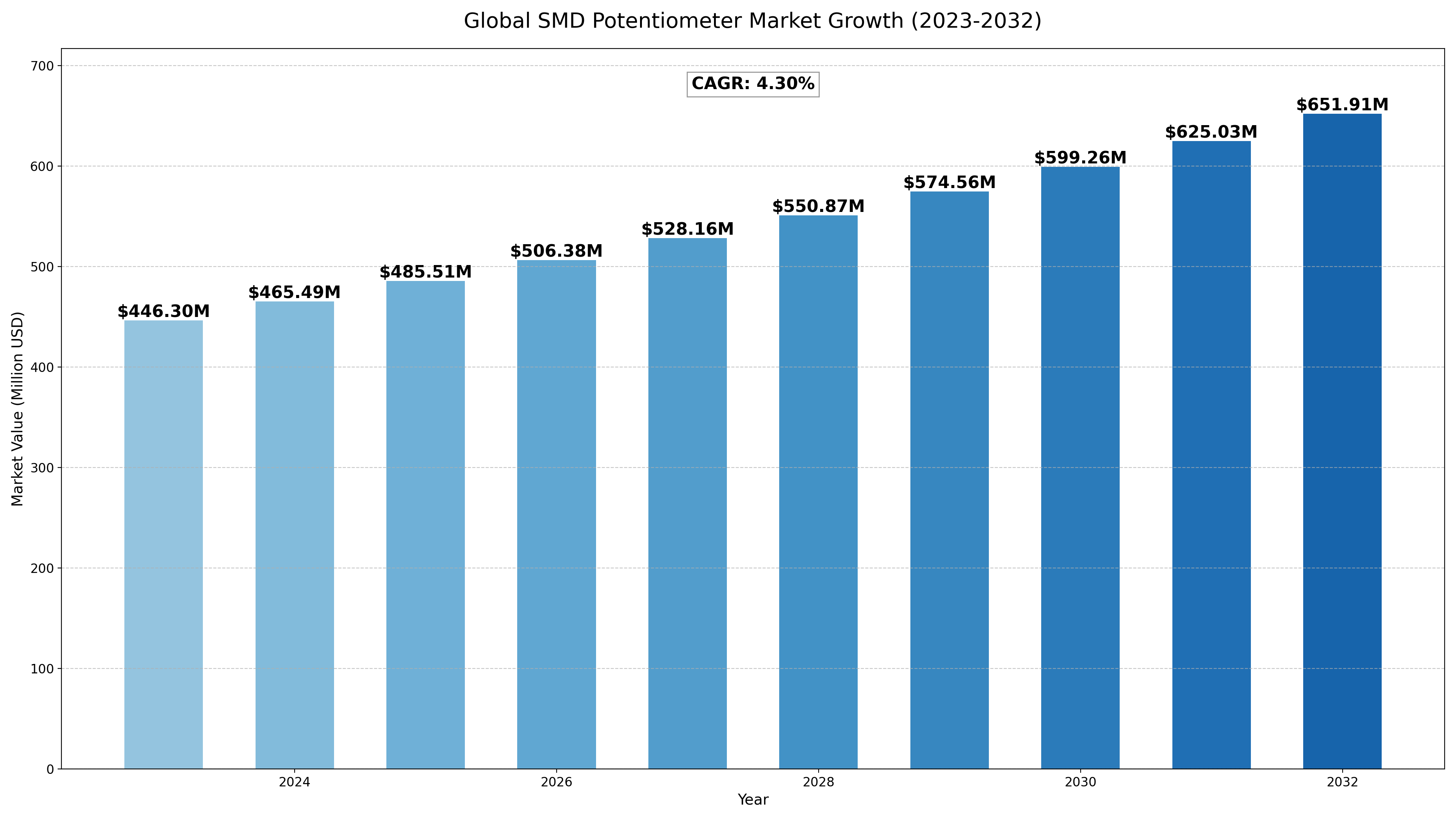
North America SMD Potentiometer market size was estimated at USD 125.02 million in 2023, at a CAGR of 3.69% during the forecast period of 2025 through 2032.
An SMD potentiometer is a type of variable resistor designed to be mounted directly onto the surface of a printed circuit board (PCB). It is used to adjust voltage or current in electronic circuits, allowing users to control parameters such as volume, brightness, or sensitivity. SMD potentiometers are compact, durable, and widely used in devices like consumer electronics, automotive systems, and industrial controls.
Report Overview
It can adjust electronic circuits and manage system tolerances and parameters as needed.
This report provides a deep insight into the global SMD Potentiometer market covering all its essential aspects. This ranges from a macro overview of the market to micro details of the market size, competitive landscape, development trend, niche market, key market drivers and challenges, SWOT analysis, value chain analysis, etc.
The analysis helps the reader to shape the competition within the industries and strategies for the competitive environment to enhance the potential profit. Furthermore, it provides a simple framework for evaluating and accessing the position of the business organization. The report structure also focuses on the competitive landscape of the Global SMD Potentiometer Market, this report introduces in detail the market share, market performance, product situation, operation situation, etc. of the main players, which helps the readers in the industry to identify the main competitors and deeply understand the competition pattern of the market.
In a word, this report is a must-read for industry players, investors, researchers, consultants, business strategists, and all those who have any kind of stake or are planning to foray into the SMD Potentiometer market in any manner.
Global SMD Potentiometer Market: Market Segmentation Analysis
The research report includes specific segments by region (country), manufacturers, Type, and Application. Market segmentation creates subsets of a market based on product type, end-user or application, Geographic, and other factors. By understanding the market segments, the decision-maker can leverage this targeting in the product, sales, and marketing strategies. Market segments can power your product development cycles by informing how you create product offerings for different segments.
Key Company
- Microchip Technology
- Analog Devices
- ON Semiconductor
- Maxim Integrated
- TI
- Renesas
- Infineon Technologies
- Digital
- Analog
- Industrial
- Commercial
- North America (USA, Canada, Mexico)
- Europe (Germany, UK, France, Russia, Italy, Rest of Europe)
- Asia-Pacific (China, Japan, South Korea, India, Southeast Asia, Rest of Asia-Pacific)
- South America (Brazil, Argentina, Columbia, Rest of South America)
- The Middle East and Africa (Saudi Arabia, UAE, Egypt, Nigeria, South Africa, Rest of MEA)
- Industry drivers, restraints, and opportunities covered in the study
- Neutral perspective on the market performance
- Recent industry trends and developments
- Competitive landscape & strategies of key players
- Potential & niche segments and regions exhibiting promising growth covered
- Historical, current, and projected market size, in terms of value
- In-depth analysis of the SMD Potentiometer Market
- Overview of the regional outlook of the SMD Potentiometer Market:
- Access to date statistics compiled by our researchers. These provide you with historical and forecast data, which is analyzed to tell you why your market is set to change
- This enables you to anticipate market changes to remain ahead of your competitors
- You will be able to copy data from the Excel spreadsheet straight into your marketing plans, business presentations, or other strategic documents
- The concise analysis, clear graph, and table format will enable you to pinpoint the information you require quickly
- Provision of market value data for each segment and sub-segment
- Indicates the region and segment that is expected to witness the fastest growth as well as to dominate the market
- Analysis by geography highlighting the consumption of the product/service in the region as well as indicating the factors that are affecting the market within each region
- Competitive landscape which incorporates the market ranking of the major players, along with new service/product launches, partnerships, business expansions, and acquisitions in the past five years of companies profiled
- Extensive company profiles comprising of company overview, company insights, product benchmarking, and SWOT analysis for the major market players
- The current as well as the future market outlook of the industry concerning recent developments which involve growth opportunities and drivers as well as challenges and restraints of both emerging as well as developed regions
- Includes in-depth analysis of the market from various perspectives through Porters five forces analysis
- Provides insight into the market through Value Chain
- Market dynamics scenario, along with growth opportunities of the market in the years to come
- 6-month post-sales analyst support
Customization of the Report
In case of any queries or customization requirements, please connect with our sales team, who will ensure that your requirements are met.
Drivers:
- Rising Demand for Miniaturization in Electronic Devices: The ongoing trend of miniaturization in electronic devices, such as smartphones, wearables, and consumer electronics, has driven the demand for Surface Mount Device (SMD) components. SMD potentiometers, with their compact size and efficient functionality, are ideally suited for these applications.
- Increased Adoption in Automotive Applications: With the growing use of electronic control systems in vehicles (e.g., climate control, seat adjustment, and infotainment systems), SMD potentiometers are becoming integral in automotive electronics for precise control of various settings.
- Automation and IoT Growth: The proliferation of the Internet of Things (IoT) and automation systems in industries such as smart homes, industrial controls, and medical devices further boosts the demand for SMD potentiometers. Their precise and reliable performance in sensors and controllers makes them highly valuable.
- Cost-effectiveness: SMD potentiometers offer a cost-effective solution compared to traditional through-hole potentiometers due to their smaller size and ease of integration in automated manufacturing processes, driving their adoption across different industries.
- Technological Advancements in Electronics: Continuous advancements in semiconductor technology, leading to more compact and efficient designs for electronic devices, have also contributed to the growing popularity of SMD potentiometers.
Restraints:
- Limited Precision Compared to Other Control Systems: SMD potentiometers, while versatile, often have limitations in terms of precision and durability compared to other technologies like digital or encoder-based controls. This can restrict their use in high-precision applications, such as certain medical and industrial systems.
- Complex Calibration: While SMD potentiometers are compact, their small size can make them more difficult to calibrate or adjust accurately. This adds to the complexity of manufacturing and may limit their adoption in some highly sensitive applications.
- Competition from Digital Potentiometers: The rising adoption of digital potentiometers, which offer greater precision, flexibility, and programmable control, poses a significant challenge to the SMD potentiometer market. Digital potentiometers are also more robust and can be integrated into smart systems with ease, thus limiting the growth potential of SMD potentiometers.
- Environmental Sensitivity: SMD potentiometers can be susceptible to wear and tear, especially in harsh environments or applications with high vibration, moisture, or temperature fluctuations. This may limit their usage in outdoor, automotive, or industrial environments.
Opportunities:
- Expanding Consumer Electronics Market: The ever-expanding consumer electronics market offers significant opportunities for SMD potentiometers, especially in portable devices, audio equipment, and gaming systems where precise volume or power control is required.
- Integration with Smart Technologies: The increasing focus on smart devices and automation presents opportunities for SMD potentiometers to be integrated into a wide range of products, from smart home devices to industrial automation systems. Their use in touch control panels and user interfaces for smart devices is set to grow.
- Growth in Medical Devices: The rising demand for wearable medical devices and other portable health-monitoring equipment opens new avenues for SMD potentiometers, particularly in devices that require precise adjustments for calibration and control.
- Emerging Markets: As emerging economies continue to grow, the demand for consumer electronics, automotive applications, and industrial automation is expected to rise, providing a substantial market for SMD potentiometers. The shift towards low-cost electronics in these regions will also drive the demand for cost-effective SMD potentiometers.
- Sustainability Trends: With increasing focus on sustainability and energy efficiency, SMD potentiometers can find new applications in green technologies, such as energy-efficient lighting systems and renewable energy control systems, where precise control and miniaturization are key factors.
Challenges:
- Technological Obsolescence: The rapid pace of technological advancements in the electronic components industry may lead to obsolescence for SMD potentiometers. Emerging alternatives like digital potentiometers and capacitive touch controls could replace them in many applications, posing a threat to market growth.
- Supply Chain Disruptions: The global supply chain issues, particularly the shortage of raw materials and semiconductors, can impact the production and availability of SMD potentiometers. These disruptions can increase manufacturing costs and lead to delays in product availability.
- Price Sensitivity in Consumer Electronics: While SMD potentiometers are cost-effective, their pricing still faces downward pressure in highly competitive sectors, especially in consumer electronics. Manufacturers must balance cost reductions with maintaining quality, which can sometimes limit profitability.
- Regulatory Challenges: Compliance with industry-specific standards and regulations in sectors such as automotive, aerospace, and medical devices could add complexity to the production of SMD potentiometers, potentially leading to higher development costs and time delays.

Get Sample Report PDF for Exclusive Insights
Report Sample Includes
- Table of Contents
- List of Tables & Figures
- Charts, Research Methodology, and more...
 Download Sample Report PDF