MARKET INSIGHTS
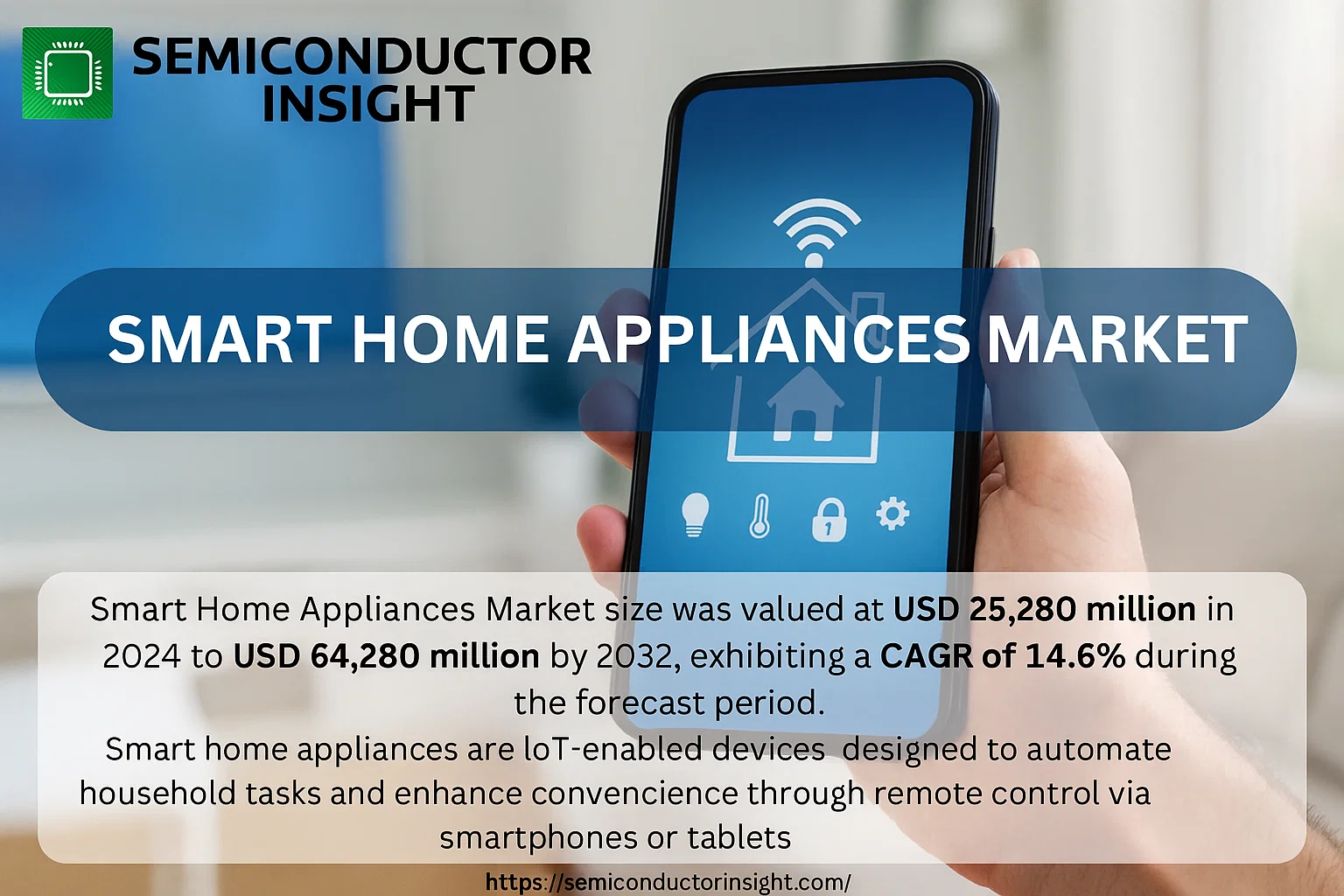
Global Smart Home Appliances Market size was valued at USD 25,280 million in 2024 to USD 64,280 million by 2032, exhibiting a CAGR of 14.6% during the forecast period.
Smart home appliances are IoT-enabled devices designed to automate household tasks and enhance convenience through remote control via smartphones or tablets. These devices include smart air conditioners, heaters, washing machines, refrigerators, large cookers, dishwashers, vacuum cleaners, and other connected appliances that optimize energy efficiency and user experience. Leading manufacturers such as Samsung, GE, Whirlpool, and LG dominate the market, collectively holding a 59% share globally.
Market growth is driven by increasing adoption of IoT technologies, rising disposable incomes, and growing consumer demand for energy-efficient solutions. While North America currently leads in market share with nearly 30% of global consumption, Europe follows closely at 29%, reflecting strong regional demand for smart home innovations. Furthermore, advancements in AI integration and voice-controlled assistants like Alexa and Google Home are accelerating market expansion, making smart appliances more accessible to mainstream consumers.
MARKET DRIVERS
Rising Consumer Demand for Convenience and Energy Efficiency
The primary driver for the smart home appliances market is the growing consumer preference for convenience, remote monitoring, and energy management. Modern lifestyles demand solutions that save time and provide greater control over the home environment, fueling the adoption of connected appliances such as smart refrigerators, thermostats, and washing machines. Furthermore, increasing awareness about energy conservation and the potential for utility bill savings through smart, energy-efficient devices is compelling consumers to upgrade their household appliances.
Proliferation of IoT and AI Technologies
The integration of Internet of Things (IoT) and Artificial Intelligence (AI) is fundamentally transforming standard appliances into intelligent systems that can learn user habits and automate tasks. The expanding ecosystem of interoperable smart home platforms, like those from Amazon, Google, and Apple, creates a seamless user experience, encouraging broader adoption. The market is further accelerated by the rollout of 5G networks, which enhance the reliability and speed of connectivity for a multitude of smart devices.
➤ Consumer surveys indicate that over 40% of households in developed economies are actively considering purchasing a smart appliance within the next two years, highlighting the strong market momentum.
Government initiatives promoting smart cities and the development of supportive infrastructure are also contributing to market growth by creating a favorable ecosystem for connected home technologies.
MARKET CHALLENGES
High Initial Costs and Consumer Price Sensitivity
A significant challenge is the high upfront cost of smart appliances compared to their conventional counterparts. This price premium can deter cost-conscious consumers, particularly in price-sensitive and developing markets. The total cost of ownership, which may include subscriptions for advanced features or required ecosystem hubs, can further limit mass-market penetration.
Other Challenges
Interoperability and Fragmentation
The lack of universal standards often leads to interoperability issues, where devices from different manufacturers do not work seamlessly together, causing consumer frustration and hindering the creation of a unified smart home experience.
Data Privacy and Security Vulnerabilities
Connected appliances collect vast amounts of personal data, making them potential targets for cyberattacks. Persistent concerns about data privacy and the security of connected homes remain a major barrier to consumer trust and adoption.
MARKET RESTRAINTS
Economic Uncertainty and Inflationary Pressures
Global economic volatility and rising inflation are restraining market growth by impacting consumer discretionary spending. During periods of economic downturn, purchases of non-essential, premium-priced smart appliances are often delayed or cancelled, as households prioritize essential expenses. Supply chain disruptions can also lead to increased product costs and limited availability, further dampening market growth.
Technical Complexity and User Experience Hurdles
The perceived complexity of installation, setup, and daily use of smart appliances can be a significant restraint, especially for less tech-savvy consumers. A poor initial user experience, including complicated pairing processes and unreliable connectivity, can lead to product returns and negative word-of-mouth, slowing down the adoption curve.
MARKET OPPORTUNITIES
Expansion in Emerging Economies
Rapid urbanization, growing middle-class populations, and increasing internet penetration in emerging economies present a substantial growth opportunity. As infrastructure improves and disposable incomes rise, these regions are expected to become key growth markets for affordable and entry-level smart appliances, offering significant potential for market expansion.
Advancements in Predictive Maintenance and Services
Smart appliances equipped with sensors and AI offer opportunities for predictive maintenance, alerting users and service providers to potential failures before they occur. This opens up new revenue streams for manufacturers through value-added subscription services, extended warranties, and proactive customer support, enhancing brand loyalty and creating a circular economy model.
Integration with Renewable Energy Systems
The growing focus on sustainability is driving opportunities for smart appliances that can integrate with home solar power systems and smart grids. Appliances that can automatically operate during off-peak energy hours or when solar generation is highest offer compelling value propositions, aligning with global decarbonization goals and attracting environmentally conscious consumers.
Main Smart Home Appliances Market Trends
Rapid Market Expansion Fueled by Connectivity
The global Smart Home Appliances market is undergoing a period of exceptional growth, projected to expand from a valuation of $25,280 million in 2024 to an estimated $64,280 million by 2032. This represents a compound annual growth rate (CAGR) of 14.6%. The core trend driving this expansion is the increasing consumer demand for convenience, energy efficiency, and remote control capabilities. The ability to manage household tasks via smartphones and tablets is becoming a standard expectation, fueling adoption across a broad range of devices including smart air conditioners, washing machines, refrigerators, and large cookers. North America currently leads in consumption with nearly 30% of the global market, closely followed by Europe with a 29% share.
Other Trends
Consolidation and Competitive Landscape
The market is characterized by a high degree of concentration among a few key players. The top four manufacturers—Samsung, GE, Whirlpool, and LG—collectively hold a dominant 59% market share. This consolidation trend encourages intense competition focused on innovation, integration with broader smart home ecosystems like Amazon Alexa and Google Assistant, and the development of new product features. This competitive pressure is accelerating the pace of technological advancement and feature rollout across all product categories.
Segmentation and Specialization
Growth potential varies across different product segments. The market is segmented by application into key areas such as Cooking, Food Storage, Cleaning, and House Maintenance. Each segment is experiencing unique trends; for example, smart food storage appliances are integrating features like inventory tracking and expiration alerts, while cleaning appliances are becoming more autonomous through advanced robotics. Manufacturers are increasingly specializing in these segments to capture niche markets and address specific consumer needs more effectively.
Regional Growth Diversification
While North America and Europe are currently the largest markets, significant growth potential exists in the Asia-Pacific region. Countries like China, Japan, and South Korea are emerging as major consumption hubs, driven by rising disposable incomes, rapid urbanization, and strong local manufacturing presence from companies like Haier and Midea. This geographical diversification trend is prompting global manufacturers to tailor their products and marketing strategies to meet the specific demands and infrastructure realities of different regional markets.
COMPETITIVE LANDSCAPE
Key Industry Players
A Market Dominated by Established Electronics and Appliance Giants
The global Smart Home Appliances market is characterized by a high level of consolidation, with the top four manufacturers—Samsung, GE, Whirlpool, and LG—collectively commanding a formidable 59% market share. These industry titans leverage their extensive brand recognition, robust global distribution networks, and significant investment in research and development to maintain their leadership. Their product portfolios are comprehensive, covering key categories such as smart refrigerators, washing machines, air conditioners, and large cookers, often integrated into broader smart home ecosystems. Competition revolves around technological innovation, energy efficiency, connectivity features, and the user experience provided by companion mobile applications, creating a dynamic environment where scale and continuous innovation are critical to sustaining a competitive edge.
Beyond the dominant players, a number of other significant companies compete effectively in specific niches or regional markets. European manufacturers like BSH (parent of Bosch and Siemens) and Electrolux hold strong positions, particularly in the premium appliance segment, renowned for their engineering and design. Similarly, Japanese conglomerate Panasonic is a key player, especially in the Asian market. The segment for smaller, specialized smart appliances, such as robotic vacuum cleaners, is led by companies like iRobot, Ecovacs, and Neato. Furthermore, major Chinese manufacturers including Haier, Midea, and Hisense are increasingly influential on the global stage, competing aggressively on price and innovation, which intensifies competition across all product categories and price points.
List of Key Smart Home Appliances Companies Profiled
- Samsung
- BSH Hausgeräte GmbH
- GE Appliances
- Whirlpool Corporation
- LG Electronics
- Electrolux
- Panasonic Corporation
- Miele & Cie
- Philips
- iRobot Corporation
- Ecovacs Robotics
- Neato Robotics
- Haier Group
- Midea Group
- Hisense
Segment Analysis:
| Segment Category | Sub-Segments | Key Insights |
| By Type |
|
Smart Washing and Drying appliances represent a cornerstone of the market, demonstrating robust consumer demand driven by the universal need for efficient laundry solutions. The integration of features such as remote monitoring, energy optimization, and automated detergent dispensing offers significant value by saving time and resources. This segment’s leadership is further reinforced by continuous innovation from major manufacturers, focusing on connectivity with broader smart home ecosystems and advanced fabric care technologies that appeal to a wide demographic. Market dynamics indicate that convenience and tangible utility are paramount, with this category excelling in delivering both. |
| By Application |
|
Cleaning applications are experiencing the most dynamic growth within the smart home ecosystem, propelled by the high adoption of robotic vacuum cleaners and smart washing machines. The appeal lies in the direct addressal of routine, time-consuming chores, offering consumers unprecedented levels of automation and convenience. This segment benefits from strong consumer awareness and rapid technological advancements in navigation, suction power, and integration with virtual assistants. The market trajectory suggests that automation of mundane tasks is a primary driver for smart home adoption, with cleaning applications sitting at the forefront of this trend due to their immediate and visible impact on daily life. |
| By End User |
|
Residential Households constitute the dominant end-user segment, forming the core consumer base for smart home appliances. The primary drivers include the growing desire for convenience, energy efficiency, and enhanced home management. Early adopters are typically tech-savvy individuals and families seeking to modernize their living spaces, but the market is rapidly expanding to include a broader audience as prices become more competitive and interoperability between devices improves. The trend towards urbanization and the increasing value placed on time-saving solutions are powerful forces sustaining strong, long-term demand from this critical segment. |
| By Connectivity Protocol |
|
Wi-Fi is the leading connectivity protocol, favored for its ubiquity and ease of integration without requiring additional hardware. The dominance of Wi-Fi is driven by its direct connection to existing home networks, allowing for straightforward smartphone control and cloud-based features. While protocols like Zigbee and Z-Wave offer advantages in creating robust mesh networks for extensive smart homes, the convenience and widespread availability of Wi-Fi make it the default choice for most consumers, particularly for primary, high-usage appliances. The market trend is towards ensuring broad compatibility with major voice assistants and platforms that primarily operate over Wi-Fi. |
| By Distribution Channel |
|
Online Retail channels are increasingly becoming the primary avenue for purchasing smart home appliances. The growth of e-commerce is propelled by the ability of online platforms to offer extensive product comparisons, detailed customer reviews, and competitive pricing. For technology-driven products, the online space provides an ideal environment for educating consumers about complex features and interoperability. This channel also caters perfectly to the demographic of early adopters who are comfortable with digital research and transactions. While brick-and-mortar stores remain crucial for demonstrating products, the convenience and informational depth of online retail are driving its leadership position. |
Regional Analysis: Smart Home Appliances Market
There is a deep-rooted consumer understanding of the benefits of smart home technology, from remote control via smartphones to voice-activated commands. This tech-savvy base is eager to upgrade traditional appliances, viewing them as integral to a modern, connected lifestyle focused on convenience and security.
The region benefits from a sophisticated retail environment where smart appliances are prominently featured and demonstrated. Furthermore, seamless integration within larger smart home ecosystems (e.g., integrating a smart refrigerator with a digital assistant for shopping lists) is a standard expectation, pushing manufacturers towards greater interoperability.
A significant market driver is the demand for energy-efficient appliances that help reduce utility bills and environmental impact. Smart thermostats, energy-monitoring plugs, and connected laundry units that optimize water and electricity usage are particularly popular, aligning with both consumer values and regulatory standards.
The market is characterized by fierce competition among established appliance brands and new tech entrants, leading to rapid innovation cycles. This environment fosters a trend towards premiumization, with consumers willing to pay more for appliances offering advanced features, superior design, and robust connected services.
Europe
The European market for smart home appliances is mature and rapidly expanding, shaped by strong environmental consciousness and a push for energy efficiency driven by EU-wide regulations. Markets in Western Europe, such as Germany, the UK, and France, lead the adoption, with consumers valuing appliances that offer precise control over energy consumption and integration with home energy management systems. The diverse nature of the region, including varying housing styles and consumer preferences, creates demand for a wide range of products. Data privacy and security are paramount concerns for European consumers, influencing product design and marketing strategies. The market sees growth in smart heating controls, connected large kitchen appliances, and security-focused devices, all aligning with the regional emphasis on sustainability, safety, and quality of life.
Asia-Pacific
The Asia-Pacific region represents the fastest-growing market for smart home appliances, fueled by rising urbanization, a burgeoning middle class, and increasing internet penetration. China is the dominant force, with local tech giants driving innovation and offering affordable, ecosystem-based solutions. Countries like South Korea and Japan are characterized by high technological adoption and a preference for compact, multifunctional appliances suitable for urban living. In emerging economies across Southeast Asia and India, growth is driven by increasing affordability and the appeal of basic smart features that offer convenience and status. The regional dynamic is diverse, ranging from sophisticated, integrated smart homes in developed nations to the initial adoption of single smart devices in developing markets, presenting a vast and varied growth trajectory.
South America
The smart home appliance market in South America is in a developing stage, with growth concentrated in major urban centers in countries like Brazil and Argentina. Economic volatility remains a challenge, but a growing middle class with increasing disposable income is showing interest in smart devices that offer security and convenience. Initial adoption often focuses on entry-level products like smart plugs, lighting, and security cameras rather than full-scale integrated systems. Market growth is influenced by improving internet infrastructure and the gradual entry of international brands. Consumer interest is primarily driven by the perceived benefits of home security and remote monitoring, with energy-efficient features becoming increasingly important due to rising electricity costs in the region.
Middle East & Africa
The market in the Middle East & Africa is nascent but displays significant potential, particularly in the affluent Gulf Cooperation Council (GCC) countries. High disposable incomes, hot climates driving demand for smart climate control, and a focus on luxury and convenience are key drivers in the Middle East. Smart appliances are often part of high-end residential projects. In contrast, the African market is largely untapped, with growth potential lying in urban areas where improving mobile connectivity could leapfrog traditional adoption paths. Challenges include infrastructure limitations and economic constraints outside of wealthier nations. The regional dynamic is thus a tale of two speeds: rapid adoption in luxury segments of the Middle East versus slow, foundational growth focused on basic connectivity in parts of Africa.
Report Scope
This market research report provides a comprehensive analysis of the Smart Home Appliances Market , covering the forecast period 2025–2032. It offers detailed insights into market dynamics, technological advancements, competitive landscape, and key trends shaping the industry.
Key focus areas of the report include:
- Market Overview: The report begins with an overview outlining its current market scenario, key growth indicators, and industry transformation drivers. It discusses macroeconomic factors, demand–supply balance, regulatory landscape, and the strategic role of semiconductors in powering advancements across industries such as automotive, telecommunications, consumer electronics, and industrial automation.
- Market Size & Forecast: Historical data and future projections for revenue, unit shipments, and market value across major regions and segments.
- Segmentation Analysis: Detailed breakdown by product type, technology, application, and end-user industry to identify high-growth segments and investment opportunities.
- Regional Insights: Insights into market performance across North America, Europe, Asia-Pacific, Latin America, and the Middle East & Africa, including country-level analysis where relevant.
- Competitive Landscape: Profiles of leading market participants, including their product offerings, R&D focus, manufacturing capacity, pricing strategies, and recent developments such as mergers, acquisitions, and partnerships.
- Technology Trends & Innovation: Assessment of emerging technologies, integration of AI/IoT, semiconductor design trends, fabrication techniques, and evolving industry standards.
- Market Drivers & Restraints: Evaluation of factors driving market growth along with challenges, supply chain constraints, regulatory issues, and market-entry barriers.
- Stakeholder Insights: Insights for component suppliers, OEMs, system integrators, investors, and policymakers regarding the evolving ecosystem and strategic opportunities.
Primary and secondary research methods are employed, including interviews with industry experts, data from verified sources, and real-time market intelligence to ensure the accuracy and reliability of the insights presented.
FREQUENTLY ASKED QUESTIONS:
What is the current market size of Smart Home Appliances Market?
-> Global Smart Home Appliances Market was valued at USD 25,280 million in 2024 and is projected to reach USD 64,280 million by 2032, at a CAGR of 14.6% during the forecast period.
Which key companies operate in Smart Home Appliances Market?
-> Key players include Samsung, GE, Whirlpool, LG, Electrolux, Panasonic, and Haier, among others. The top four global smart home appliance manufacturers are Samsung, GE, Whirlpool, and LG, with a combined market share of 59 percent.
What are the key growth drivers?
-> Key growth drivers include increasing consumer demand for connected devices, the convenience of remote control via smartphones or tablets, and advancements in IoT technology.
Which region dominates the market?
-> North America is the largest consumption region, with a market share of nearly 30%. Europe is the second largest consumption region with a market share of 29%.
What are the emerging trends?
-> Emerging trends include deeper integration of AI for predictive maintenance, enhanced energy efficiency, and the expansion of product categories like smart vacuum cleaners and smart large cookers.

Get Sample Report PDF for Exclusive Insights
Report Sample Includes
- Table of Contents
- List of Tables & Figures
- Charts, Research Methodology, and more...
 Download Sample Report PDF