Key Statistics
Key Takeaways
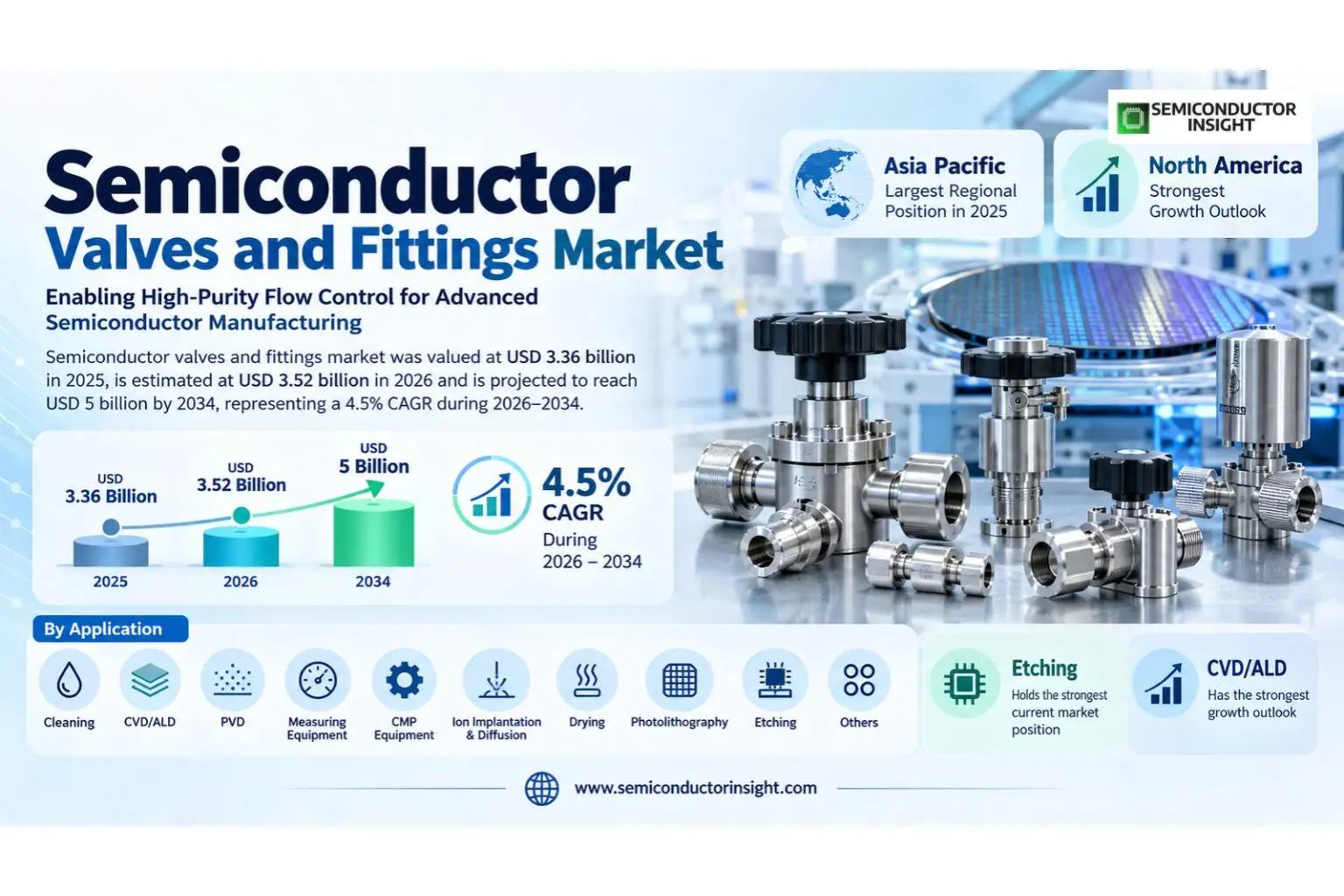
- The semiconductor valves and fittings market was valued at USD 3.36 billion in 2025, is estimated at USD 3.52 billion in 2026 and is projected to reach USD 5 billion by 2034, representing a 4.5% CAGR during 2026–2034.
- Semiconductor Valves represents the leading type, while Semiconductor Fittings offers the strongest growth momentum because buyer requirements are shifting toward higher integration, flexibility and performance within the product architecture.
- Etching provides the largest application base, while CVD/ALD is developing faster as users prioritize measurable operating outcomes and application-specific functionality rather than generic hardware capability.
- Asia Pacific is the largest regional market in 2025, supported by largest semiconductor equipment and fab investment region, with China, Taiwan and Korea accounting for the majority of global equipment spending. North America has the fastest growth outlook as investment, adoption and supply ecosystems broaden.
- The principal growth mechanism is Record semiconductor equipment investment. It changes the economic case for adoption by improving utilization, performance or lifecycle value rather than relying on replacement demand alone.
- A meaningful restraint is Semiconductor capital cyclicality. Suppliers that reduce this barrier through integration support, qualification evidence and clearer total-cost economics are better placed to convert technical interest into repeatable commercial deployments.
Semiconductor Valves and Fittings Market Overview
Semiconductor valves and fittings market was valued at USD 3.36 billion in 2025, is estimated at USD 3.52 billion in 2026 and is projected to reach USD 5 billion by 2034, representing a 4.5% CAGR during 2026–2034. Asia Pacific held the largest regional position in 2025, while North America has the strongest growth outlook.
Base year: 2025 · Estimated year: 2026 · Forecast period: 2026–2034 · Values in USD million unless stated otherwise
Semiconductor valves and fittings are ultra-clean fluid-control components used to move, isolate and regulate process gases, vacuum streams, chemicals and high-purity utilities throughout wafer-fabrication equipment. Unlike general industrial hardware, these components must control particles, metal contamination, leakage and outgassing at levels compatible with advanced semiconductor processes. Product value is therefore determined by cleanliness, vacuum performance, materials, actuation precision, reliability and qualification with equipment OEMs and fabs.
The demand environment strengthened as semiconductor capital spending accelerated with AI-related logic, memory and advanced-node investment. SEMI reported worldwide semiconductor manufacturing equipment billings of $135.1 billion in 2025, while VAT reported semiconductor valve sales of CHF 724.7 million in 2025, up 14.6% from 2024. As etch, deposition and other vacuum-intensive steps increase in complexity, valve content and performance requirements rise even when wafer starts grow more slowly than equipment value.
Segment Analysis: By Type
By Type segmentation comprises Semiconductor Valves, Semiconductor Fittings. Semiconductor Valves holds the strongest current market position within this axis, while Semiconductor Fittings has the strongest growth outlook. The distinction reflects differences in purchasing triggers, technical requirements and qualification intensity rather than a uniform shift across all customer groups. Type-level competition is therefore determined by architecture, performance and lifecycle economics at the product-design stage.
| Type | Market role | Commercial and technical analysis |
|---|---|---|
| Semiconductor Valves | Leading segment | Semiconductor Valves are qualification-sensitive components within semiconductor gas, vacuum and chemical delivery systems. Selection depends on leak integrity, particle performance, corrosion resistance, actuation reliability and compatibility with the process medium. Once designed into a tool platform, supplier changes can trigger substantial validation work. This makes installed-base service, documentation and global support commercially important alongside the component itself, especially for leading-edge deposition, etch and cleaning equipment. |
| Semiconductor Fittings | Fastest-growing segment | Semiconductor Fittings are qualification-sensitive components within semiconductor gas, vacuum and chemical delivery systems. Selection depends on leak integrity, particle performance, corrosion resistance, actuation reliability and compatibility with the process medium. Once designed into a tool platform, supplier changes can trigger substantial validation work. This makes installed-base service, documentation and global support commercially important alongside the component itself, especially for leading-edge deposition, etch and cleaning equipment. |
Segment Analysis: By Application
By Application segmentation comprises Cleaning, CVD/ALD, PVD, Measuring Equipment, CMP Equipment, Ion Implantation & Diffusion, Drying, Photolithography, Etching, Others. Etching holds the strongest current market position within this axis, while CVD/ALD has the strongest growth outlook. The distinction reflects differences in purchasing triggers, technical requirements and qualification intensity rather than a uniform shift across all customer groups. Application-level demand follows the operating problem being solved, so adoption speed varies with the measurable value delivered to users.
| Application | Market role | Commercial and technical analysis |
|---|---|---|
| Cleaning | Established segment | Cleaning imposes its own pressure, purity, chemistry and cycle-life requirements on flow-control hardware. Demand is linked to the number and complexity of process modules installed rather than wafer output alone. Advanced nodes can increase component intensity as tools add gas lines, precursor delivery and tighter process control. Suppliers therefore compete on cleanliness, materials compatibility, response characteristics and the ability to maintain consistent specifications across global equipment builds. |
| CVD/ALD | Fastest-growing segment | CVD/ALD imposes its own pressure, purity, chemistry and cycle-life requirements on flow-control hardware. Demand is linked to the number and complexity of process modules installed rather than wafer output alone. Advanced nodes can increase component intensity as tools add gas lines, precursor delivery and tighter process control. Suppliers therefore compete on cleanliness, materials compatibility, response characteristics and the ability to maintain consistent specifications across global equipment builds. |
| PVD | Established segment | PVD imposes its own pressure, purity, chemistry and cycle-life requirements on flow-control hardware. Demand is linked to the number and complexity of process modules installed rather than wafer output alone. Advanced nodes can increase component intensity as tools add gas lines, precursor delivery and tighter process control. Suppliers therefore compete on cleanliness, materials compatibility, response characteristics and the ability to maintain consistent specifications across global equipment builds. |
| Measuring Equipment | Established segment | Measuring Equipment imposes its own pressure, purity, chemistry and cycle-life requirements on flow-control hardware. Demand is linked to the number and complexity of process modules installed rather than wafer output alone. Advanced nodes can increase component intensity as tools add gas lines, precursor delivery and tighter process control. Suppliers therefore compete on cleanliness, materials compatibility, response characteristics and the ability to maintain consistent specifications across global equipment builds. |
| CMP Equipment | Established segment | CMP Equipment imposes its own pressure, purity, chemistry and cycle-life requirements on flow-control hardware. Demand is linked to the number and complexity of process modules installed rather than wafer output alone. Advanced nodes can increase component intensity as tools add gas lines, precursor delivery and tighter process control. Suppliers therefore compete on cleanliness, materials compatibility, response characteristics and the ability to maintain consistent specifications across global equipment builds. |
| Ion Implantation & Diffusion | Established segment | Ion Implantation & Diffusion imposes its own pressure, purity, chemistry and cycle-life requirements on flow-control hardware. Demand is linked to the number and complexity of process modules installed rather than wafer output alone. Advanced nodes can increase component intensity as tools add gas lines, precursor delivery and tighter process control. Suppliers therefore compete on cleanliness, materials compatibility, response characteristics and the ability to maintain consistent specifications across global equipment builds. |
| Drying | Established segment | Drying imposes its own pressure, purity, chemistry and cycle-life requirements on flow-control hardware. Demand is linked to the number and complexity of process modules installed rather than wafer output alone. Advanced nodes can increase component intensity as tools add gas lines, precursor delivery and tighter process control. Suppliers therefore compete on cleanliness, materials compatibility, response characteristics and the ability to maintain consistent specifications across global equipment builds. |
| Photolithography | Established segment | Photolithography imposes its own pressure, purity, chemistry and cycle-life requirements on flow-control hardware. Demand is linked to the number and complexity of process modules installed rather than wafer output alone. Advanced nodes can increase component intensity as tools add gas lines, precursor delivery and tighter process control. Suppliers therefore compete on cleanliness, materials compatibility, response characteristics and the ability to maintain consistent specifications across global equipment builds. |
| Etching | Leading segment | Etching imposes its own pressure, purity, chemistry and cycle-life requirements on flow-control hardware. Demand is linked to the number and complexity of process modules installed rather than wafer output alone. Advanced nodes can increase component intensity as tools add gas lines, precursor delivery and tighter process control. Suppliers therefore compete on cleanliness, materials compatibility, response characteristics and the ability to maintain consistent specifications across global equipment builds. |
| Others | Established segment | Others imposes its own pressure, purity, chemistry and cycle-life requirements on flow-control hardware. Demand is linked to the number and complexity of process modules installed rather than wafer output alone. Advanced nodes can increase component intensity as tools add gas lines, precursor delivery and tighter process control. Suppliers therefore compete on cleanliness, materials compatibility, response characteristics and the ability to maintain consistent specifications across global equipment builds. |
Additional Segment Analysis: By Material
By Material segmentation comprises High-Purity Stainless Steel, Fluoropolymer/PFA, Specialty Alloys. High-Purity Stainless Steel holds the strongest current market position within this axis, while Fluoropolymer/PFA has the strongest growth outlook. The distinction reflects differences in purchasing triggers, technical requirements and qualification intensity rather than a uniform shift across all customer groups. Materials are chosen around purity, corrosion resistance and process-media compatibility, making substitution difficult after equipment qualification.
| Material | Market role | Commercial and technical analysis |
|---|---|---|
| High-Purity Stainless Steel | Leading segment | High-Purity Stainless Steel is an important material category because it changes the purchasing criteria, qualification path and value captured by suppliers. Customers evaluate compatibility with the wider system, lifecycle support and operating performance rather than treating the category as interchangeable. Market growth in this segment therefore depends on design-in activity and application-specific proof points. Suppliers with documented performance and integration support are better positioned than vendors competing on unit price alone. |
| Fluoropolymer/PFA | Fastest-growing segment | Fluoropolymer/PFA is an important material category because it changes the purchasing criteria, qualification path and value captured by suppliers. Customers evaluate compatibility with the wider system, lifecycle support and operating performance rather than treating the category as interchangeable. Market growth in this segment therefore depends on design-in activity and application-specific proof points. Suppliers with documented performance and integration support are better positioned than vendors competing on unit price alone. |
| Specialty Alloys | Established segment | Specialty Alloys is an important material category because it changes the purchasing criteria, qualification path and value captured by suppliers. Customers evaluate compatibility with the wider system, lifecycle support and operating performance rather than treating the category as interchangeable. Market growth in this segment therefore depends on design-in activity and application-specific proof points. Suppliers with documented performance and integration support are better positioned than vendors competing on unit price alone. |
Additional Segment Analysis: By Flow Function
By Flow Function segmentation comprises Isolation & Shutoff, Pressure/Flow Control, Gas Delivery, Chemical Delivery. Isolation & Shutoff holds the strongest current market position within this axis, while Pressure/Flow Control has the strongest growth outlook. The distinction reflects differences in purchasing triggers, technical requirements and qualification intensity rather than a uniform shift across all customer groups. Flow function determines valve or fitting duty, actuation demands and contamination risk, creating different qualification thresholds across tool subsystems.
| Flow Function | Market role | Commercial and technical analysis |
|---|---|---|
| Isolation & Shutoff | Leading segment | Isolation & Shutoff is an important flow function category because it changes the purchasing criteria, qualification path and value captured by suppliers. Customers evaluate compatibility with the wider system, lifecycle support and operating performance rather than treating the category as interchangeable. Market growth in this segment therefore depends on design-in activity and application-specific proof points. Suppliers with documented performance and integration support are better positioned than vendors competing on unit price alone. |
| Pressure/Flow Control | Fastest-growing segment | Pressure/Flow Control is an important flow function category because it changes the purchasing criteria, qualification path and value captured by suppliers. Customers evaluate compatibility with the wider system, lifecycle support and operating performance rather than treating the category as interchangeable. Market growth in this segment therefore depends on design-in activity and application-specific proof points. Suppliers with documented performance and integration support are better positioned than vendors competing on unit price alone. |
| Gas Delivery | Established segment | Gas Delivery is an important flow function category because it changes the purchasing criteria, qualification path and value captured by suppliers. Customers evaluate compatibility with the wider system, lifecycle support and operating performance rather than treating the category as interchangeable. Market growth in this segment therefore depends on design-in activity and application-specific proof points. Suppliers with documented performance and integration support are better positioned than vendors competing on unit price alone. |
| Chemical Delivery | Established segment | Chemical Delivery is an important flow function category because it changes the purchasing criteria, qualification path and value captured by suppliers. Customers evaluate compatibility with the wider system, lifecycle support and operating performance rather than treating the category as interchangeable. Market growth in this segment therefore depends on design-in activity and application-specific proof points. Suppliers with documented performance and integration support are better positioned than vendors competing on unit price alone. |
Regional Analysis
Asia Pacific leads the market in 2025, while North Americahas the fastest growth outlook. Regional demand differs materially because end-market investment, local manufacturing, qualification practices, channel structure and customer economics are not uniform. The comparison below treats each geography according to its own commercial mechanism rather than repeating one global narrative with different country names.
How does regional demand differ across the Semiconductor Valves and Fittings market?
Regional strategy depends on where design decisions are made, where end users deploy equipment, and how local customers evaluate lifecycle value. Asia Pacific benefits from largest semiconductor equipment and fab investment region, with China, Taiwan and Korea accounting for the majority of global equipment spending. North America is expanding more quickly because new adoption, local supply capabilities and application investment are broadening from a smaller or less mature base. Other regions remain relevant where regulation, installed base or specialized end markets create defensible demand.
| Region | Position | Growth outlook | Demand profile | Primary market logic |
|---|---|---|---|---|
| Asia Pacific | Largest | High | Fab-equipment concentration | Asia Pacific dominates semiconductor equipment spending and hosts the largest concentration of wafer-fabrication capacity. |
| North America | Fastest strategic expansion | Highest | New-fab and advanced-node led | North America is gaining importance as large new fabs and advanced packaging projects expand. |
| Europe | Mature specialty market | Moderate | Equipment and precision engineering led | Europe combines important semiconductor equipment companies with precision-vacuum suppliers and specialty fabs. |
| South America | Small | Low to moderate | Imported equipment led | Direct wafer-fab investment is limited compared with the major semiconductor regions, so demand for high-end valves and fittings is smaller and largely tied to imported equipment, research facilities and electronics manufacturing. |
| Middle East & Africa | Early stage | Moderate | New technology investment led | The region is small in wafer-fab equipment terms but contains selective semiconductor and advanced-technology investments. |
Detailed Regional Blocks
Competitive Landscape
The market has a broad supplier base, but advanced vacuum applications are highly concentrated because qualification, reliability and contamination control create substantial barriers. VAT is particularly strong in vacuum valves for semiconductor process tools, while Fujikin, Parker, Swagelok, SMC, CKD and other suppliers cover gas and liquid delivery architectures. Equipment OEMs value long field history and global service because a valve failure can stop a process chamber. Competition therefore centers on lifetime, particle performance, actuator control, footprint and OEM co-development rather than catalogue price alone.
Competition in the semiconductor valves and fittings market is shaped by design-in relationships, system integration and the cost of switching after qualification. Buyers do not evaluate suppliers solely on headline specifications. They also examine reliability, documentation, software or process compatibility, support response and the ability to maintain performance over the full product lifecycle. This favors vendors that can combine technical differentiation with repeatable delivery and customer engineering support.
The market includes established specialists, vertically integrated technology suppliers and emerging firms pursuing narrower application niches. The competitive boundary is therefore fluid: a supplier can lead in one segment without controlling the whole market. Partnerships, standards participation and ecosystem integration often matter as much as manufacturing scale because customers need assurance that a selected solution will remain compatible with future platforms and deployment requirements.
| Competitive group | Representative companies | Strategic position |
|---|---|---|
| Established / scale suppliers | VAT Group, Fujikin, Parker Hannifin, CKD, MKS Instruments, Swagelok | Compete on broad customer access, installed base, qualification history and global support. |
| Technology-focused challengers | IHARA, SMC Corporation, GEMÜ, Entegris, KITZ SCT, Festo | Compete through technical differentiation, product focus and faster adaptation to emerging requirements. |
| Specialists and ecosystem participants | TESCOM, Rotarex, Valex, Hy-Lok, Kinglai Group, FITOK Group, GCE Group | Serve specialized applications, regional demand or ecosystem roles that can be strategically important despite smaller scale. |
Profiled market participants
The profiled competitive set includes VAT Group, Fujikin, Parker Hannifin, CKD, MKS Instruments, Swagelok, IHARA, SMC Corporation, GEMÜ, Entegris, KITZ SCT, Festo, TESCOM, Rotarex, Valex, Hy-Lok, Kinglai Group, FITOK Group, GCE Group. The list spans suppliers with different scale, geographic exposure and product depth. Inclusion identifies commercial relevance to the market scope; it does not imply identical product coverage or an equal competitive position across every segment.
Production Capacity Analysis
Manufacturing capacity is split across precision machining, electropolishing, welding, clean assembly, actuator production and rigorous leak and particle testing. The supply chain can become constrained when advanced process nodes require new materials, larger valve sizes or tighter dynamic control. VAT manufactures valves in Switzerland and Malaysia and continues to scale around semiconductor demand. Capacity planning must follow equipment-OEM ramps because custom-qualified products cannot always be substituted quickly across tool platforms.
Capacity should be interpreted as the ability to deliver qualified, repeatable product rather than as nominal factory floor alone. In semiconductor valves and fittings, bottlenecks can sit in specialized materials, precision manufacturing, software validation, bonding or packaging, calibration, test, or customer qualification depending on the segment. A supplier with unused physical capacity may still be constrained if the required process window, certifications or engineering support are not available for a customer’s exact design.
Market Dynamics
Semiconductor valves and fittings are a derivative market of wafer-fab equipment investment, but content per tool can increase faster than wafer capacity when process complexity rises. Leading-edge logic, HBM-related memory, 3D NAND and advanced packaging all add vacuum, gas and chemical control requirements. Suppliers benefit from more process steps and tighter specifications, while cyclicality remains a major risk because fab equipment orders can change sharply with memory pricing, export controls and customer capital budgets.
Market Drivers
| Driver | Relative influence | Why it matters |
|---|---|---|
| Record semiconductor equipment investment | High | SEMI reported global semiconductor manufacturing equipment billings of $135.1 billion in 2025, up 15% year on year, with growth in wafer processing, test and packaging. Front-end investment directly expands the installed base of process chambers, gas lines and chemical systems that require valves and fittings. The demand effect is strongest in deposition, etch and vacuum-intensive applications where every new tool contains multiple high-specification flow-control components. |
| AI and advanced-node process complexity | High | AI accelerators and high-bandwidth memory are driving investment in leading-edge logic, DRAM and advanced packaging. More complex process flows increase deposition, etch, cleaning and vacuum steps, raising component content per wafer-fab tool. VAT specifically highlighted a shift toward leading-edge chips used for AI applications during 2025. The market therefore benefits not only from more factories but also from more demanding process architecture inside each tool. |
| Regional fab expansion | Medium to High | New fabs in the United States, Asia and other regions require localized service, inventory and qualification support. SEMI has documented sustained 300 mm fab investment and continued expansion of future production lines. Valve and fitting suppliers can gain share when they establish engineering and service near equipment OEMs and fabs because customers prioritize fast response to contamination, leakage or actuator failures that can stop production. |
| Ultra-clean manufacturing requirements | Medium | As feature sizes shrink, contamination that was previously tolerable can reduce yield. High-purity gas and chemical delivery components therefore need improved surface finish, materials, sealing and particle performance. This supports higher-value products and long qualification cycles. Suppliers with proven clean manufacturing, traceability and metrology can maintain premium positioning because fabs are reluctant to change critical fluid-path components solely for a lower purchase price. |
Record semiconductor equipment investment
SEMI reported global semiconductor manufacturing equipment billings of $135.1 billion in 2025, up 15% year on year, with growth in wafer processing, test and packaging. Front-end investment directly expands the installed base of process chambers, gas lines and chemical systems that require valves and fittings. The demand effect is strongest in deposition, etch and vacuum-intensive applications where every new tool contains multiple high-specification flow-control components.
AI and advanced-node process complexity
AI accelerators and high-bandwidth memory are driving investment in leading-edge logic, DRAM and advanced packaging. More complex process flows increase deposition, etch, cleaning and vacuum steps, raising component content per wafer-fab tool. VAT specifically highlighted a shift toward leading-edge chips used for AI applications during 2025. The market therefore benefits not only from more factories but also from more demanding process architecture inside each tool.
Regional fab expansion
New fabs in the United States, Asia and other regions require localized service, inventory and qualification support. SEMI has documented sustained 300 mm fab investment and continued expansion of future production lines. Valve and fitting suppliers can gain share when they establish engineering and service near equipment OEMs and fabs because customers prioritize fast response to contamination, leakage or actuator failures that can stop production.
Ultra-clean manufacturing requirements
As feature sizes shrink, contamination that was previously tolerable can reduce yield. High-purity gas and chemical delivery components therefore need improved surface finish, materials, sealing and particle performance. This supports higher-value products and long qualification cycles. Suppliers with proven clean manufacturing, traceability and metrology can maintain premium positioning because fabs are reluctant to change critical fluid-path components solely for a lower purchase price.
Market Restraints
| Restraint | Relative influence | Commercial effect |
|---|---|---|
| Semiconductor capital cyclicality | High | Valve and fitting demand is tied to equipment shipments and fab utilization, both of which can move sharply with memory cycles and end-market demand. A supplier may face strong orders during a capacity build and then a rapid pause when customers digest equipment. High fixed manufacturing and engineering costs can magnify the effect on margins. Diversification across logic, memory, display and industrial vacuum can reduce but not eliminate this cycle. |
| Qualification barriers | Medium to High | Critical flow-control parts are designed into process tools and qualified for particles, leakage, pressure behavior and long-term reliability. Changing a component can require extensive testing and may affect process recipes or chamber performance. This creates high entry barriers for new suppliers but also slows market adoption of alternative materials and designs. Customers favor proven suppliers, which can constrain innovation from smaller companies despite competitive pricing. |
| Raw material and precision-manufacturing cost | Medium | High-purity stainless steel, specialty alloys, fluoropolymers, precision actuators and clean manufacturing all carry higher cost than standard industrial valve production. Tight tolerances and vacuum leak testing add labor and capital expense. Suppliers must absorb or pass through material and machining volatility while meeting long-term pricing commitments to equipment OEMs. Cost pressure is strongest in mature-node tools where component specifications are stable and customers expect continuous productivity improvement. |
| Trade restrictions and regionalization | Medium | Export controls and regional semiconductor policies can change equipment demand by geography and complicate supply chains. Suppliers may need duplicate inventory, local manufacturing or revised product configurations to serve different markets. Regionalization can create new sales opportunities but also reduces the efficiency of a single global production footprint. Companies must manage compliance and customer support without fragmenting qualification control. |
Semiconductor capital cyclicality
Valve and fitting demand is tied to equipment shipments and fab utilization, both of which can move sharply with memory cycles and end-market demand. A supplier may face strong orders during a capacity build and then a rapid pause when customers digest equipment. High fixed manufacturing and engineering costs can magnify the effect on margins. Diversification across logic, memory, display and industrial vacuum can reduce but not eliminate this cycle.
Qualification barriers
Critical flow-control parts are designed into process tools and qualified for particles, leakage, pressure behavior and long-term reliability. Changing a component can require extensive testing and may affect process recipes or chamber performance. This creates high entry barriers for new suppliers but also slows market adoption of alternative materials and designs. Customers favor proven suppliers, which can constrain innovation from smaller companies despite competitive pricing.
Raw material and precision-manufacturing cost
High-purity stainless steel, specialty alloys, fluoropolymers, precision actuators and clean manufacturing all carry higher cost than standard industrial valve production. Tight tolerances and vacuum leak testing add labor and capital expense. Suppliers must absorb or pass through material and machining volatility while meeting long-term pricing commitments to equipment OEMs. Cost pressure is strongest in mature-node tools where component specifications are stable and customers expect continuous productivity improvement.
Trade restrictions and regionalization
Export controls and regional semiconductor policies can change equipment demand by geography and complicate supply chains. Suppliers may need duplicate inventory, local manufacturing or revised product configurations to serve different markets. Regionalization can create new sales opportunities but also reduces the efficiency of a single global production footprint. Companies must manage compliance and customer support without fragmenting qualification control.
Market Opportunities
Advanced etch and deposition
VAT’s 2025 commentary indicated strong growth in etch and deposition-related wafer-fab equipment, two process areas with intensive vacuum and flow-control requirements. More layers, complex materials and advanced transistor structures increase the number and precision of gas and vacuum operations. Valve suppliers can capture greater content per tool through fast actuation, pressure control and lower particle generation, particularly when they co-develop products with chamber OEMs.
Smart valves and diagnostics
Adding position sensing, cycle counting, pressure data and predictive diagnostics can shift valves from passive components into monitored subsystems. This supports preventive maintenance and can reduce unplanned chamber downtime. Semiconductor fabs already collect extensive equipment data, so intelligent flow components fit naturally into equipment-health architectures. The opportunity is highest where diagnostics can be integrated without adding contamination risk or maintenance complexity.
North American fab buildout
Large semiconductor investments in the United States create demand for local engineering, service and spare-parts support. Although equipment supply remains global, fabs value fast response for critical process components. Suppliers that expand service capacity near new manufacturing clusters can improve qualification access and aftermarket revenue. This regional opportunity is especially relevant for valves because replacement parts and field support can influence uptime.
High-purity chemical delivery
Wet cleaning, CMP, photoresist and other chemical processes require corrosion-resistant, low-contamination flow paths. Fluoropolymer valves and fittings can gain value as fabs use more specialized chemistries and pursue tighter contamination limits. Suppliers that combine material science with leak-tight connections and compact manifold design can expand beyond vacuum hardware into broader process-fluid content per fab.
Supply Chain Analysis
Upstream inputs
Core manufacturing
System integration & channels
End use & lifecycle
Upstream inputs
Materials, components, intellectual property and enabling production inputs define the technical ceiling and cost structure. Supplier concentration at this stage can affect lead times and qualification risk even when final assembly is geographically diversified. In the semiconductor valves and fittings market, the balance of value shifts toward suppliers that solve integration and qualification problems instead of merely supplying an interchangeable physical component.
Core manufacturing
Fabrication, assembly, bonding, calibration, software integration or precision manufacturing converts inputs into a qualified product. Yield, process control and test discipline determine whether nominal capacity becomes saleable output. In the semiconductor valves and fittings market, the balance of value shifts toward suppliers that solve integration and qualification problems instead of merely supplying an interchangeable physical component.
System integration & channels
OEMs, equipment builders, distributors, software platforms and integrators connect the product with the customer’s operating environment. This stage captures value through application engineering, configuration, distribution reach and support. In the semiconductor valves and fittings market, the balance of value shifts toward suppliers that solve integration and qualification problems instead of merely supplying an interchangeable physical component.
End use & lifecycle
End users monetize the technology through productivity, performance, reliability or user outcomes. Replacement, subscriptions, maintenance, upgrades and installed-base support determine how much recurring value remains after the initial sale. In the semiconductor valves and fittings market, the balance of value shifts toward suppliers that solve integration and qualification problems instead of merely supplying an interchangeable physical component.
Recent Developments
SEMI reported that worldwide semiconductor manufacturing equipment billings reached $135.1 billion in 2025, up 15% from 2024. Wafer processing equipment rose 12%, while assembly and packaging equipment increased 21%. The result confirms a larger installed base of process equipment that requires precision vacuum, gas and chemical flow control and supports continuing demand for semiconductor valves and fittings.
VAT reported 2025 semiconductor valve net sales of CHF 724.7 million, up 14.6% from CHF 632.2 million in 2024. The company also described a demand shift toward leading-edge AI-related chips. For the market, the result is direct supplier evidence that advanced semiconductor investment is translating into higher sales for high-end vacuum flow-control components.
SEMI forecast front-end fab equipment spending of $110 billion for 2025 and $130 billion for 2026, with logic, memory and regional investment driving growth. Because semiconductor valves and fittings are designed into deposition, etch, cleaning and other wafer-fab tools, sustained equipment spending provides the core demand base for the component market.
Report Scope & Segmentation
This market overview covers the commercial value of semiconductor valves and fittings across the defined product, application and buyer segmentation. The scope uses 2025 as the base year, 2026 as the estimated year and 2026–2034 as the forecast period. It distinguishes market revenue from adjacent system value and uses qualitative leadership language where public evidence does not support a reliable numerical share.
| Scope attribute | Coverage |
|---|---|
| Base year | 2025 |
| Estimated year | 2026 |
| Forecast period | 2026–2034 |
| 2025 market size | USD 3.36 billion |
| 2026 estimated size | USD 3.52 billion |
| 2034 projected size | USD 5 billion |
| CAGR (2026–2034) | 4.5% |
| Largest market in 2025 | Asia Pacific |
| By Type | Semiconductor Valves, Semiconductor Fittings |
| By Application | Cleaning, CVD/ALD, PVD, Measuring Equipment, CMP Equipment, Ion Implantation & Diffusion, Drying, Photolithography, Etching, Others |
| By Material | High-Purity Stainless Steel, Fluoropolymer/PFA, Specialty Alloys |
| By Flow Function | Isolation & Shutoff, Pressure/Flow Control, Gas Delivery, Chemical Delivery |
| Regions | North America; Europe; Asia Pacific; South America; Middle East & Africa |
| Profiled companies | VAT Group, Fujikin, Parker Hannifin, CKD, MKS Instruments, Swagelok, IHARA, SMC Corporation, GEMÜ, Entegris, KITZ SCT, Festo, TESCOM, Rotarex, Valex, Hy-Lok, Kinglai Group, FITOK Group, GCE Group |
Frequently Asked Questions
What is the size of the Semiconductor Valves and Fittings market?
The global semiconductor valves and fittings market was valued at USD 3.36 billion in 2025, is estimated at USD 3.52 billion in 2026 and is projected to reach USD 5 billion by 2034. This represents a 4.5% CAGR during 2026–2034. The forecast reflects increasing adoption within the defined product and application scope rather than the value of broader adjacent systems.
Which region leads the Semiconductor Valves and Fittings market?
Asia Pacific holds the largest market position in 2025, supported by largest semiconductor equipment and fab investment region, with China, Taiwan and Korea accounting for the majority of global equipment spending. The region combines demand, supplier access and customer readiness in a way that gives it a stronger current revenue base than other geographies. Regional leadership should be interpreted through those structural factors rather than as an unsupported universal percentage.
Which region is growing fastest?
North America has the fastest growth outlook within the forecast period. The region benefits from expanding technology adoption, new investment, local supply development and broader application deployment. Growth does not imply that every country follows the same trajectory; qualification practices, purchasing power, infrastructure and end-market concentration continue to create substantial differences inside the region.
Which product type currently has the strongest position?
Semiconductor Valves has the strongest current position within the By Type segmentation. Its leadership reflects established customer use, application fit and a larger installed or design-in base. Semiconductor Fittings has the stronger growth outlook as product architectures evolve. Supplier success depends on matching performance and lifecycle support to the specific requirements of each type.
Which application is most important?
Etching is the largest application segment within the defined scope because it provides the broadest current demand base. CVD/ALD has the stronger growth outlook as customers place greater value on specialized outcomes and deeper integration. The application mix matters commercially because purchasing triggers, qualification requirements and willingness to pay differ significantly between use cases.
What is the primary market driver?
Record semiconductor equipment investment is a principal growth driver. SEMI reported global semiconductor manufacturing equipment billings of $135.1 billion in 2025, up 15% year on year, with growth in wafer processing, test and packaging. Front-end investment directly expands the installed base of process chambers, gas lines and chemical systems that require valves and fittings. The demand effect is strongest in deposition, etch and vacuum-intensive applications where every new tool contains multiple high-specification flow-control components. The effect is commercially meaningful because adoption accelerates when the technology improves measurable performance or lifecycle economics rather than simply adding a new feature.
What is the main restraint on market growth?
Semiconductor capital cyclicality is a significant restraint. Valve and fitting demand is tied to equipment shipments and fab utilization, both of which can move sharply with memory cycles and end-market demand. A supplier may face strong orders during a capacity build and then a rapid pause when customers digest equipment. High fixed manufacturing and engineering costs can magnify the effect on margins. Diversification across logic, memory, display and industrial vacuum can reduce but not eliminate this cycle. Suppliers can reduce the barrier through clearer value proof, integration support, qualification evidence and product architectures that lower total lifecycle risk for customers.
How is competition structured?
The market has a broad supplier base, but advanced vacuum applications are highly concentrated because qualification, reliability and contamination control create substantial barriers. VAT is particularly strong in vacuum valves for semiconductor process tools, while Fujikin, Parker, Swagelok, SMC, CKD and other suppliers cover gas and liquid delivery architectures. Equipment OEMs value long field history and global service because a valve failure can stop a process chamber. Competition therefore centers on lifetime, particle performance, actuator control, footprint and OEM co-development rather than catalogue price alone. Buyers also consider integration support, qualification history, reliability and ecosystem compatibility, which means market share is not determined by a single technical specification. Competition therefore varies by application and customer class, with established suppliers and focused specialists often holding different advantages.
Why is supply capacity strategically important?
Manufacturing capacity is split across precision machining, electropolishing, welding, clean assembly, actuator production and rigorous leak and particle testing. The supply chain can become constrained when advanced process nodes require new materials, larger valve sizes or tighter dynamic control. VAT manufactures valves in Switzerland and Malaysia and continues to scale around semiconductor demand. Capacity planning must follow equipment-OEM ramps because custom-qualified products cannot always be substituted quickly across tool platforms. Capacity matters because qualified output, not nominal floor space, determines what customers can actually buy. Yield, testing, specialized materials, software or process integration and customer approvals can all constrain shipment growth even when a supplier has physical expansion room.
What should buyers and suppliers watch through 2034?
Stakeholders should watch the pace of qualification, integration into wider ecosystems, regional investment, standards or certification changes, and the ability of suppliers to convert technical capability into repeatable production and lifecycle support. The strongest opportunities will emerge where performance gains are measurable and customer switching costs support durable relationships without creating unacceptable adoption friction.
Research Sources & Evidence Base
View research sources used for this overview.
- SEMI. Global Semiconductor Equipment Billings Reached $135 Billion in 2025 — 2025 equipment billings and regional spending concentration.
- SEMI. Global Fab Equipment Investment Expected to Reach $110 Billion in 2025 — Fab investment outlook and regional equipment spending.
- VAT Group. Annual Report 2025 – Segment Results: Valves — Semiconductor valve sales and business mix.
- VAT Group. Full-Year 2025 Results — Wafer-fab equipment, etch/deposition and regional demand commentary.
Get Sample Report PDF for Exclusive Insights
Report Sample Includes
- Table of Contents
- List of Tables & Figures
- Charts, Research Methodology, and more...
 Download Sample Report PDF