MARKET INSIGHTS
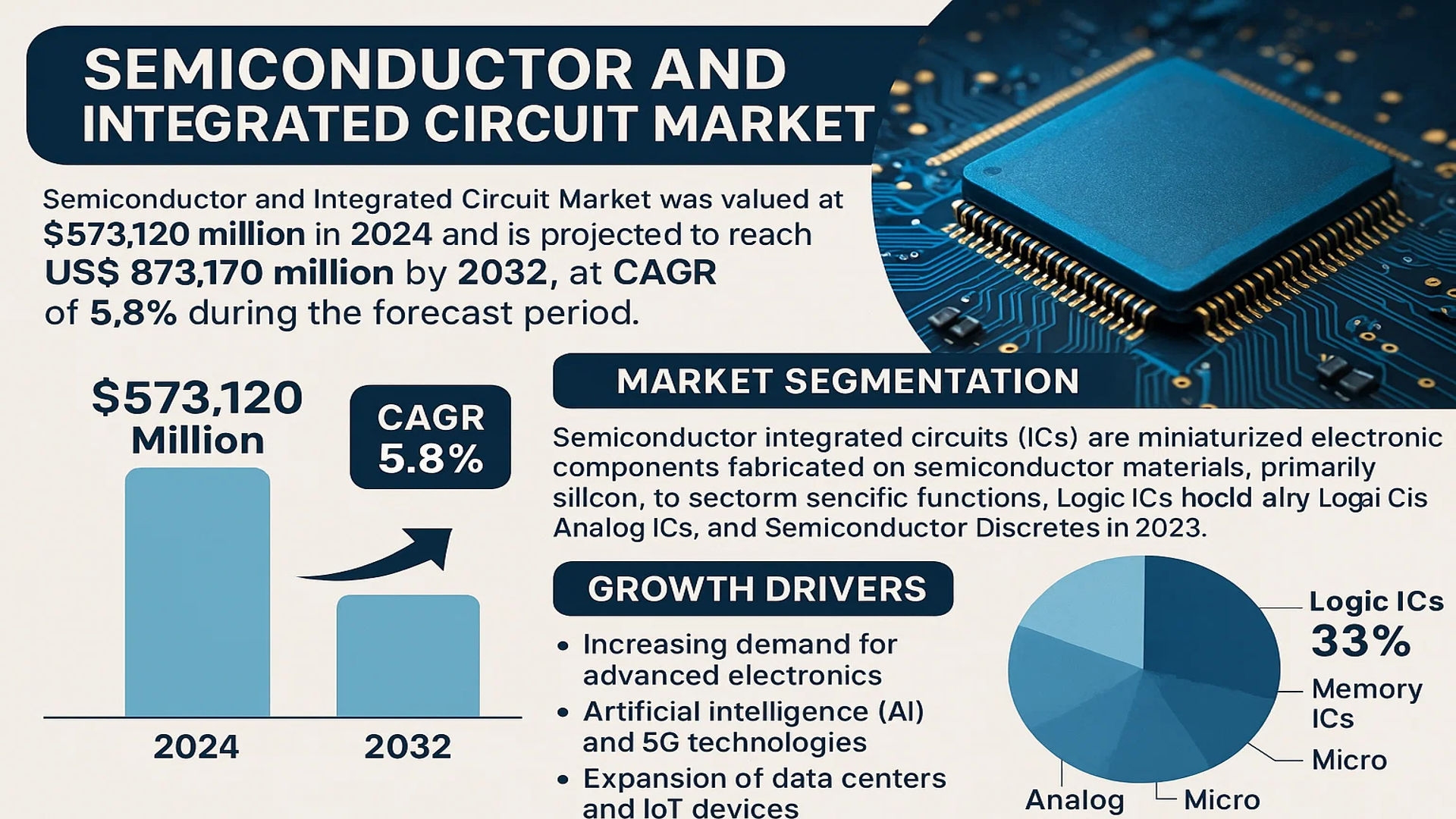
The global Semiconductor and Integrated Circuit Market was valued at 573120 million in 2024 and is projected to reach US$ 873170 million by 2032, at a CAGR of 5.8% during the forecast period.
Semiconductor integrated circuits (ICs) are miniaturized electronic components fabricated on semiconductor materials, primarily silicon, to perform specific functions in electronic devices. These chips form the backbone of modern electronics, enabling everything from computing and communication to automotive and industrial applications. The market is segmented by product type into Logic ICs, Memory ICs, Analog ICs, Micro ICs, and Semiconductor Discretes, with Logic ICs holding the largest market share of 33% in 2023.
Growth is driven by increasing demand for advanced electronics, artificial intelligence (AI), and 5G technologies, alongside the rapid expansion of data centers and IoT devices. The fabless semiconductor segment, valued at USD 217.6 billion in 2023, is expected to grow at a CAGR of 9.57% through 2030, outpacing the IDM (Integrated Device Manufacturer) segment which was valued at USD 345.3 billion in 2023. Leading players such as Intel, Samsung, and NVIDIA dominate the market, collectively holding over 55% of global semiconductor revenue in 2023.
MARKET DYNAMICS
MARKET DRIVERS
Proliferation of AI and Cloud Computing to Accelerate Semiconductor Demand
The rapid expansion of artificial intelligence (AI) and cloud computing infrastructure is driving unprecedented demand for advanced semiconductor solutions. High-performance computing chips, particularly GPUs and specialized AI accelerators, are experiencing explosive growth as enterprises adopt machine learning at scale. The global AI chip market is projected to expand at a compound annual growth rate exceeding 25% through 2030, with data center operators allocating increasing portions of their capital expenditure to AI-optimized hardware. Semiconductor manufacturers are responding with architectural innovations like chiplet designs and 3D stacking to meet the computational requirements of large language models and neural networks.
5G Network Expansion Creating New Growth Frontiers
Global 5G infrastructure deployment is creating robust demand for RF components, baseband processors, and power management ICs. The transition to 5G networks requires significantly more semiconductor content per base station compared to previous generations, with current estimates suggesting 3-5 times greater component requirements. This technology transition is coinciding with intensive investment cycles from telecom operators, particularly in Asia where 5G adoption rates are highest. Smartphone manufacturers are also driving demand through integration of 5G modems, with over 700 million 5G-capable devices expected to ship in 2024 alone.
Automotive Semiconductor Content Per Vehicle Growing Exponentially
The automotive sector is undergoing its most significant technological transformation in decades, with semiconductor content per vehicle projected to exceed $1,000 by 2025 for premium electric vehicles. Advanced driver assistance systems (ADAS), in-vehicle infotainment, and electric powertrains collectively require hundreds of specialized chips per vehicle. The electrification trend is particularly impactful, with power semiconductors becoming critical components in battery management systems and power conversion applications. While traditional automakers navigate this transition, semiconductor suppliers are establishing direct partnerships with EV manufacturers to co-develop custom solutions.
MARKET RESTRAINTS
Geopolitical Tensions Disrupting Global Supply Chains
The semiconductor industry’s complex global supply chain faces mounting pressure from geopolitical uncertainties and trade restrictions. Export controls on advanced process technologies have created availability challenges for certain chip categories, forcing manufacturers to reassess their supplier ecosystems. These constraints are particularly acute for cutting-edge logic chips below 10nm, where production capabilities remain concentrated in specific geographic regions. The resulting bifurcation of supply chains is increasing costs and extending product development cycles across multiple market segments.
Capital Intensity Creating High Barriers to Entry
The extraordinary capital requirements for semiconductor manufacturing continue to limit market competition, with leading-edge fabrication facilities now costing over $20 billion to construct and equip. This investment threshold restricts innovation to a handful of established players capable of sustaining the necessary R&D and capital expenditure. The imbalance is particularly evident in advanced node manufacturing, where only three companies globally currently operate sub-5nm production lines. This concentration creates vulnerabilities in the supply chain while making technological leadership increasingly difficult for new entrants to challenge.
Design Complexity Extending Development Timelines
As process nodes shrink below 5nm, semiconductor design complexity is growing exponentially. A modern system-on-chip (SoC) may incorporate over 100 billion transistors across multiple heterogeneous processing units, creating formidable engineering challenges. Development cycles for advanced chips now frequently exceed two years from initial design to production, with verification and validation consuming an increasing portion of engineering resources. This extended timeline reduces marketplace agility and complicates inventory planning for both chipmakers and their customers.
MARKET OPPORTUNITIES
Chiplet Architecture Revolutionizing Design Paradigms
The emerging chiplet ecosystem presents transformative opportunities across the semiconductor value chain. By disaggregating monolithic chip designs into modular components, manufacturers can achieve better yields, optimize process technologies for specific functions, and accelerate time-to-market. The approach is particularly valuable for complex processors where different functional blocks benefit from distinct process nodes. Industry consortia are actively developing standardized interface protocols to facilitate chiplet interoperability across foundries and design houses, potentially creating a $30 billion market segment by 2027.
Rise of Edge Computing Driving Specialized Silicon
The proliferation of edge computing applications is creating demand for a new generation of power-efficient processors optimized for distributed intelligence. Unlike cloud-optimized chips prioritizing pure performance, edge silicon requires careful balance between computational capability and energy efficiency. This shift is spurring innovation in areas like neuromorphic computing, analog AI acceleration, and ultra-low-power microcontrollers. Industrial IoT applications represent particularly promising growth areas, with deployments expected to require hundreds of millions of specialized edge AI chips annually by 2026.
Materials Innovation Unlocking Next-Generation Performance
Advanced semiconductor materials are emerging as critical enablers of future performance gains as device scaling approaches physical limits. Gallium nitride (GaN) and silicon carbide (SiC) power devices are gaining adoption in electric vehicles and renewable energy systems, offering superior efficiency compared to traditional silicon. In digital logic, transition to gate-all-around transistor architectures coupled with high-mobility channel materials promises to extend Moore’s Law benefits. Research into 2D materials and carbon nanotubes continues to yield promising results, potentially opening new frontiers in computing density and energy efficiency.
SEMICONDUCTOR AND INTEGRATED CIRCUIT MARKET TRENDS
Artificial Intelligence and Machine Learning Integration Driving Market Transformation
The integration of Artificial Intelligence (AI) and Machine Learning (ML) into semiconductor design and manufacturing represents the most transformative trend in the market. This is primarily driven by the insatiable demand for high-performance computing (HPC) chips required to train and run large language models and other complex AI algorithms. The market for AI-specific chips is expanding at an unprecedented rate, with logic ICs, which form the backbone of these processors, projected to grow from US$ 190.6 billion in 2023 to US$ 419.4 billion by 2030, representing a CAGR of 9.49%. This surge is not limited to data centers; the proliferation of AI at the edge, in devices ranging from smartphones to autonomous vehicles, necessitates more powerful and energy-efficient system-on-chips (SoCs) and application-specific integrated circuits (ASICs). Consequently, leading fabless companies and IDMs are heavily investing in R&D to develop next-generation architectures that can handle the immense parallel processing workloads inherent to AI, fundamentally reshaping product roadmaps and competitive dynamics.
Other Trends
Automotive Semiconductor Boom
The automotive sector has emerged as a powerhouse for semiconductor demand, a trend accelerated by the global shift towards electric vehicles (EVs) and advanced driver-assistance systems (ADAS). Modern vehicles are increasingly sophisticated computers on wheels, requiring a vast array of chips, including microcontrollers (MCUs), sensors, power management ICs, and high-bandwidth memory. The analog IC segment, crucial for power management and signal conditioning in automotive applications, is estimated to grow from US$ 86.0 billion in 2023 to US$ 113.96 billion by 2030. This growth is further fueled by the increasing level of automation; a fully autonomous vehicle is projected to require significantly more semiconductor content than a traditional car. This creates a substantial and resilient demand stream, as automakers secure long-term supply agreements to mitigate the shortages experienced in recent years.
Geopolitical Reshoring and Supply Chain Diversification
In response to persistent supply chain vulnerabilities and escalating geopolitical tensions, a major trend is the strategic push for geographic diversification and domestic capacity building in semiconductor manufacturing. Initiatives like the U.S. CHIPS and Science Act and Europe’s Chips Act are catalyzing hundreds of billions of dollars in public and private investment to reduce reliance on a concentrated geographic region for advanced fabrication. This is leading to the construction of new megafabs and the expansion of existing facilities across North America, Europe, and Japan. While this trend aims to enhance supply chain security, it also introduces complexities, including higher production costs in these regions and a intensified global competition for talent and resources. The long-term goal is to create a more balanced and resilient global semiconductor ecosystem, but the market is currently in a transitional phase characterized by significant capital expenditure and strategic realignment.
COMPETITIVE LANDSCAPE
Key Industry Players
Semiconductor Giants Accelerate Innovation and Collaborations to Maintain Market Dominance
The global semiconductor and integrated circuit market features a dynamic competitive landscape, dominated by a mix of Integrated Device Manufacturers (IDMs) and fabless companies. The market is highly concentrated, with the top 10 players holding 55% of the global market share in 2023—a testament to the capital-intensive nature of the industry and the competitive edge held by established leaders.
Samsung and Intel currently lead as the top IDMs, leveraging their vertically integrated business models and cutting-edge manufacturing capabilities. Samsung, for instance, continues to dominate the memory IC segment, while Intel is expanding into AI and data center processors. Meanwhile, NVIDIA and Qualcomm dominate the fabless segment, with NVIDIA’s AI-driven GPUs and Qualcomm’s mobile SoCs reinforcing their strong market positions.
Strategic acquisitions, partnerships, and R&D investments further intensify competition. Recent developments include Intel’s $20 billion investment in new foundries and TSMC’s expansion into advanced 3nm and 2nm node technologies. Such initiatives highlight how companies are locking in long-term technological advantages while securing supply chain resilience.
Emerging players such as MediaTek and AMD are rapidly gaining ground, challenging incumbents through disruptive pricing and innovation. AMD’s partnership with TSMC for advanced process nodes has allowed it to compete directly with Intel in the CPU space. Similarly, fabless firms like Broadcom and Marvell Technology continue to drive networking and data center IC innovation.
List of Key Semiconductor and Integrated Circuit Market Players
- Samsung (South Korea)
- Intel (U.S.)
- NVIDIA (U.S.)
- Qualcomm (U.S.)
- SK Hynix (South Korea)
- Broadcom (U.S.)
- Texas Instruments (TI) (U.S.)
- Micron Technology (U.S.)
- STMicroelectronics (Switzerland)
- Advanced Micro Devices, Inc. (AMD) (U.S.)
- MediaTek (Taiwan)
- Infineon (Germany)
- NXP (Netherlands)
- Renesas Electronics (Japan)
Segment Analysis:
By Type
Logic IC Segment Dominates the Market Fueled by Demand for High-Performance Computing and AI
The market is segmented based on type into:
- Logic IC
- Memory IC
- Analog IC
- Micro IC
- Semiconductor Discretes
- Optoelectronics
- Sensors
By Application
Servers & Data Center & AI Segment Leads Due to Exponential Growth in Cloud Computing and AI Workloads
The market is segmented based on application into:
- Mobile Devices
- PCs/Laptop/Tablet
- Automotive
- Industrial & Medical
- Servers & Data Center & AI
- Network Infrastructure
- Appliances/Consumer Goods/IoT
- Aerospace & Defense
- Government and Others
By Business Model
IDM Model Holds Significant Market Share Supported by Vertical Integration and Manufacturing Control
The market is segmented based on business model into:
- Integrated Device Manufacturer (IDM)
- Fabless
- Foundry
Regional Analysis: Semiconductor and Integrated Circuit Market
Asia-Pacific
The Asia-Pacific region is the undisputed global leader in the semiconductor and integrated circuit market, accounting for the largest share of both consumption and manufacturing. This dominance is driven by massive electronics manufacturing ecosystems in China, Taiwan, South Korea, and Japan. The region is a powerhouse for memory and logic IC production, home to giants like Samsung, SK Hynix, and TSMC (Taiwan Semiconductor Manufacturing Company). Government initiatives, such as China’s substantial investments in its domestic semiconductor industry to reduce import reliance, alongside robust demand from consumer electronics and automotive sectors, fuel continuous expansion. However, the region also faces challenges, including geopolitical tensions and intense competition, which impact supply chain stability and investment flows.
North America
North America remains a critical hub for semiconductor innovation, design, and advanced manufacturing, particularly in the United States. The region is characterized by its strong focus on high-performance computing, AI chips, and cutting-edge logic ICs, led by industry titans Intel, NVIDIA, and AMD. Recent U.S. policy, including the CHIPS and Science Act which allocates approximately $52 billion in incentives, aims to bolster domestic manufacturing capacity and reduce dependency on foreign foundries. This significant investment is driving new fab constructions and R&D in areas like quantum computing and next-generation processors. The market is further supported by robust demand from data centers, automotive innovation, and defense applications.
Europe
Europe’s semiconductor market is strategically focused on specialization rather than volume, with a strong emphasis on automotive, industrial, and power semiconductors. Key players like Infineon, STMicroelectronics, and NXP Semiconductors lead in producing essential chips for the automotive industry, including microcontrollers, sensors, and power management ICs. The European Chips Act, which mobilizes over €43 billion in public and private investments, is designed to double the region’s global market share to 20% by 2030. This initiative aims to strengthen supply chain resilience and foster innovation in areas such as edge computing and IoT. Strict environmental and quality regulations also drive the development of more efficient and sustainable semiconductor solutions.
South America
The semiconductor market in South America is emerging and primarily consumption-driven, with limited local manufacturing presence. Countries like Brazil and Argentina represent the largest markets, fueled by demand from consumer electronics, automotive assembly, and industrial applications. However, economic volatility, currency fluctuations, and a lack of significant local fabrication facilities mean the region remains heavily reliant on imports. While there is growing recognition of the strategic importance of semiconductors, investment in local production is nascent. The market’s growth is tied to broader economic stability and increased digitalization efforts across various industries.
Middle East & Africa
The semiconductor market in the Middle East & Africa is in its early stages of development, with growth largely concentrated in a few nations like Israel, Turkey, and the UAE. Israel has carved out a niche in chip design and cybersecurity semiconductors, hosting R&D centers for several multinational companies. The broader region shows potential due to increasing investments in smart city projects, digital infrastructure, and consumer electronics adoption. However, the market expansion is constrained by limited local manufacturing capabilities, geopolitical complexities, and underdeveloped supply chains. Long-term growth will depend on increased foreign investment and government-led initiatives to build a more resilient technology ecosystem.
Report Scope
This market research report provides a comprehensive analysis of the global and regional Semiconductor and Integrated Circuit markets, covering the forecast period 2025–2032. It offers detailed insights into market dynamics, technological advancements, competitive landscape, and key trends shaping the industry.
Key focus areas of the report include:
- Market Size & Forecast: Historical data and future projections for revenue, unit shipments, and market value across major regions and segments.
- Segmentation Analysis: Detailed breakdown by product type, technology, application, and end-user industry to identify high-growth segments and investment opportunities.
- Regional Outlook: Insights into market performance across North America, Europe, Asia-Pacific, Latin America, and the Middle East & Africa, including country-level analysis where relevant.
- Competitive Landscape: Profiles of leading market participants, including their product offerings, R&D focus, manufacturing capacity, pricing strategies, and recent developments such as mergers, acquisitions, and partnerships.
- Technology Trends & Innovation: Assessment of emerging technologies, integration of AI/IoT, semiconductor design trends, fabrication techniques, and evolving industry standards.
- Market Drivers & Restraints: Evaluation of factors driving market growth along with challenges, supply chain constraints, regulatory issues, and market-entry barriers.
- Stakeholder Analysis: Insights for component suppliers, OEMs, system integrators, investors, and policymakers regarding the evolving ecosystem and strategic opportunities.
Primary and secondary research methods are employed, including interviews with industry experts, data from verified sources, and real-time market intelligence to ensure the accuracy and reliability of the insights presented.
FREQUENTLY ASKED QUESTIONS:
What is the current market size of Global Semiconductor and Integrated Circuit Market?
-> Semiconductor and Integrated Circuit Market was valued at 573120 million in 2024 and is projected to reach US$ 873170 million by 2032, at a CAGR of 5.8% during the forecast period.
Which key companies operate in Global Semiconductor and Integrated Circuit Market?
-> Key players include Samsung, Intel, NVIDIA, SK Hynix, Qualcomm, Broadcom, AMD, Texas Instruments (TI), Micron Technology, and Infineon, among others. The top ten semiconductor companies held a 55% share of the global market in 2023.
What are the key growth drivers?
-> Key growth drivers include rising demand for AI and high-performance computing, expansion of 5G infrastructure, automotive electrification, proliferation of IoT devices, and increasing data center investments.
Which region dominates the market?
-> Asia-Pacific is the dominant region, accounting for the largest market share, driven by major manufacturing hubs in China, South Korea, and Taiwan.
What are the emerging trends?
-> Emerging trends include advanced chip packaging technologies (2.5D/3D), adoption of extreme ultraviolet (EUV) lithography, integration of chiplets, development of compound semiconductors, and increasing focus on semiconductor sovereignty and supply chain resilience.

Get Sample Report PDF for Exclusive Insights
Report Sample Includes
- Table of Contents
- List of Tables & Figures
- Charts, Research Methodology, and more...
 Download Sample Report PDF