MARKET INSIGHTS
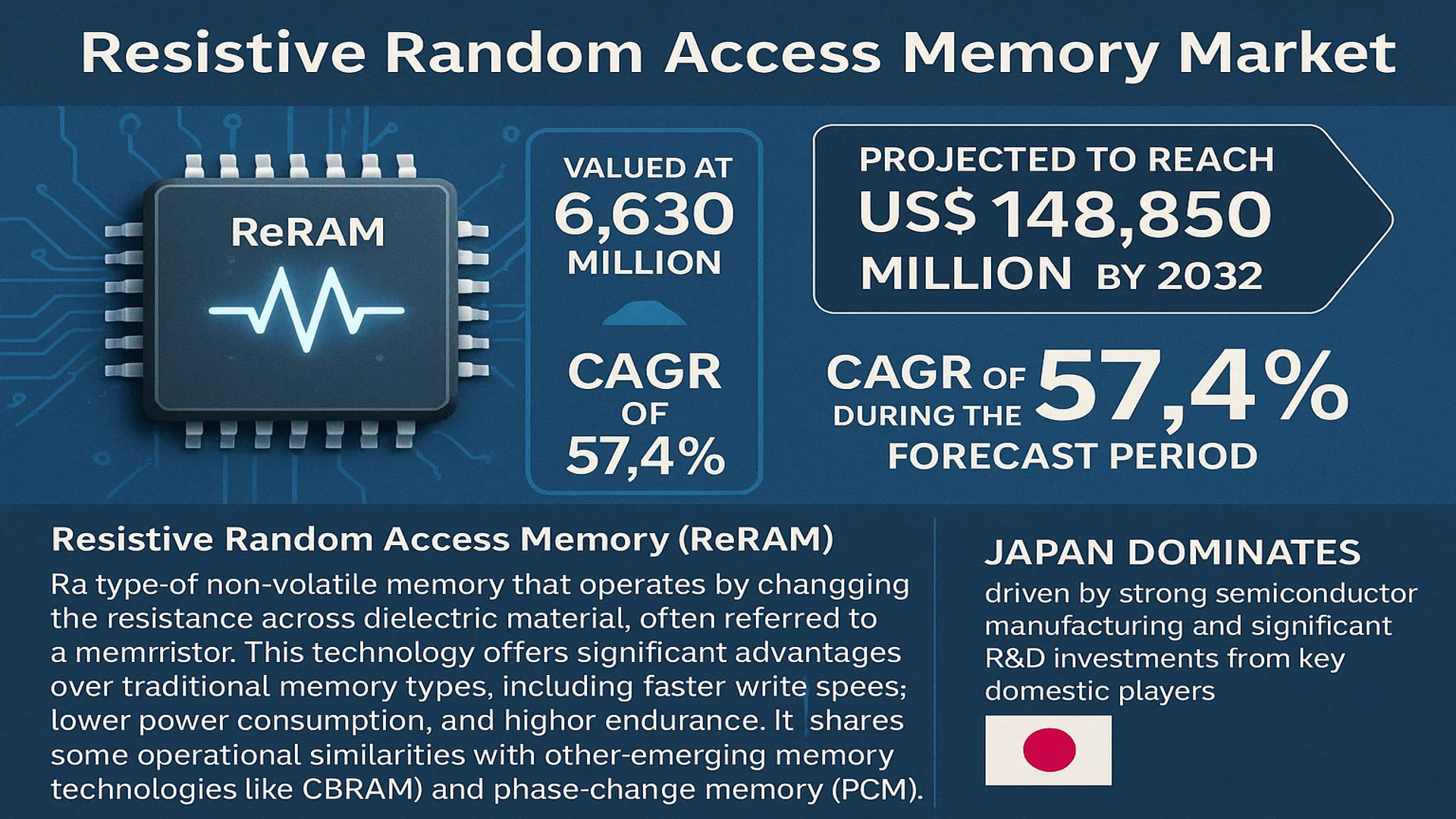
The global Resistive Random Access Memory Market was valued at 6630 million in 2024 and is projected to reach US$ 148850 million by 2032, at a CAGR of 57.4% during the forecast period.
Resistive Random Access Memory (ReRAM) is a type of non-volatile memory that operates by changing the resistance across a dielectric solid-state material, often referred to as a memristor. This technology offers significant advantages over traditional memory types, including faster write speeds, lower power consumption, and higher endurance. It shares some operational similarities with other emerging memory technologies like conductive-bridging RAM (CBRAM) and phase-change memory (PCM).
Japan dominates the global market, accounting for approximately 60% of the total market share, driven by strong semiconductor manufacturing and significant R&D investments from key domestic players. The market’s explosive growth is primarily fueled by the escalating demand for high-performance, energy-efficient memory solutions in applications such as artificial intelligence, edge computing, and the Internet of Things (IoT). Furthermore, advancements in fabrication nodes, particularly the 40nm and 180nm processes, are enabling broader commercial adoption. Key industry participants, including Fujitsu, Samsung Electronics, and TSMC, are actively engaged in developing and scaling ReRAM technology to meet the growing needs of next-generation electronics.
MARKET DYNAMICS
MARKET DRIVERS
Explosive Growth in Artificial Intelligence and Edge Computing to Propel RRAM Adoption
The global surge in artificial intelligence applications and edge computing infrastructure is creating unprecedented demand for high-performance, energy-efficient memory solutions. Resistive Random Access Memory offers significant advantages over traditional NAND flash and DRAM technologies, including faster write speeds, lower power consumption, and superior endurance characteristics. These attributes make RRAM particularly suitable for AI inference engines, neural network processing, and edge computing devices where power efficiency and instant-on capabilities are critical. The increasing deployment of 5G networks and Internet of Things devices further amplifies this demand, as these applications require memory solutions that can operate reliably in diverse environmental conditions while maintaining data integrity.
Advancements in Semiconductor Manufacturing Processes to Accelerate Market Expansion
Recent breakthroughs in semiconductor fabrication technologies are enabling more cost-effective production of RRAM devices at advanced process nodes. The transition to sub-40nm manufacturing processes has significantly improved yield rates and reduced production costs, making RRAM more competitive against established memory technologies. Major foundries have demonstrated successful integration of RRAM into their standard CMOS processes, allowing for embedded memory solutions that combine logic and non-volatile memory on a single chip. This integration capability is particularly valuable for microcontroller units and system-on-chip designs, where space constraints and power efficiency are paramount considerations for product designers across multiple industries.
Increasing Investment in Neuromorphic Computing to Drive RRAM Development
The emerging field of neuromorphic computing represents a significant growth opportunity for RRAM technology. Unlike conventional computing architectures, neuromorphic systems require memory elements that can mimic the synaptic behavior of biological neural networks. RRAM’s inherent analog switching characteristics and ability to store multiple resistance states make it ideally suited for implementing synaptic weights in neuromorphic processors. Research institutions and technology companies are actively developing RRAM-based neuromorphic computing platforms that promise orders-of-magnitude improvements in energy efficiency for certain classes of AI workloads. This alignment with next-generation computing paradigms positions RRAM as an enabling technology for future computational architectures.
MARKET CHALLENGES
Manufacturing Scalability and Yield Issues Present Significant Hurdles
Despite technological advancements, RRAM manufacturing faces persistent challenges related to process variability and yield optimization. The deposition of switching materials and electrode interfaces requires extremely precise control at atomic scales, making mass production consistency difficult to achieve. Variations in forming voltage and resistance distributions across memory arrays can affect reliability and performance uniformity. These manufacturing complexities contribute to higher production costs compared to mature memory technologies, particularly in high-volume applications where cost sensitivity is a primary concern for OEMs and system integrators.
Other Challenges
Technical Reliability Concerns
Long-term reliability remains a critical challenge for widespread RRAM adoption. Issues such as resistance drift, read disturb effects, and cycling endurance limitations require ongoing material science research and engineering optimization. The complex interplay between material properties, device structures, and operational conditions creates multifaceted reliability considerations that must be addressed through comprehensive testing and qualification procedures across various application environments.
Standardization and Ecosystem Development
The absence of industry-wide standards for RRAM interfaces, testing methodologies, and qualification requirements creates integration challenges for system designers. Unlike established memory technologies with well-defined specifications and compatibility frameworks, RRAM implementations often require custom design approaches and specialized support infrastructure. This lack of standardization increases development costs and time-to-market for products incorporating RRAM technology.
MARKET RESTRAINTS
Established Memory Technology Competition Limits RRAM Market Penetration
The well-entrenched position of conventional memory technologies creates significant market entry barriers for RRAM. NAND flash memory continues to benefit from decades of manufacturing optimization and massive production scale, resulting in continuously declining cost per bit. DRAM technology maintains performance advantages for certain applications and benefits from extensive ecosystem support. These established technologies have achieved remarkable reliability records and compatibility with existing system architectures, making designers hesitant to adopt newer alternatives without compelling performance or cost benefits. The conservative nature of many electronics industries further amplifies this restraint, as product qualification cycles and reliability requirements favor proven solutions over emerging technologies.
Intellectual Property Fragmentation and Patent Landscape Complexity
The RRAM intellectual property landscape is characterized by numerous overlapping patents and competing claims from various research institutions and companies. This fragmentation creates legal uncertainties and potential licensing obstacles for market participants. Companies developing RRAM products must navigate complex patent thickets and establish cross-licensing agreements, which can slow down technology development and increase operational costs. The distributed nature of key patents across academic institutions, startups, and established semiconductor companies adds further complexity to technology transfer and commercialization efforts.
Limited Production Capacity and Manufacturing Infrastructure
The specialized manufacturing requirements for RRAM production limit available production capacity compared to established memory technologies. While major foundries have demonstrated RRAM capabilities, dedicated production lines with sufficient volume capacity remain limited. The transition from research and development phases to high-volume manufacturing requires significant capital investment and process optimization that many potential manufacturers are hesitant to commit without clearer market signals. This capacity constraint affects both cost structure and supply chain reliability for potential adopters considering RRAM for volume production.
MARKET OPPORTUNITIES
Emerging Applications in Automotive and Industrial Electronics Create New Growth Pathways
The increasing electrification and automation in automotive and industrial sectors present substantial opportunities for RRAM adoption. These applications require non-volatile memory solutions that can operate reliably across extreme temperature ranges, withstand mechanical stress, and maintain data integrity for extended periods. RRAM’s radiation hardness and temperature stability make it suitable for automotive-grade components, industrial control systems, and aerospace applications where reliability under harsh conditions is paramount. The growing demand for advanced driver assistance systems and industrial IoT devices further expands the addressable market for robust memory solutions.
Development of In-Memory Computing Architectures Opens New Computational Paradigms
The convergence of memory and processing capabilities through in-memory computing architectures represents a transformative opportunity for RRAM technology. By performing computations directly within memory arrays, RRAM-based systems can overcome traditional von Neumann bottleneck limitations and achieve significant improvements in computational efficiency for data-intensive applications. This approach is particularly valuable for machine learning inference, database operations, and scientific computing where data movement between processors and memory constitutes a major performance constraint. Research demonstrations have shown orders-of-magnitude improvements in energy efficiency for certain computational tasks using RRAM-based in-memory computing architectures.
Strategic Partnerships and Cross-Industry Collaborations Accelerate Technology Adoption
Increasing collaboration between memory developers, foundry partners, and system companies is creating new pathways for RRAM technology validation and deployment. These partnerships enable comprehensive technology qualification, application-specific optimization, and ecosystem development that addresses integration challenges. Joint development agreements between memory technology companies and end-user industries facilitate the creation of tailored solutions that meet specific application requirements while mitigating adoption risks. Such collaborative efforts are essential for building confidence in RRAM technology and establishing robust supply chains capable of supporting volume production across multiple market segments.
RESISTIVE RANDOM ACCESS MEMORY MARKET TRENDS
Advancements in Next-Generation Computing Architectures to Emerge as a Trend in the Market
Advancements in next-generation computing architectures, particularly the emergence of neuromorphic computing and in-memory processing, have revolutionized semiconductor design and significantly increased the demand for Resistive Random Access Memory (ReRAM). Recent innovations in material science have enabled the development of more reliable oxide-based ReRAM and conductive bridging RAM (CBRAM) variants, which offer superior endurance cycles exceeding 10^12 write cycles and faster switching speeds below 10 nanoseconds. Moreover, the integration of ReRAM into 3D cross-point arrays has dramatically improved storage density, with some prototypes achieving 128-layer stacks. These developments are particularly crucial for artificial intelligence workloads where memory bandwidth often becomes a bottleneck. The ability of ReRAM to function as both storage and processing element makes it ideal for edge computing applications, driving adoption across multiple industries seeking to overcome von Neumann architecture limitations.
Other Trends
IoT and Edge Computing Expansion
The massive expansion of Internet of Things (IoT) devices and edge computing infrastructure has significantly heightened the demand for non-volatile memory solutions with low power consumption and high endurance, driving ReRAM market growth. With projections indicating over 75 billion connected IoT devices by 2030, the need for energy-efficient memory that can operate in resource-constrained environments has become paramount. ReRAM’s ability to operate at voltages below 1V and its compatibility with existing CMOS fabrication processes make it particularly suitable for these applications. Furthermore, the technology’s radiation hardness and wide temperature operation range (-40°C to 125°C) enable deployment in industrial and automotive environments where traditional flash memory faces reliability challenges.
Regional Manufacturing Leadership and Technological Development
Japan’s dominant position in the ReRAM market, capturing approximately 60% of global production, is driving accelerated technological development and commercialization efforts. This regional concentration stems from decades of research investment and strong collaboration between academic institutions, government research organizations, and semiconductor manufacturers. Japanese companies have pioneered the commercialization of ReRAM technology, with several manufacturers already producing 40nm node ReRAM chips in volume for specialized applications. The country’s leadership is further reinforced by extensive patent portfolios covering fundamental ReRAM technologies and manufacturing processes. While other regions are increasing their investments, Japan’s established infrastructure and technical expertise continue to provide a significant competitive advantage in bringing ReRAM products to market, particularly for automotive and industrial applications where reliability requirements are most stringent.
COMPETITIVE LANDSCAPE
Key Industry Players
Companies Accelerate Innovation and Strategic Alliances to Capture Market Share
The global Resistive Random Access Memory (ReRAM) market exhibits a semi-consolidated competitive structure, characterized by the presence of established semiconductor giants, specialized technology firms, and emerging innovators. While the market is still in a growth phase, competition is intensifying as companies race to commercialize viable ReRAM solutions and secure intellectual property. Samsung Electronics and TSMC are recognized as pivotal players, leveraging their immense manufacturing scale, advanced process nodes, and deep integration into global electronics supply chains. Their dominance is further solidified by substantial and continuous R&D investments aimed at overcoming technical hurdles related to endurance and scalability.
Japanese companies hold a particularly influential position, a fact underscored by the region’s commanding approximately 60% share of the global market. Fujitsu has been a historic leader in memristor research and development, contributing significantly to the foundational technology. Alongside Fujitsu, Crossbar Inc., though a smaller entity, has made considerable strides with its proprietary technology and strategic partnerships aimed at embedding ReRAM in various applications, from IoT to enterprise storage.
Furthermore, the competitive dynamics are shaped by a wave of strategic movements. Intel and Micron, through their historical collaboration on other memory technologies, bring considerable expertise and resources to bear, though their public roadmap focus has often been on competing technologies like 3D XPoint. Meanwhile, pure-play specialists like 4DS Memory (Australia) and Weebit Nano (Israel) are focusing on disruptive innovations and niche applications, aiming to carve out significant market segments through technological differentiation.
These companies are aggressively pursuing growth through a multi-pronged strategy involving geographical expansion, particularly in the Asian market which is a major hub for electronics manufacturing; frequent new product launches and technology demonstrations to showcase progress; and strategic partnerships with foundries and end-product manufacturers. This intense focus on innovation and collaboration is expected to be the primary driver for capturing market share throughout the forecast period, as the technology matures and finds its place alongside, or in replacement of, existing NAND flash and DRAM solutions.
List of Key Resistive Random Access Memory Companies Profiled
- Samsung Electronics (South Korea)
- TSMC (Taiwan)
- Fujitsu Ltd. (Japan)
- Intel Corporation (U.S.)
- Micron Technology, Inc. (U.S.)
- SK Hynix Inc. (South Korea)
- SMIC (China)
- Crossbar Inc. (U.S.)
- 4DS Memory Limited (Australia)
- Weebit Nano Ltd. (Israel)
Segment Analysis:
By Technology Node
40nm Segment Leads Due to Superior Performance and Manufacturing Scalability
The market is segmented based on technology node into:
- 180 nm
- 40 nm
- Others
By Application
Consumer Electronics Segment Dominates Owing to High Demand for Faster, More Efficient Memory in Smart Devices
The market is segmented based on application into:
- Computer
- IoT
- Consumer Electronics
- Medical
- Others
By End-User Industry
Semiconductor and Electronics Manufacturing Holds Largest Share Due to Extensive R&D Investments
The market is segmented based on end-user industry into:
- Semiconductor and Electronics Manufacturing
- Automotive
- Healthcare
- Aerospace and Defense
- Others
By Memory Density
High-Density Memory Solutions Gain Traction for Data-Intensive Applications
The market is segmented based on memory density into:
- Low Density
- Medium Density
- High Density
Regional Analysis: Resistive Random Access Memory Market
Asia-Pacific
Japan dominates the global RRAM market, accounting for approximately 60% of the total market share, driven by its advanced semiconductor manufacturing ecosystem and significant R&D investments from leading technology firms. Countries like South Korea and Taiwan are also key contributors, with companies such as Samsung Electronics and TSMC actively developing and commercializing RRAM technologies. The region benefits from strong government support for next-generation memory solutions and a robust consumer electronics manufacturing base. However, supply chain complexities and intense competition from established memory technologies like NAND and DRAM present ongoing challenges. The push toward IoT devices, AI applications, and high-performance computing continues to fuel demand for non-volatile, low-power memory solutions like RRAM across the region.
North America
The North American RRAM market is characterized by strong research initiatives and early adoption in specialized applications such as aerospace, defense, and data centers. The United States, in particular, sees significant activity from companies like Intel, Micron, and Crossbar, which are investing in RRAM as a potential successor to current memory technologies. Government and private funding for advanced computing and AI research further accelerates development. However, high production costs and the entrenched position of flash memory limit rapid commercialization. The region’s focus remains on innovation and high-value applications rather than mass-market adoption, with an emphasis on overcoming technical hurdles related to scalability and endurance.
Europe
Europe shows a growing interest in RRAM, particularly for automotive, industrial, and medical electronics applications where reliability and energy efficiency are critical. Companies and research institutions in Germany, France, and the UK are exploring RRAM’s potential in embedded systems and IoT devices. Strict EU regulations on energy consumption and electronic waste are indirectly encouraging the development of more efficient memory technologies. While the market is still in a relatively early stage compared to Asia-Pacific, collaborative R&D projects between academia and industry are helping to advance RRAM integration. The region’s cautious approach focuses on ensuring robustness and compliance with stringent performance standards before widespread adoption.
South America
The RRAM market in South America is nascent, with limited local manufacturing capabilities and reliance on imported semiconductor components. Brazil and Argentina show sporadic interest in emerging technologies, primarily driven by academic research and small-scale industrial applications. Economic volatility and underinvestment in high-tech infrastructure hinder significant market growth. However, increasing digitalization efforts and the gradual expansion of the electronics sector present long-term opportunities. For now, adoption remains minimal, with most applications relying on established memory technologies due to cost constraints and limited technical expertise in advanced semiconductor fabrication.
Middle East & Africa
This region represents an emerging but underdeveloped market for RRAM, with activity concentrated in a few technologically advanced countries such as Israel and the UAE. Israel’s strong tech startup ecosystem shows interest in novel memory solutions for cybersecurity and data storage applications. However, the broader region faces challenges such as limited semiconductor infrastructure, scarce R&D funding, and a primary focus on importing rather than developing cutting-edge technologies. While there is recognition of RRAM’s potential benefits, practical adoption is slow, with growth prospects tied to broader economic development and increased investment in high-tech industries over the coming decades.
Report Scope
This market research report provides a comprehensive analysis of the global and regional Resistive Random Access Memory (ReRAM) markets, covering the forecast period 2024–2032. It offers detailed insights into market dynamics, technological advancements, competitive landscape, and key trends shaping the industry.
Key focus areas of the report include:
- Market Size & Forecast: Historical data and future projections for revenue, unit shipments, and market value across major regions and segments.
- Segmentation Analysis: Detailed breakdown by technology node (180nm, 40nm, others), application (Computer, IoT, Consumer Electronics, Medical, Others), and end-user industry to identify high-growth segments.
- Regional Outlook: Insights into market performance across North America, Europe, Asia-Pacific, Latin America, and the Middle East & Africa, with Japan accounting for approximately 60% of global market share.
- Competitive Landscape: Profiles of leading market participants including Fujitsu, Samsung Electronics, Intel, TSMC, and emerging players like 4DS Memory and Weebit Nano.
- Technology Trends & Innovation: Assessment of memristor technology advancements, integration with AI/ML systems, and comparison with competing NVM technologies like CBRAM and PCM.
- Market Drivers & Restraints: Evaluation of factors driving market growth including demand for low-power memory solutions in IoT devices, along with manufacturing scalability challenges.
- Stakeholder Analysis: Strategic insights for semiconductor manufacturers, foundries, OEMs, and investors regarding the evolving ReRAM ecosystem.
Research methodology incorporates primary interviews with industry experts, analysis of financial reports from key players, and validation through multiple data sources to ensure accuracy.
FREQUENTLY ASKED QUESTIONS:
What is the current market size of Global Resistive Random Access Memory Market?
-> Resistive Random Access Memory Market was valued at 6630 million in 2024 and is projected to reach US$ 148850 million by 2032, at a CAGR of 57.4% during the forecast period..
Which key companies operate in Global Resistive Random Access Memory Market?
-> Key players include Fujitsu, Samsung Electronics, Intel, TSMC, Micron, SK Hynix, SMIC, 4DS Memory, and Weebit Nano, among others.
What are the key growth drivers?
-> Key growth drivers include rising demand for energy-efficient memory in IoT devices, advancements in neuromorphic computing, and the need for high-density non-volatile memory solutions.
Which region dominates the market?
-> Asia-Pacific dominates the market, with Japan alone accounting for approximately 60% of global ReRAM production and consumption.
What are the emerging trends?
-> Emerging trends include development of 3D ReRAM architectures, integration with AI accelerators, and adoption in edge computing devices.

Get Sample Report PDF for Exclusive Insights
Report Sample Includes
- Table of Contents
- List of Tables & Figures
- Charts, Research Methodology, and more...
 Download Sample Report PDF